FW
CIRC partners Andritz to commercialize recycling technology
US-based textile recycling technology provider CIRC has partnered Austrian technology group Andritz to commercialize CIRC’s patented textile recycling technology. As per Textile Today, Andritz will design and manufacture continuous processing equipment for CIRC facilities worldwide. CIRC technology can also separate and recover mixed polymer strands, including any blend of polyester and cotton.
Jorma Latva-Kokko, Vice-President-Mechanical Pulping, Andritz says Andritz will help CIRC capture a significant portion of the global circular textile market with its expansive engineering and equipment capabilities. Julie Willoughby, Chief Scientific Officer, CIRC adds, the Andritz team is working shoulder-to-shoulder with CIRC to implement its vision of a circular economy for textiles and beyond.
CIRC makes the technology to source nature’s raw ingredients and enables fashion brands to harness its proprietary technology that resources and re-harvests raw ingredients out of clothing waste. It aims to entirely eliminate the demand for raw ingredients needed to make clothing by creating new clothes entirely out of old ones.
NILIT releases sustainability report for 2017-2020
Global supplier of high-quality Nylon 6.6 for apparel, and owner of the SENSIL® sustainable brand, NILIT has released its sustainability report for 2017-2020. The document, titled ‘Making Nylon Sustainable,’ details the company’s significant initiatives to improve environmental footprint as well as plans to positively influence the textile and apparel industry to choose more sustainable products and use them in more responsible ways.
As per Textile World, the report highlights NILIT’s accomplishments as well as its ongoing plans to continuously improve the ecological and social influence of its operations and practices in the market and in the communities where the company operates. The company has developed the largest portfolio of sustainable premium Nylon 6.6 products under its SENSIL® consumer brand through collaboration with brands, retailers, customers, employees, and vendors. The SENSIL® brand offers performance products that directly address the apparel industry’s most pressing environmental issues, such as water and energy consumption, waste reduction, use of recycled inputs, and impact to ecosystems.
Also, the NILIT Total Product Sustainability program ensures that all NILIT products meet stringent criteria for responsible production. The company also introduced QR Codes in all SENSIL® hangtags. Produced with FSC paper and distributed on certified garments from brands worldwide, these hangtags guarantee authenticity and provide more information to consumers about the technologies and benefits of premium Nylon.
Bangladesh RMG exports to the US surge 26.81 per cent in H1 2021
Bangladesh RMG exports to the US surged by 26.81 per cent from January-June 2021 as increased vaccination in the US boosted demand for apparel items in the country. As per Office of Textiles and Apparel (OTEXA) data by the US Department of Commerce, US’ apparel imports from Bangladesh increased $662 million to $3.13 billion in the first half of 2021 from $2.45 billion in the same period of 2020. As per a New Age Data report, export orders and the inquiries from the US buyers increased in recent months as the country opened its business after massive COVID vaccination.
In value terms, Bangladesh’s apparel export to the US in June 2021 grew by 139 per while it increased by 133 per cent in volume compared with that in the same month of the past year. India’s RMG exports to the US Increased by 32.28 per cent to $2.03 billion in January-June of 2021 from $1.53 billion in the same period of 2020. Total apparel imports by the US from different countries in the first half of 2021 increased by 26.92 per cent to $35.37 billion from $27.87 billion in the same period of the previous year.
The US apparel import from China grew by 26.77 per cent to $7.31 billion from $5.77 billion in the same period of the previous year. Vietnam’s RMG export to the US in the first half of 2021 grew by 20.45 per cent to $6.81 billion from $5.65 billion in the same period of 2020. RMG imports by the US from Cambodia in January-June of 2021 increased by 13.85 per cent to $1.42 billion from $1.24 billion in the same period of the previous year.
Adidas predicts €500 million sales loss due to COVID-19
German sportswear retailer, adidas predicts sales loss worth €500 million due to fast rising COVID-19 cases. The sportswear brand will suffer from its inability to produce enough stock to meet growing demands. The retailer gets substantial portion of its stock from Vietnam.
However, adidas’s sales in the first half of 2021 have touched pre-pandemic levels. The retailers’ sales in the first six-months grew by 52 per cent to €5.8 billion encouraging the retailer to raise its outlook for the full year. Kasper Rorsted, CEO, adidas, said, the brand plans to move its operations to other countries. However, ongoing interruptions mayhave a negative impact on its business in the second half.
The German retailer was founded in 1924 and is known for apparels, shoes and fashion accessories. It generated €21.915 billion in 2018.
LVMH posts 56 per cent growth in H12021 revenues
Paris-based conglomerate LVMH Moet Hennessey Louis Vuitton, posted revenues worth € 28.7 billion in the first half of 2021. As per ETF Trends reports, the group’s revenues grew by 56 per cent from the same period last year and by 14 per cent from 2019. The fashion and leather goods segment saw the largest growth in revenues. Revenues from the segment during the first six months increased 81 per cent from 2020 and 38 per cent from 2019 to €13.8 billion. Profits from the segment increased to €5.6 billion.
Due to a strong stock market and near-zero interest rates, the pandemic did not slow down capital creation for many in 2020. According to Credit Suisse, more than 1 per cent of the global population can now be considered dollar millionaires, with the top 10 economies minting 5.2 million new millionaires last year alone, according to Credit Suisse. This brought the global total of adults with more than $1 million to 56.1 million, the most in history.
Introduced in July 2020, the Global Luxury Goods Fund (USLUX) grew by over 56 percent in the 12-month period ending June 30, 2021compared to its benchmark, the S&P Composite 1500 Index, which increased by 42 per cent.
ILO report highlights acceleration in shift to thrift amongst developed markets
A new research brief by the International Labor Organization (ILO) shows, the pandemic has accelerated so-called ‘shift to thrift’ among developed market consumers. Resale markets in Europe and America are on the rise with young generation showing growing preference for second-hand clothing.
Nevertheless, there is still considerable uncertainty about the future of these alternative consumption models, particularly when their environmental credentials are more closely scrutinized, notes the brief, titled ‘The post-COVID-19 garment industry in Asia. Growing demand for customization is increasing manufacturers’ efficiency and profit margins as they use algorithmic fitting for customers and 3D weaving. These new models also reduce losses due to inventory mismanagement that result in markdowns and stockouts.
Yet, the dominant garment industry model remains linear as the pace of sustainability progress in the fashion industry is slow. In addition, the pre-pandemic projections of rapid income growth among Asia’s 4.3 billion consumers and 4-5 per cent annual global growth in new garment sales are likely to far outstrip increases in garment reuse and resale, the report observes.
Data reveals a persistent ‘gap between intention and action on sustainability initiaitves. . Though their concerns about labor rights and environmental costs in garment supply chains have been growing, there is a general reluctance amongst them to pay for better social and environmental standards for garments that are produced with such costs internalized, the report adds.
GBG’s bankruptcy has suppliers worrying
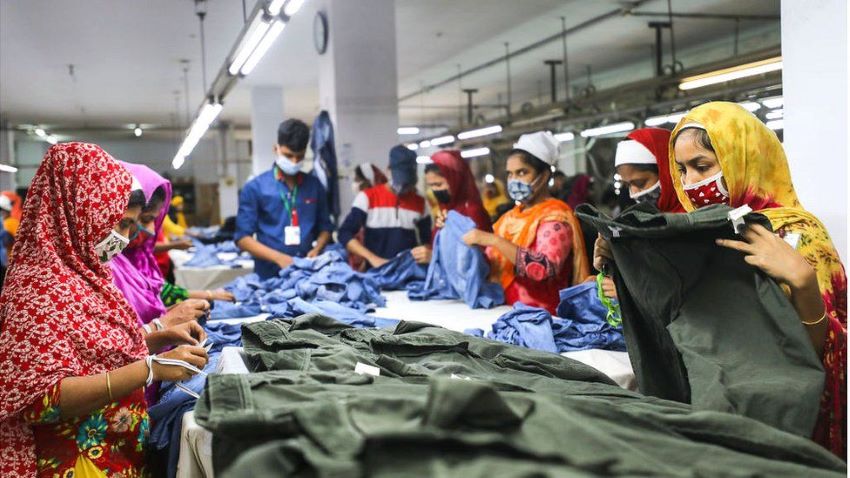
The bankruptcy of Global Brands Group (GBG) Holding’s American subsidiary has created tensions amongst Bangladeshi ready-made garment (RMG) manufacturers who supplied their garments to the apparel and footwear wholesaler. As per a Dhaka Tribune report, GBG USA sourced apparels from at least 10 Bangladeshi factories with payments to several of these factories still pending.
The North American division of GBG Holding recently filed for chapter 11 protection in the US Bankruptcy Court of New York, putting its apparel and footwear brands up for sale with help from a $16 million bankruptcy loan, reports the Wall Street Journal. GBG also sourced garments from Li and Fung, another subsidiary of Fung Group and Rising Group, a Mirpur-based BGMEA-listed apparel factory. GBG USA had also ordered products worth $2.4 million in late 2019 from Denim Expert, a Chittagong-based apparel factory. The company had managed to ship the products before the outbreak of COVID-19. But GBG USA delayed taking the products when the pandemic hit the US. Mostafiz Uddin, Managing Director, Denim Expert, says the company’s bankruptcy negatively impacts its supplier factories.
Garware Synthetics’ Q1 FY2021-22 net profit declines by 64.18 per cent
Garware Synthetics’ net profit declined 64.18 per cent to Rs 0.5,556 crore in Q1FY 2021-22 that ended June 30, 2021 as against 0.1,552 crore in Q4 FY20-21 that ended March 31, 2021. The company reported total income of Rs.2.26 crore during the Q1 FY2021-22 quarter ended June 30, 2021 as compared to Rs.2.74 crore during the Q4 FY20-21 ended March 31, 2021.
The company has reported EPS of Rs.0.10 for the period ended June 30, 2021 as compared to Rs.0.27 for the period ended March 31, 2021. Garware Synthetic’s net profit grew by 220.35 per cent to Rs 0.0556 crore in Q1 FY2021-22 as compared to Rs 0.0462 crore in Q1 FY2020-21.
The company’s income grew by 246.36 per cent to Rs 2.26 crore in Q1 FY2021-22 as against Rs 0.6525 crore in Q1 FY2020-21. The company has reported EPS of Rs.0.10 for the period ended June 30, 2021 as compared to Rs.(0.08) for the period ended June 30, 2020.
Cone Denim uses Higg MSI to access Life Cycle Assessment and comparison data
Denim mill Cone Denim is using the Higg Materials Sustainability Index (MSI) tool to enable customers to access Life Cycle Assessment and comparison data for details on specific materials used in the mill’s fabrics. The mill has developed custom materials in the MSI tool for its full Spring/Summer 2022 fabric collection, and is among the first to offer this type of accessible, verified transparency to its customers.
As per Sourcing Journal, Cone Denim is a longtime champion of the Higg MSI as well as other tools in the Higg Index product suite, including the Higg Environmental Module (FEM), which provides insight on the environmental performance of individual facilities, and Higg Facility Social & Labor Module (FSLM), which promotes safe and fair social and labor conditions. Earlier this year, Cone Denim’s parent company Elevate Textiles formally joined the Sustainable Apparel Coalition to contribute data and resources to further support the Higg Index.
The new functionality is one part of the denim mill’s ongoing commitment to using more sustainable materials. In April, Elevate Textiles released its 2021 sustainability report highlighting that it has already reached 68 percent sustainably sourced cotton usage. By 2025, it aims to achieve 80 percent sustainably sourced cotton and 50 percent recycled polyester content.
Philippines garment exports to fall below $1.4 billion projection: FOBAP
The Foreign Buyers Association of the Philippines (FOBAP) expects the country’s garment exports will fall below $1.4 billion projection for the year with disruptions caused by pandemic-induced lockdowns and shipping space constraints. Robert Young, President, FOBAP said, Philippines’ garment exports are expected to be lower than $1.2 to $1.4 billion target for this year as exporters are facing order cancellations amid disruptions due to lockdowns.
All manufacturing activities by exporting locators in the Freeport Area of Bataan have been ordered to halt operations during the ECQ given the surge in coronavirus cases, said Young. While garment exporters located in Philippine Economic Zone Authority zones and factory suppliers in Clark and Laguna are operational, their productivity is affected by the lack of transport, curfew and other restrictions, he added. Garment exporters are also facing other challenges such as the lack of shipping space, Young added.