FW
COVID-19 effect: Quarterly sales of Levi’s, Macy’s decline
Denim giant Levi’s announced a net loss for the quarter of $364 million, which included restructuring charges, inventory costs and other charges related to the COVID-19 economic freeze. Its net revenues declined 62 percent to $498 million compared to $1.3 billion in the same quarter the previous year.
Because of the economic freeze, the denim giant would lay off 700 people, or about 15 percent of nonretail and nonmanufacturing workforces, said Chip Bergh, president and chief executive officer. But, according to Bergh, an annualized savings of $100 million is expected from the downsizing move.
Like many colleagues, Macy’s has been dealing with store closures caused by the COVID-19 pandemic. Macy’s closed all of its 775 stores in March and started reopening them in late May. As a part of a restructuring plan to deal with the COVID-19 economic slowdown, the retailer plans to eliminate 3,900 jobs in its corporate and management sectors. These expected job cuts and its restructuring would contribute to savings of $365 million this year.
The jobs-cuts are a result of the retailer’s performance during the first fiscal quarter of the year, which ended May 2. Its net sales were $3.017 billion, down more than 45 percent compared to $5.5 billion in the first fiscal quarter of 2019. The company reported an earnings per share loss of $11.53. Macy’s withdrew its 2020 sales and earnings guidance and declined to provide an updated outlook. However, Macy’s Inc.’s digital business showed resilience and the retailer expects this to continue at a healthy double-digit growth rate through the back half of the year.
Ascena Retail Group to declare bankruptcy
Ascena Retail Group is planning to declare bankruptcy besides closing at least 1,200 stores permanently.
As early as next week, thea group could be looking at filing for protection under Chapter 11, in an attempt to unload US $ 700 million of a total US $ 1.1 billion in debt.
Out of a total fleet of around 3,000 stores, the company can choose to keep some running while it prepares to either shut or sell some of its brands during the bankruptcy proceedings.
While the pandemic is largely to be blamed, Ascena had been battling lower sales as shoppers turned to e-commerce and footfall in malls dropped.
During the lockdown, the company had cut base salaries, furloughed employees and stopped paying rent while senior staff members took as much as 50 per cent pay cuts. However, this effort to preserve liquidity could not save their tanking finances.
The company has hired restructuring lawyers at Kirkland & Ellis and investment bank Guggenheim Securities for advice to tide over this time. Eaton Vance Corp will presumably take control of the company.
H&M Foundation initiates project for Bangladesh female apparel workers
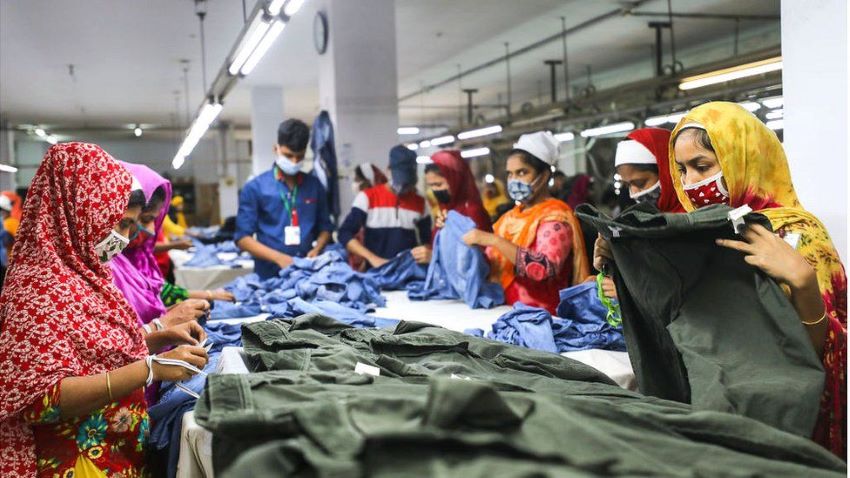
H&M Foundation, an initiative of the Swedish fashion giant H&M Group, is initiating a long-term project to support women garment workers in Bangladesh with a primary fund of $1.3 million, starting with their urgent needs connected to COVID-19.
As a first step, $1.3 million will be donated to WaterAid, CARE and Save the Children to provide around 76,000 young women, their families, and community members in around Dhaka with emergency relief, also reaching 1 million people with messages on Covid-19 and hygiene practices.
The initial support will include cash assistance for food, medication, and other necessities, health care and Covid-19 testing, hygiene materials and handwashing facilities, and work on awareness-raising, support to families where gender-based violence increases as an effect of the crisis, child protection and child education focusing on disadvantaged children.
In addition, H&M Foundation is also taking on a long-term commitment, starting in the autumn of 2020, involving important players from different sectors to achieve systemic long-lasting change, equipping women garment workers in Bangladesh for a future where work is defined by automation and digitalization.
Mulberry to lay off quarter of its global workforce
Mulberry is planning to let go of a quarter of its global workforce. The British brand best known for its luxury handbags is already preparing to shutter its offices in Paris and Hong Kong. According to information obtained by FashionNetwork.com, starting Spring/Summer 2021, the brand also intends to discontinue its footwear and ready-to-wear collections, which are produced under licence by Onward Luxury Group.
The brand is hoping to refocus on London and leather goods, its core activity. It will also continue to offer jewellery and its eyewear line, which is produced under licence. Bags and small leath er goods account for 70 per cent of the brand's total sales.
Both Brexit and the current economic climate have been hard on the brand which, faced with the effects of the coronavirus pandemic, is now in serious trouble. On 8 June, Mulberry issued a profit warning and announced that it would have to "manage [its] operations and cost base accordingly to ensure the company is the correct size and structure to reflect market conditions."
In reality, the fate of the brand's ready-to-wear line already looked to be sealed in March, with the announcement of the departure of creative director Johnny Coca. His last collection for Fall/Winter 2020-21 is still on sale. Coca joined the house in July 2015, as it sought to reposition itself around the high-quality accessible luxury segment and push forward with its international development.
According to Drapers, Mulberry is also on the verge of closing one of its two British, Somerset-based production sites, where the company manufactures almost half of its bags and leather goods. The factory in question is "The Rookery," which is located not far from Bath, in Chilcompton, where the brand was founded in 1971.
Milano Digital Fashion Week adopts hybrid show format
Milano Digital Fashion Week's has adopted a hybrid format that mixes digital and physical elements. From Tuesday 14 July to Friday 17, some 37 brands will unveil their menswear collections for Spring/Summer 2021, with around a dozen presentations being shown per day. Fashion will also take over the streets of the Lombard capital, with videos that being projected on giant screens in the city's major squares and avenues.
Oraganizer Camera Nazionale della Moda Italiana (CNMI) has created a digital platform offering a range of different content, thanks to the support of Accenture, Microsoft and PwC, as well as an international partnership with The New York Times. Along with the official calendar of video presentations made by brands, visitors to the platform will also be able to access different pages or "rooms".
There will be thematic rooms devoted to cultural and digital personalities, an institutional room featuring interviews with businessmen, and two spaces dedicated to emerging design: the International Hub Market and Together for Tomorrow. Each brand will also have its own digital showroom, accessible via the CNMI platform.
Jack & Jones livestreams Spring 2021 collection
Bestseler’s’ digitalization transformation took a big step forward last week as Jack & Jones streamed its Spring 2021 collection launch to colleagues from 21 countries around the world.
In total, Jack & Jones broadcast 20 hours of content from 16 different showrooms via Direct. The global event consisted of 15 individual streams, plus corresponding Q&A sessions via Microsoft Teams and numerous pre-produced videos – including one with Formula 1 driver Kevin Magnussen – while Anders Holch Povlsen and brand director Anders Gam made special live appearances.
Going forward, Jack & Jones will be working with two different livestreaming options: a simple ‘plug-and-play’ solution that can be easily implemented on a day-to-day basis and an advanced livestream solution for bigger events.
Global Fashion Group expects second profitable quarter
Global Fashion Group expects a second profitable quarter on an adjusted EBITDA basis, as well as its first cash flow-positive three months. It’s expecting the second quarter to end with net merchandise value (NMV) growth on a constant currency basis of above 20%, despite the virus impact in April, driven by more than two million new customers.
The company operates webstores such as The Iconic, Zalora, Dafiti and La Moda in Asia Pacific, Latin America and Eastern Europe. They sell own labels, as well as major brand names under partnership deals from Mango to Dorothy Perkins, Lee, Topshop, Guess and many more.
It’s predicting its adjusted EBITDA profitability will be due to a strong gross margin and “significantly better marketing efficiency”.
The company also said it has seen improved Marketplace share of more than 30% (up from 19% in Q2 2019) and around 90% Marketplace NMV growth “as a result of category mix shift and increased Marketplace SKU share”.
The company added that profitability, alongside disciplined working capital management and capital expenditure, resulted in strong cash generation and a pro-forma cash balance at 30 June of around €260m, up €50m from the end of March.
Brands using recycled plastic to make apparel products: Report
The newly released report ‘Nature of Fashion by the Biomimicry Institute’ notes many apparel and beauty brands like Adidas and Genusee are using recycled plastics to make their products. In 2020, Adidas plans to produce a record 15 to 20 million pairs of shoes made with plastic waste in partnership with Parley for the Oceans. The brand will also make 50 per cent of its polyester from recycled plastic this year.
Similarly, eyewear brand GlassesUSA.com recently launched its SeaClean collection made from upcycled plastic bottles. Another eyewear brand Genusee has also starting making eyewear from recycled plastic. A report titled Waste & Opportunity 2020 by Plastic Free July shows that though the production of plastic is set to quadruple by 2050, only 13 per cent is recycled in the US, which greatly contributes to climate change. The report predicts green house gas emissions from plastic to reach 13 per cent of the earth’s entire remaining carbon budget by 2050.
Over 110 fashion commit to 2020 Circular Fashion Pledge
Over 110 fashion brands have committed to participate in the 2020 Circular Fashion Pledge launched by Sustainable Brands, the premier global community of brand innovators. The pledge asks brands to commit to one of three goals by the end of 2020: enable take-back or resale, increase recycled content, or design for durability. It provides them with options to either upcycle, repair, donate, or recycle their unsold items.
The community also urges brands to increase the total percentage of certified recycled content or scrap fabric by 10 percent in their top selling items. It also challenges brands to increase the use of non-blended materials, and/or modularity and repairability in their top five selling times.
Of 117 brands, 62 percent have pledged to enabling take-back/resale, 60 percent to increasing recycled content, and 50 percent to design for durability; roughly half have pledged to at least two commitments.
Massive surge in google searches for clothes recycling: Survey
A survey by UK-based End of Tenancy Cleaning Services reveals, there has been a massive surge Google searches for clothes recycling in EU countries. Ireland has registered the highest number of searches with around 12,670 people googling how to recycle old clothes. This is followed by high search results in Germany where 9,390 people and the Netherlands where 6,840 people have searched for the same.
On the other hand countries like Luxembourg, Slovenia, and Slovakia have reported the lowest number of searches with 330 searches in Luxembourg, Slovenia and Slovakia are as low as 300 and 270 searches a month, respectively. Saveonenergy.com/uk also analyzed search volumes to find out which of the most-worn items of clothing are recycled most in each of the Top 10 EU countries. The results show shoes to be the most recycled item of clothing in 70 per cent of the ten countries analyzed, including Ireland, the Netherlands and Spain. While jeans are the most recycled item of clothing in 30 per cent of the 10 countries analyzed, including Germany, France, and Italy.