


FW
Invista to present bi-stretch at Kingpins
Invista has a collaboration with Who What Wear. This addresses common denim dilemmas and shows how jeans with Lycra dual FX technology can solve them.
Last year Invista conducted an extensive consumer research project across five countries and found the main issue with stretch jeans was how they lost their shape as people moved throughout their daily activities. Invista needed to educate consumers on what’s inside their jeans matters and encourage them to look for styles with Lycra dual FX technology. The challenge was to do this in an engaging way.
Invista found the answer by teaming up with Who What Wear, a leading online destination for fashion, editorial content, and shopping. A key element of the collaboration is a curated shop where consumers can purchase jeans with Lycra dual FX technology from 19 featured brands.
At the upcoming Kingpins shows in Amsterdam and New York, Invista will showcase will showcase its latest denim fabric innovations. Invista will also share results from a study on bi-stretch that can help brands and retailers choose the best bi-stretch fabrics for their particular needs. This new tool can help guide fabric selection by illustrating the relative merits of different ways of achieving bi-stretch denim.
Invista presents innovations at Intertextile Shanghai
Invista showcased innovations at October’s Intertextile Shanghai Apparel Fabrics. The rich and vivid content delivered at the show focused on Invista’s innovative attitude to consumers, partners as well as the whole industry. To build a healthy and sustainable marketing environment, Invista cooperated with a number of media organisations to conduct a survey on IP protection in the textile industry. The results were revealed at the show.
Visitors experienced the latest possibilities offered by Lycra Moves bra, Lycra Moves leggings and Lycra Moves hosiery. Invista launched Lycra lasting fit technology for bra wings. Invista is one of the world’s largest integrated producers of polymers and fibers.
At its stand at Intertextile Shanghai, Invista highlighted some of the branded technologies it tested with consumers during the study. Arranged under three key pillars (fit, shaping, and climatic comfort), each pillar featured key insights in the form of consumer quotes from the research, along with garments from key mill partners that showcased Invista technologies that addressed those consumer needs.
Invista designed the stand to be consumer centric, highlighting consumer needs and solutions. Intertextile Shanghai Apparel Fabrics has been a platform for Invista to communicate with players across the value chain for 23 years.
India’s cotton yarn exports fall
India’s cotton yarn exports make up more than a tenth of its total textile exports and are one of the few segments in which the country had historically enjoyed an advantage until. However, in 2016-17, exports of cotton yarn fell 7.7 per cent. Apart from trade reasons, GST on both yarn and fabric has hit the hitherto untaxed industry hard. The rupee's rise over the past year, with high raw material prices in the past six to nine months, has affected the industry.
Also, with domestic demand not growing, investment in spinning mills has dropped, pushing up manufacturing prices. India’s cotton yarn industry wants benefits under the Merchandise Exports from India Scheme and the Interest Equalisation Scheme, something manmade yarn already gets.
It has raised the issue of drawback rates. Exporters have called for policy interventions with major buyers of Indian cotton yarn, such as China. India is disproportionately dependent on China for exports. But export orders have continued to decrease over the past couple of years. Vietnam and Bangladesh have advanced on the Chinese market with more than a four per cent tariff advantage due to trade agreements and cheaper labor costs. Cotton yarn is also exported to Bangladesh, Pakistan, Egypt and Korea.
India’s textile machinery exports set to grow 15-20 per cent this fiscal
India’s exports of textile machinery, equipment for spinning, spinning accessories, weaving preparatory and other accessories are likely to increase by about 15 to 20 per cent this fiscal year. Domestic investments were hampered by demonetisation and GST. However, this is expected to correct in five or six months, which is when investments would pick up. China is a big supplier of looms, accessories and spares to India.
Indian textile machinery industry has been experiencing tremendous growth over recent years, facilitated by the country’s booming textile and apparel market. India is expected to be a leading textile producing country in the world by 2020, and the domestic textile and apparel market in India is estimated to grow at 12 per cent CAGR over 2020. The technical textile market in India is also showing a promising growth, at 18 per cent CAGR.
The machinery industry is expected to reach Rs 35,000 crores by 2021. The industry plays a vital part in shifting India’s textile and apparel industry from a labor-intensive production to a more advanced and industrialized sector. Major manufacturers of textile machinery are: Germany, Italy, Japan, Switzerland, France and China. India is one of the major importers of textile machinery of these countries today.
Dolce & Gabbana’s turnover up nine per cent
Dolce & Gabbana’s turnover for 2016-17 increased nine per cent over the previous year. Italy represents 24 per cent of total turnover. The rest of Europe makes up 27 per cent, the Americas 13 per cent and Japan six per cent. Dolce & Gabbana’s wholesale increased 8.7 per cent in 2016-17, retail grew 7.1 per cent while licensing revenue fell 9.2 per cent.
Net profit was four times higher than that achieved in 2015-16. Dolce & Gabbana’s strong presence in its domestic market has led the Italian house to further its initiatives abroad. On October 4, the brand organised a runway show at a department store in Japan for which the creative duo Domenico Dolce and Stefano Gabbana designed a special collection. In the same month, the label also opened its first outlet store in Mexico, at a mall in the northwest of the country.
For the holiday season, the brand has plans for a large-scale operation with London-based luxury department store Harrods. These will include the launch of exclusive products, as well as a number of in-store interventions organised by Dolce & Gabbana from November 2 to December 28, such as in stores-in-stores, a Christmas tree, window displays and a traditional Italian market.
Chinese drive global luxury business
Chinese consumers are reshaping the luxury business. Traditional ways of developing the luxury business are no longer effective. Chinese luxury consumers, who have increasingly become the core of the market over the past 15 years, have drastically influenced the retail industry.
First and foremost, the strategy of fast retail network expansion is no longer functional for luxury brands globally. The growth paradigm based on space no longer works. The industry as a whole is now facing a significantly lower retail space growth opportunity.
In fact, China has led the wave of luxury store closings around the world over the past several years. Over-expansion by brands in China is one reason. Another is that Chinese consumers are purchasing goods on e-commerce. Turning a blind eye to this trend can be counter-productive. China’s middle-class luxury shoppers are highly budget-wise and price-sensitive.
The constant thirst for new products and designs that is demanded by Chinese luxury shoppers has accelerated the innovation cycle of luxury brands. Innovation is an imperative for luxury brands if they hope to stay in line and up to par with Chinese consumers’ evolving tastes. Newness and affordability are crucial. New products and new ideas are indispensable to make consumers part with their money.
BMC amends land rules for textile units
The Brihanmumbai Municipal Corporation (BMC) has proposed draft amendment to the existing Development Control Regulations rules pertaining to the development and redevelopment of open land and built-up area of sick and/or closed cotton textile mills. The revised draft rules envisage land up to and inclusive of five hectares, wherein 33 per cent is to be earmarked for open space, 27 per cent for public housing, and 40 per cent for residential or commercial use.
Previously the entire land was to be divided one-third each for open space, for public housing, and for residential and commercial use. For areas between five hectares and 10 hectares, BMC has proposed 33 per cent for open space, 34 per cent for public housing, and 33 per cent for residential or commercial use. For land more than 10 hectares, 33 per cent will be for open space, 37 per cent for public housing and 30 per cent for residential or commercial use.
The owner of the land will be entitled to floor space index (FSI) up to 2 as per the draft regulations 30(A) (1) and (4), excluding area of the notional plot of residential buildings, chawls located on the lands of cotton textile mills, if any.
Amazon ventures into sportswear with own labels
Amazon is tapping some of the biggest athletic apparel suppliers to foray into private label sportswear. The project is new and long-term contracts haven’t been signed yet. Manufacturers are producing small amounts of products for Amazon as part of a trial.
Amazon previously ventured into private label fashion, offering office clothing, jackets and dresses under names like Goodthreads and Paris Sunday. But pushing into active wear would bring fresh competition to some of the world’s biggest athletic brands.
Amazon also has been hiring staff with know-how in private-label athletic apparel. Amazon has developed its own brands in part because they fill gaps in its inventory. If customers are searching for a certain type of shoe or skirt, and don’t see much of a selection from established brands, Amazon wants to be able to offer its own options.
This also sends a message to brands reluctant to sell their full inventory on Amazon. If shoppers can’t find a brand’s products on the site, Amazon will make its own substitutes and become a competitor. The move may be unwelcome for active wear companies already struggling to stand out in a sea of competition and discounts. Online apparel sales accounted for 19 per cent of all apparel sales in 2016, up from 11 per cent in 2011.
EPCH organizes trend seminars
As a large number of exhibitors display their home, lifestyle, fashion, textiles and furniture products at IHGF-Delhi Fair, EPCH organises seminar on trends and forecasts during each edition of the show by inviting international designers and experts.
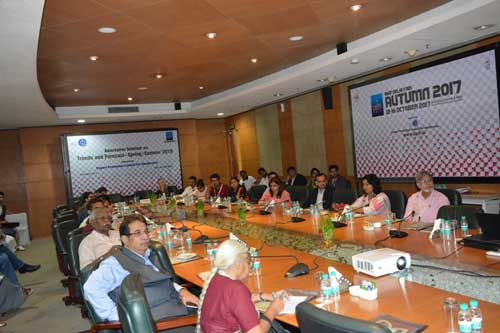
This is to enable exhibitors keep abreast and prepare their collections for the future as per trends prevalent in the world market.
One of the objectives of EPCH is to create awareness through seminars and workshops on export marketing, procedures and documentation, packaging, quality compliances, service tax, foreign trade policy, design development and awareness about trends and forecasts prevalent in the world market.
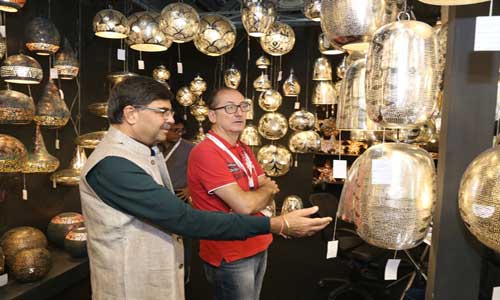
During the 44th edition of IHGF-Delhi a seminar on trends and forecasts for spring/summer 2019 was organised in which PJ Arnador, Filipino international designer, and Erika Mierow, Trendcoach, Germany, apprised participants about trends for the coming season about key colors, moods of the consumers, relevant materials, dominant patterns and significant images for 2019. Such sessions help the handicrafts exporting community tap foreign investment for scaling up production of handicrafts, sourcing raw materials, designing and crafting etc. to increase the global market share for their products.
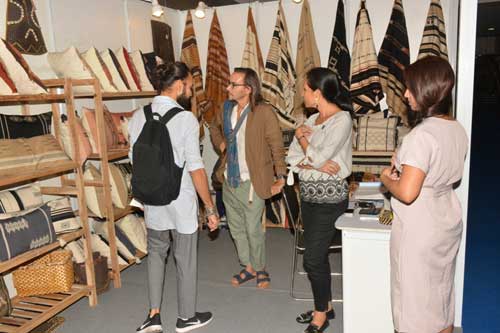
India is regarded as one of the fastest growing economies of the world, ranked among the ten top attractive destinations for inbound investment. The handicraft sector is the largest employment providing sector in India after agriculture.
EPCH provides north east a platform
India’s north east is known for eco-friendly crafts. Assam, Nagaland, Arunachal Pradesh, Manipur, Meghalaya, Mizoram, Sikkim and Tripura are known for abundant natural materials such as cane, bamboo, timber, silk, clay, natural fiber, etc. The region’s skills are unique and well-guarded through generations.
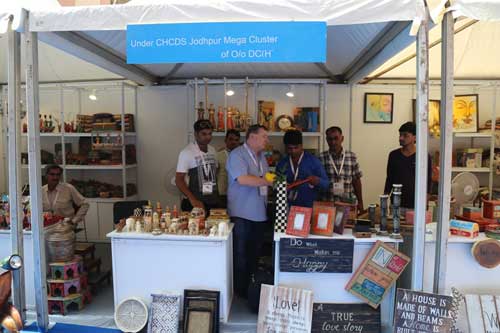
The large number of tribes and sub-tribes bring into this region’s export basket natural and handmade products from about 450 different communities. They incorporate the use of modern sustainable technologies to enhance quality.
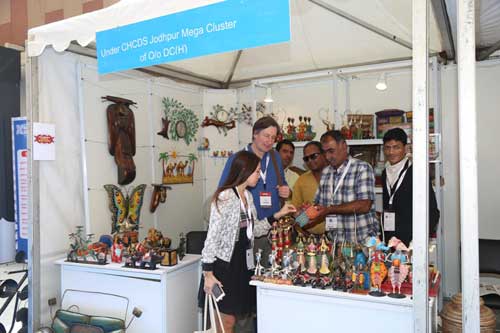
EPCH’s export promotion programs provide a platform to the artisans, crafts persons and manufacturers of north eastern State through fairs and trade shows.
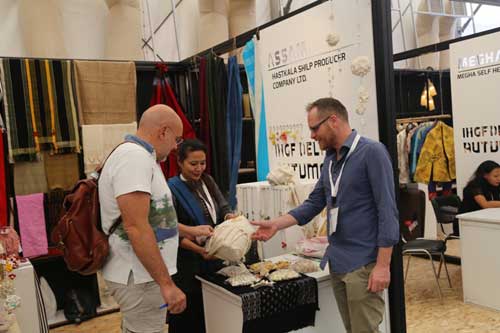
About 20 exporters, entrepreneurs and crafts persons from the region are displaying in the special theme pavilion the complete range of handicrafts of the region such as water hysin, muga silk and eri silk, apart from products made of cane and bamboo.
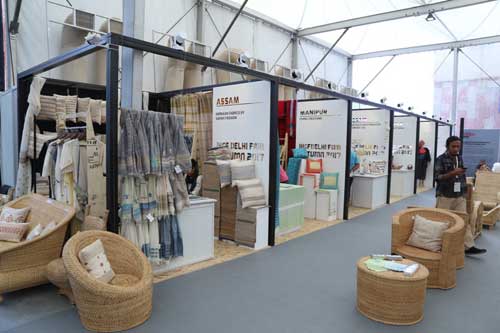
Another theme pavilion from Jodhpur mega cluster has also been set up in which ten artisans are displaying their skills of leather embroidery, horn, tie and dye crafts, embroidery and appliqué hand block printing, punja durries, art metal ware and woodcraft.
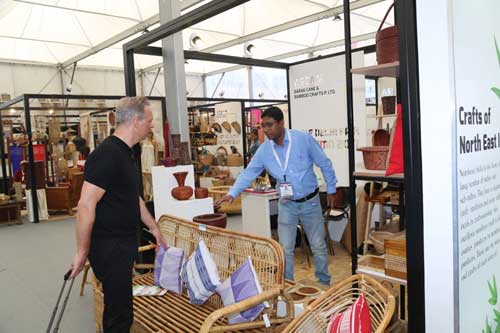
This participation will definitely boost the morale of the small and upcoming entrepreneurs of these regions and motivate others to step up their efforts in product design and innovation, so that they can also get connected to the international buying community.











