FW
Pearl Global to expand European operations across North Africa production hubs
Major international apparel manufacturer Pearl Global Industries is actively exploring manufacturing opportunities across North Africa and Jordan to establish closer proximity to European retail buyers.
Facing persistent maritime logistics bottlenecks and shifting trade policies in North America, leading garment exporters are recalibrating their global footprints to mitigate supply chain vulnerabilities. The company, which produces ready-to-wear apparel for prominent fashion brands including Zara, Gap, and Levi’s, aims to balance its geographic revenue concentration. While the United States remains its primary market, its revenue share has decreased to approximately 50 per cent from over 85 per cent in FY21. Meanwhile, the European Union contributed 16 to 17 per cent of group revenue in FY26, prompting executive leadership to pursue structural growth closer to Mediterranean retail destinations. We are again evaluating things, and could consider partnerships in locations closer to Europe, noted Pallab Banerjee, Managing Director, Pearl Global.
Accelerating financial performance and capacity
The prospective Mediterranean expansion aligns with an aggressive capital expenditure program, with the firm investing between Rs 200-Rs 250 crore during the current financial year to scale global infrastructure. Industry analysts observe, establishing localized production networks in North Africa will enable faster inventory replenishment cycles for European fashion brands seeking agile nearshoring alternatives. Boosted by expanding order books across Spain, Britain, and Japan, corporate leadership anticipates revenue growth exceeding 15 per cent for FY27, tracking ahead of schedule to meet its Rs 60 billion milestone before 2028.
Aiming for diversified global market penetration
Established as a leading Indian multinational apparel manufacturer and exporter, Pearl Global specializes in comprehensive garment design, manufacturing, and supply chain solutions. Serving major international fashion retailers, the company maintains multi-country manufacturing operations across Asia and Central America, targeting sustained long-term revenue expansion and diversified global market penetration.
Bangladesh textile sector contracts as thresholds for value addition in apparels rise
The Bangladeshi apparel manufacturing industry is confronting a challenging regulatory shift following trade policy updates that push minimum local value-addition requirements up to 40 per cent for specialized synthetic segments. While traditional cotton-based knitwear has historically navigated lower compliance baselines comfortably, the enhanced mandates place heavy operational pressure on mills utilizing man-made fibers. Industry stakeholders note, meeting these elevated thresholds is complicated by an underdeveloped domestic backward-linkage infrastructure for synthetics, alongside persistent utility constraints such as erratic natural gas supply. Achieving thirty percent value addition is manageable for standard cotton assemblies, but synthetic and technical lines require robust local support systems that are still evolving, states Fazlul Hoque, Managing Director, Plummy Fashions. Exporters warn, rigid enforcement could temporarily restrict manufacturing throughput unless regional supply networks scale rapidly.
Balancing export growth and sourcing realities
The stricter regulations aim to deepen domestic industrial integration and reduce foreign exchange leakage by forcing apparel producers to source intermediate materials locally rather than depending on imports. However, trade associations argue, aggressive compliance targets conflict with ongoing efforts to rehabilitate shuttered production units and diversify away from basic product portfolios. Manufacturers handling technical garments and synthetic underwear emphasize that international buyers frequently dictate specific raw material inputs, leaving local factories with limited operational flexibility. Economic analysts suggest, while the mandate creates long-term incentives for domestic spinning and weaving investments, short-term margin contraction remains a distinct risk for export-oriented factories navigating competitive global pricing environments.
Rapid expansion into MMF and sustainable technical textiles
Bangladesh operates as a premier global hub for readymade garment exports, serving major international retail brands across the United States, Europe, and Asia. Driven primarily by cotton knitwear and woven categories, the sector anchors the national economy while aggressively expanding into man-made fibers and sustainable technical textiles.
The Lycra Company redefines trade engagement with immersive Shanghai showcase
The Lycra Company has significantly expanded its trade exhibition strategy by launching an expansive 356-square-meter Lifestyle District within its main pavilion at the autumn edition of Intertextile Shanghai Apparel Fabrics. Designed to foster deeper operational synergy across the textile value chain, the immersive zone unites prominent supply chain collaborators including Jingzili New Material, JYT Textile, Lianxingfa Knitting, and Trend Textile. This cooperative framework is integrated into a broader 895-sq-m exhibition footprint featuring nineteen co-exhibitors, highlighting advanced technical applications in performance wear, denim, workwear, and daily essentials. Industry executives emphasize, translating raw component technology into commercially viable consumer products requires unprecedented multi-tier coordination among fiber producers, spinners, and garment manufacturers.
Driving performance and sustainable growth
The multi-partner showcase places strong emphasis on high-performance stretch and eco-efficient material compositions designed to meet stringent international environmental regulations. Participating mills are displaying advanced fabric lines powered by proprietary technologies that optimize comfort, durability, and moisture management without compromising mechanical resilience. Market analysts note, such collaborative platforms enable apparel brands to secure reliable, certified inputs amidst shifting global trade and sourcing dynamics. By bridging the gap between raw fiber innovation and finished garment manufacturing, the initiative helps mills accelerate time-to-market cycles while satisfying rising consumer demand for sustainable, high-function apparel.
A global leader in innovative fiber solutions
Headquartered in Wilmington, Delaware, The Lycra Company is a global leader in developing innovative fiber and technology solutions for the apparel sector. The firm manages a diverse portfolio of specialty brands, focusing on sustainable chemistry, circular manufacturing, and advanced performance materials for international markets.
Bangladesh RMG sector rebounds in Q4, FY26
Bangladesh's readymade garment sector registered a notable recovery in the final quarter of FY25-26, with gross export earnings rising 11 per cent Y-o-Y to $10.10 billion. According to Central bank evaluations, the sector's net earnings bounced by 10.38 per cent over the preceding quarter, propelled primarily by robust performance in the knitwear category, which generated $5.50 billion. Industry executives note that renewed inventory replenishment across North American retail channels helped offset persistent sluggishness inside European Union markets.
Margin pressures and rising operational headwinds
Despite the positive quarterly turnover, sector leaders emphasize that underlying vulnerabilities continue to threaten long-term stability. Escalating utility tariffs, soaring production overheads, and tighter compliance mandates have considerably compressed operating margins for local manufacturing units. While top-line figures display encouraging momentum, factories are grappling with severe cost escalations and stiff regional competition, states Faruque Hassan, a prominent Dhaka-based apparel exporter. Analysts also caution, a portion of the recent expansion stems from base effects and shipment timing rather than a structural surge in global retail consumption.
Strategic adaptation and diversification imperatives
To sustain this recovery, sector stakeholders are accelerating investments in automated production lines, energy-efficient machinery, and high-value product diversification. Factories in Gazipur and Narayanganj are increasingly transitioning from basic volume assembly to complex synthetic and technical textiles. Trade economists maintain, that scaling up non-traditional export destinations and upgrading workplace safety standards will remain critical as the nation prepares for its upcoming graduation from Least Developed Country status.
RMG sector landscape
The readymade garment industry represents the backbone of Bangladesh's export-driven economy, encompassing thousands of export-oriented manufacturing facilities specializing in knitwear and woven apparel. Major destination markets include the European Union, the United States, and the United Kingdom. Current strategic planning focuses heavily on value-addition, sustainability compliance, and operational efficiency to secure long-term competitiveness against rival manufacturing hubs in Asia. Historically evolving from a nascent cottage trade in the late 1970s, the sector has matured into the world's second-largest apparel exporter, anchoring national industrial employment and foreign exchange reserves.
Charlotte expo creates unified commercial platform for fiber production and recycling
The textile and apparel landscape in North America is entering a new phase of integration as the Textiles Manufacturing Expo prepares to launch in Charlotte, North Carolina. Staged alongside the established Textiles Recycling Expo USA, the co-located event creates a unified commercial platform bridging raw fiber production and end-of-life recovery. Industry organizers note, bringing production machinery and recycling technologies under one roof addresses an urgent market demand for synchronized supply chains. Connecting primary manufacturing directly with circular innovators allows brands to solve sustainability bottlenecks before garments even hit retail floors, remarks Elena Vance, Senior Industrial Manufacturing Consultant.
Overcoming operational pressures and waste mandates
Textile producers across the United States continue to navigate stringent environmental regulations, shifting Extended Producer Responsibility frameworks, and escalating material costs. Integrating automated production lines with advanced sorting and fiber-to-fiber recycling equipment provides a viable pathway to reduce virgin resource dependency. For instance, recent operational trials by regional fabric mills incorporating automated sorting systems have successfully lowered raw material waste by 14 per cent while improving yarn quality consistency. Analysts emphasize that scaling these technological investments is essential as consumer expectations and federal compliance mandates tighten across the apparel sector.
Textiles value chain evolution
The broader textile sector encompasses advanced fiber production, apparel manufacturing, and post-consumer recycling infrastructure, serving global fashion and industrial markets. Strategic expansion centers on automation, waste reduction, and compliance readiness. Historically rooted in traditional weaving and labor-intensive assembly, the North American industry is rapidly transitioning toward high-tech, circular production models to secure long-term economic viability.
India’s MMF push faces rising risk from China’s petrochemical dominance

India’s ambition to build a globally competitive synthetic textile industry is facing constraints as downstream capacity alone cannot solve: concentration of upstream petrochemical feedstock in China. As East Asian producers rationalise ageing and loss-making chemical assets, the resulting supply decline risks increasing China’s influence over the pricing and availability of polyester intermediates such as paraxylene (PX), purified terephthalic acid (PTA) and mono-ethylene glycol (MEG).
For India, which is investing heavily to expand man-made fibre (MMF) apparel, fabrics and technical textiles, this creates a contradiction. The country is building capacity at the spinning, weaving, knitting and garmenting ends of the chain while remaining exposed to external feedstock economics.
East Asia retreats, China gains market share
The restructuring of East Asia’s petrochemical industry is pushing up this imbalance. Japan is set to lose its remaining domestic PTA production following Mitsui Chemicals’ exit and Toray Industries’ closure of its 240,000-tonne-a-year Aichi facility. In Thailand, Indorama Ventures has permanently shut a 700,000-tonne PTA plant. South Korean refiners are also aiming for a reduction of 1.5-2.5 million tonnes in naphtha-cracking throughput, equivalent to roughly 15-20 per cent of national capacity. Japan is expected to remove over 10 per cent of its ethylene production base.
Taken together, industry estimates indicate that China, Japan and South Korea could decommission over 10 million tonnes of regional ethylene capacity. While this is a rationalisation of inefficient capacity, it also changes the competitive geography of the polyester value chain.
China already accounts for over 60 per cent of global PTA manufacturing capacity and possesses enormous integrated PX, PTA and MEG infrastructure. As competing Asian capacity disappears, Chinese integrated complexes gain greater influence over regional price benchmarks.
Table: Structural risks across India's textile supply chain
|
Supply-chain segment |
Emerging risks for India |
|
PX, PTA and MEG |
High concentration of capacity in China |
|
Polyester fibre and filament |
Exposure to imported feedstock economics |
|
Fabric and knitting |
Higher input-cost volatility |
|
Apparel manufacturing |
Margin pressure under FOB price competition |
|
Technical textiles |
Feedstock dependence can dilute scale benefits |
India’s capacity push faces an input reality
India is attempting to shift its textile growth engine beyond cotton. The government’s Rs 10,683-crore Production Linked Incentive (PLI) Scheme for Textiles targets MMF apparel, fabrics and technical textiles, encouraging manufacturers to build internationally competitive production capacity.
The scale of the investment response is significant. Approved beneficiaries proposed Rs 19,798 crore of capital expenditure, of which Rs 8,117.64 crore had been realised by March 31, 2026. The investments have generated 33,427 direct industrial jobs across manufacturing clusters in Gujarat, Tamil Nadu, Karnataka and Maharashtra. Yet investment at the downstream end does not automatically create supply-chain resilience. A new polyester spinning line, high-speed knitting unit or technical-textile plant remains vulnerable if PX, PTA or MEG prices move sharply because of developments in another country's petrochemical sector. This is the biggest weakness in India’s synthetic-textile strategy: conversion capacity is expanding faster than upstream feedstock security.
Cost advantage can disappear upstream
The consequences are particularly relevant for hubs such as Surat and Tiruppur. Indian manufacturers may achieve efficiency gains through automation, scale and lower labour costs, but these advantages can be neutralised when their raw-material costs diverge from those of fully integrated Chinese producers.
A mid-market sportswear manufacturer in Tiruppur, for instance, may invest in circular knitting and digital printing to supply recycled-polyester activewear to European buyers. But if domestic PTA prices rise relative to Chinese fabric and yarn benchmarks, the manufacturer can face a substantial cost disadvantage even when its manufacturing operations are efficient.
In such circumstances, an estimated 7-9 per cent raw-material premium can become commercially significant. Global buyers negotiating FOB prices against Chinese supply benchmarks are unlikely to compensate Indian suppliers simply because their domestic feedstock costs are higher. The problem is therefore not merely import dependence. It is input-price parity.
Sourcing diversification has a blind spot
Global brands are pursuing China-plus-one sourcing strategies, expanding garment orders across India, Vietnam, Bangladesh and Cambodia. But diversification in garment assembly does not necessarily translate into diversification of the synthetic textile supply chain.
Performance knits, microfibres, fleeces and other polyester-based materials continue to rely heavily on Chinese yarn and chemical ecosystems. As merchant PTA facilities disappear elsewhere in Asia, alternative sources for independent polyester producers could become even narrower. For global buyers, this creates an uncomfortable paradox. Apparel sourcing may become geographically diversified at the factory level while remaining concentrated at the feedstock level. That means a brand can source a garment from India but still carry indirect exposure to Chinese petrochemical pricing.
Backward integration becomes strategic
India’s next phase of MMF development therefore, needs to move upstream. Increasing fibre and fabric capacity without strengthening domestic PX, PTA and MEG availability risks creating a large downstream industry but its competitiveness remains externally determined.
The policy challenge is more complex than simply adding petrochemical capacity. Investments must be economically viable, globally competitive and integrated with textile manufacturing corridors. Stable feedstock availability, competitive energy costs, logistics infrastructure and environmental compliance will all determine whether domestic upstream production can compete with China’s scale.
A stronger domestic chemical base would also improve the effectiveness of the PLI scheme. The Rs 8,117.64 crore already invested by March 2026 represents substantial downstream capital; protecting the competitiveness of those assets requires corresponding attention to the raw materials that feed them.
From textile capacity to supply-chain sovereignty
India’s synthetic-textile opportunity remains substantial. Global demand for sportswear, athleisure, performance apparel and technical textiles is expanding, while brands continue to diversify manufacturing away from concentrated sourcing bases.
But the country cannot secure durable market share merely by becoming a larger processor of imported inputs. If China’s dominance of polyester intermediates strengthens as Japan, South Korea and Southeast Asia rationalise capacity, Indian manufacturers could remain price takers despite substantial investments in modern production. The objective, therefore, should shift from building synthetic textile capacity to building a resilient synthetic textile ecosystem.
India’s PLI programme can boost downstream scale. The next policy priority must be ensuring that the chemical foundations beneath that scale are equally competitive. Without greater upstream integration, China’s feedstock dominance could become the hidden cost embedded in India’s synthetic textile ambitions.
Shein’s Vietnam retreat exposes the limits of nearshoring

The global apparel industry has spent the past few years pursuing a straightforward strategy: reduce dependence on China by moving production to Vietnam, Bangladesh, India and other lower-cost manufacturing destinations. For conventional apparel, that strategy can work. But Shein’s retreat from a major logistics project in Vietnam shows why the same formula becomes far more difficult when the business model depends on ultra-fast, micro-batch production.
Shein has sharply reduced its planned warehouse footprint near Ho Chi Minh City, cutting it from about 15 hectares to roughly six hectares, while also reducing its workforce. The reversal is significant because the Vietnamese facility was intended to strengthen the company’s ability to serve overseas consumers while reducing exposure to trade restrictions affecting China. The lesson extends beyond Shein. Nearshoring can diversify supply chains, but it does not automatically reproduce the dense industrial ecosystem that makes China exceptionally competitive in fast, flexible and small-volume manufacturing.
The tariff advantage fades
Shein’s original Vietnam strategy was closely linked to US trade policy. The company encouraged parts of its Chinese supplier network to establish production capacity in Vietnam as Washington increased scrutiny of Chinese imports.
The attraction was straightforward. Low-value shipments had always benefited from the US Section 321 de minimis exemption, allowing packages valued below $800 to enter without normal customs duties. That gave cross-border platforms such as Shein a powerful economic advantage because products could be shipped directly to consumers rather than passing through conventional distribution channels. That advantage has now largely disappeared.
Table: Tariff and cost analysis Vietnam and China
|
Factor |
Vietnam |
China |
|
Base tariff on knit polyester dress |
16% |
16% |
|
Section 301 penalty |
None |
Up to 17.5% |
|
Forced-labour-related penalty cited |
12.50% |
12.50% |
|
Indicative total tariff burden |
28.50% |
44.50% |
|
Micro-batch efficiency |
Higher unit-cost penalty |
Established low-cost model |
|
Typical turnaround cited |
10–14 days |
3–5 days |
|
Commercial position |
Advantage narrowed by overhead |
Stronger overall efficiency |
China and Hong Kong and subsequently extended the policy globally. Once the exemption ceased to give a meaningful origin advantage, Vietnam lost an important reason for becoming a distribution base for a Chinese-led cross-border model. Vietnam can still retain a tariff advantage over Chinese-origin merchandise in some product categories. But the calculation for Shein is not simply the headline tariff. Freight, handling, inventory, production minimums, labour productivity and speed all matter. For a business selling inexpensive garments at extremely high volumes, even small increases in these costs can erase a nominal tariff saving.
Speed is the real attraction
The bigger obstacle is operational rather than regulatory. Shein's model is built around testing demand before committing significant production. Suppliers can initially produce tiny quantities, sometimes only 100–200 pieces. Customer clicks, purchases and engagement then determine whether a style should be scaled. This system requires factories that can accept small orders, change production schedules rapidly and replenish successful products almost immediately. That is where Guangdong has an advantage that cannot easily be relocated.
The Panyu and wider Guangdong manufacturing system contains thousands of specialised businesses operating within a tightly connected geography. Fabric mills, dyeing units, printing facilities, trim suppliers, garment workshops and logistics providers are close enough to respond to changes in demand almost in real time. A factory does not have to be large to participate. The system works because numerous small suppliers specialise in individual stages of production and can collectively deliver an integrated supply chain.
In Vietnam, production is more sophisticated, but the system remains less dense and is more dependent on imported Chinese fabrics, trims and other inputs. This creates a paradox. Moving garment assembly to Vietnam can reduce exposure to Chinese tariffs, but if the fabric, accessories and other inputs still originate in China, the supply chain remains partially anchored to the country it was intended to bypass.
Micro-batches change the economics
Traditional apparel sourcing generally rewards scale. A factory receives a sizeable order, schedules production, purchases materials and runs a predictable manufacturing cycle.
Ultra-fast fashion reverses that logic. Shein's competitive advantage depends on placing small orders, observing consumer behaviour and rapidly increasing successful styles. The supplier therefore has to absorb more frequent production changes and lower utilisation of its machinery. That model is viable in Guangdong because manufacturers have built their businesses around flexibility and extremely thin margins. Some suppliers can accept orders of only a few dozen pieces because they operate within an enormous surrounding of complementary businesses.
Vietnamese factories, in contrast, often require larger production runs to achieve acceptable economics. Longer lead times and lower flexibility can therefore make a garment that appears cheaper on a tariff sheet more expensive once its entire production cycle is considered. As Sheng Lu, professor of fashion and apparel studies at the University of Delaware, has argued, diversification beyond China has practical limits for companies whose competitive advantage depends on speed, flexibility and extremely small production runs.
That distinction matters for global brands. Nearshoring is much easier when a retailer can forecast demand several months ahead. It is considerably harder when the business model is based on discovering demand only after products reach consumers.
China responds with capital
Shein's retreat also shows how industrial clusters defend their competitive position. Instead of simply accepting the shift of suppliers, Guangdong has incentives to retain manufacturing activity, employment and investment. Shein has responded by committing over 10 billion yuan toward smart supply-chain infrastructure in the province.
The investment includes a logistics hub reported at about $504 million and a broader effort to digitise production and coordinate thousands of manufacturing partners. This is more than a conventional factory investment. It showcases an attempt to make the existing Chinese manufacturing segment even faster and more automated. That matters because China's advantage is no longer based solely on low labour costs. Automation, supplier density, logistics infrastructure, digital production scheduling and proximity to raw-material producers form the competitive divide. For Shein, strengthening that system may offer greater certainty than attempting to recreate it abroad.
Suppliers seek alternatives
The strain is also visible among manufacturers themselves. Small suppliers accustomed to Shein's tiny orders and narrow margins face greater pressure when international demand slows or logistics costs rise. Some are responding by reducing their dependence on a single platform and selling through other digital channels, including Temu and Amazon, while also returning to more conventional wholesale orders.
This reflects an important shift in platform economics. Shein originally transformed the supplier relationship by connecting thousands of small factories to a massive digital demand engine. But the same digital infrastructure can eventually give manufacturers access to competing platforms and direct customers.
The result could be a gradual rebalancing of power. Suppliers that once depended heavily on one ultra-fast-fashion platform now have more avenues to monetise their production capacity.
Nearshoring has a limit
Shein's Vietnam experience should not be interpreted as proof that nearshoring is failing. Vietnam remains a major apparel manufacturing hub and will continue to benefit from companies seeking geographic diversification. The more important conclusion is that nearshoring and replication are not the same thing.
A company can move sewing machines, warehouses and workers. It cannot instantly move the thousands of supplier relationships, specialised workshops, logistics routes, raw-material networks and accumulated manufacturing know-how that have developed in Guangdong over decades.
For conventional apparel, the cost advantage of Vietnam, Bangladesh, India and other sourcing destinations can outweigh the benefits of China's industrial density. For ultra-fast fashion, however, speed itself is a source of value. Shein's retreat therefore exposes a limit in the global China plus one strategy. Diversification can reduce concentration risk, but it may not replace the original production ecosystem.
As trade barriers rise and de minimis benefits disappear, the next phase of apparel sourcing will be less about finding the cheapest factory and more about finding the most efficient system. For ultra-fast retail, China's system remains difficult to beat.
Regional pavilions compete on fiber strengths and supply chain niches at Yarn Expo Autumn 2026
The trade floor at Yarn Expo Autumn 2026 in Shanghai, held between Aug 25-27, capitalizing on a sharp rebound in cotton yarn demand across China’s downstream knitting and weaving mills. Operating within an international sourcing platform spanning 27,000 square meters and nearly 600 exhibitors across 14 countries at the National Exhibition and Convention Center.

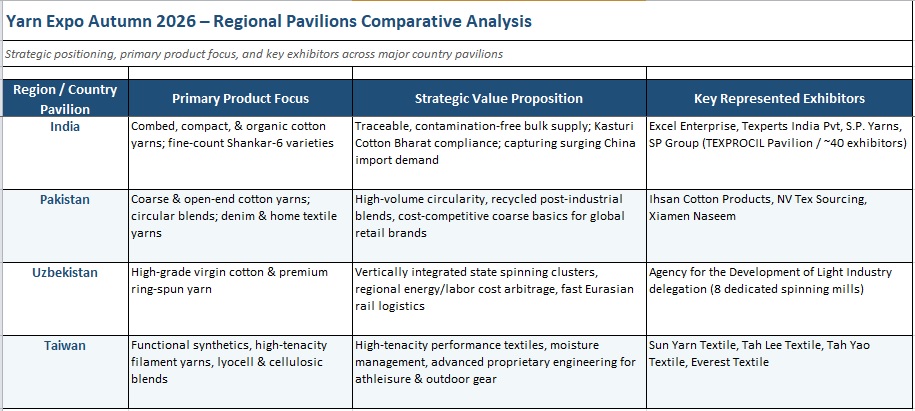
The event reflected a clear segmentation of the global upstream textile market, with regional pavilions deploying contrasting value propositions. As international spinning mills, synthetic extruders, and fabric developers converge at the National Exhibition and Convention Center, the primary country and regional pavilions; India, Pakistan, Uzbekistan, and Taiwan, targeted distinct tiers of the downstream textile matrix. Their collective presence illustrates how global textile hubs are responding to demands for cost efficiency, specialized functionality, traceable raw materials, and circular production standards.
India targets premium spinning and branded traceability
The India Pavilion, coordinated by The Cotton Textiles Export Promotion Council (TEXPROCIL) and featuring approximately 40 exhibitors, is positioned around high-grade natural fibers. Indian spinners, including Excel Enterprise, Texperts and S.P. Yarns concentrated on premium Shankar-6 long-staple combed cottons, compact ring-spun yarns, and certified organic fibers tailored for circular knitting and fine weaving.
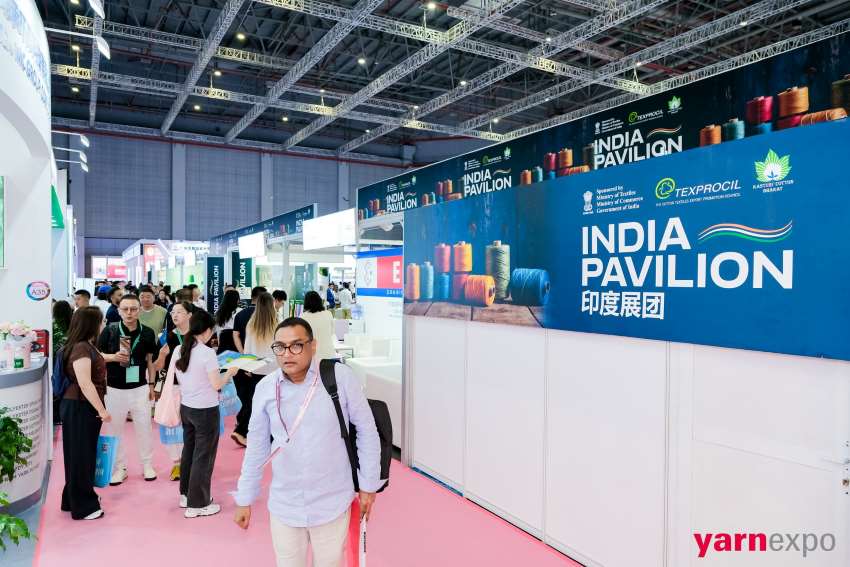
India's strategic push capitalizes on raw material availability and the national Kasturi Cotton Bharat program to deliver certified traceability and low contamination. This strategy aligns with Indian mills' commercial rebound in China, where exports surged 112 percent to cross $460 million in FY2025-26 as fabric converters sought reliable, high-specification yarn inputs.
Pakistan capitalizes on ‘Recovered’ fibers and coarse counts
In contrast to fine-count apparel focus, the Pakistan Zone is targeted at the industrial denim, workwear, and home textile segments. Suppliers such as Ihsan Cotton Products and NV Tex Sourcing are spotlighting open-end yarns, blended substrates, and circular solutions manufactured from post-industrial textile waste. By prioritizing regenerated cotton and cost-competitive coarse-to-medium counts, Pakistani exporters are catering to international home furnishings and casualwear brands under strict mandates to incorporate post-manufacturing recycled content into basic fabric constructions.
Uzbekistan accelerates vertical value addition and regional logistics
Represented by eight dedicated suppliers coordinated by the Agency for the Development of Light Industry, the Uzbekistan Pavilion highlighted the rapid industrial transformation of Central Asia’s cotton sector. Moving decisively away from raw fiber exports, Uzbek mills are promoting high-grade, 100 percent virgin cotton ring-spun yarns. Backed by state-driven modern spinning clusters, lower regional energy inputs, and direct overland Eurasian rail links, Uzbekistan is positioning itself as a competitive alternative supplier for standard knitting and weaving yarns required by large Asian fabric converters.
Taiwan leads in Functional Cellulosics and Technical Polymers
Occupying the high-performance end of the regional pavilion spectrum, the Taiwan Zone bypassed conventional cotton commodity competition altogether. Exhibitors including Sun Yarn Textile, Tah Lee Textile, and Tah Yao Textile are presenting high-tenacity filament yarns, functional blends, and low-impact cellulosic developments like lyocell. Taiwanese manufacturers are targeting downstream athleisure, outdoor apparel, and specialized protective textiles, leveraging proprietary spinning technologies to deliver moisture management, tensile strength, and eco-certified next-generation man-made fibers.
Regional strategies mirror fragmented sourcing mandates
The interplay among these four manufacturing hubs demonstrates that global apparel and fabric mills are no longer deploying single-source procurement models. While Taiwan captures technical margins through engineered functional blends, India and Uzbekistan are competing for dominance in traceable, premium natural ring-spun yarn. Concurrently, Pakistan’s focus on mechanical recycling and open-end counts provides the high-volume circular feedstock demanded by retail mass markets. Yarn Expo Autumn 2026 serves as the primary stage where these differentiated industrial strategies directly interface with global demand.
Specialized export councils advance national competitiveness
National trade bodies like TEXPROCIL and Uzbekistan’s Agency for the Development of Light Industry serve as institutional catalysts for their domestic spinning sectors. By funding national pavilions, standardizing quality certifications, and managing cross-border commercial outreach, these organizations enable regional mills to scale export revenues and capture specialized market segments across global manufacturing hubs.
Inside activewear's shift from stitched mesh to precision engineered textiles

The global functional apparel market, on track to touch $640 billion, is looking at a production shift as activewear manufacturers replace conventional cut-and-sew mesh panels with engineered, body-mapped textiles. For decades, sportswear brands have relied on secondary mesh fabrics in sweat-prone areas such as the back, chest and underarms. While effective for ventilation, this approach adds cutting, positioning and stitching operations, increases seam points and generates fabric waste.
Advanced circular knitting, thermal imaging and variable yarn tensioning are changing that model. Manufacturers can now engineer ventilation, stretch and moisture-management zones directly into a single knitted structure. The result is a garment that can deliver differentiated performance while reducing manufacturing complexity.
From sweat data to knitting instructions
The technology begins with performance data. Infrared thermography and sweat-rate sensors monitor body temperature, moisture accumulation and heat zones during athletic activity. This information can be converted into digital body maps that identify where garments require greater ventilation, support or moisture transfer. Knitting software then translates these requirements into machine instructions. High-gauge circular knitting systems, including machines operating with approximately 280-320 needles, can vary yarn density, stitch structure, aperture size and denier within the same production cycle.
This allows a single garment to contain multiple functional zones without adding separate fabric panels. Yarn selection further enhances the effect. Hydrophilic fibres positioned toward the skin can draw moisture into the fabric, while hydrophobic exterior filaments encourage outward movement and evaporation. According to the supplied technical benchmarks, directional constructions can move moisture up to 40 per cent faster than uniform synthetic weaves. The biggest change is that performance is being programmed into the textile rather than added to it.
Manufacturing gains strengthen margins
The commercial case for body mapping is particularly strong because it combines product differentiation with manufacturing efficiency.
Table: Technical & commercial comparison
|
Metric/Feature |
Legacy cut-and-sew mesh panels |
Mapped engineered knits |
|
Manufacturing Steps |
12-18 manual cut/sew steps |
1-3 single-pass automated knit steps |
|
Fabric Scrap Rate |
12-18% yield loss |
Less than 3% scrap rate |
|
Garment Seam Points |
High (6-12 structural seams) |
Minimal (Seamless or single flatlock frame) |
|
Capillary Moisture Transfer |
Passive through open mesh gaps |
Directional gradient yarn transport |
|
Average Retail Gross Margin |
48-52% |
58-64% |
|
Average Retail Price Point |
$45-$65 |
$85-140+ |
Traditional mesh construction can require numerous cutting, positioning and sewing operations. Engineered knitting compresses much of this work into automated production. The supplied benchmarks indicate that as many as 18 manual cutting and stitching operations can be eliminated in some garments, while fabric yield loss can fall from about 15 per cent to below 3 per cent.
For premium activewear manufacturers, lower material waste is significant because technical yarns are often more expensive than commodity fabrics. Reduced labour requirements and fewer production defects can further lower total manufacturing costs once machines reach sufficient utilisation. Fewer seams may also improve garment durability and reduce potential failure points, an increasingly important consideration as sportswear sales shift toward direct-to-consumer and online channels.
Technical construction becomes a pricing tool
Body mapping is also strengthening activewear's premiumisation strategy. Traditional mesh provides visible ventilation, but its differentiation can be difficult to communicate beyond basic breathability. Engineered garments allow brands to promote targeted cooling, anatomical support, moisture management, lightweight construction and enhanced stretch as integrated product features. The supplied comparison places conventional technical garments at around $45-65, while engineered mapped products can reach $85-140 or more. Estimated gross margins also rise from 48-2 per cent to 58-64 per cent. These figures will vary by brand, product complexity and distribution model, but the broader commercial principle is important: construction technology can support a stronger value proposition than simply changing the fibre blend. Body mapping therefore, turns manufacturing precision into a retail story.
Sportswear giants expand the model
The technology is moving across both global sportswear companies and specialist performance labels. Nike has expanded its Dri-FIT ADV platform using engineered material structures designed to provide different levels of breathability and support across garments. On Running has developed zoned airflow and variable thread tension for lightweight running products, while Lululemon has incorporated targeted knit structures into products requiring stretch, support and thermal management.
Under Armour has also been moving high-performance base layers toward strategic ventilation structures rather than relying solely on stitched panels. At the specialist end, Paris-based Satisfy Running demonstrates how technical construction can support premium positioning. Its products, some priced above $140, combine lightweight materials, ventilation technologies and performance-focused design. The significance extends beyond elite sports. As consumers become more familiar with technical apparel, body mapping provides brands with a mechanism to create differentiated products across running, training, outdoor and athleisure categories.
Capex separates advanced suppliers
The transition does carry a substantial entry barrier. Advanced circular and flatbed knitting machinery requires significant capital investment, while manufacturers need technical designers, software specialists and machine operators with expertise in digital textile production. This could widen the gap between technically advanced suppliers and factories dependent on conventional cut-and-sew production.
However, the economics become more attractive at scale. Higher machine utilisation allows manufacturers to spread capital costs while benefiting from reduced labour hours, lower material wastage and improved production consistency. This may encourage greater vertical integration. Textile manufacturers that can combine yarn expertise, digital knitting, programming and garment development will be better positioned to become strategic partners to global sportswear brands rather than simply fabric suppliers. Competitive advantage could consequently shift from low-cost sewing capacity toward engineering capability.
Sustainability adds to the case
Body-mapped knitting also aligns with several emerging sustainability priorities. Lower scrap rates reduce production waste, while fewer components can simplify material management. A garment engineered around a narrower material architecture may also make traceability and future recycling easier. This becomes relevant as European regulation places greater emphasis on product traceability, material disclosure and circularity.
However, engineered construction is not automatically sustainable. Many performance garments continue to rely on virgin synthetic fibres and energy-intensive production. The strongest sustainability case emerges when manufacturing efficiency is combined with recycled inputs, longer product lifetimes and designs that facilitate end-of-life recovery.
The next activewear production model
Body mapping was initially associated with elite athletes because its development costs could be justified only at the highest levels of performance. Advances in digital knitting are now allowing the technology to move into mainstream activewear. The shift is significant. Traditional mesh treats ventilation as an additional component that must be attached to a garment. Engineered knitting treats ventilation, moisture management and support as functions designed into the garment from the beginning.
For manufacturers, that can mean lower waste, fewer production operations and improved scalability. For brands, it creates opportunities for higher price points and stronger margins. For consumers, the most advanced performance feature may increasingly be invisible. The future of activewear may therefore be less about adding more components and more about making every stitch perform a specific function.
Brazil’s cotton dominance puts Asian spinners on a new sourcing map
Brazil’s emergence as the world’s largest cotton exporter is no longer simply an agricultural success story. It has given a boost to the global spinning industry. The country closed the 2025/26 marketing year with a record 3.374 million tonnes of lint exports, up 19 per cent from 2.836 million tonnes a year earlier, generating $5.3 billion in export earnings. More importantly, the destination pattern shows that Brazilian cotton is being absorbed by the world’s principal spinning hubs.
China took 770,523 tonnes, Bangladesh 584,756 tonnes, Turkey 441,054 tonnes, Pakistan 414,340 tonnes, Vietnam 393,206 tonnes and India 353,820 tonnes. Together, these six markets accounted for 87 per cent of Brazil’s exports.
Table: Brazil’s cotton exports
|
Market destination |
Annual volume (tonnes) 2025/26 |
Market share (%) |
July 2026 exports (tonnes) |
July 2026 share (%) |
|
China |
770,523 |
23% |
5,133 |
3% |
|
Bangladesh |
584,756 |
17% |
30,053 |
19% |
|
Turkey |
441,054 |
13% |
26,609 |
17% |
|
Pakistan |
414,340 |
12% |
23,051 |
15% |
|
Vietnam |
393,206 |
12% |
26,565 |
17% |
|
India |
353,820 |
10% |
15,376 |
10% |
|
Indonesia |
204,182 |
6% |
12,950 |
8% |
|
Egypt |
76,758 |
2% |
4,834 |
3.10% |
|
Malaysia |
51,476 |
2% |
5,362 |
3% |
|
South Korea |
32,112 |
1% |
2,145 |
1.40% |
|
Others |
51,715 |
2% |
2,887 |
1.90% |
|
Total Export Volume |
3,373,922 |
100% |
154,965 |
100% |
The implication is significant: Brazil is not merely supplying cotton to traders; it is embedding itself deeper into the procurement strategies of competing textile-manufacturing countries.
India is the emerging swing market
The sharpest shift is visible in India. Brazilian shipments to the country have multiplied over 40 times in two years, reaching 353,820 tonnes. This is not simply a price arbitrage story. Indian spinning mills operate under pressure to maintain consistent quality, yarn specifications and delivery schedules even when domestic cotton arrivals fluctuate. Brazilian cotton offers an alternative pool of machine-harvested, HVI-tested fibre that can be incorporated into mill laydowns with greater predictability.
With Indian cotton consumption projected at a record 5.77 million tonnes in 2026/27, imported cotton can easily work as a risk-management instrument rather than an emergency substitute. That distinction matters. Once mills qualify an overseas origin for particular counts and customers, procurement relationships can become structural.
Brazil is correcting, not retreating
Brazil’s next crop indicates that exporters are not pursuing volume at any cost. Abrapa’s August estimate puts 2026 planted area at two million hectares, down 8 per cent from 2025, while lint production is forecast at 3.9 million tonnes, 8.2 per cent below the previous record. Yet productivity remains remarkably resilient.
Table: Brazilian crop indicator
|
Crop indicator |
2021 |
2022 |
2023 |
2024 |
2025 |
2026* (forecast) |
2026 vs. 2025 change |
|
Planted Area (Million Ha) |
1.37 |
1.6 |
1.66 |
1.99 |
2.17 |
2 |
-8.00% |
|
Seed Cotton Output (Million Tonnes) |
5.8 |
6.27 |
7.7 |
8.91 |
10.32 |
9.5 |
-7.90% |
|
Cotton Lint Output (Million Tonnes) |
2.36 |
2.55 |
3.17 |
3.7 |
4.25 |
3.9 |
-8.20% |
|
Seed Cotton Yield (Kg/Ha) |
4,230 |
3,920 |
4,628 |
4,584 |
4,753 |
4,758 |
+0.1% |
|
Cotton Lint Yield (Kg/Ha) |
1,721 |
1,596 |
1,907 |
1,904 |
1,958 |
1,954 |
-0.20% |
This is arguably the more important signal. Brazil is reducing acreage while preserving yields. The adjustment therefore resembles inventory and market management rather than a deterioration in agricultural competitiveness. With global Brazilian exports still projected at around 3.33 million tonnes in 2026/27, the country retains considerable export capacity.
Price is reinforcing the shift
Brazil’s advantage is also being supported by international price spreads. In early August, Brazilian Cepea/Esalq cotton stood at 82.1 cents a pound and nearby ICE New York at 83.2 cents. The Cotlook A Index was higher at 95 cents, while China’s cotton index was at 120.8 cents. India’s domestic spot price was 91.6 cents and Pakistan’s 80.1 cents.
Table: Global crop index
|
Benchmark index |
Latest value (Aug 12) |
Latest month (July) |
12-month average (Aug 25–Jul 26) |
|
Cepea/Esalq (Brazil Domestic) |
82.1 cents/lb |
80.4 cents/lb |
72.1 cents/lb |
|
ICE Futures NY (Nearby) |
83.2 cents/lb |
78.6 cents/lb |
68.7 cents/lb |
|
Cotlook A Index |
95.0 cents/lb |
88.9 cents/lb |
80.2 cents/lb |
|
China Cotton Index (CC) |
120.8 cents/lb |
118.4 cents/lb |
105.6 cents/lb |
|
Indian Spot Index |
91.6 cents/lb |
86.7 cents/lb |
79.9 cents/lb |
|
Pakistani Spot Index |
80.1 cents/lb |
79.0 cents/lb |
73.9 cents/lb |
These spreads create room for Brazilian cotton to remain commercially attractive even after freight and landing costs, particularly for mills purchasing large volumes. But price alone cannot explain the durability of the trend. Consistency, logistics and quality documentation increasingly influence fibre selection as much as the headline cotton price.
Traceability becomes a competitive weapon
The sustainability dimension could strengthen Brazil’s position further. During 2024/25, Brazil accounted for 3.32 million tonnes of Better Cotton-licensed fibre against a 4.25 million-tonne crop forecast, with 2.11 million tonnes recorded in verified commercial transactions.
Mass-balance transactions represented 85.6 per cent of that volume, while segregated supply accounted for 14.4 per cent. For exporters serving global apparel brands, this infrastructure is becoming commercially relevant as traceability requirements move closer to the farm level.
The experience of Bangladesh’s Apex Yarn Spinners is an expample. By replacing 30 per cent of its traditional Central Asian cotton with Brazilian middling cotton, the mill reportedly reduced comber nil waste by 2.5 per cent and improved yarn-strength uniformity in 30s and 40s counts. Such outcomes turn origin diversification into an operational proposition rather than merely a sourcing preference.
The new cotton geography
Brazil’s rise does not mean traditional suppliers will disappear. Nor does it imply that Asian mills will abandon domestic cotton. Instead, the global spinning system is moving towards a more diversified sourcing architecture in which Brazil provides scale, consistency and an increasingly credible sustainability proposition.
That is the significance of the Cotton Brazil initiative, backed by Abrapa, Anea and ApexBrasil. Its focus on Asian spinning markets reflects where the next battle for fibre demand will be fought. For India, the lesson is particularly important. Brazilian cotton can help mills manage domestic crop volatility, but growing dependence on imported fibre also exposes the industry to freight, currency and international price risks.
The larger picture, therefore, is not Brazil replacing another cotton powerhouse. It is the emergence of a new supply-chain anchor. The Cerrado has moved from being a peripheral cotton-growing region to becoming an increasingly consequential component of the global spinning economy. And as mills optimise for consistency, traceability and cost simultaneously, that influence is likely to deepen.