FW
Clean Clothes Campaign red flags Pakistan on safety
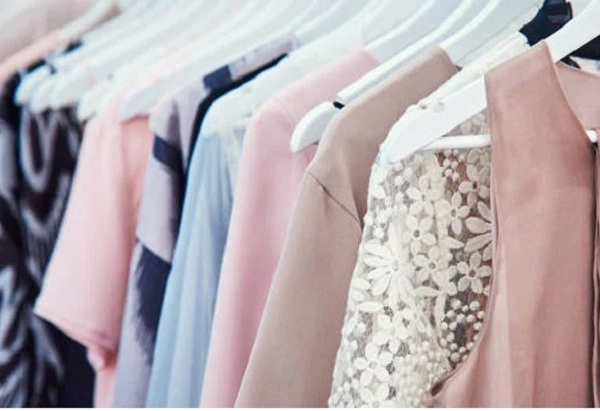
Since 1989, Netherlands-based Clean Clothes Campaign has been working for the interest and betterment of workers in the textile and garment industries. It is now a global network of 235 organizations across 45 countries, helping identify work-force related issues that workers in these industries face and provide support and assistance to find solutions that improve working conditions and quality of life. In 2021, Clean Clothes Campaign introduced the International Accord on Health and Safety that became a binding contract for both, brands and local unions. Now, the South Asian Coalition of Clean Clothes Campaign has placed Pakistan on the radar as reports show regular violation of safe working conditions for its labor force by brands that have signed the Accord as well as brands that are outside the agreement.
Rampant disregard
In 2012, a factory in Karachi burnt due to arson and in what is described as the worst incident recorded of a factory fire, 264 factory workers perished. In a country mired with many problems that affect the manufacturing sector, safety hazards are ignored or lie unattended due to a lack of concern by proprietors and lack of awareness of workers about their rights to work in a safe environment. Deadly incidents are quite frequent and due to their numbers, the media don’t attach much importance to such news.
Clean Clothes Campaign tracked as many as 36 such incidents since January 2021. Tracking showed that most of these deadly incidents could have been well-avoided if basic safety measures were put in place. Plans have been underway since 2018 as garment workers unions in the country have been calling for signing the Clean Clothes Campaign International Accord on Health and Safety but four years on, obstacles prevent the introduction of the Accord. It is a surprise that brands such as Levi’s, GAP, Lee and Wrangler have a bad track record in Pakistan.
A vocal General Secretary of National Trade Union Federation in Pakistan, Nasir Mansoor has often stated how the signing and establishment of the Accord on an urgent basis is the need of the hour. He feels that it is right of every Pakistani factory worker to work in a place where their life is not in danger and he urges owners of manufacturing units to cooperate with the authorities in getting their premises inspected and faults fixed immediately. Ineke Zeldenrust, International Coordinator at Clean Clothes Campaign, supported Mansoor by stating that brands must act immediately in scrutinizing their supply chain to ensure that workers in their supply chain are not putting their lives on risk.
Stalled Accord
Whilst Clean Clothes Campaign says establishment of the Accord in Pakistan is in advanced stage, there are hurdles that keep stalling its implementation. The authorities are yet to decide when to launch it and a definite date is not in the horizon. Additionally, workers don’t know when and how they can seek protection of their rights from the program. Moreover, many stakeholders are opposed to an Accord built on the lines of the one established in Bangladesh as they feel the socio-political environment of Pakistan is unique in its own way. Thus the Accord is being redesigned to fit the Pakistan context and data collection is ongoing to get it right to enable just and legal representation of workers’ rights.
Gap Q3 sales up two per cent
Gap’s thirdquarter net sales rose 2.5 per cent.
The brand’s formal clothing and dresses are having a steady demand from affluent consumers. People are preferring more formal clothing, dresses, woven tops and pants, shelving casual wear like T-shirts and shorts as they return to travel, work and social occasions after two years of pandemic-induced restrictions.Gap's Banana Republic, an affordable luxury brand, posted an eight per cent rise in sales, while its Old Navy brand that has been struggling with out-of-fashion clothes reported a two per cent increase.It expects fourth-quarter net sales to be down in mid-single digits. Gap saw strong volume in October slow a bit in the end and a little bit of a slow start to November.
Gap is expected to continue to struggle over the next 12 months because of its low- to middle-income consumer base and underperforming brands. Heading into the holiday season and 2023, discounts could continue for brands like Gap due to a weaker consumer. Soaring prices of essential commodities have damped lower-income consumer spending on non-essentials like apparel. In October, Gap removed products from its Yeezy Gap line created in partnership with Kanye West, and shut down YeezyGap.com following the rapper's anti-Semitic comments.
Arvind combats textile waste with PurFi
Arvind and PurFi will jointly attempt to reduce the amount of textile waste going to landfills.
Arvind is India’s largest textile to technology conglomerate and PurFi is a sustainable technology company specializing in rejuvenating textile waste into virgin quality products. PurFi’s proprietary technology creates a traceable 360-degree circular solution that rejuvenates textile waste into virgin quality fibers utilizing 96 per cent less water and 90 per cent less energy than virgin textiles. PurFi and Arvind will locate the first in a series of planned fiber rejuvenation facilities near one of Arvind’s manufacturing facilities in India.
This facility will process textile waste – white cotton, colored cotton, denim and synthetics – into virgin-like fibers for reuse from two lines, where each line will have a 5,500-ton capacity per year with plans to expand over the next five years. Expansion plans include an additional production line that removes elastomers from fabrics utilizing another of PurFi’s proprietary technologies.
The textile industry generates more than 64 billion pounds of post-industrial textile waste and 284 billion pounds of post-consumer waste annually. Yet only 12 percent of textiles globally are recycled and about one percent are upcycled. The circular economy is being embraced by those who are conscious of their carbon footprint.
Japan October clothing imports up 40 per cent
Imports of clothing and accessories by Japan increased by 40 per cent yearonyear in October 2022.
They were three per cent of Japan’s total imports during the period. The country’s imports of textile yarn and fabrics in October 2022 were 45 per cent higher than the same period of last year. Yarn and fabric imports were one per cent of the total imports by Japan. The country’s exports of textile yarn and fabrics during October 2022 increased by 17 per cent yearonyear. The country’s exports of textile machinery were 38 per cent higher than exports in October 2021.
They contributed 0.3 per cent to the country’s total exports.Japan’s imports of clothing and accessories increased by 29 per cent during April 2022 to September 2022. These imports were three per cent of total imports during the first six months of this year. Imports of textile yarn and fabrics from April 2022 to September 2022 were 30 per cent higher than the same period of last year.These imports were one per cent of the total imports by Japan.The country’s exports of textile yarn and fabrics during the first half of fiscal 2022 increasedby 17 per cent yearonyear. These exports were 0.8 per cent of total exports from Japan during April 2022 to September 2022.
Falling orders hit accessory makers
The accessories and packaging industry in Bangladesh is feeling the pinch of falling orders for readymade garments.
Foreign buyers are asking readymade garment companies to delay shipments of finished goods because they are faced with a fall in demand in their domestic markets and have large unsold inventories.Orders for garment exports have slowed down since October and any such reduction will have a corresponding effect on all the sub-sectors.
This is true especially of the accessories and packaging industry, the profit or loss of which is tied to the rise and fall of readymade garment exports. It is feeling the pinch as orders have declined. The accessories industry has to deal with delayed payments since garment exports are on hold.
Work orders for readymade garment exporters have fallen by as much 40 per cent. If garment accessories and packaging manufacturers received a work order for 0.1 million pieces earlier, it now has come down to 35,000 or 40,000 pieces.As garment companies see their business fall, accessories industries that supply various items which constitute the finished fabric are also facing deferred payment for finished goods delivered. There are at least some 2000 accessories and packaging companies in Bangladesh producing more than 25 products needed by the readymade garment sector.
Indian textiles go from linear to circular
The textile industry in India is shifting gears from linear to circular operations.
Manufacturers are making concerted efforts to introduce sustainability by using innovative materials, safe dyes, reducing water and energy consumption, treating waste material and ensuring a greater focus on reducing, reusing and recycling, ensuring that both pre-consumer and post-consumer waste are controlled. Zero Liquid Discharge, for instance, is a wastewater treatment process that removes all liquid discharge from a system. Apart from prioritising organic fabrics, the focus of the sector is all about conserving the natural environment.
Other projects, like processing PET bottles to make recycled polyester fibers, are also underway.This has triggered the movement towards slow fashion that works on a‘fit-to-demand model, reducing surplus and investing in garments that have a long life.With new innovations like 3D printing and new age fabrics made from hemp and bamboo, these changes come as first steps in a long journey towards sustainability.
With the high environmental impact, but large room for improvement, it is very probable that measures to implement sustainability in the textiles sector will have a significant impact.The textile industry in India, which has a four percent share of the global trade in textiles and apparel, is expected to grow by a compound ten percent a year till 2026.
Low demand hits Chinese markets
Guangzhou’s large wholesale fabric market has been hit by low demand rather than the epidemic.
As of November 13, 707 new confirmed cases and 3,941 new asymptomatic infections were reported in Guangdong province, mainly concentrated in Guangzhou. Factories in Guangzhou areshut or running with limited operations. Though the epidemic has caused regional disruptions in production and distribution, lack of demand is the main reason for the depressed market. There has been no increase in orders from markets that have been unsealed.
Hanzheng Street in Wuhan, China Textile City in Shaoxing, China Oriental Silk Market in Suzhou, Nantong Folded Stone Bridge and other major cloth and garment markets are currently less affected by the epidemic, but market transactions are still thin. Factory orders have not improved significantly after the end of the epidemic control.Downstream finished goods inventory pressure is high, and the operating rate has gradually declined.
The high inventory of filament is mainly due to the obvious weakness of downstream demand, as grey fabric, textile and clothing are all under high inventory pressure. In China domestic sales of textile and clothing have gradually weakened and at the same time export orders have not improved. Domestic sales of filament declined rapidly in November.
Deja from Indorama wins award
Indorama’s Deja has won the Chemical Week award. Deja is the world’s first carbon-neutral virgin polyethylene terephthalate resinaimed at reducing environmental impact. These are the world’s first certified carbon-neutral virgin PET pellets. The Deja brand covers carbon neutral virgin and recycled PET resins and a range of recycled PET products, including flakes, resins, fibers, and yarns.It provides Indorama’s global customers with a range of high-performance applications, including packaging, lifestyle, automotive, apparel, and medical equipment.
The solutions help environmentally conscious companies meet their sustainability goals. Deja supports the UN Sustainable Development Goals of promoting a sustainable, greener circular economy. Chemical company Indorama Ventureshas set ambitious 2025 and 2030 targets, which are expected to be met through its six-pronged decarbonization strategy, including energy transition, improving operational efficiency, circular feedstock, and future technologies.
The company also has a goal to recycle 100 billion PET bottles annually by 2030.Chemical Week Sustainability Awards recognize the industry’s best efforts in addressing financial, operational, and strategic challenges by focusing on ESG and sustainable product development. The awards were assessed by S&P Global, the world’s leading credit rating agency, and a panel of experts from various companies across the chemical industry’s value chain.
Primark opens three more US stores
Value fashion retail giant Primark has opened three new stores in the United States.
The target is to reach 60 US stores by 2026. As of now there are a total of 16 US stores and a worldwide tally of 411 stores. Primark first entered the US in 2015,introducing its products to a myriad Americans, thirsty for its everyday low price model, a system different from the majority of other US retailers who operate with extensive discounting, promotions and coupons. The Irish retailer continues to pursue the American dream at a slow pace. The US market is the biggest market in terms of fashion sales and one of the most complex alongside the high competition.
Primark is a company that only operates with physical stores amid an era driven by digitalization and e-commerce. The Irish fast fashion chain’s jeans collection designed in line with the Ellen MacArthur Jeans Redesign guidelines uses organic cotton and recycled content. The collection meets all of the Jeans Redesign standards, with adult jeans in the collection made from either 70 per cent organic cotton, 29 per cent recycled cotton and one per cent elastane, or 70 per cent organic cotton and 30 per cent recycled cotton. Children’s jeans are made of 78 per cent organic cotton, 20 per cent recycled cotton and two per cent elastane.
Denim event showcases the entire value chain
Bangladesh Denim Expo was held November 15 to 16, 2022.
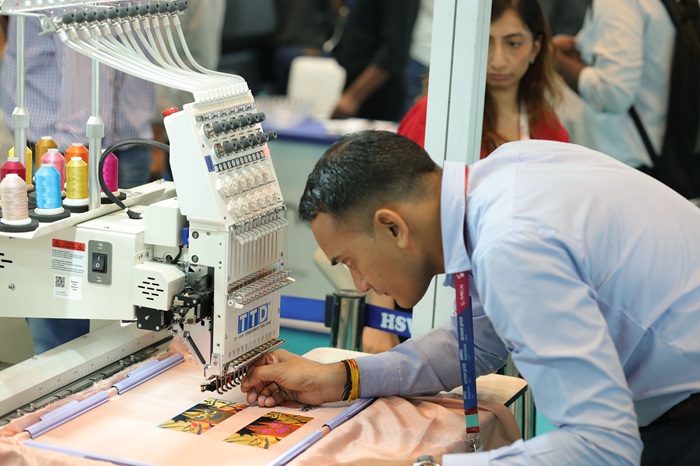
It was a grand event showcasing the entire value chain, creating a platform for connecting with people who love, appreciate, and care for denim.The trade show featured businesses from around the world spanning textiles, machinery, and technology, with a focus on sustainability. The event hosted renowned global denim manufacturers, industry leaders, sustainability practitioners, and the latest technology adopters from all around the world,brought businesses together, enabled meaningful collaborations, and kept participants updated with global denim fashion trends and manufacturing techniques.
Denim offers Bangladesh great prospects. Bangladesh’s next business is denim. With the huge demand from global retailers and brands, the country has established some 30 denim mills. These meet 40 per cent of the demand for denim fabrics from garment makers. The remaining demand is met through imports, mainly from China, India, Turkey and Pakistan.Bangladesh has overtaken China in denim supply to the EU countries because of quality products at competitive prices.Due to the focus on sustainability Bangladesh denim fabric makers have dramatically reduced water consumption over the last few years with the adoption of the latest technologies in production. The target is to reduce water consumption by 80 per cent in the denim making process.