


FW
EU’s RMG imports recover, US, UK continue to remain low importers Wazir Advisors

Wazir Advisors July 2023 ‘Apparel Trade Scenario in Key Global Markets and India’ study that covers the three months of April, May and June 2023 highlights global trade in readymade garments (RMG) hasn’t really changed since the last report that was released in June 2023. The report which covers four of the largest readymade garment importers: US, EU collective, UK and Japan reveals, Japan is the only country out of the four that continues to increase import of readymade garments while the EU has turned its import quantities around in June, gaining an increase of 1.6 per cent year to date, and 4 per cent in April 2023. The decrease in import of RMF continues in the UK and US.
It may be noted the Wazir Advisors report publishes import, physical retail and online retail scenarios of these four countries, month after month and the July report highlights the current trends in these markets.
RMG imports recovers in the EU
The EU’s apparel imports in April 2023 increased by 4 per cent compared to April 2022. The April 2023 imports were valued at $7.8 billion. On YTD basis, imports were 1.6 per cent higher than in 2022. In the EU market, Bangladesh's share witnessed an increase of 4.5 per cent from 2022 and, China’s share decreased 7.4 per cent.
As retail shines in the US, imports still lag
In June 2023, the US’ monthly apparel store sales were estimated at $18.4 billion, 6 per cent more than in June 2022. On YTD basis, sales were 6 per cent higher than in 2022. E-commerce growth was not as significant - in Q1 2023, online sales of clothing and accessories registered a growth of 2 per cent over Q1 2022 and were 32 per cent lower than Q4 2022 sales. This is, explained by the fact that the fourth quarter of every year is the peak of festive sales. The report indicated mixed fortunes for home furnishings in June 2023. US monthly home furnishing store sales are estimated to be $5.1 billion, which is 2 per cent lower than in June 2022. However, on a year-to-date basis, sales were 1 per cent higher than in 2022. The downward slide of imported RMGs now stands at a negative 20 per cent, year-to-date.
Japanese buyers remain steady in RMG imports
In April 2023, Japan’s apparel imports were $1.8 billion, 6 per cent higher than that in April 2022. In a reversal of fortune since the last Wazir report, Vietnam’s share decreased by 7.2 per cent and China’s share declined further 1 per cent, bringing the total to a decline of 8 per cent compared to 2021. Between January and April 2023, China was the largest supplier of apparel to Japan, still holding on to more than half of the total imports, at 51 per cent. Vietnam in that period supplied only 16 per cent whereas Bangladesh and Cambodia supplied 6 per cent and 5 per cent respectively.
UK imports continue to fall
UK apparel imports in May 2023 were $1.6 billion, which is 24 per cent lower than in May 2022. On YTD basis, imports in 2023 are 17 per cent lower than in 2022. In the first five months of 2023, China has only 16 per cent market share, equaling that of rival Bangladesh. So far down 2023, Italy and India have gained 1 per cent each, standing with market shares of 8 per cent and 7 per cent respectively.
On the other hand, in physical retail, May registered monthly apparel store sales were £3.8 billion, which is 6 per cent higher than in May 2022. On a year-to-date basis, sales were 11 per cent higher than in 2022. On the e-commerce front, the first quarter of 2023 fared better than the first quarter of 2022 by 13 per cent.
Increasing urbanisation to drive yarn market growth at 5.1% CAGR
The textile yarn market is set to grow robustly from USD 14.4 Billion in 2023 to USD 18.5 Billion by 2028, with a CAGR of 5.1% during the forecast period, driven by increasing global population and urbanization.
Urban migration fuels the demand for textiles and, consequently, textile yarns. Cotton yarn dominates the plant yarn segment and is expected to hold the largest share in 2023 due to its popularity in the clothing industry, particularly for comfortable and breathable garments like t-shirts, jeans, and dresses.
The home textiles segment is rapidly growing, enhancing residential spaces with bedding, curtains, towels, and rugs, utilizing textile yarns as essential components in production. China is expected to lead the Asia-Pacific market in 2023, benefitting from its established textile industry, cost-effective production capabilities, and abundant raw materials.
The future of textile yarn is driven by sustainability and advanced technologies. Eco-friendly fibers like organic cotton, bamboo, and recycled polyester gain momentum, reducing the industry's carbon footprint. Advancements in eco-efficient processes, such as waterless dyeing and energy-saving methods, aim to minimize resource consumption during yarn manufacturing.
Innovative yarns like UHMWPE and conductive yarns revolutionize various industries, from aerospace to wearable technology. Smart textiles integrate conductive yarns and microelectronics for interactive fabrics with applications in sports, healthcare, and consumer electronics. Customization and personalization thrive with digital manufacturing and additive technologies, allowing tailored yarns to meet specific design requirements.
In conclusion, the future of textile yarn lies in sustainability, performance, and technological innovations, offering eco-friendly and high-performance textiles with intelligent functionalities to embrace a more advanced and sustainable future.
Srilanka: JAAF urges increased export quota for India
The Joint Apparel Association Forum (JAAF) stressed the need to exceed the current export quota in the India-Sri Lanka Free Trade Agreement (ISFTA) for apparel to gain significant benefits. Presently, Sri Lanka can export eight million pieces of ready-made apparel to India without duties, but the JAAF desires a wider allowance to tap into extensive trade opportunities for both nations.
The apparel sector faces challenges with a 20 percent decline in textile and apparel exports, mainly due to reduced demand in primary export markets. JAAF believes that India, as a close trading partner, could offer a lifeline to Sri Lanka while benefiting Indian fabric manufacturers. As Sri Lanka recovers from its worst economic crisis since independence, the role of merchandise exports becomes increasingly crucial.
Since the ISFTA's implementation, Sri Lanka's export trade surged from US $47 million in 1999 to US $815 million in 2021, facilitating the promotion of a diverse range of products. Despite these successes, the eight million export quota hinders the apparel industry's full potential under the ISFTA.
Sri Lanka's imports from India also exceed its exports, leading to a trade imbalance. This restricts Sri Lankan exporters from negotiating substantial orders with Indian buyers. JAAF welcomes the ongoing FTA talks between India and Sri Lanka and remains optimistic about the mutual benefits. While awaiting the FTA's finalization, the JAAF urges the removal of the eight million-piece quota to bolster apparel exports to India.
The association stresses the importance of flexible trade arrangements amid global market conditions, decreased demand, and the prevailing economic crisis in Sri Lanka.
Indian Textile Minister's Vision: $250B Textile Ascent
Piyush Goyal, the Minister of Textiles, Commerce, and Industry, is at the forefront of an ambitious vision for India's textile sector, aiming to achieve a momentous $250 billion in textile production and $100 billion in exports by 2030.
To chart the course towards this goal, Goyal led the visionary roadmap discussion at the Chintan Shivir event, which took place on July 18, 2023, bringing together officials from across the country for a collective brainstorming session to address the challenges facing the industry.
During the event, Goyal placed significant emphasis on the necessity of an integrated approach and institutional reforms to enhance the sector's global competitiveness. The discussion delved into several pivotal themes, including strategies for boosting exports, attracting increased investments, scaling up operations, ensuring sustainability, and navigating the transition from natural to man-made fibers.
In her address, Darshana Jardosh, the Minister of State for Textiles, highlighted the textile industry's vital role in India's economic growth and called for concerted efforts to nurture all segments of the value chain.
With the firm determination and innovative solutions generated at the Chintan Shivir, India's textile sector endeavors to embark on a transformative journey towards unparalleled success.
Pakistan’s textile sector faces headwinds as the country copes with economic instability
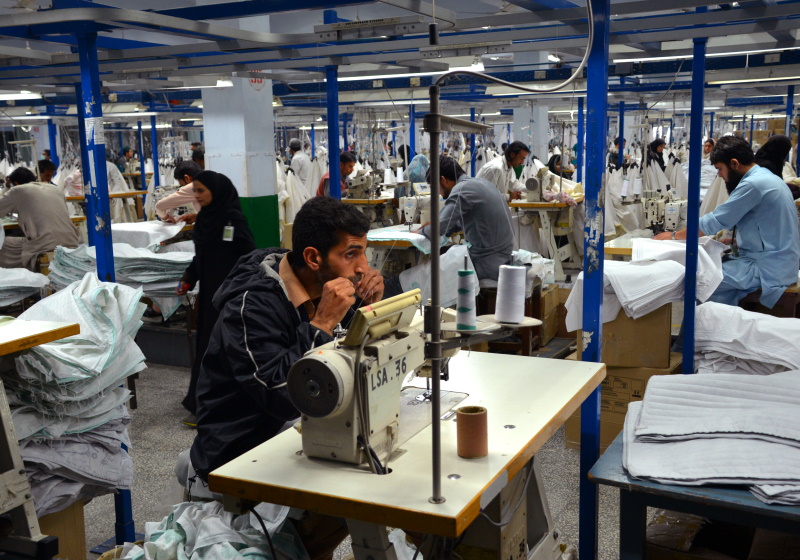
Pakistan’s exports share in the international market has dropped to 1.76 per cent due to expensive electricity. As per APTMA, textile exports dropped to $35.21 billion in FY2022-23 compared to $39.59 in FY2021-22. Moreover 50 per cent production capacity of textile mills is not being utalised and with high electricity rates exports are expected to move down even more.
Passing through tough times
The world is witnessing Pakistan’s ongoing battle to save itself from financial default, despite a $3 billion IMF loan to be received in installments, followed by loans from Saudi Arabia and the UAE. The nation is struggling with record inflation, high energy prices, severe forex liquidity crisis that’s stalled imports, continuous political upheavals. This has hit manufacturing sectors including the textile industry hard.
This financial year, saw a massive decline in textile exports of almost 15 per cent valued at $2.8 billion. To make matters worse, as the government and opposition continue their stand-off, so, intervention through quickly-implementable policies are nowhere in the picture. In this scenario, Bangladesh has seized the opportunity and lured many Pakistani textile manufacturers to its cost-friendly, professional and productive shores. Bangladesh has the added attraction of providing tax-free access to RMG and textiles to 37 countries.
Devaluation didn’t help, instability made it worse
The country’s economic think-tank had advised a devaluation of Pakistan’s Rupee to boost exports. However, as the devaluation happened on the back of a severe economic crisis and not in a planned manner, it backfired. As export-oriented textile sector is reliant on import of raw material, machinery and parts, things started falling apart when the country’s central bank gave directives to all commercial banks to stop issuing LCs due to a crucial forex shortage.
The blow was hard and forced many to stop operations and some to operate at half or quarter of their productivity level. Moreover, with a devalued currency, importing became expensive, shooting overheads up and pricing therefore, becoming non-competitive. What made it worse was the complete lack of stabilizing policies to spearhead a growth of 25 to 40 per cent. The industry has been waiting hopelessly since 2014, as two successive five year policies lie in cold storage and banks hiked borrowing rate to 22 per cent.
Lack of raw material another letdown
Lack of fiber, cotton and PSF have reduced or closed operations of many factories as both these fibers were to be imported in large quantity in an environment where LC’s were not being opened or honored. This brought to focus the urgent need for establishing a reliable local supply of cotton and PSF to avoid such situations in future.
Pakistan’s cotton farming, which is crucial to the textile industry, faces daunting challenges due to climate change, rising temperatures, unpredictable rainfall, and water scarcity resulting in lower crop yields and diminished quality. Result: cotton production and productivity has reached a 40-year low. This not only jeopardizes farmers’ livelihoods but also threatens sustainability and profitability of the entire textile industry. When the situation was at its lowest, the floods of 2022 destroyed vast amounts of cotton crop. In fact, amongst cotton-producing countries, the yield per hectare is one of the lowest in Pakistan.
Absence of working capital
Meanwhile, the withdrawal of zero-rating (SRO 1125) and the imposition of an 18 per cent GST on export-orientated sectors have had a negative impact, especially now that the FASTER system is not working and refunds are held up. The higher cost of doing business, unsustainable working capital levels, higher interest rates, and currency depreciation have formed obstacles for new projects and export expansion. High-borrowing rates and banks being stringent in loan approvals, working capital has reached scarcity levels.
The government has to take a step back and begin implementing the 2020-24 policies which includes cotton farming, energy supply and price control as well as look outward to guarantee investors a safe haven.
Messe Frankfurt, Kingpins: Denim's Sustainable Partnership
Messe Frankfurt and Kingpins Show have forged a partnership aimed at advancing sustainability in the denim industry. In this joint venture, Messe Frankfurt has become a shareholder in Kingpins, allowing the latter to maintain its independence within Messe Frankfurt's Texpertise textile network. This collaboration marks a significant expansion for Messe Frankfurt, which already hosts denim events like Beyond Denim and Denimworld. Kingpins, on the other hand, stands to benefit from Messe Frankfurt's abundant resources.
The two brands share a commitment to prioritize environmental stewardship and social responsibility, striving to create a more sustainable future for the denim industry. Kingpins' expertise with Messe Frankfurt's extensive experience will create an ideal platform for business encounters in the denim sector. Having started in 2004, Kingpins has grown into a renowned entity with a flagship show in New York and an event in Amsterdam.
Over the years, it has developed Kingpins Transformers, a series of summits promoting sustainability, equity, and responsibility in the denim business, later evolving into the independent Transformers Foundation.
This collaboration represents a significant milestone for both entities, merging their strengths and opportunities for mutual growth and quality improvement.
Lingerie Market to grow at 8.02% CAGR
A new market research report titled "Lingerie Market Report (2023-2028)" reveals that the global lingerie market is estimated to be worth USD 82.28 billion in 2023, with a projected compound annual growth rate (CAGR) of 8.02% during the forecast period.
The innerwear and lingerie industry has witnessed robust growth in recent years, driven by consumers' increasing focus on both style and comfort, influenced by media and advertising. Lingerie is now perceived as a fashion product that enhances body features rather than just a necessity.
Brands are actively expanding their product portfolios through new brands, mergers, acquisitions, and innovations. The global lingerie market is highly competitive and fragmented, with key players operating across different regions and offering diverse product lines.
These industry leaders are investing in new materials and design technology to cater to evolving consumer preferences. Some of the major players dominating the global lingerie market in 2023 include Hansbrands Inc., Jockey International Inc., Victoria's Secret & Co., Triumph International, MAS Holdings, Berkshire Hathaway Inc., Zivame, PVH Corp., Aimer Group, and Wacoal Holdings Corp.
Aggressive marketing and influential endorsements have become essential for market players to adapt to the rapidly changing industry landscape. Consumers tend to connect more with brands when endorsed by their favorite celebrities, leading to potential market growth. The Asia-Pacific region holds the largest consumer base for lingerie, driven by factors like increasing e-commerce, rising disposable incomes, and changing consumer preferences.
Manufacturers are introducing gender-fluid, body-inclusive, and vegan variants to cater to sustainability-conscious customers. Recent developments in the lingerie market include Victoria's Secret & Co.'s acquisition of Adore Me Inc., Triumph International's launch of a new brand, Triumph, and MAS Holdings' partnership with ByondXR to create virtual showrooms for an enhanced retail experience.
The comprehensive Mordor Intelligence market research report serves as a valuable resource for start-ups, industry players, investors, researchers, consultants, and business strategists seeking to understand and navigate the dynamic lingerie industry.
VDMA opposes EU's PFAS ban
The VDMA, representing over 3,600 German and European mechanical and plant engineering companies, warns that the European Union's plan to ban all PFAS (per- and polyfluoroalkyl substances) would pose significant risks to industrial processes.
In particular, the textile manufacturing sector would be severely impacted, facing a double blow. Firstly, essential chemicals for technical textile production would be excluded, and secondly, crucial textile machinery components made of solid PFAS would become unavailable, disrupting the entire supply chain.
The use of PFAS, such as PTFE and FKM, in textile machinery is vital, especially in extreme operating conditions. These materials, classified as "polymers of low concern" by the OECD, are not harmful to the environment and are properly managed during disposal or replacement.
The VDMA argues that these specific PFAS, as used in textile machinery, should be exempted from the ban, following the UK's differentiated approach to PFAS substance groups. Textile dyeing machines, drying machines, damping machines, and other key equipment for sustainable textile production heavily rely on PFAS components.
If the ban is imposed, many machines critical to sustainable textile manufacturing will be affected. VDMA Textile Machinery plans to participate in the ongoing EU public consultation, advocating for the preservation of key functionalities and safe conditions of use in the textile machinery sector. They stress that the ban's implementation could have severe consequences for companies and customers within the EU. VDMA represents a significant portion of the EU-27's workforce, with around 3 million employees, 1.2 million of whom are in Germany alone.
The mechanical and plant engineering sector is the largest employer in the capital goods industries, representing a substantial turnover volume and dominating machinery sales within the EU.
Indian Apparel Industry Attracts Japanese Traders
The Apparel Export Promotion Council (AEPC) highlighted a significant opportunity for the Indian apparel industry to expand its shipments to Japan. With a decline in Chinese garment exports to Japan, Indian exporters can fill the gap and cater to the growing demand in the island nation.
AEPC Chairman, Naren Goenka, emphasized that India's robust garment industry, boasting unique offerings, provides a favorable landscape for Japanese trading companies to source their products from.
The potential for growth is evident, given the positive trend in apparel imports into Japan over the last three years, with the nation now standing as the world's fourth-largest garment importer after the US, Germany, and France. However, out of Japan's total garment imports of USD 23 billion, India's share is currently just one percent.
This scenario presents a significant business opportunity for India, as China, the dominant supplier of garments to Japan, experienced a decline in the past five years. Moreover, India enjoys a distinct advantage with duty-free access for its ready-made garments under the Indo-Japan free trade agreement, whereas China and Turkey face around 9 percent duties.
Sudhir Sekhri, the vice-chairman of the council, further emphasized India's potential by highlighting its abundant raw material availability, including cotton, jute, silk, and wool, and being backed by the world's second-largest spinning and weaving capacity.
With a remarkable 95 percent value addition, India can offer a complete value chain solution from farm to fashion to the global market. To bolster the growth and development of the textile industry, the Indian government has implemented various supportive measures like the production-linked incentive scheme and PM MITRA scheme.
In conclusion, the Indian garment industry's distinctive offerings, coupled with the decline in Chinese exports, present a golden opportunity for Japanese traders to explore and strengthen their sourcing ties with India, leading to a mutually beneficial partnership.
Superdry franchisee closes 8 UK stores
A major fashion brand, Superdry, has faced the closure of eight of its UK stores as a franchisee decided to shut down their operations.
The company recently confirmed that six store locations will be closing, while the fate of the other two remains uncertain. It's important to note that this decision is not connected to Superdry's cost-cutting plan of £35 million, which was announced last year.
The responsibility for the closures lies with the independent owner who operates these eight stores, and Superdry emphasized that it has no intention of closing any of its directly operated stores across the UK for now. Earlier this year, Superdry revealed measures to reduce costs, which included "estate optimization," hinting at possible store closures.
Since then, five branches have already closed, and three more are likely to follow suit. Among the affected locations are Stoke On Trent, Luton, Telford, Ipswich, Lincoln, and Bury St Edmunds. The other two stores earmarked for closure have not yet been officially confirmed.
Superdry's situation reflects a broader trend among big-name high street brands, as they grapple with the challenges posed by a difficult retail environment exacerbated by the aftermath of the Covid pandemic and the ongoing cost of living crisis. Boots, another renowned retailer, is also planning to shut down 300 of its stores in response to











