


FW
EFI launches latest innovations for digital textile production at ITMA Asia
Electronics For Imaging, Inc launched its latest innovations for digital textile production at ITMA Asia. These included EFI Reggiani Colors, a digital textile printer offering high-end production in up to 12 colours; the EFI Reggiani Terra solution featuring new pigment ink with binder for a greener, faster and competitive textile process; EFI Optitex® 2D/3D CAD design software; and the EFI Fiery® DesignPro software suite for print preparation and production.
With these products, designers, brands and manufacturers alike benefit from the ability to speed time to market and deliver stunning, digitally printed apparel, home textiles and more.
The Reggiani Colors printer offers a unique imaging configuration especially important for customers seeking to establish a distinct competitive advantage. The printer runs at speeds up to 560 square meters per hour, delivering unmatched printing quality and uniformity with an extended colour gamut, superior colour depth and increased penetration into fabric.
The Reggiani Terra solution for direct-to-textile production eliminates the need for steaming or washing on direct-to-textile applications using a greener, more-efficient polymerisation process that takes place as printed textile goes through the printer’s on-board dryer.
The EFI Optitex® 2D/3D CAD design software delivers a faster, more customisable, user-friendly experience, saving time and resources with a faster time to market. It includes an all-in-one avatar solution that allows users to customize avatars, adjust morphs, create sizes and define poses to visualise a final draped result and enable accurate fit.
The new version 4 of EFI’s Fiery DesignPro software includes new and updated plug-ins that significantly reduce the time and effort needed to create repeat patterns and sophisticated colorways directly within Adobe® Photoshop®.
Albini develops traceable cotton
The Albini Group in partnership with Oritain has created the first 100 per cent traceable Supima organic cotton.
Using forensic science, Oritain analyses the naturally-occurring chemical properties of the actual fiber itself, creating a unique chemical fingerprint for the product that links it back to the field in which it was grown – which cannot be altered, copied or adulterated.
Oritain can test the product at every stage of the supply chain to verify that the fabric is consistent with the original fingerprint and has not been substituted, blended or tampered with. Only an exact match shows that the product is authentic. Thanks to this procedure, each step is traceable and it is therefore possible to go back, from the finished fabric, precisely to the field in which the cotton was grown.
Albini is an Italian textile business. Oritain, based in New Zealand, is an origin verification expert.
Through this innovative project to promote sustainable fashion, the cotton grown and picked by members of the Supima association in the US, and then dyed and woven by Albini, will be fully traceable thanks to a vertically integrated supply chain and state-of-the-art scientific methods.
Cotton samples are picked from the fields and analysed using forensic science methods, to verify their chemical properties. Oritain then uses statistical models to transform this information into a unique digital fingerprint for that particular fiber, whose journey can be monitored across the entire supply chain, making sure that it has not been substituted, contaminated or tampered with.
Using this procedure, it will be possible to trace the fabric's origin to the field where the cotton it is made of has been cultivated, a hitherto unprecedented level of traceability.
46th edition of IHGF-Delhi Fair Autumn 2018 awards best design and display stands
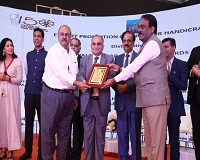 Anup Chandra Pandey, IAS, Chief Secretary, Govt. of Uttar Pradesh recently conferred the prestigious Ajay Shankar Memorial Awards for the best design and display stands at the 46th edition of IHGF-Delhi Fair Autumn 2018. These awards for the Best design & Display Stand are awarded in the categories of houseware, table, kitchen and hotelware, fashion jewellery & accessories, furniture, furniture hardware & home accessories, home textiles, furnishing & floor coverings, lamp lighting & accessories, Christmas decoratives and festive décor. In each of these categories Gold, Silver and Bronze trophies were distributed.
Pandey also appreciated EPCH for setting up various infrastructure projects in the state for the promotion and development of handicrafts such as the Common Facility Center, National Centre for Photo and Picture Framing Technology, Technology Upgradation Center at Saharanpur, Resource Center at Moradabad and State-of-the-art Exposition Centre i.e. India Expo Centre and Mart at Greater Noida. He urged the state government to set up more common facility centres as required by the artisans and exporters.
Growth in online fashion shopping lead to rise in mobile marketing
Since consumers are increasingly drawn towards the instant gratification of fashion shopping, brands are mobile-optimising their marketing through the use of digital tools such as Augmented Reality (AR) apps, rewards promotions, and digital style guides that provide ideas on how to incorporate trends in everyday life.
Under Armour used mobile rewards promotions to drive sales during the competitive back-to-school season in Canada. Japanese apparel company Uniqlo created an innovative mobile-activated campaign that used fast-moving images on billboards containing unique product codes that could only be captured by taking a photo of the display.
Designer Rebecca Minkoff embeds QR codes into handbags, so customers can scan the codes with their mobiles to unlock content and rewards. Consumers scanning the QR code initially unlock a video from Rebecca Minkoff herself, helping drive a deeper connection to the brand.
Fashion brand Maggy London created an AR catalog for mobile users, using 3D scanning and Apple’s ARKit. Shoppers can put a mobile phone up to items in the catalog and view them as realistic, virtual 3D products.
Bangladesh taps cotton advantage
Cotton has helped farmers in Bangladesh cultivate land which used to previously stay fallow due to lack of irrigation facilities.
Due to its vertical tap root, cotton is much more resilient to high temperatures, less water intensive and needs just one round of irrigation. Cotton yields better results than rice which requires standing water and multiple rounds of irrigation. While the input costs for growing cotton are slightly higher than that for rice, the returns for cotton are significantly higher.
Cotton is an economically viable crop, especially in drier regions. Here demonstration farms have been set up that provide information and inputs support to farmers and buy cotton from them at market prices to ensure they get the best returns.
Yet most small scale farmers continue to grow highly climate sensitive traditional crops such as rice for fear of perceived uncertainties. Perceived risks, primarily due to lack of information and support, have resulted in the transition to cotton cultivation being limited to farmers who have the economic avenues to bounce back from potential losses.
Bangladesh’s domestic cotton production forms merely four per cent of the industry’s demand for raw cotton. Cotton imports are proving to be a major drain on foreign exchange reserves in Bangladesh. To improve the balance of trade and make the textile industry, which contributes about 27 per cent to the country’s GDP, more self-sufficient, domestic cotton production needs to increase exponentially.
EU warns Cambodia of withdrawing tariff-free access
Cambodia could face potential economic collapse, leading to a devastating impact on garment manufacturing, if the European Union follows through on its threat this month to withdraw Cambodia’s special trade status with Europe due to human rights concerns.
The EU warned Cambodia in July that the southeastern Asian nation could lose its special access to Europe if elections returned Prime Minister Hun Sen to power and extended his 30-year rule.
Global observers, and the EU specifically, have criticised the Cambodian government for its attacks against critics and opposition parties, its crackdown on independent media and nongovernmental organisations, and its disregard for human rights.
Observers also consider the most recent election to have been a rigged election after the opposition party, the Cambodia National Rescue Party (CNRP), was forcibly dissolved.
Cambodia enjoys tariff-free access to the European market, except for weapons and ammunition, and its exports to European countries account for roughly 40 percent of Cambodia’s foreign sales and generate nearly $6 billion, according to EU data. The majority of Cambodia’s exports come from its textile, garment and footwear industry, which employs an estimated 800,000 people.
US tariffs on Chinese imports opens new opportunities for India
According to a latest commerce ministry study, the extra US tariffs on its imports from China have opened a window of opportunity for India to push for higher exports in 171 items — ranging from textiles to marine products — with additional outbound shipment potential of up to $8.7 billion a year.
The Trump administration has announced an extra levy of up to 25 per cent on $250-billion Chinese supplies in two phases, which will make Indian products more competitive than China’s in the US market. The first round of higher duties on $50-billion Chinese goods has created the space for India to tap the export window in close to three dozen items with potential annual supplies of $2.1 billion.
Similarly, in the second round of duty increase, India has the scope to drive up exports in 135-171 products, with potential outbound shipments of $5-6.6 billion a year. These Chinese goods face additional American tariff of 10 per cent up to end-December, after which it will be raised to 25 per cent. The US is India’s largest merchandise export destination with exports to the country touching $48 billion in 2017-18.
The products where India can make inroads into the American market with greater vigour include shrimps and prawns, yarn, fabrics, man-made filament, copper and products made of such base metals, steel and iron products, garlic, berries, sugar confections, oilcake, distillate fuel oil, organic compounds, certain plastic, leather, rubber and wooden products.
On-demand manufacturing eliminates waste and reduces downtime
The US apparel industry has developed the on-demand manufacturing concept which requires scalability, adjustable and flexible manufacturing processes to complete the customised packages based on real time data which USA will definitely be able to achieve.
On-demand model allows apparel brands to focus on global warming awareness which is the utmost need of today. It also lets them experiment with the size run algorithms from a regional perspective. The concept works on ‘demand and supply’ model instead of ‘supply and demand’ concept. A company that practices the ‘demand and supply’ model doesn’t have an over abundant inventory. Since a product isn’t produced until a customer orders it, the model allows a company to only produce when necessary.
This way, the manufacturers would have to deal with fewer inventories and reduced downtime can help the US apparel manufacturers compete with overseas competition.
Tariff war set to intensify
Neither the US nor China looks likely to back down in the trade war.
The US imports nearly all of its clothing and footwear, and China is by far the largest source. In 2016, about 36 per cent of US imports of textiles and clothes came from China, and about 60 per cent of footwear. The US already places some of its highest tariffs on clothing and footwear, so the industry is especially sensitive about the prospect of more duties.
The tariffs have so far increased the US trade deficit with China.
The US has already put a ten per cent tariff on a large number of Chinese goods, including certain accessories and footwear. The tariff is set to climb to 25 per cent if China retaliates. Clothing has been spared thus far, but with nobody backing down, higher tariffs on more and more Chinese products, including clothing, look inevitable.
But in the process, because of the way tariffs get factored into the final price shoppers pay for imported goods, the tariffs will raise prices for US consumers.
China has indicated it will increase export tax rebates for Chinese firms to reduce the pain of a trade war. It could also resort to non-tariff barriers.
Cematex launches Innovation Lab at ITMA 2019.
Cematex, the European Committee of Textile Machinery Manufacturers, to emphasise the importance of innovation to the textiles, garment and fashion industry has launched the ITMA Innovation Lab at ITMA 2019.
The ITMA Innovation Lab includes some features from previous editions, in addition to new initiatives and enhancements. The four main components of the Innovation Lab are: Research & Innovation Pavilion (R&I Pavilion); ITMA Speakers Platform; Innovation Video Showcase; and ITMA Sustainable Innovation Award.
The speaker’s platform will be an avenue for participating R&I Pavilion institutes to present their latest research projects and cutting-edge technological developments. The video showcase will provide a new channel for visitors to learn more about innovative exhibits at ITMA 2019. The R&I Pavilion will showcase cutting-edge textile and related research and development projects. The ITMA Sustainable Innovation Award will recognise the collaborative efforts by the global textile industry to advance business sustainability through innovative solutions and promote outstanding industry related research.
ITMA 2019 will be held from June 20-26, 2019 at Fira de Barcelona, Gran Via venue. The exhibition will feature over 1,600 exhibitors who will be showcasing their latest technologies and sustainable solutions for the entire textiles and garment manufacturing value chain, as well as fibers, yarns and fabrics.











