


FW
Korea hopes to access India through RCEP
Korea expects to benefit from the Regional Comprehensive Economic Partnership (RCEP), if and when it comes about. The Regional Comprehensive Economic Partnership involves ten Asean members and six Asia-Pacific countries – Korea, Australia, China, India, Japan and New Zealand. Negotiations were launched in 2012 and the trade deal is expected to be finalized next year.
If concluded, the RCEP is expected to create the world’s largest free trade area, comprising 49 per cent of the world’s population and a combined gross domestic product of around 25 trillion dollars, which accounts for 32 per cent of global GDP.
South Korea stands to suffer from the trade war escalating between its two largest trade partners, the US and China. Proposed changes to China’s currency and taxation policies may harm Korean exporters. The prolonged trade conflict could cut Korea’s economic growth 0.6 per cent and cost 1,50,000 jobs.
In view of this Asia’s fourth largest economy sees the pact as an opportunity to diversify its export destinations. The pact is expected to create the right conditions for Korean companies to export their products and services to India, which still has low openness to Korea.
Though Korea and India signed a Comprehensive Economic Partnership Agreement in 2009, the utilisation of the trade pact by Korean companies is 67.5 per cent, lower than Korea’s average utilisation rate for FTAs.
H One launches Res.Q| MI for managing and protecting textile machines
H One, an IT solutions provider, launched Res.Q| MI; an all-encompassing machine management solution designed with both large and small-scale factories in mind. Res.Q Machine Inventory is a revolutionary new asset management solution which leverages the capabilities of NFC (Near Field Communication) technology for the management, protection, and maintenance of one of the most vital assets of the apparel industry: its machinery.
Res.Q|MI is designed specifically to cater to such scenarios in any factory environment; facilitating the easy tracking of machinery -with just a click of a button- irrespective of where the machine is located at the time. Each machine is assigned a specific uniquely identifiable NFC tag which contains information, from the machine’s unique ID, its transaction history, break downs and service records.
The machine management solution includes smart notifications, rent-in and rent-out calculations, as well as complete visibility of available machinery, allowing for manufacturers to exhaust all available machinery before resorting to renting machinery. With Res.Q Machine Inventory, facilities will be automatically notified once a machine has completed its rental time period.
Res.Q Machine Inventory also aids the commerce of the apparel industry with machine maintenance; for manufacturers can now ensure that their machinery is functioning at its optimal performance and also monitors a detailed record of its maintenance and service history of every machine.
China’s investment in Africa to outpace US
As per QNB’s weekly economic commentary China’s investment in Africa is rapidly outstripping the regional position of the US. Last year, Africa-China trade was over three times higher than US -Africa trade. Chinese direct investment (FDI) flows to Africa have surpassed those from the US for the first time in 2014.
From 2011 to 2016, outstanding Chinese FDI in Africa increased by 130 per cent to reach $53 bn, against flat levels from the US and UK. The largest recipients of Chinese FDI were, respectively, South Africa ($6.5bn), Congo ($3.5bn), Algeria ($2.5bn), Nigeria ($2.5bn), Zambia ($2.5bn) and Zimbabwe ($1.8bn).
The three factors that contribute to the spree of Chinese FDI in Africa include China’s resource-intensive growth coupled with Africa’s relatively untapped natural wealth; China’s ‘financial diplomacy’ or bilateral loans which are a major source of support for Chinese activities in Africa and cost-effectiveness of Africa for large Chinese manufacturers.
Bangladesh exports to Chile increase by 33.32 per cent in FY 2017-18
As per Export Promotion Bureau, Bangladesh’s exports to Chile rose by 33.32 per cent in FY 2017-18 as the South American nation granted duty-free market access to Bangladeshi goods. Total earnings from exports to Chile grew to $86.28 million, of which $78.93m were accountable to the readymade garments (RMG) sector. Export earnings to Chile in the first quarter of the current fiscal year increased by 50.45 per cent from the same period last year, to $41.44m.
Bangladesh has been enjoying duty-free and quota-free market access in Chile since January 2015. The move followed a February 2014 meeting in Dhaka of Commerce Minister Tofail Ahmed with the Chilean ambassador, Cristian Barros. Before the privilege was introduced, imports from Bangladesh were subject to average tariffs of 17 per cent. This was reflected in the country’s export earnings in the fiscal year 2014-15, of only $36.93 million.
Bangladesh apparel segment gets Japanese funding
Japanese investors are showing keen interest in Bangladesh. The main reasons are low wages and low production costs. They also are pulling back their investments from China due to the high wages and production costs. Wages in the garment sector in China are four times higher than they are in Bangladesh. About 270 Japanese companies are operating in Bangladesh.
Since the garment sector is growing fast in Bangladesh, foreign investors choose the country as an investment destination in the textile sector. The available workforce at a reasonable wage, duty-free market access to major export destination, preferential location in the heart of the Asia-Pacific region and policy support have acted as a catalyst to attract foreign investment in the textile and apparel industry.
Bangladesh is seeking FDI from Singapore, India, Japan, China, Thailand and other countries. There has been a huge jump in FDI inflows. This can be attributed to the development of 100 economic zones in Bangladesh. Out of the export earnings from Japan in the last fiscal year, 74.8 per cent came from the readymade garment sector. And apparel exports to Japan have seen a 13.73 per cent rise. Meanwhile, Japan has shown a keen interest in hiring skilled labor from Bangladesh for its textile industry.
Bangladesh exports of T-shirts to increase
Bangladesh expects to export more number of T-shirts in the coming season due to an extended summer witnessed in the West. The world’s largest cotton T-shirt producer is receiving big work orders and more is expected to come, thanks to global pattern of sourcing shift from China. In 2017, Bangladesh was the top exporter of cotton-made T-shirts in the world, earning over $5.1 billion, according to an independent research organisation.
Reports prepared by international think-tanks and independent research organisations have shown that buyers are looking to pursue a China plus sourcing strategy which will benefit other competing countries like Bangladesh, Vietnam, India and others. However, an adverse effect of this shift is that buyers are still pursuing the lowest cost manufacturing. And hence, the orders filling the readymade garment factories now are low budget orders.
CITI Global Textiles Conclave 2018 to cover the entire textile value chain from "Farm to Fashion
"Confederation of Indian Textile Industry (CITI), one of the leading industry chambers of the textile and clothing sector of India, completed 60 years of its operation in 2018. To celebrate this milestone, the association will organise the ‘CITI Global Textiles Conclave 2018’ from November 27-28 in New Delhi. The theme of the event will be “Disruptions and Innovations for Sustainable Growth”. The two-day conclave will include interactions with global T&C businessmen, buyer-seller meets, exhibitions, award function, launch of a special publication and reports covering the entire journey of the CITI and T&C industry"
 Confederation of Indian Textile Industry (CITI), one of the leading industry chambers of the textile and clothing sector of India, completed 60 years of its operation in 2018. To celebrate this milestone, the association will organise the ‘CITI Global Textiles Conclave 2018’ from November 27-28 in New Delhi. The theme of the event will be “Disruptions and Innovations for Sustainable Growth”.
The two-day conclave will include interactions with global T&C businessmen, buyer-seller meets, exhibitions, award function, launch of a special publication and reports covering the entire journey of the CITI and T&C industry. The event will not only offer the participants an opportunity to interact with a very select group of 800-1000 professionals from global textile & clothing industry, but will also provide them with a platform to brainstorm, share and gain key insights into the present and future of this resurging, dynamic sector. It will delineate the disruptive ideas, innovative technologies and best practices for a sustainable growth in the textile and clothing industry. The event will also include separate sessions with partner states and countries and senior government officials.
The sessions at the conclave will focus on:
• Global & Indian T&A Industry: Disruptions and Innovations for Sustainable Growth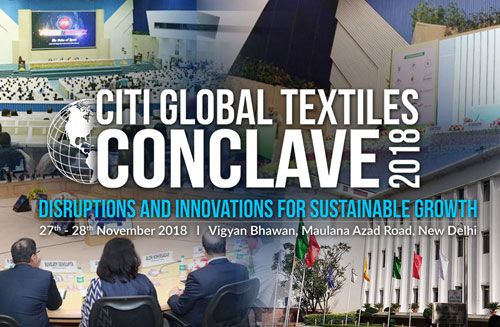
• Changes in global consumption of Textiles and Apparel – far reaching implications
• Sustaining growth for T&A manufacturers in a world of slowing economic growth
• Domestic Indian Textiles and Apparel consumption – the big driver of future growth for India's Textiles Industry
• Stimulating Investments in Indian Textiles and Apparel Industry
• Improving profitability of India's Textiles and Apparel industry
• Giving a boost to Indian Textiles and Apparel Exports
• Disrupting current paradigms, and reimagining textiles supply chains to make them future ready
• Diminishing power of WTO in global T&A trade – the threat of increasing protectionism and emergence of new preferential trading blocks
• India's Fashion Apparel Market – exciting times ahead
• Sustainability to improve work environment, reduce footprint and improve costs of manufacturing
• Opportunities for Technical Textiles in India
Presence of luminous dignitaries
The spectacular event will witness the attendance of some of the most eminent personalities of India. Narendra Modi, Prime Minister of India will inaugurate the conclave while Venkaiah Naidu, Vice President will deliver the Valedictory Address.
Suresh Prabhu, Union Minister of Commerce & Industry & Civil Aviation and Smriti Zubin Irani, Union Minister of Textiles will also attend these conclave alongwith senior government officials, policy makers & trade experts from Ministries of Textiles, Finance, Commerce, Agriculture, Labour and related departments. The event will also be attended by top global speakers like Han Bekke, President, International Apparel Federation, Netherlands; Kihak Sung, Chairman, Federation of Textile Industries (KOFOTI), Korea; Mark Green, Executive Vice President, PVH Far East; G. Gherzi, Managing Partner, Gherzi Textil Organisation AG; Prof. Thomas Gries, ITA, RWTH Aachen University; Md. Siddiqur Rahman, President, Bangladesh Garment Manufacturers and Exporters Association (BGMEA) and Dr. Christian Schindler, Director General, International Textile Manufacturers Federation (ITMF).
Opportunities open up as global textiles supply chain heads for recalibration
"Arvind Ltd will demerge some of the brand’s business and engineering business in about a month’s time. The company will relist the engineering and business in January 2019. “We are excited about the opportunity in the textile business as the world is heading for a large recalibration of supply chain in textiles. In the $750- billion global trade, 35 per cent belongs to China, India is the second largest with 5 per cent. But with China’s cost dramatically going up, global trade is moving to South Asia,” says Kulin Lalbhai, Executive Director."
 Arvind Ltd will demerge some of the brand’s business and engineering business in about a month’s time. The company will relist the engineering and business in January 2019. “We are excited about the opportunity in the textile business as the world is heading for a large recalibration of supply chain in textiles. In the $750- billion global trade, 35 per cent belongs to China, India is the second largest with 5 per cent. But with China’s cost dramatically going up, global trade is moving to South Asia,” says Kulin Lalbhai, Executive Director.
Providing solutions rather than raw materials
Arvind aims to become a solution provider rather than a provider of raw materials for garments. “We will produce end-to-end garment packages. We call verticalisation. A lot of the garmenting capacities are going to come up, which Arvind will be putting up in India and Ethiopia,” Lalbhai informs. “We expect 50 per cent of our business to move into the vertical route from 10 per cent today. We can provide a customer-oriented asset light growth strategy for end-to-end solutions for all our customers,” he further adds.
There are a couple of other strong contributors to this growth strategy. One of this includes advanced materials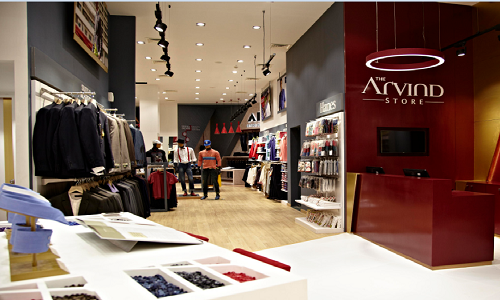 business that has come of age. A very large multi-billion dollar market is emerging in India and the export opportunity also. So that business is going to grow quickly upwards of 25 per cent.
Strong predictions for future growth
The other area Arvind has ventured into is textiles performance wear. “We believe the active and athleisure are very large segments which will emerge and this segment has been dominated by Korea, China and Taiwan. We intend to double the textile business from Rs 6,000 crore ( $US 0.82 bn) to Rs 12,000 crore ($US 1.64 bn) over the next five years. Our garmenting capacity will be increased to 125 million garments,” states Lalbhai
The brand’s business has grown at more than 20 per cent CAGR over the last five years. “We expect to continue on a similar growth trajectory of 20 per cent growth for the next five years. We want to more than double our business from to Rs 9,000 crore ($US 1.23 bn) in the next five years,” he notes.
E-commerce constitutes 12 per cent of the company’s business. Arvind has an omni channel strategy where the company integrates inventory across both online and offline markets. It is growing through a combination of third party marketplaces and its own Omni channel portal NNNow.com.
Strong execution leads to great traction
Arvind’s business has seen great traction due to a strong execution track record over the last five years. “We have strong customers who are constantly growing with us both in India and outside India. Our order book has been growing at more than 30 per cent every year,” states Lalbhai. “We aim to reach over Rs 20,000 crore ($US 2.73 bn) plus in the next five years. This will double our business Rs 6,000 crore ( $US 0.82 bn) to Rs 12,000 crore ($US 1.64 bn) . It is more than doubling the brand’s business from Rs 4,000 crore ($US 0.55 bn) to Rs 9,000 crore ($US 1.23 bn) ,” he adds.
India, Peru to discuss FTA in New Delhi next month
With bilateral trade between India and the South American country Peru touching an all-time high of $1.60 bn, the next round of talks for a free trade agreement (FTA) between the two countries is scheduled to take place next month. The aim of this FTA is to liberalise norms for trade in goods and services. Both sides are keen on expanding their trade basket as well as deepening their trade and investments.
There has been a significant increase in trade between the two countries. Import of gold from Peru has gone up from last year’s $ 1.3 bn and it has potential of going up further. Silver is the other metal that India is keen on. India buys copper from Peru as there is huge concentration of Copper which Indian mining companies can explore. Peru is the world’s sixth largest producer of gold, second largest producer of silver, and the third largest producer of copper, tin, zinc, and lead.
Versace Jeans merged with Versus
Versace will merge Versace Jeans and Versus. The merger will allow the company to further develop the Versace Jeans collections and at the same time not to lose the DNA and codes that made Versus so iconic. The Versace Jeans line is expected to hit the market soon.
Versus was first launched in 1989. In 2005, the brand underwent a four-year break, making a return in the fall of 2009. In fall of 2010, Versace teamed with Scottish designer Christopher Kane, who added a youthful, edgy and underground vibe. In 2012, Donatella Versace came out with a younger feel to the brand as a seasonless line focused on a strong digital presence. Capsule collections, co-branding projects and limited editions were undertaken under the Versus moniker with various designers and artists.
Over the past few months, Versace had been looking at ways to simplify the business model and impart a better focus and energy into the brand portfolio so as to continue being innovative and relevant. So the decision was taken to integrate its two contemporary collections into one. Versace was acquired last September by US group Michael Kors. Versace products are distributed via 200 monobrand stores and over 1,500 multibrand retailers worldwide.











