


FW
Kering, Plug and Play launches ‘Sustainable Innovation Award’ in Greater China
Kering with global innovation platform, Plug and Play launched the Kering Sustainable Innovation Award in Beijing. The award aimed to fast-track sustainable innovation within the luxury and apparel sectors in Greater China. It offers a prize that included comprehensive mentorship and networking, travel to Europe and the US to meet fashion and innovation leaders, and a € 100,000grant to the top winner.
Inspired by Kering’s motto ‘Crafting Tomorrow’s Luxury’, the award identified promising change-making startups and technologies with a positive environmental and social impact on Greater China . In particular, Kering sought startups that address challenges in terms of alternative raw materials, green supply chain, retail & use and the circular economy.
The highlights of the event were the two panel discussions featuring experts in sustainability, fashion and innovation. The conversations brought forward enlightening thoughts concerning accelerating Chinese innovation for a more sustainable luxury and fashion industry.
Indorama Ventures acquires specialised solutions textile provider UTT
Indorama Ventures Public (IVL) has entered into an agreement to acquire UTT Beteiligungsgesellschaft mbH. UTT is one of the leading suppliers of airbag fabrics and other highly specialised solutions in technical textiles. The company has two sites in Germany and Mexico with approximately 420 employees and produces around 70 million square meters of fabrics.
Subject to regulatory approvals, UTT will be acquired by PHP Fibers, a company owned by Indorama Ventures and Toyobo. With this acquisition, Indorama Ventures will strengthen its portfolio in the airbag sector and add the UTT weaving sites in Germany and Mexico to the yarn production sites in Germany, the USA and the JV participation in China as well as to the PHP Fibers weaving mills in Germany and the USA established with the expertise of Toyobo.
The combination of both companies will form a leading integrated manufacturer of airbag yarns and textiles globally to offering wider choices to its customers in a more cost efficient manner. The acquisition clearly demonstrates the strategic importance of the Automotive Division for Indorama Ventures. IVL is not only focusing on tire yarns, but also on other trendsetting segments such as airbags.
India: Simplified GST return forms to be rolled out from Apr 1
India’s new simplified return forms for goods and services tax (GST) will be rolled out from April 1 next year. The refund process is being further streamlined to make it completely online and friendly for taxpayers.
In the first eight months (April-November) of the current fiscal, the government has collected over Rs 7.76 lakh crore as GST. The 2018-19 budget had estimated annual GST collection at Rs 13.48 lakh crore, which means a monthly target of Rs 1.12 lakh crore.
The Revenue Department, whose monthly target from GST is around Rs 1 lakh crore, was short by Rs 4,000 crore in GST collection in November. GST collection in November was Rs 97,637 crore. The department wants to raise that monthly target to Rs 1.10 lakh crore.
Single, comprehensive retail policy could boost India’s retail sector
If India permits 100 per cent FDI in multi-brand retail trade it will improve the ease of doing business for the sector. To overcome the barriers and enable a smooth growth and harmonious coexistence of traditional and modern retail, a single cohesive national retail policy should adequately address all concerned areas.
Several steps need to be taken, including strengthening labor laws by regularising policies around part-time labor to ensure greater participation of women in the workforce; and reviewing food safety policies to update archaic laws governing stocking limits, weights and measures, labeling, and taxes on expired food items. Real estate constraints for retail expansion should be removed by creating dedicated retail special economic zones as well as simplifying regulations and real estate approvals for kiranas to expand their stores.
Improved access to capital will help retail business especially traditional retailers. With a simplified, cohesive policy and a focused effort on modernising the traditional retail sector, it is possible to create multiple wins such as higher growth of the sector, larger traditional retail stores under regulatory compliance, and improved back-end efficiency with a lower overall cost to serve. The current foreign direct investment policy permits overseas players to hold 51 per cent stake in an Indian retail company.
Apparel exporters in North India request for a review of duty drawback rates
With readymade garment exporters losing competitiveness due to lower rates of export incentive scheme, exporters in northern India have requested the Centre to immediately review the new rates to boost the exports. Last week, the Central Board of Indirect Taxes and Customs (CBIC) slashed duty drawback rates on cotton, man-made and blended garments. The new drawback rates will be effective from December 19, 2018
The duty drawback rates for apparel industry have decreased for most garment categories such as cotton, man-made and blended. In a letter written to the Finance Ministry, the Apparel Export Promotion Council (AEPC) has pointed out the move has come as a setback for the industry which is already losing global market share due to reduced competitiveness after the implementation of GST.
According to industry, around 30-40 per cent of exporters have already started utilising their capacity to cater to the domestic demand. The domestic market is pegged at around Rs 3.25 lakh crore and is almost three times more than the exports market. However, manufacturers having deep pockets can sustain in the domestic market.
Child labor falls in Cambodian apparel units
Child labor has fallen in Cambodia’s garment factories. A survey of almost 500 licensed garment export factories found 10 cases of child labor, down from 74 in 2014. However, there are concerns that children turned away from factory jobs may be working elsewhere, including homes where garments are produced by subcontractors.
The subcontract is a big, unknown area in Cambodia. Child labor usually involves workers under the age of 15, who are presented as much older. Child workers are often from families who have had to migrate because climate change has hit their harvests.
Companies are facing growing scrutiny to ensure their operations are slave-free as rising demand for cheap clothing fuels labor exploitation in factories worldwide. Cambodia, under fire for its human rights record, plans to increase the monthly minimum wage in the textile sector in January. A brand like H&M, for instance, says wages in Cambodian factories producing its clothing are 24 per cent higher than the minimum.
Cambodia’s garment industry is the largest employer in the country. About 40 per cent of its GDP comes from garment exports and the sector employs more than 800,000 workers. Cambodian factories supply global brands including Gap, H&M, Nike, Puma and Adidas.
Bangladesh waivers VAT for garment units
Bangladesh has given more tax waiver to encourage garment exports. Value added tax or VAT has been waived in transportation, IT services, security services, laboratory tests etc for the export oriented clothing industries. Payment of VAT on water, electricity and gas bill has also been made easier. This is expected to reduce the cost of manufacturing garments and increase export earnings and competitiveness.
Earlier garment factory owners paid five per cent VAT on the transport of goods from port to factory. Now, no VAT will be paid for transport charges. Similarly the 15 per cent VAT on employing security guards has been completely lifted. No VAT needs to be paid for chemical tests of clothing products or laboratory tests. For this examination, owners of garment units had to pay VAT at 15 per cent.
At present, garment factories have a VAT waiver facility of up to 60 per cent for the bill of services like gas, electricity, water etc. But they had to face many complications to get this facility and refunds were done through a department. Now exporters will get this facility directly. In September, the rate of source tax in the readymade garment sector was reduced by one per cent. At the same time, the corporate tax of this sector was reduced from 15 per cent to 12 per cent and for the green industries the corporate tax was fixed at 12 per cent.
Bangladesh denim exports to EU up four per cent
Bangladesh denim exports to the EU, during January-August 2018, increased 4.23 per cent compared to the same period last year. There was a healthy rise in denim exports to the US and European Union (EU) markets. The country witnessed 14.20 per cent rise in export earnings from January to September 2018.
Many factors have worked in favor of Bangladesh such as improved technology in fabrics manufacturing; better safety standards in the apparel sector; and the ongoing trade war between China and the US. Buyers’ confidence for sourcing products from the country has got a boost.
Bangladesh has increased its production capacity in both denim fabric manufacturing and denim products. Bangladeshi manufacturers have also moved to introduce the latest technologies for improved quality of products. The country has established state of the art denim fabric manufacturing plants with increased production capacity. This has attracted more work orders from buyers in the US and EU. As a result, manufacturers can supply orders within a much shorter time compared to earlier.
The US is the single largest importer of clothing and China is the largest exporter of apparel goods in the world. The trade war has brought in more orders for Bangladesh manufacturers.
A performance show of functional, warp-knitted textiles
The textile machinery manufacturer, KARL MAYER, is participating more and more in shows concentrating on applications and end-uses. “We want to pick up customers at key textile areas and introduce them to something new by offering innovative textiles and concepts,” says Oliver Mathews, the Sales Manager of the Business Unit Warp Knitting, when speaking about the aims behind this decision. The next important date in KARL MAYER’s diary of events is ISPO Munich. KARL MAYER can be found here on stand 408 in hall C4 of Messe München – right at the centre of the exhibition’s trends hub.
KARL MAYER will be demonstrating the performance features of warp-knitted textiles on an area of 120 m², surrounded by the latest fabrics, styles and accessories.
TEXTILE-CIRCUIT shows how electrically conductive yarns can be incorporated directly into the textile in a single step during fabric production. The positioning of the electrically conductive yarns is done to meet the requirements of the intended end-use. For example, this can produce warp-knitted textiles having sensor functions, which are opening up completely new potential applications in the sportswear and outdoor sectors.
Textiles that can do so much more are also at the focus of solutions in the field of active sports. With their functional zones, which are also integrated directly during manufacture, these new articles provide breathability and compression following the principles of body mapping. They, therefore, deliver maximum efficiency when producing high-performance activewear for ambitious athletes.
LEISUREE.FASHION is a futuristic concept for producing sporty athleisure wear and comfortable, everyday clothing, as well as conventional underwear and lingerie. The fabrics offer all the comfort of sportswear with the soft support of activewear and also produce a sophisticated look with zones featuring decorative lingerie elements – the perfect combination of style, sportiness and comfort.
Gabriela Schellner, the Head of Textile Product Development at KARL MAYER, is convinced that the products on show will familiarise the sportswear and outdoor sectors with warp knitting technology. In particular, she intends to come into even closer contact with brand manufacturers at ISPO. She wants to learn more about their ideas and requirements for new product developments, and to develop new solutions with them.
ColorJet displaying it's best selling digital textile printer VASTRAJET at DTG-2019
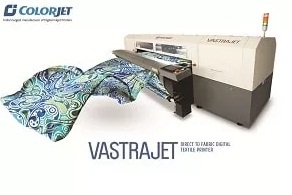 ColorJet India Ltd, India’s largest manufacturer and exporter of digital textile printing technologies will be launching and showcasing live demonstrations of its best selling direct to fabric printer, VASTRAJET at DTG-Dhaka which runs from January 9-12, 2019, at ICCB in Bangladesh in hall no. 6, booth no. 313.
ColorJet digital printers are an established name in, both textiles, as well as sign & signage applications. ColorJet digital printers are reputed to offer reliable performance year after year. Having firmly established itself as the biggest digital printer manufacturer in India, ColorJet is now all set to repeat its success story in Bangladesh and countries of Asia, Africa and Europe.
The consumers of Bangladesh share a common passion for colourful textiles with consumers of India and ColorJet brings to the table its experience and expertise, which includes a deep understanding of fashion sense in the sub-continent.
Fully realising that investment in digital printing requires a lot of support and hand holding in the initial stages, ColorJet has tied up with Universal Textile Machinery & Spares Ltd - Bangladesh to fully meet the need for making spares and consumables available to customers in Bangladesh.
To investors in digital printing, perhaps even more important than the technical support, it is the extensive and the holistic approach to selling a digital inkjet printing solution rather than a digital inkjet printing machine.
The VASTRJET is a workhorse with its robust Konica-Minolta print heads and for the production rate it delivers, it probably has the lowest carbon footprint. The printer is ideally suitable for home furnishing producers with a working width of up to 320 cms.
What’s more, it is also available in a hybrid version or two ink systems. Though reactive dye inks are the most popular choice in the sub-continent, pigment inks are preferred by some. ColorJet offers the VASTRAJET in the open system with both ink systems and also with direct disperse.
“Before the end of 2019, ColorJet hopes to install atleast five printers in Bangladesh, two of which are already in advanced stages of negotiations,” Jitender Pal Singh, Textile Head at ColorJet India said.
ColorJet maintains its No.1 position in India as per the latest IDC 2018 Q1 Super Wide Format report, while assiduously pursuing excellence in digital printing since 2004.
About ColorJet India Ltd: ColorJet India Ltd, the largest manufacturer of digital inkjet printers in India, markets its products in 14 countries worldwide. Founded in 2004, the company maintains its operations via two manufacturing facilities and sales offices spread across seven countries, which include India, China, Bangladesh, UAE and Sri Lanka. To-date, ColorJet has installed and implemented over 4,000 of its printing solutions and products across 315 cities around the world backed by a strong 278 member team, of which almost 100 are in technical related functions. For more information please visit www.colorjetgroup.com











