


FW
US-China Tariff War: India’s exports to the US increase riding on GSP benefits
The year-long trade war between the US and China is increasing American imports from GSP beneficiary countries including India, Thailand, Cambodia, Indonesia and Turkey. The GSP is the largest and oldest US trade preference programme and is designed to promote economic development by allowing duty-free entry for thousands of products from designated beneficiary countries
The Generalised System of Preference or GSP saved American companies $105 million in March, an increase of $28 million (36 per cent) from March, 2018 and the second-highest level on record. In the first quarter of 2019, the GSP saved American companies $285 million, which is $63 million more than the first quarter of 2018.
On March 4, President Donald Trump announced the US intention to terminate India as a beneficiary developing country under the GSP programme. The 60-day notice period ended on May 3. As imports from China, current subject to new tariffs, have declined significantly, imports from other GSP beneficiaries have increased in the first quarter of 2019. India benefited the most from this as 97 per cent of its increased 2019 GSP imports are on the China Section 301 lists.
Fespa to have new section
Sportswear Pro will be held alongside Fespa, March 24 to 27, 2020. A new exhibition dedicated exclusively to sportswear manufacturing, Sportswear Pro will bring together suppliers of solutions for three key areas of sportswear manufacture, design (CAD/CAM and 3D body scanning); production (CMT [‘cut, make and trim’], bonding and knitting) and decoration (printing, engraving, embroidery and laser appliqué systems), as well as developers of accessories, smart textiles and printed electronics. It will have a focus on the latest technologies in on-demand and customised sportswear production.
Visitors to Sportswear Pro will be business decision-makers seeking the latest technological innovations as a means to streamline production processes, reduce inventory and waste, and enable on-demand and just-in-time production in response to shortening fashion cycles. In addition, the new event will feature a dedicated conference program reflecting the business priorities of sportswear manufacturers and designers, such as sustainability and automation.
The co-location of Sportswear Pro with Fespa will allow visitors to move seamlessly between the two events, taking advantage of the array of screen and digital printing exhibits within the Fespa textile halls, and also providing access to the Print Make Wear educational feature. This takes the form of a fast fashion factory, demonstrating a range of garment manufacturing technologies through guided tours, expert chats and catwalk displays.
Fairtrade in India promoting sustainable fashion
The Indian branch of Fairtrade is promoting sustainable fashion through initiatives and campaigns. The campaign ‘Show Your Label 2019’ encourages people to wear their clothing inside-out to show its label and see if it bears the Fairtrade mark. The initiative is intended to make people feel proud of wearing sustainable fashion. The campaign ran across Bangalore, Mumbai, Kolkata, and Goa with a number of interactive events in schools. Students promoted the Show Your Label campaign and wore 100 per cent sustainable Fairtrade school uniform T-shirts. Going forward, Fairtrade will deepen engagement to minimise exploitation and maximise positive impact across the entire life-cycle of fashion products.
Fairtrade, for instance, aims at reducing the social and environmental costs of cotton production. On a social level, genetic modification of cotton seeds has wreaked havoc in traditionally agrarian communities. In India, the second biggest cotton producer in the world after China, there has been a surge in farmer suicides. These tragic deaths are linked to genetically modified cotton and the ugly cycle of dependence on special seeds and chemicals into which many farmers fall. Cotton accounts for 24 per cent of global sales of agricultural insecticides and uses a huge amount of water.
Copenhagen Fashion Summit celebrates a decade, focus on sustainability
Copenhagen Fashion Summit held from May 15 to 16, 2019 attracted 1300 guests, and 78 high-level speakers who talked on topics spanning executive leadership, design, manufacturing, policy and investment. Discussion topics ranged from climate change and circular economy to the power of creatives and how fashion can address overconsumption.
Fashion leaders, policymakers, NGOs, creative directors and innovators from across the globe convened to demand urgent action on sustainability in the fashion industry. The event marked the summit’s 10th anniversary and provided a platform for companies to unveil new solutions, launch new commitments, collaborate with industry peers and partake in agenda-setting discussions. Discussions and debates emphasised that companies must collaborate now, more than ever, to rectify the harmful consequences of the fashion industry and combat the climate crisis, resource scarcity and social issues. The summit provided a forum for stakeholders to come together and rewrite fashion to safeguard the planet.
At seven leadership roundtables, select fashion leaders, NGO representatives and government officials met to discuss the fashion industry’s most pressing sustainability issues and to collaborate to push the agenda forward. At this year’s roundtables senior participants from fashion companies of diverse sizes, segments and geographies discussed climate change and the circular economy.
Tufts University develops color-changing dyed threads
Tufts University engineers have developed dyed threads that change hues when exposed to carbon monoxide and other hazards. With these gas sensing washable threads, the sensor can be embedded into something one would already be wearing, such as a shirt.
The developers hope the threads can eventually be woven into smart clothing to benefit workers in a variety of fields. This clothing could potentially be even more affordable and easy to use than current methods of gas detection. Researchers studied three kinds of dye: MnTPP, methyl red and bromothymol blue. MnTPP and bromothymol blue detect ammonia, while methyl red detects hydrogen chloride, both of which can harm the eyes, skin and respiratory tract.
They used a special process to bind the dye to the thread by treating it with acetic acid, which makes the thread coarser and allows for a firmer attachment. They then applied a polymer to the thread to create a water-repellent seal. This way, the resulting garment can be washed without the dye leaching out.
The color change that happens when the threads are exposed to gas can be seen by the naked eye, or with a smartphone camera. The camera allows for even more sensitive detection, reading subtle color changes occurring when dangerous substances are as low as 50 parts per million.
Burberry shuts unprofitable outlets
Burberry is working on a plan to wind up 38 stores. Five, in Brazil and Spain, have already been shut. This is part of the luxury fashion brand’s move to go more upmarket and turn its flagship stores into luxury destinations for well-heeled shoppers. Burberry wants to go super-luxe, in the same league as Gucci and Dior, which have higher prices and profit margins. Like the rival brands, Burberry wants to be able to design coveted leather handbags that can command price tags of up to 2000 pounds.
Burberry is known for its trench coats and signature check. The 163-year-old company replaced its longstanding creative supremo Christopher Bailey with another Italian, Riccardo Tisci, last year, and is in the process of rolling out his debut collection. Bailey, who was credited with helping to transform Burberry from a small UK company into a global fashion brand, left last year. The clothes and accessories designed by Tisci have been a big hit with shoppers, delivering double-digit sales increases on the equivalent ranges in 2018. Tisci is revitalising a brand that was at risk of becoming outdated and repetitive. His dark grungy styles, previously seen at Givenchy, have provided a welcome update to Burberry’s classic tailoring and neutral tones.
Asia Pacific drives wool worsted yarn
The Asia Pacific region accounts for a major share of the wool worsted yarn market, followed by North America and Europe. Worsted yarns are made from high quality wool. These yarns differ from other woolen yarn based on their weight, type, and quality. The fabric made from worsted woolen yarn is stronger, smoother, and finer than normal wool. Worsted fabric is primarily used for men’s suitings. Compared to normal woolen yarn, worsted woolen yarn tends to be costly as the sheep from which the wool is taken is of higher breed. Also worsted fabric needs more processing, as a result its price tends to increase. These yarns are not carded; instead they are washed, gilled, and combed using heated long-tooth metal combs, later oiled, and spun.
The worsted wool yarn market can be segmented into tropical worsted wool and plain weave worsted wool. They differ based upon the type of fibers used for their production, combinations of fibers used, and blend of fibers used for weaving. Tropical worsted wool is designed to be worn in hot climates. This wool is light, smooth, breathable, and easy to maintain. Tropical worsted wool fabric finds application in making trousers and skirts, among others. Plain weave worsted wool fabric finds application in suits and other upholstery fabrics.
Intertextile Pavilion Shenzhen: Exhibitors ready to tap China’s market potential
With around 30,000 designers and 2,000 retailers, Shenzhen has around 70 per cent share of China’s high-end women’s wear market. The city benefits from the South China’s status as a significant trading hub and a key area of the central government’s new Belt and Road Initiative, supported by Guangdong’s solid garment manufacturing industry.
 With around 30,000 designers and 2,000 retailers, Shenzhen has around 70 per cent share of China’s high-end women’s wear market. The city benefits from the South China’s status as a significant trading hub and a key area of the central government’s new Belt and Road Initiative, supported by Guangdong’s solid garment manufacturing industry. To exploit the market potential of this city, Messe Frankfurt (HK) has teamed up with Sub-Council of Textile Industry, CCPIT; the China Textile Information Centre and the Shenzhen Garment Industry Association to organise Intertextile Pavilion Shenzhen from July 4-6, 2019 at the Shenzhen Convention & Exhibition Center.
Around 1,000 leading exhibitors will participate and display a wide range of fabric product categories including man-made, knitted, silk, linen / ramie, wool, denim, sportswear / functional, lace & embroidery and swimwear / lingerie, as well as yarn and fibre and accessories. They will also feature new product groups including OEM, sewing equipment and textile additives to further fulfill buyers’ diverse sourcing needs.
International pavilions
Domestic exhibitors in this exhibition will be housed in Halls 6 – 9, while Hall 9 will house the International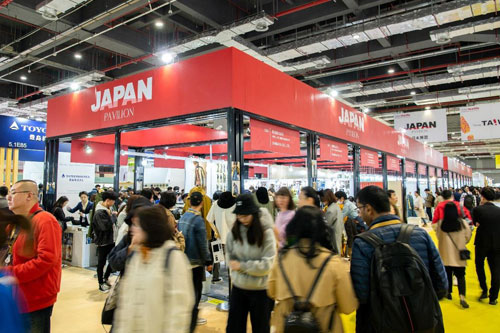 Zone. This year, international pavilions at the event include:
• Taiwan Pavilion: Organised by the Taiwan Textile Federation, this zone will feature knitted, jacquard, lace and embroideries, woven fabrics, functional and denim fabrics.
• Korea Pavilion: Organised by Korea Fashion Textile Association (KFTA) and Daegu Gyeongbuk Textile Industry Association (DGTIA), this zone will display a wide range of ladies wear fabrics, such as man-made fashionable fabrics, knits, embroidery jacquard, tri-acetate woven and printed fabrics. Some exhibitors will also showcase functional fabrics and faux fur.
• Fine Japan Zone: This zone will cover a range of high-quality cotton and man-made fabrics for ladies wear as well as casual wear, with the ability to handle small order quantities, product-in-stock orders and quick delivery service.
Japan Pavilion to feature noted exhibitors
The Japan Pavilion at the Intertextile Pavilion Shenzhen will feature noted exhibitors like Kokka, Sojitz, Stylem, Sun Fashion, Sunwell, Uni Textile and Yonezawa. This pavilion will be a prime platform for Japanese exhibitors to meet high-end Chinese fashion brands, as well as high quality overseas trade buyers.
France to stop companies from destroying unsold goods
As per a French government official, France plans to stop companies from destroying unsold items. The government has urged brands to tackle the matter at the industry level and also revealed that it too would pursue a ban. This pledge comes after Burberry Group Plc revealed its plan to end this practice last year after the disclosure that the UK trenchcoat maker had destroyed almost $37 million worth of unsold goods in 2017.
While mass-market apparel brands often mark down goods until their shelves are cleared, luxury labels have long preferred to burn some unsold items or bury them in landfills rather than risk damage to their image that might come from having them spotted in discount bins.
Finding other ways to dispose of $2,500 jackets or $1,000 shoes will be challenging for luxury brands that don’t want to give away unsold items, since the array of materials in them could make recycling difficult.
Global polyester polyol grows at five per cent
The global polyester polyol market is growing at 5.3 per cent. Polyurethane elastomers that are extracted from polyester polyols are highly preferred materials used in manufacturing shoe soles and other footwear products. They are a preferred option as they are tough and durable, which is a core requirement for footwear items. Polyester polyols are also inexpensive in nature and their specialized application capabilities make them perfect for soft material footwear applications. Besides, polyester polyols are known to create apposite and translucent thermoplastic elastomers. Moreover, polyester polyols also offer greater thermal stability as compared to polyether polyols, which makes them a preferred option in several industrial applications. However polyester polyols also display moisture absorption propensities and to an extent demonstrate toxicity. These adverse characteristics have been hindering application of polyester polyols in various industries to an extent.
To cater to the growing needs of consumers and the vertical industries, manufacturers of polyester polyol are focusing on production expansion along with product portfolio expansion. This will help them not only in expanding their consumer base but also retain their position in the market. Manufacturers of polyester polyols concentrate on using eco-friendly raw materials, for example, bio-succinic acid for manufacturing of polyester polyols, thereby decreasing the environmental footprint significantly.











