


FW
Karl Mayer’s product feature at ISPO Munich
The new development, 4D-Knit.Solutions was illustrating what can be achieved with double-bar raschel technology for 3D warp-knitted textiles. With their unique, three-dimensional, cushioning construction, these voluminous fabrics offer a new level of design potential. Ready-made panels, e.g. entire back components for use in mid-layer jackets, can be produced, as well as imaginative designs with pronounced sculptured effects, and combinations of 4D effects and breathable openings.
 Following its first successful time exhibiting at ISPO Munich 2019, Karl Mayer will attend the next edition of fair that will take place from January 26-29, 2020. The company will showcase functional, warp-knitted textiles and smart, on-trend lingerie and clothing items for its visitors.
Textile solutions for sportswear
The highlights of Karl Mayer’s stand include an ECG shirt for measuring vital signs. This garment, which features integrated sensor technology, was developed under the concept of Textile Circuit in the company’s Textile Makerspace and was premiered at ITMA 2019 to a highly interested audience. The sensors have been upgraded for the ISPO show. One of the reasons for doing this was to improve the wear comfort. The electrically conductive material required is incorporated directly into the textile on the warp knitting machine in the desired arrangement.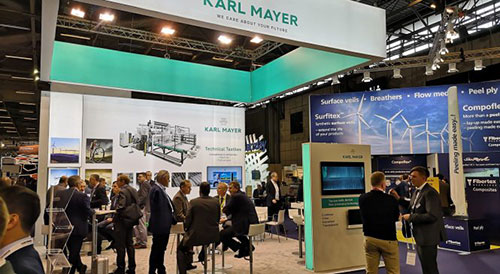
Simultaneously there will be a presentation of warp-knitted textiles that have been especially developed to meet the requirements of the sports sector. These include lightweight, stable mesh linings, hardwearing shoe fabrics, stylish 4-way-stretch fabrics with breathability and compression characteristics, a variety of tricot fabrics with decorative, striped patterns, and warp-knitted spacer textiles for a range of end-uses.
The new development, 4D-Knit.Solutions was illustrating what can be achieved with double-bar raschel technology for 3D warp-knitted textiles. With their unique, three-dimensional, cushioning construction, these voluminous fabrics offer a new level of design potential. Ready-made panels, e.g. entire back components for use in mid-layer jackets, can be produced, as well as imaginative designs with pronounced sculptured effects, and combinations of 4D effects and breathable openings. Different fabric weights can also be produced. Thanks to the internal cushioning, the cuddlesome fabrics provide good insulation, without any micro-particles being produced – performance characteristics that are tailor-made for functional garments and shoes.
Design aesthetics of Karl Mayer’s machines can be exploited optimally by linking them to KM.ON’s digital systems. The digital products and software of this Karl Mayer start-up will also be at the center of the ISPO presentation. In particular, the features of the k. The innovation product category is revolutionising warp knitting with an intuitive design tool, which reduces the time-to-market considerably. A special feature of k. Innovation is the possibility of web-based collaboration between different partners involved in the project. All the designers, customers and suppliers involved in producing the sample patterns have access to the same data – enabling them to engage easily with the development process.
Under the concept of Body Mapping Revolution, Karl Mayer will be showing the potential of The Rascheltronic for producing new, virtually seamless, comfortable clothing for wearing during active sports or for every day. Design edges and hems, as well as functional zones can be worked during actual production on this versatile machine. Breathable mesh designs, stable areas, and zones with different elastic moduli for providing support and a perfect fit can be placed wherever they are needed.
Carvico and Jersey Lomellina showcase performance driven fabrics at Mare di Moda 2019
Cutting Edge Classic, the new capsule collection created by Carvico and Jersey Lomellina, in collaboration with The Lycra, was showcased at Mare di Moda on November 5, 2019.
The collection, designed in collaboration with designer Angelo Figus, has been transformed into a collection dedicated to the world of beachwear and water sports.
Lightness, fluidity and dynamism, Cutting-Edge Classics is a collection created to inspire designers, brands and garment makers that perfectly combines 17 of the most famous and performing fabrics by Carvico and Jersey Lomellina, all powered by the best in class & fiber Lycra Xtra Life™.
Cutting-edge fabrics that recall the fluidity of water and classic elegance, enriched with hi-tech details and sporty suggestions. The iconic and versatile Aqua wear proposals, is perfect for every type of activity from water sports to the coolest of beach parties.
The stand of Carvico and Jersey Lomellina, inspired by a Hollywood pool, is the backdrop to the exhibition of a crew of fashion dancers who, wearing the garments of the capsule-collection, which interpreted the essence of glamour and exclusive performances, enchanting the public of the fair.
Adidas to produce athletic footwear with speedfactory technologies
To start by end of this year, adidas will use its Speedfactory technologies to produce athletic footwear at two of its suppliers in Asia. The company expects this to result in better utilisation of existing production capacity and more flexibility in product design. adidas consumers will benefit as the combination of existing technical possibilities of the suppliers, and new production methods developed in Ansbach and Atlanta will work on variations of Speedfactory footwear models in the future. This will continue particularly for short production time, allowing the company to continue to respond quickly to consumer needs. Production at the two Speedfactories in Ansbach, Germany, and Atlanta, USA, however, will be discontinued by April 2020 at the latest. In the future, adidas will concentrate its resources and capacities even more on modernizing its other suppliers and using 4D technology in footwear production.
“adidas initiative Speedfactories has been instrumental in furthering our manufacturing innovation and capabilities. Through shortened development and production lead times, we’ve provided select customers with the hyper-relevant product for moments that matter. This was our goal from the start. We are now able to couple these learning with other advancements made with our suppliers, leveraging the totality of these technologies to be more flexible and economic while simultaneously expanding the range of products available," says Martin Shankland, Member of the Executive Board of adidas AG, responsible for Global Operations.
Moving forward, not only running shoes, but also a bunch of other product categories will be able to produce in a short period of time by using the production processes tested in the Speedfactories.
However, adidas will continue to develop, improve and test manufacturing processes in Germany. Process innovations will be bundled and driven forward at the adidas production site in Scheinfeld, the so-called adiLab.
adidas will continue its collaboration with Oechsler, the operator of both Speedfactories, in other manufacturing areas such as the production of soles for shoes using Boost technology, soles for football shoes and 4D-printed soles.
Denim brands gear up to survive upcoming environmental storm
"Brands introduced a bunch of initiatives for ensuring sustainability in denim manufacturing, these drove up the cost of the garment. So the real challenge before Morrision was to offer customers a more sustainable solution at much closer price value proposition. He believes, though people are interested in being carbon neutral to a certain extent, they are not willing to pay more for it. Fortunately, today there are enough brands offering sustainable denims at affordable rates."
 Scott Morrison, Founder and President of American denim brand 3X1 views jeans as one of the dirtiest garments produced by the fashion industry. The designer, who has been at the forefront of the high-end denim movement in America since its inception at the end of 20th century, owns three denim brands: Paper Denim & Cloth launched in 1999, Earnest Sewn launched in 2004, and 3x1 that was launched in 2011.
Paper Denim & Cloth was started in Italy-the country which has been a major source of inspiration for Morrison. Inspired by the Italian denim brand Diesel, Paper Denim & Cloth explores denim’s recent history to understand its evolution and create future strategies for its growth. On the other hand, Tonello focuses on more eco-friendly processes like waterless washing and laser distressing.
Italian brands focus on technology and innovation
One major reason why Morrison started his denim journey in Italy was unlike traditional capitalist businesses, Italian brands take a long term perspective on teeing up the future. Also, these brands focus more on technology and innovation. For example Tonello manufactures incredible machines and technology for waterless washing. The company has also been involved in the creation of lasers for garment processing for denim for the last 12 to 14 years.
Sustainability at an affordable price
Though his brands introduced a bunch of initiatives for ensuring sustainability in denim manufacturing, these drove up the cost of the garment. So the real challenge before Morrision was to offer customers a more sustainable solution at much closer price value proposition. He believes, though people are interested in being carbon neutral to a certain extent, they are not willing to pay more for it. Fortunately, today there are enough brands offering sustainable denims at affordable rates.
Hence, Morrison is optimistic about the future of the denim industry. His recent documentary series Common Thread, explores how the most democratic of garments can survive the coming environmental storm. This project, inspired by Morrison’s passion for denim, focuses on three major denim players of the luxury denim industry: fashion brand Diesel, denim manufacturer Candiani, and garment finishing company Tonello. He looks at how these multi-generational businesses take a longview approach to both financial and environmental sustainability, and how that view stands in stark contrast to the race-to-the-bottom influence of fast fashion.
Textile show Destination Africa on in Egypt
Destination Africa is on in Egypt from November 9 to 11, 2019. This is an opportunity for textile exports from Egypt to reach international markets through increasing shares in existing markets or by accessing new ones. Destination Africa is an annual international pan-African B2B sourcing event for the textile industry in Egypt. It brings together African textile, apparel and home textile manufacturers in one place along with international buyers.
The event has a regional exhibition with African countries’ pavilions. Destination Africa has witnessed outstanding success, with a growth of 74 per cent visitors since 2016, resulting in an increase in exhibitor numbers, exhibiting space, and the number of local, regional and international visitors. Around 150 exporters and 230 buyers from the United States and European Union are participating in the exhibition. There are field visits to textile and apparel factories. The participation of major international buyers working in the textile field is an opportunity for Egypt to maximise its benefits from its huge potential in the textile industry. Important bilateral meetings are being held in the exhibition to close export deals between Egyptian exporters and foreign buyers.
The US is the top export market for Egyptian textiles, followed by the EU and Arab markets.
Vietnam apparel earnings up 10 per cent
In the first ten months of 2019, Vietnam’s earnings from apparel exports grew 10.4 per cent. Year-on-year increase has been 8.7 per cent. In October, Vietnam’s apparel and textile exports grew by nine per cent. There are over 2,000 textile and garment projects in the country. Vietnam’s supply chain diversification has been happening for the past few years, mainly driven by rising labor costs in China. The full supply chain has been set up in the country for the past decade already. There has been a shift of manufacturing units from China to Vietnam.
But unlike 2017 and 2018 many apparel companies in Vietnam have witnessed a significant dip in long-term orders mainly because of the uncertain global scenario. Also, Vietnam’s clothing imports have risen 13.5 per cent. Customers are avoiding long-term orders and trying to reduce prices, eating into firms’ profits. The yarn market witnessed a sharp decline in both demand and prices between the end of 2018 and the first quarter of 2019. Vietnam’s yarn producers, particularly those exporting products to China, have been hit the hardest by continuous price decreases. The situation is getting worse as these companies are facing fierce competition for orders from FDI-funded firms and those from Thailand, Indonesia, and Pakistan.
Chinese cotton prices move up
Chinese cotton prices are on a strong upward momentum. In October, transactions were mainly among ginners and traders, and traders showed high buying interests on new cotton, while the procurement from mills was bleak. With flat cotton yarn sales, mills procured only slightly more feedstock.
During the week from November 4 to 8, purchasing volumes of mills improved somewhat compared to the prior week. But mills had no plans to purchase much. A few large mills increased the feedstock inventory from 45 days to 90 days, but for most mills the feedstock inventory ranged between 15 to 30 days. Some mills even stopped purchasing after cotton prices moved up. The downstream grey fabric market has shown signs of weakness, so cotton yarn sales are restricted, and mills show a lower buying inclination.
Ginning volumes of new cotton are about 3.62 per cent lower than the corresponding period of last year. Inspection volumes have declined by 5.02 per cent. For spot cotton, about one third and a half of new cotton has been procured by traders and large mills. Meanwhile, due to strong upward trend of ZCE cotton futures previously, some on-call cotton at traders’ hand is locked. Therefore, the available supply of new cotton is reduced.
Gap partners with Hkrita to develop sustainable soulutions
Gap has partnered with the Hong Kong Research Institute of Textiles and Apparel (Hkrita) to develop sustainable solutions for the fashion industry and textiles that are recyclable and can be used for a long time.
The purpose of the collaboration is to change the apparel industry from a linear model to a circular model across the lifecycle of textiles through eco-friendly production processes and technology. Initial research projects to create sustainable solutions for the fashion industry will focus on separating spandex from used garments and denim decolorisation for recycling. The first project will be conducted by Hkrita in partnership with textile manufacturer Artistic Milliners to develop a sustainable separation technology that removes spandex using bio-solvents. In collaboration with denim manufacturer Arvind, the second research project will enhance the denim decoloring tech niche so that the cotton can be more easily reused or re-dyed. The research projects will run for two years and the technologies developed will be open for licensing.
Hkrita maintains close ties with industry and keeps abreast of developments so as to provide timely and workable solutions. Gap is positioned to solve sustainability challenges at scale, and this partnership with Hkrita is an important step to developing new solutions that impact the planet and are deeply important to its customers around the world.
SV Pittie fosters small, medium enterprises in GCC region
SV Pittie is laying strong foundations to nurture the culture of entrepreneurship in Oman. This 100 per cent export oriented textile company is supporting efforts to boost employment and job creation through small and medium enterprises. It invites aspiring entrepreneurs to discuss and engage with it on various opportunities. The company has enabled creating several upstream opportunities for agriculturists, and downstream opportunities for knitting, weaving and garment entrepreneurs. Apart from the economic opportunities, the company has pledged jobs to 1,000 Omani women, who are under training. The training incorporates experiential learning through advanced textile machinery.
First of its kind in the entire GCC region, SV Pittie has the unique advantage of being strategically located on the global trade route. The company exports cotton yarn to countries such as China, Pakistan, Bangladesh and Vietnam. The group prides itself on its entrepreneurial spirit, and people-oriented approach, and has continuously been inspired by individual excellence. This is a performance and employee driven company with a focus on the most economical and efficient use of available resources. As a family-oriented company, it takes immense pride in individual ability, and collective success with a firm belief that the purpose of business is not just for profit, but for building lasting prosperity for the community.
Brands opt to overhaul operations to reach sustainability goals
"The realisation that fashion is one of the most polluting industries in the world is also impacting consumer behavior. For instance, Swedish climate activist Greta Thunberg took a zero-emissions sailboat to New York for the UN’s climate conference this summer instead of the regular airplane. Similarly, brand H&M has launched an initiative to use only recycled or sustainably sourced material by 2030. The company plans to reduce or offset more greenhouse gas emissions than its entire production process emits by 2040."
 Fashion comes at a cost. Even though fast-fashion retailers are quickly churning out fresh, low-priced styles that attract trend-seekers into stores, they are also creating a lot of unwanted clothes that usually end up in landfills due to changing fashion trends. As the United Nations Environment Program reveals, the garments industry generates about 10 per cent of the global greenhouse gas emissions. It also consumes more energy than aviation and shipping combined as one trash truck’s worth of textiles is either burned or sent to a landfill every second. Luxury clothing brand Stefano Rucci regularly burns its unsold products. Similarly, Swedish fast-fashion giant Hennes & Mauritz, better known as H&M has around $4.3 billion of unsold inventory in hand. To dispose off this unsold inventory, the company had to offer more discounts and it couldn’t stop stocking up on new styles.
Spurt in demand for secondhand clothes
Growing concern about unsold goods has not escaped the customer’s eyes as they are now opting for more sustainable options. A Neilsen Survey revealed, last year, US shoppers bought $128.5 billion worth of sustainable versions of quick-selling goods such as groceries and toilet paper. Also around 48 per cent of Americans surveyed expressed their willingness to change their consumption habits to reduce their environmental impact. Around 53 per cent of these shoppers also expressed their willingness to give up a brand-name product in order to buy an environmentally friendly one.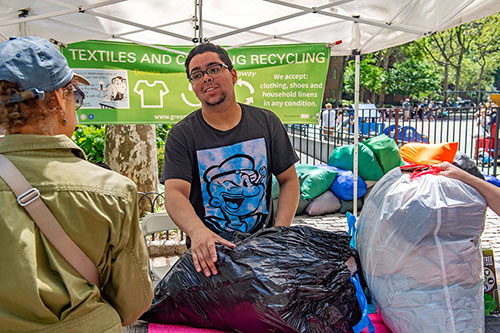
Instead, these shoppers are turning to secondhand dealers like online marketplaces ThredUp and Poshmark. Both websites sell discarded clothes at lower prices which are instantly snapped up by buyers. ThredUP receives around 100,000 items of used women’s and children’s clothes a day. The company buys a few of these items and then lists them for sale on its online marketplace. Till now, it has raised over $380 million in funding through its sale of these second clothes.
Recycling gains ground
The realisation that fashion is one of the most polluting industries in the world is also impacting consumer behavior. For instance, Swedish climate activist Greta Thunberg took a zero-emissions sailboat to New York for the UN’s climate conference this summer instead of the regular airplane. Similarly, brand H&M has launched an initiative to use only recycled or sustainably sourced material by 2030. The company plans to reduce or offset more greenhouse gas emissions than its entire production process emits by 2040.
On its part, Fast-fashion pioneer Forever 21 has launched a textile- and shoe-recycling program in stores around LA and is looking into using recycled products. Similarly, Adidas is experimenting with personalised gear to cut down on returns, increase customer satisfaction and reduce inventory. Others brands launching eco-friendly initiatives include: Ralph Lauren, which announced plans to use 100 per cent sustainably sourced key materials by 2025, and designer Tracy Reese, whose collection for bohemian-inspired retail chain Anthropologie used non-harmful dyes.
The industry is thus adopting a comprehensive, holistic approach that includes a complete overhaul of manufacturing, distribution and materials.











