


FW
Manufacturing excellence, quick delivery, skills development to make India a textile superpower
"A new report ‘Winning in Disruptive Times’ by FICCI-Wazir Advisors says, in order to compete with global counterparts, India needs to upgrade its manufacturing standards and service orientation. Also, Indian companies need to build digitally enabled smart factories besides focusing on skilling of middle and top management to build efficient and service oriented business."
 A new report ‘Winning in Disruptive Times’ by FICCI-Wazir Advisors says, in order to compete with global counterparts, India needs to upgrade its manufacturing standards and service orientation. Also, Indian companies need to build digitally enabled smart factories besides focusing on skilling of middle and top management to build efficient and service oriented business.
Ability to take risk and align with emerging trends
The report was released at the FICCI TAG 2020 Seminar held in Mumbai. Presenting the report, Prashant Agarwal, Co-Founder and Joint MD, Wazir Advisors emphasised on the government’s role in neutralising cost disadvantage with global competitors and building infrastructure for producing large scale manufacturing zones. He said, we need to have better risk taking capabilities and ability to speedily align with emerging mega trends to remain in the business.
Improving product speed and quality
RD Udeshi, President-Polyester Chain, Reliance Industries stressed upon the need to improve the speed and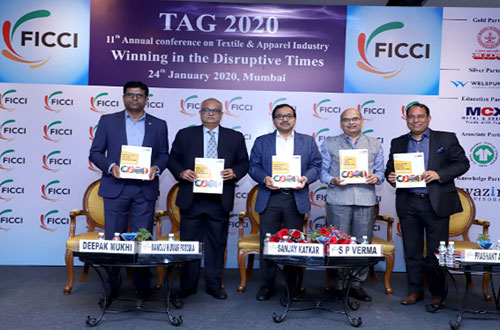 quality of product deliveries as per international standards besides focusing on value addition and skill development. He pointed out, India’s manufacturing excellence and scale of its factories gives it an advantage over competitors like China, Bangladesh, and Vietnam etc.
Rahul Mehta, Chief Mentor, CMAI advised Indian manufacturers to start manufacturing clothes closer to the place of raw material and cheaper labor instead of being close to the market. “Agility, speed and transparency” are the key factors to win in disruptive times, felt Rajendra K Rewari, Executive Director and CEO, Morarjee Textiles. He advised manufacturers to attract young talent in the business by offering adequate remuneration.
Roadmap to deal with challenges
The theme of TAG 2020 conference was very contemporary and it offered an excellent platform for giving a clear roadmap to overcome the current challenges that the industry is facing. Applauding the conference, Sharan, Director, India Operations, Saurer Textile Solutions said that it deliberated on relevant topics such as surviving through disruptive times, sustainability, size and scale of business, investments and interventions for winning the global race. The conference upheld the view proposed by Anil Nair, President, Shubhalakshmi Polyester that India should aim to be a superior textile producer through innovation, technology, versatile fiber availability and ample manpower resources.
Messe Frankfurt’s postpones Shanghai textile fairs
Three textile fairs of Messe Frankfurt in Shanghai will be postponed from March to a later date due to the Novel Coronavirus outbreak. This includes Intertextile Shanghai Apparel Fabrics – Spring Edition, Yarn Expo Spring and Intertextile Shanghai Home Textiles – Spring Edition which were due to be held in Shanghai from 11 – 13 March at the National Exhibition and Convention Center.
This follows the recent announcement that the company’s other fairs to be held in China in the coming two months – Prolight + Sound Guangzhou, SPS – Industrial Automation Fair Guangzhou (SIAF) and Asiamold in Guangzhou, and Toy & Edu, Baby & Stroller and Licensing China in Shenzhen – have also been postponed until later in the year.
Intertextile Shanghai Apparel Fabrics is co-organised by Messe Frankfurt (HK) Ltd; the Sub-Council of Textile Industry, CCPIT; and the China Textile Information Centre. The co-organisers of Yarn Expo Spring are Messe Frankfurt (HK) Ltd and the Sub-Council of Textile Industry, CCPIT. Intertextile Shanghai Home Textiles is co-organised by Messe Frankfurt (HK) Ltd; the Sub-Council of Textile Industry, CCPIT; and the China Home Textile Association (CHTA). All three fairs are held concurrently with the PH Value and CHIC textile fairs, which will also be postponed.
Messe Frankfurt’s China textile fairs form a part of the company’s Texpertise Network, which consists of some 50 fairs around the world. More information can be found
Kering sets ambitious eco targets for 2025
In its ambitious ‘Fashion Pact’,luxury brand set following objectives for 2025: to reduce its environmental impact by 40 per cent and cut its CO2 emissions in half, compared to results from 2015. All of this is to be achieved with entirely traceable raw materials and on the same timetable.
From 2015 to 2018, the brand reduced its ‘environmental global impact’ by 14 per cent and its greenhouse gas emissions by 36 per cent. Across the same period, the greenhouse gas emissions related to its stores and other worldwide placements were reduced by 77 per cent.
The group will use renewable energy sources for 67 per cent of its operations. It has reached 100 per cent in seven countries and is at 78 per cent in Europe. In 2018, the company became carbon neutral across its entire business and supply chain, including through forest protection programs.
Moreover, Kering has put in place new standards for raw materials and manufacturing processes. This has formalized the best procedures in terms of environmental protection, social compliance, traceability, the use of chemicals and the wellbeing of animals. These measures have already been implemented across 68% of the group’s suppliers.
CMAI welcomes Union Budget 2020-2021
The Clothing Manufacturers Association of India (CMAI) has welcomed the Union Budget presented by Finance Minister Nirmala Sitharaman on February 1, 2020 as positive and growth oriented for the apparel industry. Rakesh Biyani, President of the association says the most important step in this Budget for the textile industry was the removal of the anti-dumping duty on PTA, which was a long standing demand of the textile manufacturing value chain. This will potentially open up the MMF value chain, and give a fillip to the entire MMF industry and enhance its global competitiveness.
According to Biyani several other measures could also benefit the textile industry such as the technical textile mission, a review of the Rules of Origin especially in our FTAs, a review of cheap imports of goods being made by our MSME Sector, refund of all the taxes and levies for exports, and the targeting of making every district an export hub. The proposed financing of invoices of the MSME sector could again be a huge benefit to the Industry, which is largely comprised of the MSME units.
Levi’s to open 100 stores in 2020
Levi Strauss is set to open 100 stores in 2020, as the denim giant is seeing strong gains on the international front and in e-commerce. The brand posted a 3 per cent gain in net revenue in the first quarter of the fiscal year. The company expects its net revenue to grow by 6 per cent in fiscal 2020 This estimate incorporates anticipated benefits of a Black Friday week in the first quarter, and a 53rd week, which will fall in the fourth quarter and will include a second Black Friday.
During the fiscal, Levi’s adjusted earnings before interest and taxes (EBIT) margin expansion is expected in the range of 30 to 40 basis points, reflecting gross margin expansion partially offset by an increase in adjusted sales, general and advertising (SG&A) expense as a percentage of revenues. Its adjusted diluted earnings per share (EPS) are forecast in the range of $1.18 to $1.22.
Capital expenditures are expected to be approximately $200 million to $210 million, with nearly 100 new company-operated store openings on a gross basis in 2020, in addition to 80 stores from the company’s acquisition in South America.
Forever 21 to sell assets to a consortium
Forever 21 looks t to sell assets to a consortium that includes mall owners Simon Property Group and Brookfield Property Partners and brand management company Authentic Brands Group. The sale of Forever 21’s assets includes its side brands, such as beauty store Riley Rose, and its e-commerce platforms.
US-based Forever 21, filed for bankruptcy protection in September and has since closed 100 stores. Fast fashion retailer Forever 21 became a multibillion dollar operation in over 40 countries before it filed for bankruptcy in September 2019. It plans to close most physical stores in Asia and Europe while continuing to ship to international customers through its US website. The fashion chain had become successful due to its coolness factor and its ability to identify the needs of its customers. But these same customers started to move to online and other retailers. The brand specialised in the fast fashion principle as it made outfits for young teenage girls, who wanted to dress like their favorite celebrities. Forever 21 helped them by providing these fast and at affordable rates. Customers would form huge lines for new store openings. The company also became an attractive tenant for most malls, usually becoming the anchor tenant with its huge sized stores.
Cambodia may lose EU trade privileges
Cambodia may soon lose its tariff-free access to Europe. Less than two weeks remain until the European Union decides whether it will revoke Cambodia's trade privileges, granted under the Everything But Arms scheme for least developed nations, due to the country’s systematic violations of human and labor rights. Losing EBA privileges would add a 12 per cent tariff to Cambodian apparel exports to the EU and between eight per cent and 17 per cent for shoes. Europe is a crucial market for the country’s apparel and footwear export sector. Other countries competing in the cutthroat world of low-cost apparel will be keen to snatch market share from Cambodia.
Much work still needs to be done to n improve labor and living conditions in Cambodia. Much progress including wage increase and social security benefits, have been accomplished already. But this many not be enough for Cambodia to retain trade privileges. The EU feels the country has not done enough to maintain its EBA access. The EU also has the option of applying a partial suspension of trade privileges.
Despite the uncertainty, Cambodia’s total exports in the first 10 months of 2019 grew by 6.45 per cent. Exports of textiles, apparel, footwear, travel wear and headwear remained stable.
McKinsey partners with Global Fashion Agenda
McKinsey has joined Global Fashion Agenda (GFA) as a strategic knowledge partner. Together, they will work to tackle the biggest challenges facing fashion. GFA and McKinsey will embark on a joint redesigning growth venture. The overall aim of the collaboration is to look beyond existing solutions, to seek inspiration from experts, academia, and other industries to identify the systemic changes needed for the industry to become leaders in sustainability. It seeks to challenge the traditional concept of growth and prosperity, by collaborating to identify solutions for the industry to meet the demands of the future within planetary boundaries. GFA and McKinsey will provide new assessments and reports for the industry to track and follow progress on sustainable development. The alliance is setting ambitious goals to accelerate the pace on sustainability and to push for real industry transformation.
GFA is the leadership forum for industry collaboration on fashion sustainability. Sustainability and corporate responsibility have risen to the top of every industry executive’s agenda. Still, the industry has a long way to go before achieving transformative change. Companies are not implementing sustainable solutions fast enough to counterbalance the negative environmental and social impacts of their rapid growth.
Spanish brand Mango expands presence in Africa
Mango is consolidating its presence in Africa. The brand is now present in Kenya, Angola, Egypt and South Africa, among other African countries. The African store count totals 52 retail outlets, including four Mango megastores, a retail concept that the company introduced in late 2013. Compared to the traditional average store format of 300 sq mts, megastores have surface areas of between 800 and 1,500 sq mts, while flagship stores could be as large as 3,000 sq mts. Mango was one of the first European fashion brands to expand in Africa when it opened its first store on the continent 18 years ago. The company founded in 1984 has an extensive store network extending across 111 countries.
Mango has a new logistics center in Spain. Approximately 600 people work six days a week at the highly automated facility, where around 400 operations are machine-driven, to process items for store deliveries. The 186,000 sq mt facility can stock up to seven million hung garments and 20 million folded garments and accessories at the same time. By incorporating the latest automation technologies, the center can process 75,000 garments an hour. As soon as hung garments arrive at the facility they are unloaded onto one of nine automatic loading bays, which can process 27,000 garments an hour.
Abolished PTA duty makes imports cheaper
Polyester or synthetic yarn could become cheaper in India. The anti-dumping duty on Purified Terephthalic Acid (PTA) has been abolished in this Budget. This will make imports of the petrochemical from Iran, China, Indonesia, Malaysia, Korea, Taiwan and Thailand cheaper. Removal of the anti-dumping duty will put pressure on realisations of domestic PTA manufacturers and will lead to accelerated imports at a time when the market is facing a glut emanating from large capacity additions in China recently. The duty removal will now allow Indian synthetic yarn spinners to access cheaper, good quality raw material from outside India, making their cost structure more efficient. The move will open up the manmade fiber value chain, benefiting technical textiles, home furnishing, sportswear, saris and dress materials, among others.
Once this key textile raw material becomes cheaper, domestic yarn manufacturers are expected to pass on the benefit to consumers. China has added huge capacities in recent quarters and there is a possibility of cheaper imports from that country after removal of this duty.
PTA is a key raw material in synthetic yarn production on which anti-dumping duty was imposed to protect domestic manufacturers. These produce nearly 3.5 million tons PTA for the domestic market. The rest is exported.











