


FW
China lowers duties on Bangladesh imports
The Chinese government has lowered duties on goods imported from Bangladesh. Taxes on almost all goods from Bangladesh have been reduced by upto 60 per cent, reports China Briefing. Henceforth, China will offer a duty-free export advantage to an extra 5,161 Bangladeshi goods, with the number of exempt goods being increased to 8,256, provided by professional services company, Decan Shira and Associates. This includes the products authorized under the Trade Agreement of Asia Pacific (APTA).
Since 2010, Bangladesh exporters enjoyed majority of duty-free benefits, according to the report, with the most common imports into China being jute, plastics, crude hide, hides, frozen seaweeds and crabs, live eels, sesame seeds and cotton waste products. But these exports have shown no noticeable growth, given the duty advantages that the country has had over the last decade. Data by Export Promotion Bureau data shows, during the 2014-2015 fiscal year, total exports to China amounted to $791 million. By 2019, the figure rose to $831 million and by May, exports totaled $557 million.
US tariffs on homeware, wool may see retaliatory measures: UK’s Walpole
Walpole, the trade association representing British luxury enterprises warned, tariffs imposed on products like tailoring, wool, cashmere and linen homeware by the US Trade Representative (USTR) effective September 1 will see retaliatory tariffs of 25 per cent. Washington import tax on certain high-end goods from Europa had previously risen to 25 per cent, hitting luxury enterprises in the UK and in EU harshly in return for subsidies charged for the Airbus fleet.
Walpole said the disproportionate effects that the US EU tariffs have on UK producers and the creation of an imbalance between different markets could lead to US retailers turning to Italian and Chinese cashmere producers to avoid the tariffs on Scottish cashmere. This would impact brands and companies negatively and lead to scaling down operations and export volumes in the US and potentially cut jobs.
UK’s Department of International Trade (DIT) has advised Walpole to urge Liz Truss, the Secretary of State for International Trade, to push for the removal of all tariffs and to reach a resolution to this situation with expediency.
CFDA creates Black advisory board to ensure equality and inclusivity
The Council of Fashion Designers of America (CFDA) has created a separate Black advisory board responsible for all its efforts on inclusivity, diversity and equality. This board will be led by CaSandra Diggs, President.
The board will be chaired by executive board vice chairwoman, Tracy Reese and include Samira Nasr, editor-in Chief, Harper’s Bazaar; Bozoma Saint John, Chief Marketing Officer, Netflix; Stacie Henderson, Cofounder, Fashion Tech Connectsand Martin Cooper, CFDA member and co-founder, The Punctilious Mr. P’s Place Cards Company as its members
The CFDA has also appointed Bonnie Morrison to a newly created role to lead the strategy and execution of CFDA equity program initiatives with the goal of building opportunities for Black creatives and professionals in fashion.
In this role, Morrison will help support and execute new initiatives including the newly created CFDA task force and talent placement program made for Black creatives and professionals in the American fashion industry. In June, CFDA had announced that it would launch a series of new initiatives to combat systemic racism in the fashion industry in response to ongoing protests and public outcry against racism in the United States.
Cambodia needs to step up its game to stay ahead as a sourcing destination
 China diversification is likely to benefit Asian countries having a strong economy, reliable infrastructure, sufficient human capital and local geopolitical and supply security risk, says a new Moody’s report. The Southeast Asian nation likely to benefit most from this is Cambodia, which currently faces soft economic sanctions for not addressing the civil rights demonstrations triggered by some politically-linked arrests. However, the country needs to first restore its brand image, says Stephen Higgins, Co-founder and Managing Director, Mekong Strategic Partners (MSP).
Penn Sovichat, Minister of Commerce Cambodia says, Cambodia’s young labor force can help it to accomplish industrial development goal besides offering generous incentives to investors. In addition, its trade integration may help local producers to create niche markets and promote indigenous brands.
Logistic, productivity enhancement to benefit Cambodia
According to Anthony Galliano, Group CEO, Cambodia Investment Management Co, Cambodia benefits from access to European and US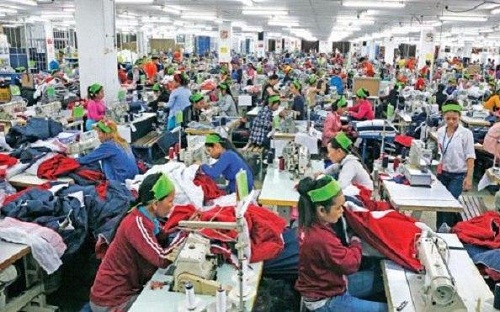 markets for certain goods under the Generalized System of Preferences (GSP) and remaining Everything But Arms (EBA) advantages. However, these schemes have made Cambodia complacent as neither has the country upgraded its skills nor introduce any robust policy over the years.
For nearly two decades, the preferential tariff schemes enabled Cambodia to export products tax-free to the US and EU, boosting economic growth at an annual average of seven per cent. The country’s garment and footwear exports surged to over $9.5 billion in 2018 from just $80 million in 1996, said a 2019 World Bank special report. In the last 20 years, Cambodia’s backward and forward integration enabled it to expand faster than Malaysia, Thailand, Vietnam, Bangladesh and Sri Lanka, although it was from a low base.
High production costs, weak industrial base pose challenges
Despite these strengths, Cambodian garment exports are eclipsed by certain shortcomings. The country’s high production costs have made it less competitive and created a barrier to diversifying into similar productions and producing higher value-added products, said the World Bank. Yet Cambodia is well-placed to benefit from supply chain shifts if it improves it logistics, wages, productivity, says Stephen Higgins, Co-founder and Managing Director, Mekong Strategic Partners. However, it needs to shift its energy mix more towards renewable, otherwise MNCs and their supply chain will avoid it, Higgins adds.
Cambodia is unable to compete fiercely with other ASEAN member countries due to a weak industrial base, labor market and private sector, points out Chheng Kimlong, Director, AVI’s Centre for Governance Innovation and Democracy. To gain competitive and comparative advantages, the private sector needs to promote technology and innovation.
Positioning itself for the future
Local advocate David Van believes, as global supply chain may be broken down into a more regional format post COVID-19, Cambodia needs to position itself for such a setting. Anthony Galliano, CEO, Cambodia Investment Management Co, opines to capitalize on shifting production bases, the Kingdom needs to diversify export outputs and destinations, increase product categories, reduce electricity costs, improve connectivity in transport and logistics, and raise its labor market and skills.
Though investments in other production plants in lower-wage economies will continue, Cambodia will not be able to replace China as a global production powerhouse due to its fragmented logistics and infrastructure networks. To win against neighbors, Cambodia has to first step up its own game.
Paul Gaudio exits from Adidas
Paul Gaudio, Global Creative Director, Adidas has left the company after posting a controversial comment online.
According to multiple reports, Gaudio exited the athleticwear company on August 31. His departure came just two days after the former Adidas exec commented under an image of 17-year-old Kyle Rittenhouse -- who has been accused of shooting and killing two peoople during protests in response to the police shooting of Jacob Blake in Kenosha, Wisconsin -- posted on Instagram by Complex. In his comment, Gaudio referred to Rittenhouse as ‘also a victim.’
In support of Jacob Blake -- who was shot seven times by police in front of his children, but survived with severe injuries -- many members of the professional athletic world, including the Milwaukee Bucks, the New York Mets and the Miami Marlins, have boycotted or postponed games in protest and solidarity. Earlier this week, Adidas made a post on Instagram in support of these protests.
Asian factories shake off COVID-19 gloom in August: Fitch Ratings
According to Fitch Ratings, Asian factories continued to shake off the coronavirus gloom in August as more bright signs in China raised hopes of a firmer recovery in global demand, reducing pressure on policymakers to take bolder steps to avert a deeper recession.
Manufacturing activity in China expanded at the fastest clip in nearly a decade in August, as factories ramped up output to meet rebounding demand, a private survey showed. New export orders rose for the first time this year.
The upbeat findings contrasted with an official survey on Monday, which showed China's factory activity grew at a slightly slower pace in August. But fears of a resurgence in infections in some economies may discourage firms from boosting capital expenditure and delay a sustained rebound for the Asian region, some analysts say.
China's Caixin/Markit Manufacturing Purchasing Managers' Index(PMI) rose to 53.1 in August from July's 52.8, marking the biggest rate of expansion since January 2011.
Japan and South Korea both saw factory output contract at the slowest pace in six months in August, T expectations the region's export powerhouses have past their worst from a collapse in demand after COVID-19 struck.
The spill-over to other parts of Asia, however, remains patchy. While manufacturing activity rose in Taiwan and Indonesia, they slid in the Philippines, Vietnam and Malaysia.
Wolford inks agreement with Adidas
Wolford has inked an agreement with Adidas to collaborate on a series of new seamless performance garments with the emphasis on all-day wearability. This debut collaboration will be launched on November 2.
Inspired by 80s & 90s sportswear, the collab’ will feature luxury sheer and opaque knits that hug the body to create a feminine silhouette with comfort and support.
Wolford’s collaboration with German global sportswear giant will include two capsule collections, Studio Motion and Sheer Motion, “both featuring sleek and supportive performance pieces crafted with opaque and sheer knitting techniques to cover and highlight the body,” the Austrian skin-wear and hosiery marque said in a release.
The project also marks the emergence of Josefine Aberg, Adidas VP of Design, with particular focus on apparel.
Adidas is the first sportswear company to partner with Wolford, noted for its mastery of knitting capabilities and yarn. The goal being to combine Adidas’ expertise in athletic performance and technical fabrics with Wolford’s premium knit products.
The collection will feature two drops of completely seamless garments including three coordinated long sleeve top and legging sets and two body-suit looks, all offering full coverage and a second skin feel. All looks are designed to be worn during workouts and layered throughout the day, providing an easy transition from the studio to the professional day.
Meepl partners with Stoll
Swiss retail technology company meepl, a ‘3D smartphone body scanning clothes shopping companion’, has partnered with Stoll the leading flat knitting machine manufacturer, to offer bespoke made-to-measure knitwear for the fashion industry on a global scale.
Coupling meepl’s 3D body scanning app with Stoll’s knit and wear innovative technology will provide a customer-centric solution to the historical issues surrounding customised clothing production. It will allow knitwear to be customised on an automated and scalable level, using meepl’s highly accurate measurements fed straight into the knitelligence software controlling Stoll’s machines.
The knitwear industry has previously struggled with inefficiencies with made-to-measure sizing, relying on manual methods of measuring and human input, which is prone to error, meeple says. According to the company, meepl’s smartphone-enabled 3D body scanning technology uses body reconstruction algorithms to produce an almost 100% accurate body image from just two pictures, instantly obtaining up to 100 measurements of the body.
With meepl’s easy-to-use and accurate body scanning technology the consumer’s personal body measurements can easily be connected to our knitelligence platform. The platform automatically adjusts the knitting pattern based on the body measurements being provided making it possible to knit tailored garments in a very short time without any manual intervention. For the first time ever, this combination of technologies makes it possible to offer mass customisation for everyone from the convenience of their homes.
Phygital strategy to help luxury brands boost China business
Several luxury market analysts estimated the percentage of Chinese consumers making global luxury purchases to jump from 40 to 50 per cent over the next 10 years. However, over the past few months, many Chinese consumers have begun to buy domestically due to significant travel disruptions. Many global luxury brands are yet to find success in China and have posted poor sales performances, wasted cash, and couldn’t connect with Chinese customers.
Many are lost when trying to plan for success in China, particularly smaller brands. China currently has the youngest, most digitally –savvy and most discerning luxury market in the world. Since the country’s consumers trust KOLs more than brands, they follow their advice. So if their KOL’s don’t promote a particular brand, Chinese consumers won’t consider buying from it. Most Western brands fail in the market sooner or later
These brands need to think more holistically by seamlessly combining their strategy, positioning, and story across all digital and physical brand experiences and through the most relevant products. Too many companies ignore local preferences, customs, materials, and shopping traditions.
Cambodian trade unions agree for 6.1 per cent pay hike in 2021
Cambodian trade unions have agreed that textile, garment and footwear factory workers should receive a 6.1 per cent raise in monthly wage in 2021. The proposed figure will be negotiated at a meeting of the National Council on Minimum Wage at the Ministry of Labor and Vocational Training on Thursday. The meeting will be attended by representatives of trade unions, garment factory and the labor ministry.
Cambodian Labor Confederation president Ath Thorn said the figure was based on three main factors – a two per cent increase to account for annual inflation, two per cent for factory productivity and 1.3 per cent for margins of profit of employers. Adding that employers have raised concerns about a wage raise considering the disastrous effects of COVID-19 has had on factories.
Kaing Monika, Deputy Secretary-General, Garment Manufacturers Association in Cambodia (GMAC) said the association is still analyzing data. He said each wage raise demand is generally based on the current situation. Given the pandemic, he said it is highly likely that workers will face a wage decrease rather than a raise.











