


FW
Pakistan’s cotton imports surge as textile exports recover
Pakistan’s textile sector is on track towards swift recovery following the devastation caused by COVID-19 as the country has witnessed a sharp surge in its cotton imports. Textile exports from Pakistan grew 16 per cent and 9 per cent in September and October 2020 on a monthly basis compared to a massive decline in August 2020 owing to torrential rains, explains Muhammad Saad Ziker, Analyst, Insight Securities.
In his research report, the analyst pointed out the much-needed growth was being achieved through import of cotton and man-made yarn. The government is also pushing hard for exports growth as it aims to lift them to $50 billion by 2030, according to the textile policy 2020-25. The 5 per cent regulatory duty on the import of cotton has been eliminated; subsidized energy to industries is ongoing and loans under the Long-Term Financing Facility (LTFF) have been facilitated. The value added segment is expected to grow on the back of huge export orders, which will be delivered by May 2021.
Mahmood Nawaz Shah, Senior Vice President, Sindh Abadgar Board emphasized that Pakistan’s weather and environment suited cotton production the best. Apart from growers, ginning and allied businesses would also bear the brunt of imports as their cost would soar, said Shah.
Pakistan’s cotton imports surge as textile exports recover
Pakistan’s textile sector is on track towards swift recovery following the devastation caused by COVID-19 as the country has witnessed a sharp surge in its cotton imports. Textile exports from Pakistan grew 16 per cent and 9 per cent in September and October 2020 on a monthly basis compared to a massive decline in August 2020 owing to torrential rains, explains Muhammad Saad Ziker, Analyst, Insight Securities.
In his research report, the analyst pointed out the much-needed growth was being achieved through import of cotton and man-made yarn. The government is also pushing hard for exports growth as it aims to lift them to $50 billion by 2030, according to the textile policy 2020-25. The 5 per cent regulatory duty on the import of cotton has been eliminated; subsidized energy to industries is ongoing and loans under the Long-Term Financing Facility (LTFF) have been facilitated. The value added segment is expected to grow on the back of huge export orders, which will be delivered by May 2021.
Mahmood Nawaz Shah, Senior Vice President, Sindh Abadgar Board emphasized that Pakistan’s weather and environment suited cotton production the best. Apart from growers, ginning and allied businesses would also bear the brunt of imports as their cost would soar, said Shah.
Promising vaccine test results improve Indian RMG exporter’s sentiment
The news of promising vaccine tests has improved sentiments of ready-made garment exporters with western retailers placing bulk garment orders for the upcoming Spring/Summer season. The decline in orders is narrowing in H2, says Gautam Nair, Managing Director, Matrix Clothing. However, the real impact of the news around vaccines would be felt in coming month as buyers finalize their orders for summer collections.
The country exported ready-made garments worth $15.4 billion (Rs 1.1 lakh crore) in the previous fiscal year, according to data from the Directorate General of Commercial Intelligence and Statistics (DGCIS). The October to March period is relatively busier for apparel exporters as they ship the Spring/Summer collections to the US and Europe. India’s garment trade is skewed towards cotton-based fabrics, the demand for which peaks during this time of the year. It accounts for over 55 per cent of total exports, according to DGCIS data.
High sales during this period could help companies offset some of the losses incurred during the first half of this financial year. However, leftover inventory from last year could play spoilsport, exporters cautioned. Many retailers had stored excess inventory in warehouses to be sold in 2021, which could impact the business of Indian exporters this season.
Vietnam’s textile, garment exports to decline by 15 per cent
Vietnam’s textile and garment exports are poised for 15 percent decline to $34 billion this year due to the COVID-19 impact. However, this decrease is lower than the 20-25 per cent plunge in global demand this year, says Vietnam Plus. Domestic companies have been making efforts to pump up revenue by producing lower-added value products to ensure cash flow.
The recently-signed Regional Comprehensive Economic Partnership (RCEP) is likely to boost China’s demand for garments made in Vietnam, say experts. The country is also likely to benefit from increasing demand from Japan. It requires Vietnamese companies to prove their products are sourced from other ASEAN countries or from Japan to enjoy incentive tariffs while most of Vietnamese products are made from materials imported from China.
Besides, the scrapping of tariffs on many textile and garment exports to the EU thanks to the EU-Vietnam Free Trade Agreement will push the sector’s growth.
CAI expects cotton exports to decline by 54 lakh bales
The Cotton Association of India (CAI) expects India’s cotton exports to decline by around 10 per cent to 54 lakh bales from an earlier projection of 60 lakh bales. CAI had earlier projected cotton exports to rise by 20 per cent this year from 50 lakh bales exported last year. The price of Indian cotton has increased from Rs 38,000 per candy of 356 kg each to Rs 41,500, while the international prices have declined by about 4 per cent.
The CAI retained its import projections at 14 lakh bales for the year. The cotton stock held by mills in their godowns, as on November 30, 2020, is estimated at 40 lakh bales, which is equivalent to an average 43-day cotton stock. Various agencies like CCI, Maharashtra Federation, MNCs, Ginners and MCX are estimated to have stock of about 91.57 lakh bales as on 30 November. Thus, total stock held by spinning mills and stockists as on November 30 is estimated at 131.57 lakh bales.
The CAI has retained the overall crop size at 356 lakh bales for the year 2020-21. The overall cotton consumption is estimated at 330 lakh bales for the year of which about 57.5 lakh bales has been consumed during the first 2 months of the year.
Apparel retail to bounce back in 2021: Moody’s
As per a 2021 outlook report from Moody’s Investor Services, apparel retail is set to bounce back.The report expects operating profit of department stores, including Macy's, Nordstrom and Kohl's, to rise over 500 per cent; at off-prices like TJX Companies and Ross more than 450 per cent; and at apparel and footwear retailers brands like those at Tapestry, Gap Inc. and L Brands by over 100 per cent.
The report says, casualization accelerated by the pandemic will continue, as will online sales and healthy living trends, benefiting companies like Nike, Under Armour, VF Corp and Wolverine World Wide. Work and formal attire will continue to decline but companies like PVH Corp. and G-III Apparel Group will prosper thanks to their diversity of merchandise and "ability to tactically evolve product mix. The analyst expects strong profit improvement" next year thanks to international sales and sales growth, cost cutting and inventory management.
Moody's analysts also describe 2021 ripe for a comeback for some apparel retailers, who had to react not just to the pandemic's disruption of their front and back operations, but also to swiftly changing consumer behavior. As per the report, many of those behaviors are set to last beyond the pandemic. Migration online will continue to pressure profit margins. However, it will also increase price competition to gain market share.
The lingering economic troubles will hit financially weaker retailers especially hard and erode the positive effects of low interest rates on debt servicing capacity, said Moody's. Despite the sales recovery, helped along by the upcoming year-over-year comparisons, more stores are expected to shut down, the analyst warned.
Cambodia closes 110 garment factories by September
Cambodia closed around 110 garment factories in the first nine months of this year, leaving 55,000 employees without jobs, though union leaders fear that the figures maybe even higher. As per a Textile Focus report, Ngoy Rith, Undersecretary of State for the Ministry of Labor and Vocational Training, the country has closed 111 factories in the clothes, footwear and travel goods sector by early September. The number of these closures is equivalent to the first nine months of last year when 110 factories were closed, Rith said. According to him, these closures left 55,174 jobs unemployed.
However, the government has enforced suitable step to keep factories though COVID-19 pandemic and other causes had effectively shut down the global demand for garment goods. The number of suspended job contracts had steadily subsided while the number of frozen work contract garment factories had declined to 52, impacting the incomes of nearly 14,000 employees, says Rith. However, Fa Saly, President, National Trade Union Confederation, says, the real statistics may be higher than the estimates published by the Ministry of Labor and that more Cambodian employees every day were losing their employment and incomes.
Value of Canada’s apparel imports increases by 15.21
As per Apparel Resources, after a temporary setback in September ’20 both on M-o-M and Y-o-Y basis, Canadian apparel import values improved significantly in October. The report estimates the import value of Canada to have increased by 15.21 per cent from October ’19 to $ 960 million in October ’20, and by 5.39 per cent as compared to September ’20. Imports increased with the onset of festive season in November and this surge is expected to continue till December.
Of all, the value of knitted garments imports increased to $508.97 million while that of woven garment categories reached $ 451.03 million. Imports of woven garments increased by 27.95 per cent in October ’20 over October ’19 while those of knitted garments increased by 5.87 per cent.
As far as January-October ’20 period is concerned, Canadian apparel import declined by 17.57 per cent to $7.23 billion, making a total loss of $1.54 billion for exporters from a year earlier.
As per estimates import recovery benefitted partner countries and all top Asian apparel manufacturing destinations. China’s share increased 31.84 per cent from October’19 to $381 million in October ’20. The country’s share has been falling for last two months as it stood at 45.63 per cent in August which fell to 42 per cent in September and has gone further down to below 40 per cent in October.
On the other hand, Bangladesh’s shipments increased 1.25 per cent to $106.94 million worth of garments to Canada in October ’20, noting 9.79 per cent growth from a year earlier. However, as compared to September ’20 figures, Bangladesh shipped just 1.25 per cent more garments in the subsequent month. India exported $25.19 million worth of garments to Canada in October, noting 17.61 per cent growth from October ’19 and 39.72 per cent surge from September ’19.
Safety, accuracy can boost ‘Made to Measure’ segment amid retail slowdown
 The pandemic has been a nightmare for retailers with big department store chains going into bankruptcy. This year, the global retail industry faces a 30 per cent drop in revenue as retailers continue to close stores and lay-off employees, says a report by Business of Fashion and McKinsey & Co study.
Returns rate to spike as stores remain closed
As per Be Global Fashion Network magazine, though brick and mortar stores may eventually reopen and offline operations resume, retailers will face significant hurdles in maintaining social distance and ensuring safety of products and environment. Made-to-measure (MTM) businesses will face more challenges as they provide perfectly fitting garments, which require multiple personal fitting sessions with customers. Studio and store closure have made personal fitting sessions impossible. MTM players can’t ask customers to measure themselves as there is no room for inaccuracies in their businesses. Hence, they expect a spike in garments return rate.
Safety, economic concerns affect business
Many countries have advised retailers to keep fitting rooms closed and limit fitting sessions. However, even if these restrictions are relaxed, retailers are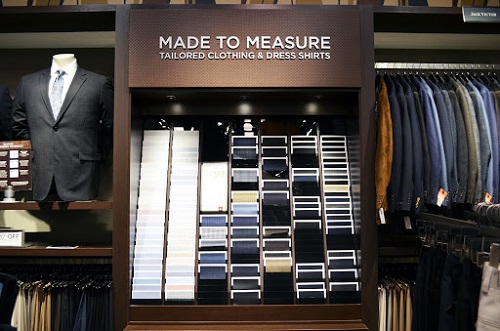 not confident of customers returning to stores soon. A recent survey by predictive analytics company First Insight finds less than 45 per cent consumers feel safe returning to physical stores due to COVID-19.
Also, consumers are likely to pull purse strings in due to economic uncertainty. Experts expect consumer spending on high end garments to contract 39 per cent with MTM businesses being the worst hit. Bespoke brands may also suffer on account of extended lead times due to factory closures and lack of raw materials. These issues will make it difficult for brands to increase their customer base.
Affordable MTM tools to ensure smooth operations
Though the fashion industry has woken up to innovative design, manufacturing and sales technologies few are beneficial to MTM businesses as they are expensive. Also, MTM brands lack the technical knowledge to implement these solutions. These solutions require the knowledge of working in 3D design environments, building fabric and trimming libraries, and using 3D across pattern fit. To benefit MTM businesses, these technologies need to be affordable and simple.
The tools and technologies that the fashion industry currently has access to, fail to address specific needs of MTM sector. A digital process doesn’t require costly hardware or hiring, outsourcing developers. It enables bespoke fashion businesses to operate entirely online through new tools such as 3DLOOK’s Mobile Tailor. The tool was built to address the needs of smaller businesses. Its contactless technology allows MTM businesses to provide additional in-store benefits, such as virtual try-ons. These tool also provide contactless in-store fitting process that combine the safety of a digital process with the convenience of having expert tailors at hand.
Deloitte estimates a strong demand for personalized clothing amongst 41 per cent consumers, majority of who belong to Generation Z. It advises MTM retailers to collect accurate and safe body measurements that would help them provide memorable shopping experiences to customers.
New Cotton Project to pave the way for a global blueprint solution
 As per Ellen MacArthur Foundation, the global apparel industry loses $500 billion every year as over 100 million tons of clothing is thrown into landfills. Lack of recycling initiatives has made circularity elusive in the industry with brands focusing on a few isolated initiatives. To halt climate change and restore biodiversity, the industry needs global-scale solutions, says a Forbes report. As per this report, the industry needs scaled circular solutions to control increasing waste generation and carbon emissions. It also needs active participation from various industry stakeholders to thrive in the fiercely competitive market.
Providing the required scale for recycling
To deliver affordable textile recycling solutions, Finnish biotechnology group Infinited Fiber Company has introduced a €6M European Union research and innovation fund which encourages 12 consortium members, spanning Finland, Sweden, Germany, The Netherlands, Portugal, Slovenia and Turkey, to launch the New Cotton Project to reduce fashion waste and environmental impact. To be developed in collaboration with industry giants like Adidas and H&M, the project will provide the required scale and volume to test recycling technology, says, Petri Alava, CEO, Infinited Fiber.
Spanning three years, the project will provide 3 ton cellulose carbamate fibers to Inovafil, Tekstina and Kipas, partners of H&M and Adidas who operate within the brands’ supply chains. The fibers will spun, dyed, knit and weaved into yarns and fabrics of the brands’ commercial fashion products.
Analyzing new business models
For this project, global consortium collaborators aim to collect and analyze new workflows and processes. For instance, Holland-based Frankenhuis plans to pre-process textile waste, while the South-Eastern Finland University of Applied Sciences (XAMK) plans to launch new solutions for processing waste fibers. For consumers and retailers, RISE (the research institute of Sweden) plans to analyze the sustainability and techno-economic feasibility of the project besides managing its eco-labeling. Finland-based Aalto University also plans to analyze the project’s resulting ecosystem and circular business models on a more macro level
Its magnitude and complexity make EU funding for this project extremely essential. However Katheleen Rademan, Facilitating Stakeholder and Petri Alava, CEO, Infinited Fiber, are confident that the project will achieve commercial viability as there is growing consciousness amongst brands about environment protection. The newly established Fashion Pact further stimulates these brands’ sustainability drive.
Determining the planet’s future health
KirsiNiimimaki, Professor, Aalto University believes, the project will educate the industry on the environmental impact that fashion has on developing countries. Though launched in Europe, project targets apparel producers in China and Bangladesh. Hence, it will pave the way for an immediately implementable global blueprint solution.
The project will take into account the entire value chain, from raw materials through to fiber, yarn and garment production, as well as end-of-life. For this project Infinited Fiber is negotiating with two Chinese companies to license their recycling technology. The company is also exploring other business models that could see it become a large-scale supplier.
Besides determining Infinited’s future business model, the outcome of this three year project will also determine the future health of our planet.











