FW
Kornit Konnect’s new software at ITMA 2019 maximises productivity
"Kornit Digital, a worldwide market leader in digital textile printing technology, launched Kornit Konnect –a new cloud-based, mobile workflow software platform at ITMA 2019. The software enables businesses to maximise productivity of their digital printing solutions. This is the first phase in Kornit’s implementation of its industry vision of textile design, decoration and production being fueled by data-driven insights and performance metrics."
 Kornit Digital, a worldwide market leader in digital textile printing technology, launched Kornit Konnect –a new cloud-based, mobile workflow software platform at ITMA 2019. The software enables businesses to maximise productivity of their digital printing solutions. This is the first phase in Kornit’s implementation of its industry vision of textile design, decoration and production being fueled by data-driven insights and performance metrics.
In its first phase, the Kornit Konnect enables businesses to monitor production, analyse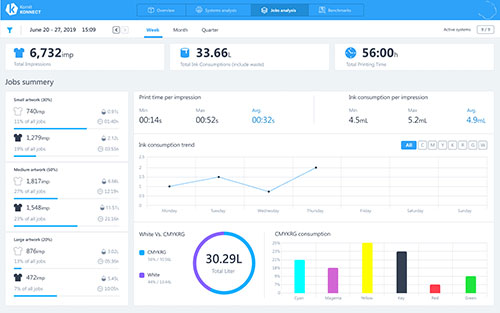 insights and manage their fleet, in order to eliminate blind spots. It includes a fleet management dashboard, data driven benchmarks, actual production costs, and cost structures per job, making it easy for businesses to learn more, react faster and perform better.
Future phases and releases of the Kornit Konnect will enable deeper insights and actions as it comes to optimising production management and enabling a seamless software workflow environment for businesses of all sizes.
Konnect empowers businesses to make better-informed production decisions and act on them, with greater visibility and control over their operations. The company plans to frequently add new modules and features that customers can leverage for long-term business success.
EFI Reggiani showcases advanced textile solutions at ITMA 2019
"EFI is showcasing advanced textile solutions at ITMA 2019 in Barcelona, Spain. This includes the EFI Reggiani BOLT single-pass inkjet printer. This 1.8-meter (71-inch) wide printer is designed to give textile manufacturers high uptime and reliability, high performance throughout and unparalleled printing uniformity and accuracy, in addition to superior printhead life and minimal maintenance needs."
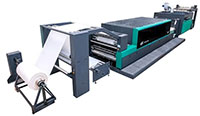 EFI is showcasing advanced textile solutions at ITMA 2019 in Barcelona, Spain. This includes the EFI Reggiani BOLT single-pass inkjet printer. This 1.8-meter (71-inch) wide printer is designed to give textile manufacturers high uptime and reliability, high performance throughout and unparalleled printing uniformity and accuracy, in addition to superior printhead life and minimal maintenance needs. Thanks to its cutting-edge printhead concept and high-performance ink delivery system, the Reggiani BOLT reaches a record throughput speed of 90 meters/minute at a 600 x 600 dots per inch (dpi) resolution. It features high-end imaging in drop sizes from 5 to 30 picoliters, and also provides premium-quality 600 x 4,800 maximum-dpi resolution printing, allowing customers to address their full range of design needs.
A robust, industrial platform designed for 24/7 operation, the Reggiani BOLT printer offers an innovative, low-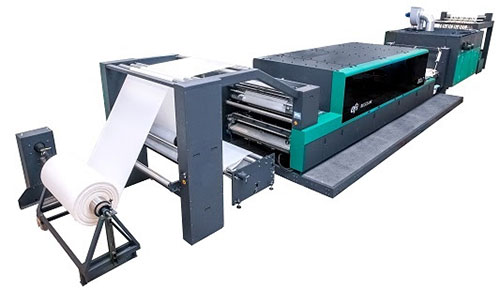 maintenance, fast-startup recirculation printhead that delivers more-uniform, high-quality printing with superior uptime. Users can reduce the cost per meter of digitally printed textiles with the Reggiani BOLT while creating a broader range of designs quickly and efficiently. The printer also has another remarkable advantage in its ability to include one or more analog printing stations as an option, integrated into the digital printer for special effects.
The Fiery BT-1000 DFE is a professional color management and RIP solution that enables efficient job management and streams jobs directly to the Reggiani BOLT printer in real time. It is purpose-built to deliver fine detail, smooth gradations, clean solid colors, deep blacks, and high saturation. Superior screening and fine dithering algorithms provide high-quality print results.
The EFI exhibit in Hall 3, Booth B204 at ITMA also features: EFI Reggiani Colors Printer: A high-quality, highly productive solution that prints with up to 12 colors and offers unmatched printing quality and uniformity with an extended color gamut, superior color depth and increased penetration into fabric.
This EFI Optitex Software: This software addresses retailers’ and brands’ urgent need to bring new products to market faster. The new release delivers true-to-life fabric simulations, enabling custom views of designs for consistent and adaptable 3D sample displays, minimising the need for physical samples and costly photo shoots across the design and production workflow. A new EFI Optitex Print & Cut feature enables complete garment printing on a single roll, creating significant savings in fabric roll inventory, with typically 15 per cent-40 per cent greater efficiency compared to traditional methods. Fashion and apparel manufacturers also benefit from an improved nesting algorithm in the software that increases fabric utilization.
The EFI Mezzera Denim System: This system uses patented Nitrogen Indigo technology. Its key advantages include upto 35-40 per cent reduction in chemical usage compared to other dyeing technologies; up to 6.5% higher indigo intensity compared to other dyeing technologies; improved colorfastness; deeper sulphur dyeing shades with no steaming and a smaller machinery footprint.
“Denims can be sustainable and beautiful”
“ We made it happen,for the first time, that denims can be sustainable as well as beautiful looking product,” said Alberto Candiani, Owner, Candiani-Denim, winner of ITMA Sustainability Innovation award” in an exclusive conversation with Sanjay Chawla, Global Convener, FashionatingWorld at ITMA 2019 at Barcelona, Spain.
 “We made it happen,for the first time, that denims can be sustainable as well as beautiful looking product,” said Alberto Candiani, Owner, Candiani-Denim, winner of ITMA Sustainability Innovation award” in an exclusive conversation with Sanjay Chawla, Global Convener, FashionatingWorld at ITMA 2019 at Barcelona, Spain.
“Of course , it is challenging to create sustainable denims, we strived for over 2 years with Lenzing to create this beautiful and sustainable product,” he further added.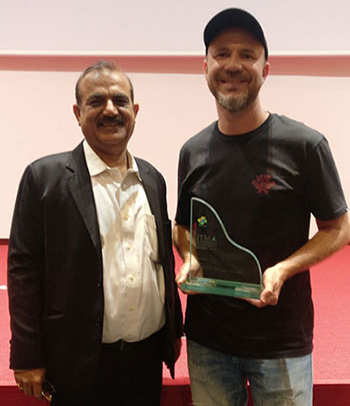 “I aimed to convert denim waste into sustainable fabrics.
If we could convert even 250,000 meters i.e. 1 percent of our 22.5 million meter of denim fabrics, it would be a great achievement. However, other denim fabric manufacturers can convert upto 5 per cent of their wastes, “he opines.
The new sustainable denim is around 15 percent more expensive than the regular denim. “However, buyers are willing this extra prize for a sustainable fabric.
We tried many blends and combinations, but the equal combination of recycled fibre and Refibra worked out as the best. Now, we plan to add sustainable elastane materials to take regeneration concept further,” adds Candiani.
Normalisation, not a boom expected after ITMA
"It has been a difficult year, demand of new machines is low, will see whether ITMA has an impact,” said Dr Norbert Klapper, CEO Rieter, in the first press conference of ITMA 2019 here in Barcelona on June 20. He further added, “The year saw worsening and uncertain business environment in China, elections in India, and though the government is stable now, but remains to be seen, if in the progressive steps, is textile being included. Situation in Turkey remains the same."
 “It has been a difficult year, demand of new machines is low, will see whether ITMA has an impact,” said Dr Norbert Klapper, CEO Rieter, in the first press conference of ITMA 2019 here in Barcelona on June 20. He further added, “The year saw worsening and uncertain business environment in China, elections in India, and though the government is stable now, but remains to be seen, if in the progressive steps, is textile being included. Situation in Turkey remains the same. The demand for new machines was low, customers are asking us the reason to invest and we have to see what impact ITMA brings? We expect normalization and not a big boom post ITMA as the fundamentals are not supportive.” Dr Norbert opines.
Developments focused on recycling, shorter staple fibre spinning at Rieter
Rieter showcased innovations based on productivity, cost efficiency and flexibility in technology. The focus of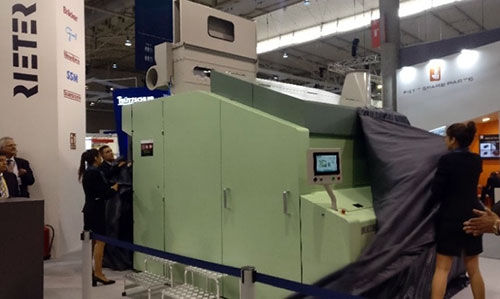 many developments is spinning of low cost, short staple and waste recycling technology.
At ITMA 2019, Rieter showcased innovations for all four spinning processes of fibre preparation, Ring and compact-spinning process and Rotor spinning process .These innovations have been designed to reduce raw material, energy and labor costs, while also increasing productivity during production of the yarn quality required in each case. Solutions also focused on to increase the flexibility of the spinning mill .
Fiber preparation
The blow room VARI Oline with the new UNI Clean B 15 brings significantimprovements in terms of energy consumption and the cleaning result for all spinningprocesses. The same applies to the new high-performance card C 80, which offersan unrivaled level of productivity.
Ring and compact-spinning process
To increase the cost effectiveness of the ring spinning and compact spinning process, Rieter reveals the new comber E90, the new roving frame F 40, the piecing robot ROBO spin and three different compacting units that can easily be installed on and removed from a ring spinning machine: COMPACT drum, COMPAC Tapron and COMPACT easy.
Rotor spinning process
Innovations that bring considerable improvements in efficiency for the rotor spinning process were also presented. The draw frame module RSB-Module 50 can be used in combination with the high-performance card C 80 and can be configured to a highly efficient direct process with the new semi-automated R 37 or the fully automated R 70. The new, cost-effective rotor spinning machines are characterized by low energy consumption, high productivity and high machine availability with low raw material costs.
ESSENTIAL – Rieter Digital Spinning Suite
The new innovations for the four spinning processes are supplemented by two new functionalities of ESSENTIAL: ESSENTIALorder and ESSENTIALconsult, which are available to all Rieter customers free of charge with the purchase of a new machine.
In addition to the existing modules ESSENTIALmonitor, ESSENTIALmaintain andESSENTIALpredict, the next steps are demonstrated: ESSENTIALlab for integrating laboratory data into the spinning mill management system, ESSENTIALoptimize, the intelligent recipe management system, and ESSENTIALautomate for integrating the transport and logistics systems.
Rieter is the world’s leading supplier of systems for short-staple fiber spinning. Based in Winterthur (Switzerland), the company develops and manufactures machinery, systems and components used to convert natural and manmade fibers and their blends into yarns. Rieter is the only supplier worldwide to cover both spinning preparation processes and all four end spinning processes currently established on the market. Furthermore, Rieter is a leader in the field of precision winding machines.With 16 manufacturing locations in ten countries, the company employs a global workforce of some 5150.
Kornit Digital launches sustainable solutions for industrial digital textile printing at ITMA 2019
Kornit Digital, a leader in digital textile printing technology, has launched a range of industrial digital textile printing solutions at ITMA 2019. These solutions enable unlimited design creativity, faster turnaround times and sustainable production.
The first of these solutions, the Kornit Presto is the world’s only industrial single-step solution for direct-to-fabric printing. The system is perfectly suited for the home décor and fashion markets. It eliminates the need for pre and post treatment of fabric and allows for high-quality printing on an extraordinarily broad variety of fabric types. The Kornit Presto solution uses the 100 per cent water-free patented NeoPigmentTM process, and is the shortest process from file to finished product, making it the most environmentally friendly solution available for direct-to-fabric textile printing today.
Kornit Konnect is a cloud-based software analytics platform that enables businesses to monitor production, analyse insights and manage their fleet, to eliminate blind spots. It includes a fleet management dashboard, data-driven benchmarks, actual production costs, and cost structures per job, making it easy for businesses to learn more, react faster and perform better.
Also on show in the booth are the Kornit Atlas and the Avalanche Poly Pro systems that were introduced earlier this year. Following dozens of installations worldwide and successful ramp-up at multiple customer sites, hundreds of thousands of garments have already been produced. Kornit will perform live printing of Adidas products on these two systems at ITMA. The Adidas mission is to be the best sports company in the world and one of their three key strategic choices is an Open Source strategy. Adidas is collaborating with Kornit to support their direct-to-garment innovation strategy, with Kornit as a key partner in digital embellishment. Adidas has recently invested in the Kornit Atlas and Avalanche Poly Pro solutions and is looking to expand its digital embellishment capabilities further.
Archroma to join ZDHC as active and engaged contributor
Archroma, a global leader in color and specialty chemicals towards sustainable solutions, has decided to join the ZDHC Foundation (ZDHC) as a contributor.
Archroma will upload its key products onto the ZDHC Gateway Chemical Module and support the ZDHC Manufacturing Restricted Substance List (MRSL) and the related “pyramid” conformity system designed to eliminate duplicative approaches.
The company will actively engage in various task forces focused on supporting the continuous improvement programs of ZDHC. As such Archroma together with the GCIRT Initiative look forward to a close and open cooperation with all stakeholders of ZDHC.
Archroma’s decision to join ZDHC will bring the world’s most reliable chemical producers at the forefront of driving the change. This intensified collaboration between all stakeholders in the supply chain will strongly accelerate the adoption of dye and chemical manufacturing innovations and processes to help minimize risk to the consumer and the environment.
Bangladesh mills want tax scrapped
Textile mills in Bangladesh want the five per cent advance tax proposed on import of textile machinery and spare parts to be withdrawn.
They say the proposed taxes would discourage investment in the sector and halt expansion of textile mills in the country. The five per cent tax is also proposed on some raw materials used in textile mills such as polyester, tencel fiber and viscose. As of now import of textile machinery is subject to only one per cent customs duty.
Besides, another five per cent value added tax is contemplated on manufacturing of yarn. Yarn manufacturers say this will deter fabric manufacturers from buying local yarn since the proposed five per cent VAT on yarn will force a manufacturer to pay an additional amount for each kilogram of yarn. Bangladesh’s yarn manufacturers are facing trouble due to illegal imports of yarn. They want yarn to be kept out of the VAT net.
There are 430 yarn manufacturing mills, 802 fabric manufacturing mills, and 244 dyeing-printing finishing mills in Bangladesh. Proposals the industry has welcomed are those relating to keep the corporation tax rate at 15 per cent for the textile sector for the next three years and a one per cent cash incentive against exports of apparel goods to traditional markets.
Denim conference in Vietnam advocates green production
Experts at the recently held conference in the Ho Chi Minh City noted that denim production is attracting more investors in Vietnam, but eco-friendly production is essential to protect the environment. Denim products account for around 10-20 per cent of Vietnam’s textile and garment product exports now.
The conference was part of Denims and Jeans Vietnam, an international exhibition on textiles, garment sand machinery organised by the Vietnam Textile and Apparel Association, Denimsandjeans.com and other organisations on June 12-13.
Both domestic and foreign companies in the denim production sector in Vietnam are investing in advanced manufacturing chains and technologies. However, the number of domestic businesses in this sector supplying materials for garments is still limited.
Nguyen Dinh Truong, Deputy Standing Chairman of the association noted that considering the trend toward sustainable development, consumers were keen for green production and environment-friendly products.
Fashion for Good expands to South Asia
Fashion for Good is expanding to South Asia with the launch of a dedicated regional innovation program.
This global initiative is already active in Asia, having partnered with Hong Kong-based tech incubator Mills Fabrica and is continuously expanding its activities with manufacturers such as textile manufacturer Arvind.
Selected innovators will have the opportunity to showcase their solutions as part of Fashion for Good’s Innovation Day to be held at the Sri Lanka Fashion Week on November 24, 2019. These innovators will also gain priority access to the Fashion for Good program, which enables access to a network of global partners such as founding partner C&A Foundation, and corporate partners C&A, Adidas, Kering and PVH Corp. to name a few, as well as to funding, mentoring and bespoke coaching, providing innovators with the tools needed to grow.
Fashion for Good is actively working on scaling innovations in the region and by catalysing collaborative pilots, which address areas such as making organic cotton traceable and solutions for the treatment of waste water from the apparel manufacturing process. A physical and local presence facilitates a deeper focus on innovators and allows for swifter implementation of pilot programs with partner brands and manufacturers, including targeted connections to corporate partners and investor ecosystems.
India imposes anti-dumping duty on Jute sacking cloth from Bangladesh
India has imposed anti-dumping duty of $125.21 per tonne on jute sacking cloth from 15 Bangladeshi exporters and $138.97 on others. This duty was triggered by a spike in jute import following the imposition of similar duty on sacks and products in 2017. The tariff comes as the value-addition in converting jute cloth into sacks is insufficient.
However, around11 exporters escaped the fine as the Indian finance ministry’s investigations found their shipment quantities of jute cloth to not be excessive.
The development is a big blow to jute goods exporters, who are progressively seeing their export market shrink for a host of reasons including competition from the lower priced polypropylene and synthetic goods and falling demand from traditional markets.
India was one of the largest export destinations for Bangladesh’s jute and jute goods but after the imposition of the anti-dumping duty in 2017 shipments shrank. The latest round of levy would exacerbate matters.
According to data from the Export Promotion Bureau; the exports of jute and jute goods dipped by 20 percent year-on-year to $773 million in the first 11 months of FY 2018-19. The shipment of jute sacks and bags also suffered a 33 percent slump.