FW
Fashion is entering a new world of endless possibilities
The frontier between the real and virtual worlds is gradually eroding, inspiring a host of fashion designers. Inspired more than ever by the virtual world, fashion designers are now trying out new digital experiences, fusing reality and computer-generated images.
Augmented reality has taken on a new dimension over the years with an increasing number of imaginary Instagrammers. Like Kylie Jenner or other influential millennials, Brazilian avatar Lil Miquela posts a wealth of selfies, collaborates with luxury brands, promotes beauty products and creates her own tracks available on Spotify. With 1.7 million followers, Lil Miquela could therefore represent the future of influencers on social media. In 2018, Olivier Rousteing decided to showcase Margot, Shudu and Zhi, three virtual icons with perfect features. Up to then the creative director had championed diversity for models in the fashion industry. In a stranger and more disconcerting world, in the same year Balenciaga chose elastic virtual models without any backbone, who were able to endlessly contort themselves. Dior collaborated with the avatar Noonoouri and Louis Vuitton with Final Fantasy figures. The performance highlights exceptional progress in terms of computer-generated imagery and artificial intelligence. Notwithstanding the realisation that humans can become a bit dull and uninteresting in the light of flawless computer-generated physiques.
Fast Retailing introduces robots for automation
Fast Retailing has enlisted the help of Mujin and Exotec Solutions to help improve efficiency in warehousing and distribution. Fast Retailing, Asia's biggest fashion retailer by sales, is a Japanese fashion group, owner of clothing chain Uniqlo. Mujin is a Japanese robotics controller maker. Exotec is a French robotics startup. They will help introduce more automation at global warehouses, including in picking and shipping processes.
Known for its affordable line of casual clothing like the lightweight down jackets, Uniqlo is currently enjoying strong growth in China. However, the unit has struggled with inefficiencies, occasionally blaming unseasonable weather for poor sales and excess inventory - an issue Fast Retailing hopes to address with shorter lead times and improved logistics. The hope is to avoid making, shipping or selling anything unnecessary.
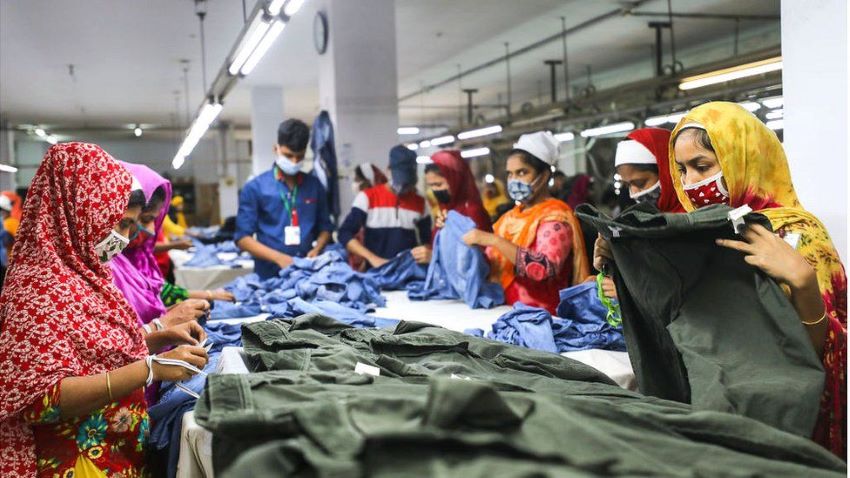
Fast Retailing in partnership with UN Women will champion women’s rights and empowerment in the apparel industry. This is the first formal alliance between UN Women and a clothing company based in Asia. Under the new partnership, Fast Retailing and UN Women will together promote safe and secure work environments, and advance empowerment for all women and girls. The scope of the partnership is to jointly implement a program for female workers in garment factories in Asia, Fast Retailing’s main production hub.
China’s filament yarn prices drop
Prices of polyester filament yarn have continued dropping in China since late September. Supply of and demand for MEG may be balanced in November, but stocks of MEG are anticipated to increase by 100 kilo tons in December. Meanwhile, downstream plants have entered the off-season, and demand may weaken.
Current inventory of polyester filament yarn is medium-to-high, and may accumulate at a later period, which may weigh in on its price. Downstream demand is muted. Purchasing on a need-to-basis is expected to have small risks, but the speculative restocking will have minor significance as stocks will occupy capital. If the price of polyester filament yarn keeps falling, and losses enlarge, polyester filament yarn plants may cut their run rate. Market players hold a bearish view toward market outlook. As for fundamentals, stocks of polyester filament yarn are supposed to accumulate by more than 100 kilo tons in November, and may rise by more than 300 kilo tons in December. If there is big stimulus, participants can have bargain-hunting, too, but market players would do well to retreat to the sidelines temporarily.
In view of the upstream market, current PX-PTA spread and PX-naphtha spread has hit a historic low, and some plants have suffered losses.
Global Fashion Group sales up 22 per cent
Sales of the Global Fashion Group have risen 22.8 per cent in the third quarter. Net merchandising value has grown 29.2 per cent. The number of orders increased 20.8 per cent. The group’s customers are purchasing 7.5 per cent more often at 2.6 times per year with a 2.8 per cent increase in their average order value. Global Fashion Group registered 12.4 million active users in the third quarter, 15 per cent more. Global Fashion Group finished the third quarter with an adjusted ebitda margin of 2.8 per cent. The company has focused on enhancing its market leading customer experience through broadening its assortment, enhancing app functionalities and further cementing sustainability as a key pillar of the business.
Global Fashion Group is a part of Rocket Internet, a business accelerator that has promoted platforms like Zalando. In addition to the fashion segment, Global Fashion operates with food and consumer companies. In the third quarter, the company has introduced more than four hundred new brands on its platforms. In addition to launching its first eco-owned firm, Aere, the group has appointed a new sustainability director to pilot this segment. By the end of the year, the company estimates a net merchandising value growth of between 20 per cent and 23 per cent.
Iconix Q3 revenues down 23 per cent
For the third quarter revenues of Iconix decreased by 23 per cent. For the nine months ending September 30, 2019, total revenue declined by 27 per cent compared to the nine months ending September 30, 2018. Adjusted ebitda increased 30 per cent from the prior year quarter while the adjusted ebitda margin improved to 59 per cent from 35 per cent in the prior year quarter. The decline in the third quarter of 2019 was principally as a result of the transition of the company’s Danskin and Mossimo direct to retail licenses in its women’s segment. Revenue for the third quarter of 2019 was also impacted by the effect of the Sears bankruptcy on its Joe Boxer and Bongo brands in the women’s and the Cannon brand. While Iconix recently signed new agreements with the new Sears and Kmart for the Cannon and Joe Boxer brands, overall revenue for the Cannon and Joe Boxer brands was down year over year. Revenue for the men’s segment increased nine per cent in the third quarter of 2019 compared to the prior year quarter, primarily from the Buffalo and Starter brands. The international segment declined 17 per cent in the third quarter of 2019 primarily as a result of the poor performance of Umbro in China and Umbro and Lee Cooper in Europe.
IndustriALL, Inditex form global union to share industrial framework
IndustriALL general secretary, Valter Sanches, and Inditex executive chairman, Pablo Isla, worked on a global framework agreement (GFA) at the International Labour Organisation in Geneva, Switzerland. The agreement contains provisions for a global union committee to share better practices in uplifting the freedom of association and to form collective bargaining.
The committee will be made of union representatives from Inditex's six main production clusters around the world and representatives from IndustriALL Spanish affiliates Comisiones Obreras and UGT.
Through the global union committee, local union representatives will participate more directly in how the GFA is applied and have the chance to receive advice from union experts, as was stipulated in the expansion of the agreement agreed upon in 2016.
The meeting also focuses on the establishment of joint training policies and programs that involve workers at Inditex factories and suppliers, in order to make progress on the promotion of social dialogue and workplace equality, among other things.
Masai Copenhagen achieves FSC certification
The design brand Masai Copenhagen became the first Danish fashion brand ever to gain FSC certification. In Denmark, FSC certification is best known in the paper, furniture and wood products industries, but Masai is the first Danish company in the fashion industry to gain certification. It is one thing for Masai’s paper goods to be FSC certified, but the fact that the brand’s wood-based textiles are now also certified is a significant achievement in the brand’s overall sustainability and CSR strategy because large parts of Masai’s collections are made from wood-based viscose fibres.
“It has been and is a pleasure to work with Masai Copenhagen through certification and as they begin to implement the CSR strategy. Right from the start, they’ve been keen to do something big that would make a positive impact on large elements of production, and that desire has now been fulfilled. Of course, it didn’t just mean Masai making changes; their suppliers had to start sourcing in a different, sustainable way, while also ensuring traceability through certification. Fulfilling this objective demands dedication from both Masai and their suppliers. Masai is the first Danish textile industry player to take this step and also to have its suppliers on-board, and praise is richly deserved here,” Loa observes Dalgaard Worm, strategic director, FSC Denmark said.
Bahadurke Textile and Knitwear Association face authorities ire due to affluence
The Bahadurke Textile and Knitwear Association is going through though time as the November 15 deadline for starting a new Common Effluent Treatment Plant (CETP) is approaching, but the Municipal Corporation authorities are not happy by the approach of the association.
Around 26 dyeing unit owners at Bahadurke Road were served notices for disconnection of sewer lines from the MC’s main sewer. MC Commissioner Kamalpreet Brar said, “Today, association members had come to submit their representation. They should have accomplished the task within the stipulated time, especially when they had committed it to the NGT. Their discharge is choking our sewer lines. But now this issue is to be dealt with at the MC General House meeting. Their representation has been moved to the Mayor today itself. Action will be taken accordingly by the House.”
A few days back, the MC authorities had served notices to association members to disconnect their connections from the MC’s main sewer lines by November 15 else it was to be cut. MC authorities said several deadlines were crossed but the association had not been able to start CETP.
Michael Kors Q2 revenue up nine per cent
Michael Kors’ revenue increased 9.3 per cent in the second quarter. Retail revenue was approximately flat compared to the prior year. Comparable store sales decreased 2.1 per cent. On a constant currency basis, comparable store sales decreased 1.3 per cent. Wholesale revenue declined 1.3 per cent. Jimmy Choo delivered better than anticipated revenues driven by strength in footwear. The company acquired by Jimmy Choo in 2017 and, compared to Jimmy Choo standalone results from the prior year, revenue increased double digits. Michael Kors has also acquired Versace, setting the stage for accelerated revenue and earnings growth.
For the full year, reported comparable store sales for Michael Kors are expected to be down in the low single digits, primarily driven by an unfavorable currency impact. The company has raised guidance for operating margins to approximately 18.2 per cent. For the third quarter of fiscal 2019, the company expects retail revenue for Michael Kors to grow in the low single digits. Comparable store sales on a reported basis are expected to decline in the low single digits, primarily due to an unfavorable foreign currency impact. The company expects wholesale revenue to decrease in the high single digits, and licensing revenue to decline in the mid-teens. Operating margin is expected to be approximately 20.8 per cent.
Retailers face scrutiny over Xinjiang cotton
Global retailers are facing scrutiny over cotton supplies sourced from Xinjiang, a Chinese region plagued by allegations of human rights abuses. China is one of the world’s top cotton producers and most of its crop is grown in Xinjiang.
H&M, Esprit and Adidas are among the firms said to be at the end of supply chains involving cotton products from Xinjiang. The Xinjiang region is a key hub of Chinese cotton production. China produces about 22 per cent of global cotton supplies. Last year, 84 per cent of Chinese cotton came from Xinjiang. That has raised concerns over whether forced labor has been used in the production of cotton from the region. In many cases western companies aren’t buying directly from factories in Xinjiang. Rather, the products go through several stages of transformation after leaving Xinjiang before they are sent to large western brands. H&M does not have a direct or indirect business relationship with any garment manufacturer in the Xinjiang region. It has an indirect business relationship with Huafu’s spinning unit in Shanyu, which is not located in the Xinjiang region. Since it has an indirect business relationship with the yarn supplier Huafu, it has also asked for access to its spinning facilities in Aksu.