FW
Purchasing Manager’s Index grows by 1.8 per cent in the US: ISM
As per a report from the Institute of Supply Management (ISM), the Purchasing Manager’s Index in the US grew 1.8 per cent to 56 per cent in August. Timothy R Fiore, Chairperson, ISM Manufacturing Business Survey Committee, revealed five of the big six industry sectors expanded with new orders and production indexes continuing at strong expansion levels. Demand and consumption continued to drive expansion growth, with inputs representing near- and moderate-term supply-chain difficulties. ISM’s New Orders Index registered 67.6 per cent in August, a 6.1 per cent increase compared to July. This indicates that new orders grew for the third consecutive month following a dip in April.
Production Index registered 63.3 per cent in August, up 1.2 per cent from July, indicating growth for the third consecutive month and the highest level of performance since January 2018. The 15 industries out of 18 sector reporting growth in production during the month included textile mills. Delivery performance of suppliers to manufacturing organizations was slower in August, as the Supplier Deliveries Index registered 58.2 per cent. This is 2.4 per cent higher than the 55.8 per cent reported in July.
Textile mills were among 11 of 18 industries reporting slower supplier deliveries in August. The Inventories Index registered 44.4 per cent in August, down 2.6 per cent from July. Inventories contracted for the second straight month after two consecutive months of expansion. This is the lowest reading for the Inventories Index since January 2014.
The two industries reporting higher inventories in August were apparel, leather and allied products, and plastics and rubber products. Textile mills reported no change in inventories for the month.
The ISM Prices Index registered 59.5 per cent, a jump of 6.3 per cent compared to the July reading of 53.2 per cent , indicating raw materials prices increased for the third consecutive month. The 17 industries reporting paying increased prices for raw materials in August were led by textile mills and apparel, leather and allied products.
Risk of slavery in Asian hubs to worsen with COVID-19 impact: Index
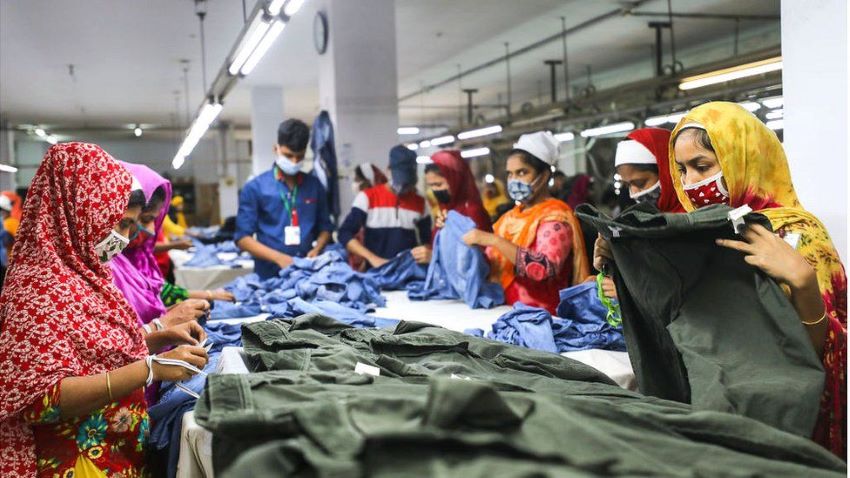
According to a Modern Slavery index, the risk of slavery in Asian manufacturing hubs is set to worsen with the economic impact of coronavirus, increased labour rights violations and poor law enforcement. The index prepared by risk analytics company Verisk Maplecroft, for the first time included India and Bangladesh in the extreme risk category, joining China and Myanmar in a group of 32 countries with the worst risk of slave labor.
The risks faced by workers in Cambodia and Vietnam also rose to their highest in four years, taking 32nd and 35th places in the ranking of 198 countries which identified North Korea, Yemen and Syria as the three worst nations for slave labor. Asian garment workers supplying global fashion brands lost up to $5.8 billion in wages from March to May, the Clean Clothes Campaign pressure group as the COVID-19 pandemic led to store closures and cancelled orders.
About 60 million people work in Asia’s garment industry and falling sales have put many jobs at risk. Laid-off workers are likely to turn to exploitative jobs or may put their children to work to cope with the loss of earnings, industry experts say. The affiliates of IndustriALL Global Union, a federation that represents workers in 140 countries, have reported wage cuts in existing jobs as well as removal of facilities such as transport and canteen with subsidized food.
Travel restrictions have made it harder for companies to carry out audits to ensure ethical working practices in their supply chains, said the slavery index, which aims to help businesses identify risk.
Global brands to increase India sourcing: TEA
Raja Shanmugam, President, Tirupur Exporters Association (TEA) believes, global brands will increase sourcing from India. Shanmugam therefore, urges the government to extend the six-month moratorium period as it needs support to rebuild its business post COVID-19. P Nataraj, Managing Director, KPR Mills, also expects sourcing from India to be much higher than last year. Carter’s, a baby wear brand has asked SP Apparels to develop new fabrics as it wants to shift significantly from China to India.
AEPC is also negotiating with Taiwanese and Korean entities for a joint venture, which will work on developing the fabric with man-made fibre. Garment exports from Tirupur dropped to Rs 25,000 crore for the year ended March 2020 from Rs 26,000 crore in the previous year as the Covid pandemic wiped away most March exports. The target was to export garments worth Rs 28,000 crore. Domestic sales were flat at Rs 25,000 crore for the fiscal. The town employs 6 lakh workers, half of whom are from other states.
Guess focuses on cost and inventory management to mitigate COVID-19 effects
Apparel retailer Guess is tightly managing costs and inventory to mitigate the effects of COVID-19. During the second quarter of fiscal 2021, the company continued to experience lower net revenue compared to previous year, as it remained challenged by store closures and lower demand. The company partially offset revenue declines by reducing sales, general and administrative (SG&A) expenses for the quarter through expense savings, including one-time actions such as furloughs and temporary salary reductions, and permanent ones, including headcount reductions and lower discretionary spending.
The company also paid back a significant portion of previously drawn down credit facilities and reinstated salaries that had been temporarily reduced. During the quarter, Guess gradually reopened most of its global fleet of brick-and-mortar stores, resulting in stores being closed for approximately 30 per cent of quarter. As of August 1, approximately 95 per cent stores were open, with the majority of closed stores within interior malls of California.
The company’s net revenue for the second quarter ended August 1 declined by 41.7 percent to $398.5 million from $683.2 million in the prior-year period. It recorded a net loss of $20.4 million in the quarter compared to net earnings of $25.3 million for year-ago period. It saw an operating loss in the quarter of $14.3 million, including $12 million in non-cash impairment charges taken on certain long-lived store related assets. Its operating margin decreased by10.3 percent to negative 3.6 percent from positive 6.7 percent in the same year-ago quarter, driven primarily by overall deleveraging of expenses due to the negative impact from the COVID-19 pandemic on global operations.
Demand for Indian apparels declines in the US, Europe
Take-off of retail demand in the US and Europe, India’s key markets for apparel exports, has been downsized from June. Buyers have revised demand projections by 30 to 40 per cent. They have also delayed orders for Indian ready-made garments for the next spring season by 15-20 days. Spring collections start arriving at retail stores in the Northern hemisphere closer to January. Orders for these are usually placed by mid-August or early September and goods are shipped by November.
However, Gautam Nair, Managing Director, Matrix Clothing says downward revision of orders was specific to a few buyers and it was still early to generalize it as a decline across the board. Another manufacturer point out retailers may also be carrying leftover stock from last spring as sales were hampered due to the onset of pandemic.
India exports ready-made garments to some leading high-street labels, departmental stores and supermarket chains overseas. These include H&M, Banana Republic, JC Penney, J Crew, Neiman Marcus, and Target. Exports declined by over 50 per cent in April-July of this fiscal year to $2.5 billion, according to data from Apparel Export Promotion Council (AEPC).
AEPC expects 40 per cent increase in apparel exports
Apparel Export Promotion Council (AEPC) expects apparel exports from the country to expand by about 40 per cent this fiscal. A Sakthivel, Chairman, AEPC, said, AEPC is majorly focusing on exports of new medical textiles this year. This will help the council to increase its total apparel exports from $15.4 billion last fiscal to about $22 billion in 2020-21.
Sakthivel also urged the council members to begin exporting manmade fibre (MMF)-based garments as there is a huge demand in the global market. Sakthivel says, AEPC will sign MoUs with his MMF manufacturers, including Reliance Industries in a bid to increase textile exports. For facilitating R&D into various fiber base, technologies, processing and sample development, the Council will set up a dedicated R&D Centre at its head office. The Council also plans to foray into Virtual Trade Fairs & Exhibitions by setting up AEPC’s own virtual platform.
Government approves India-Japan pact
The government approved for signing a pact between India and Japan aimed at increasing India's exports of textile and apparel to the Japanese market, and to boost co-operation in the textiles sector.
The MoU, when signed, will help identify areas for optimising the benefit of the Comprehensive Economic Partnership Agreement (CEPA) signed between India and Japan earlier, and improve the quality and testing of Indian textiles and clothing for the Japanese market. It will facilitate Indian exports to meet the requirements of Japanese importers as per technical requirements
This will help exporters expand their market in Japan and boost Indian textiles and apparel exports, including technical textiles to Japan. The MoU would enable the Nissenken Quality Evaluation Centre, Japan, to assign the textile committee as their cooperative testing and inspection service providers in India for textiles and apparel products.
These include technical textiles and any other products mutually agreed upon at a later date for both domestic and overseas clients.
Capital crunch, changing regulations threaten Indian apparels and textiles
 With dwindling number of large retailers in the US, domestic textile and apparel firms heavily dependent on contracts from discount stores, Narendra Modi -led government’s push for a self-reliant India has further complicated problems for small and mid-sized exporters as they now have to certify the origin of imported inputs. Though these rules aim to prevent Chinese goods from being routed in via Asean countries, they could cause sourcing problem for Indian companies. The government’s focus on import substitution and its FTA re-strategization could result in many labor-intensive export firms being liquidated this year.
Acute need for non-farm jobs needed
In the last five years, India’s leather exports have declined to $4.8 billion, textiles and garments exports have declined to $32.3 billion while gems and jewelry exports have fallen to $35.8 billion. These trends were mostly seen in July when gems and jewelry exports declined by 50 per cent year-on-year and leather and man-made yarn by about a quarter.
Sebastian Morris, Professor-Economics, IIM-Ahmedabad, India opines, India fails to protect its labor-intensive industries To arrest the growth of under- employed labor in the country, the country needs to create jobs at a record pace, says a new McKinsey & Co report. According to his report, India needs to create around 140 million non-farm jobs by 2030.
Focus on exports
The return of US buyers lost to Chinese manufacturers augers well for Indian suppliers though high raw material costs puts them at a disadvantage against larger factories. Tirupur garment exporters are not sure of surviving without imports as they already face delays in routine reimbursements from New Delhi to compensate for fuel taxes and other central and state government levies.
Even though the government acknowledges the need to increase India’s exports, it is confident of micromanaging industrial development. On August 26, the Centre released a report assessing the export preparedness of different states. It highlights the government’s aim to increase electronic exports over the next five years as smartphone giants and component makers are likely to shift about a tenth of global production to India,
Capital-crunch increases risk of decline
Often, labor-intensive exporters in India are overlooked by Indian government as decisions are made on the merits of a free trade agreement with the European Union. An FTA with the EU would help garment exporters compete against Bangladesh. The government should also reflect on why apparel business is going to other countries, says Sunit Jain, Ratan Textiles. Morris attributes this to the squeezing of India’s smaller exporters between China and Asia’s new export-led economies.
Indian exporters have to perennially struggle with ever-changing government regulations, inflation and an overvalued rupee as well as severe competition from Vietnam and Bangladesh. They have very little money to upgrade their business which increases their risk of decline over the next few years, says Morris.
PVH posts better than expected results in August quarter
PVH, which also owns clothing brands such as Tommy Hilfiger, Van Heusen and Arrow, posted better-than-feared results in the quarter ending August 2.
The company’s revenues reached $1.5 billion, a decline of 33 per cent from a year ago, and the company recorded a loss of 13 cents per share on an adjusted basis, down from $2.10 earnings per share last year.
The company reported seeing encouraging trends in the China and Europe markets, but ongoing headwinds continue to plague the North American market as coronavirus continues to spread across the US. The company is not concerned about the status of stimulus discussions than about getting a grip on the virus outbreak in the US
Shares of PVH dropped by 3 per cent in the aftermarket after the company posted fiscal second-quarter 2020 results. Its stocks declined by 43 per cent year to date.
Womenswear brand Eka launches new collection
Womenswear brand Eka has launched a new re-purposed clothing range named ‘Ekaco.re’, that is a continuous collection to promote sustainability in the fashion industry.
The clothing line recently launched online with a separate, dedicated Instagram page to showcase its maiden collection. According to the page, the line is designed to be trans-seasonal, eliminating waste generated by left over stock from past collections when new ones launch. Clothing by Ekaco.re will retail until it sells out, no matter the time of year, and is designed to be versatile enough to be worn in different climates.
The line also recently launched offline with a showcase event at multi-brand luxury Indian fashion retailer Ogaan. Garments available at the launch included loose jackets, shift dresses, shirts, and palazzo pants in signature Eka hues of navy blue and ecru.
Eka, which means ‘one’ in Sanskrit, specialises in handloom textiles made by craft clusters in India. The brand’s studio is based in Gurugram and it also retails from multi-brand outlets in India and internationally.