


FW
Paris Women's Fashion Week AW23 showcases Parisian luxury and cultural heritage
Paris Women's Fashion Week AW23 celebrated Parisian luxury, where labels capitalised on their geographical identity and cultural heritage.
The French Federation of Haute Couture and Fashion had 106 brands registered on the official calendar, which represents the core of Fashion Week. The majority of brands aimed for the official calendar to obtain credibility with industry players abroad.
Foreign names increasingly perceived Paris as the springboard to internationalisation. For example, Palm Angels, The Row, and Vaquera entered the FHCM calendar.
Serbia Fashion Week and the Arab Fashion Council participated in the "Welcome To Paris" programme. Dior's AW23 collection showcased "French style around three extraordinary personalities: Catherine Dior, Edith Piaf and Juliette Gréco". Balmain presented an intimate show that evoked Parisian sophistication and glamour. Louis Vuitton evoked its tricolour roots for its AW23 collection, answering the question "What is French style?" in 44 feminine looks.
Paris Fashion Week also reproduced the stereotypical Parisian woman en masse with effortless lines infused with nonchalance, dark, neutral shades, and lots of black looks. Harris Reed's first show as Nina Ricci's creative director featured vibrant hues and couture volumes, carried by a cast with a plus-size silhouette.
Overall, Paris Women's Fashion Week AW23 revived the idea of Parisian luxury and celebrated the cultural heritage of a house.
EU’s textile waste problem management project launched
A project titled "Transform Textile Waste into Feedstock" has been launched, aimed at addressing the issue of textile waste in the European Union.
The circular service specialist, Texaid has the support of major stakeholders in the textile value chain and plans to build and operate scalable sorting facilities across Europe. The project will involve renowned companies like Lenzing, Inditex, and Worn Again, jointly evaluating technologies and the business case for scaled sorting for reuse and recycling.
According to estimates, only 30-35 per cent of the 7-7.5 million tonnes of textiles discarded annually in the EU are collected separately, with just 15-20 per cent sorted by medium and large facilities within the EU. This has prompted the need for fibre-to-fibre recycling to preserve valuable resources. Texaid is leading the project, with a blueprint for sorting factories that meet the future needs of fibre-to-fibre recycling among its major outcomes. The first facility will have a capacity of 50,000 tonnes by the end of 2024.
ITA Academy GmbH, in cooperation with RWTH Aachen and CETIA, will assess technologies to create an innovative sorting system 4.0, building on cross-functional technologies with digitalisation and automation at the heart. If the project is successful, the recycling rate for textile waste could reach 18-26 per cent in 2030, creating economic, social, and environmental value that could total €3.5-4.5bn.
BGMEA touts potential for $5bn in revenue from recycled garment exports
The Bangladesh Garment Manufacturers and Exporters Association (BGMEA) has predicted significant potential for the export of value-added garments made from recycled yarn.
During a pre-budget discussion held on Tuesday, the BGMEA estimated that around $5bn in revenue could be generated from apparel products made from scrap fabric or used cloth. BGMEA highlighted the export potential of recycled ready-made garments (RMG) products, noting that $500m worth of scrap fabrics are currently produced in the country.
Bangladesh could become a hub for recycled garments, with three factories already producing recycled yarn, and encouraged others to invest. BGMEA also sought policy support from the government and suggested that exempting local textile mills from the value-added tax on selling scraps would encourage investment in recycling.
AATCC introduces new test method for measuring condensation on textile fabrics
AATCC has introduced a new test method, AATCC TM214, to measure accumulated condensation on textile fabrics. The new method applies to clothing systems, tenting fabrics, and medical and technical temporary shelters. The condensation rate is dependent on temperature and vapor pressure across a fabric system.
The method, developed by AATCC Research Committee RA63 Water Resistance Chair, Kiarash Arangdad of Elevate Textiles, measures the water condensation accumulation on the innermost surface of waterproof fabrics in a humid microclimate. During the test, the outermost fabric surface is subjected to dry and wet conditions. The condensation accumulation is determined by calculating the mass change of a filter paper attached to the inner chamber for a prescribed time.
This is the first method to measure condensation created by the microclimate of the textile product. TM214 is a valuable tool for the textile industry to assess the performance of fabrics in wet and dry conditions.
The test apparatus has an inner chamber and an outer chamber and can be conducted inside an environmental chamber or under ambient conditions, making it suitable for use across various textile systems.
The new test method is an important step forward in helping the textile industry better understand the role condensation plays on textile components, particularly with changing climates and a growing focus on sustainability. The insights gained by using this method will help organizations improve and develop new hydrophobic and water-repellent fabric systems.
Demand for plus size clothing reinforces the niche category’s global growth

On, February 22, 2023, Amazon India went live with its plus size store that has the finest collection of plus size clothing for Indian consumers, curated from leading fashion brands in India – Biba, Bigbanana, Pluss, Allen Solly, NYKD and the U.S. Polo Association among others. The outlet offers over 6,00,000 products spanning 2XL to 8XL. While going live, the head of Amazon Fashion India, Saurabh Srivastava said India is a fast-growing plus size market, mirroring the growth worldwide and just like Amazon elsewhere, the Indian division of the global e-commerce giant is catering to the needs of a diverse range of customers and is being inclusive.
Creation of the plus size consumer
Demand for plus size clothing is rising as plus-size customers across the world seek attractive and trendy garments that are readily available in larger sizes. Valued at $276 billion in 2022, the worldwide closing value projected for 2023 sits at $288 billion.
While the debate rages regarding mainstreaming of plus size clothing, brands have jumped in to cater to a large global market that is predicted to keep growing at CAGR of 5.7 per cent as projected until 2032. When Walmart launched a new plus-size brand named Terra and Sky in 2018, it proved to be a runaway success in the US which has a sizeable number of plus size consumers. The US is leading and will continue leading the world as the biggest plus size clothing market as it has the world’s largest plus size population and the category of clothing sells the most here.
High street plus size apparel retailers such as River Island, Marks & Spencer, and New Look also now offer a wide range of plus size items to cater to demand. When global fashion labels jumped into the plus size bandwagon, regional and local brands followed, boosting the size of a market that was considered niche even five years ago. Zara and the Good American launched their first size inclusive collection of denims in May 2022, creating a path for other globally-popular brands to follow, wherein a collection covers the entire range of sizes so everyone gets the size that’s right for them. As social and legacy media are championing inclusivity and body positivity, such campaigns are seeing the plus size clothing industry becoming mainstream, generating greater demand. Sports brands Adidas, Puma, Nike and Under Armour have introduced plus size clothing for both genders and teenagers. H&M, Mango, ASOS, and bridge-brand Michael Kors have extended their regular lines to include plus size units.
Trends in plus size market
A report by Allied Market Research reveals, casual wear leads growth of the plus size category, followed by formal wear. Plus size sportswear is fast catching up and currently comes in third. Men’s clothes are predicted to become the driver of growth as men’s plus size clothing is selling more than women’s. However, the world is seeing a rapid increase of obese women and soon sales of women’s plus size clothing may level with men’s. In the Western world, the age group with the highest purchase of plus size clothing is 60 years and above.
During the forecast period, the mid-priced clothing segment is expected to dominate the plus size clothing market which is why luxury fashion brands are being cautious about the category. Following the US, as the market leader, the Middle East and Asia are expected to become sizeable markets as their population is registering a sharp rise in obesity.
Recovering China textile markets reflect unpredictable demand
While analysts await the results of China’s textile demand in the first quarter of 2023, there seems to be some improvement in textile end-user demand compared to the second half of 2022, mainly apparent in the country’s domestic demand.
Although end-user demand graph may be close to the periodical peak of the same period of last year, it remains to be seen if this growth in fabric demand can be sustained throughout the season. There is a better-expected growth figures in East Asia and Pacific (EAP) region which is projected at 4.3 per cent up in 2023, as pandemic-related restrictions have been lifted allowing business activity in China to gradually recover.
Spring festival hiked unreliable demand
A report by CCF Group- a premier consultancy in China providing data and information for the petrochemicals, chemical fibers and the cotton textile industry- points out some important facts in China’s current growth in the apparel segment.
Firstly, exports will be difficult to improve in H1 2023 while performance in the next accounting season of H2 2023 will depend on destocking situation of the overseas market. Secondly, the sustainability issue remains unclear in this demand hike which is unreliable and the climb difficult to maintain. Also, the upcoming autumn/winter demand will be slow as last year's inventory is still unused, thus the intermediate inventory is high till May-June season is over.
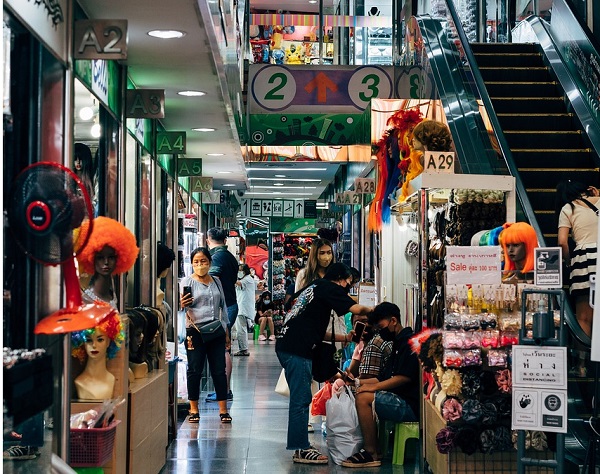
Currently, business is picking up in the largest apparel wholesale market of China the Shisanhang Garment Wholesale Market in Guangzhou and Sijiqing Costume Market in Hangzhou after the pandemic. Even the Spring festival in February didn’t help much to boost sales with factories closed and workers gone home due to Covid infections, there were relatively few spring clothes at Guangzhou market.
Even when the pandemic situation stabilizes in 2023, the problems will continue for downstream wholesalers as the changing seasons is a process in which the whole store must be replaced.
South China markets are front-runners
The CCF report also points out demand in the East China textile market does not measure up to the South China textile market. This is mainly because there is a large replenishment demand after the Spring festival which is super-reinforced with a significant rebound in seasonal demand for H1 2023 whereas there is not much spring apparel in Guangzhou where brands usually directly prepare summer apparel. Moreover, the South China textile market uses a lot of cotton yarn and in spite of the cotton industry chain having declined greatly last year, price is relatively low and the market is doing well.
The printing and dyeing textile industry has greatly suffered due to the huge increase in production costs last year which has made them currently come and increase prices to repair losses. Some dyeing factories are currently rushing to hurriedly complete their old orders as they have received new orders in the first two weeks after the Spring Festival which is confusing the supply chain.
Although China’s domestic fabric demand in the spring-summer season is before time having already arrived in February, demand for seasonal fabrics such as water-jet silk-like fabrics including chiffon, spandex silk satin and CEY plain fabrics also is unreliable and unsustainable.
Textile demand in the first half of the year is mainly divided into three categories of export: seasonal fabric demand and autumn and winter fabric stock preparation demand. However, there is poor demand for autumn and winter stock preparation in H1 2023 compared to the current good demand. The pandemic had destroyed Guangzhou as logistics were not smooth, and missed the last winter sales time.
Demand in the post Zero Covid lockdown phase for the coming seasons looks unpredictable but it’s only a matter of time till the autumn-winter 2023 -season’s loss and profit balance sheet will show if China will soon be back to its former glory in the global apparel export segment.
The Arrivals shifts focus towards performance pieces in new rainwear collection
New York-based outerwear brand, The Arrivals, has shifted its focus towards performance pieces. The move led the entire brand to embrace the technical side of apparel, resulting in the launch of its first rainwear collection on March 1.
The collection includes a three-layer bonded membrane to compete with other performance brands. The brand uses a factory in China for its technical gear and one in Los Angeles for its cut-and-sew fashion pieces.
The Arrivals aims to positioned in the space between brands like Patagonia and Arc’teryx, which have credibility among outdoors enthusiasts, and luxury brands such as Moncler. The brand hopes to fill the gap between the two extremes. The Arrivals wants to compete by showcasing the unique, objectively measurable performance features of its product.
To grow its performance-focused audience, The Arrivals has hosted community hikes on both coasts and worked with content creators with outdoor credibility. It has also shifted its advertising and creative content to include more photo shoots on the West Coast.
Sustainable Apparel Forum to highlight green production technologies and circular economy in Bangladesh
On 16th March, the Sustainable Apparel Forum (SAF) will host its 4th edition in Dhaka, Bangladesh.
The conference and exhibition event will focus on sustainable clothing production in Bangladesh and showcase green production technologies. The event will bring together more than 60 high-profile speakers, 20 exhibitors, and attendees from the government, finance, human rights, and fashion sustainability sectors.
The speakers will address topics such as circularity, CO2 reductions, renewable energy, and human rights due diligence. Notable speakers include the Honourable Ministers for Commerce and Local Government and the State Ministers for Power, Energy, and Mineral Resources, Information and Communication Technology, and Environment, Forest, and Climate Change. Also, present will be ambassadors from the US, Denmark, and Sweden, and representatives from the International Labour Organization and USAID.
The event partners include numerous organizations such as Laudes Foundation, WaterAid Bangladesh, Oxfam in Bangladesh, and the US Embassy in Bangladesh, among others.
Bangladesh is the world's second-largest garment sourcing destination and is known for its green production and factory safety programs. The event will provide an opportunity for clothing manufacturers, policymakers, green finance professionals, and sustainability experts to engage, network, and explore green growth exhibitions.
Temu, Chinese e-com platform aims to surpass Shein's sales within a year in North America
Chinese e-commerce firm PDD Holdings' shopping platform, Temu, is aiming to outperform Shein, the world's leading fast-fashion retailer, within a year. The company's sales target for its North American arm is to achieve a day's gross merchandise value that tops Shein's.
The app, which offers a wide range of low-priced items, from clothing to kitchenware, launched in the US five months ago and quickly achieved $500m in GMV. In January alone, sales were almost $200m.
Temu is betting on a significant marketing campaign to drive sales growth, and launched two 30-second Super Bowl adverts in February, while rolling out social marketing practices including discounts, cash rewards and free gifts to customers who refer their friends.
The firm has already attracted 24 million downloads and about 11 million monthly active users, up 47 per cent from the December shopping season. Its next goal is to take on Amazon and eBay.
INVISTA names Francis Murphy as CEO
INVISTA, a global leader in nylon 6,6 and propylene production, has announced the appointment of Francis Murphy as its new president and CEO. Murphy, who previously held various leadership positions at Flint Hills Resources (FHR), a Koch company and affiliate of INVISTA, brings 30 years of industry experience to the role.
Having joined INVISTA as part of the company's acquisition of FHR's propylene business in 2022, Murphy is well-positioned to lead the organization as it seeks to expand its presence in the nylon 6,6 and propylene value chains.
"As president and CEO of INVISTA, I look forward to working with our global employees and partners as we continue to innovate in these key areas," said Murphy. "We are excited about the tremendous opportunities ahead for our business."
Murphy takes over from Jeff Gentry, who recently retired after nearly four decades with INVISTA and Koch companies.











