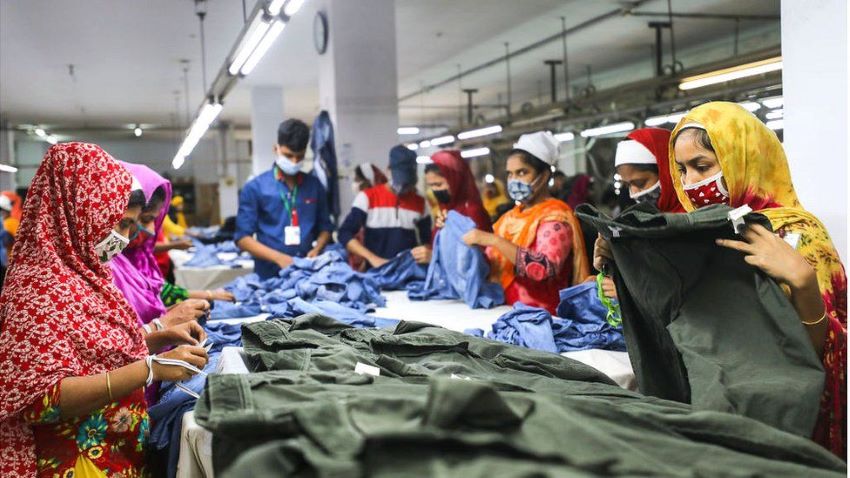
Labor and human rights and environmental practices are being violated in Bangladesh’s leather sector. Workers labor in tanneries in hazardous environments and many of them are underage despite the fact that Bangladesh prohibits work by anyone under 18 at a tannery. They are exposed to heavy metals like chromium, cadmium, lead and arsenic, as well as biocides, acids, bases and dyes, and usually have little protective gear to safeguard themselves from exposure to these hazardous chemicals. Workers are often soaked in chemicals and frequently breathe in hazardous fumes.
Tannery workers often suffer fever, eye inflammation, skin diseases and cancer as they work with toxic chemicals and rarely have any safety training or protection. They work long hours with toxic chemicals for poverty wages, making shoes and clothes for western brands. Accidents regularly occur. Machine operators get trapped. Workers cleaning underground waste tanks suffocate from toxic fumes or drown in toxic sludge at the tannery premises. Deaths often occur due to hydrogen sulphide inhalation.
Due to the absence of a fully functional waste management infrastructure, the tanneries dump thousands of cubic meters of untreated waste into rivers and fill the water with toxic chemicals. The central effluent treatment plant is yet to be fully functional and there is no effective system yet in existence to remove salt from effluent.
- 1
- 2
- 3
- 4
- 5
- 6
- 7
- 8
- 9
- 10
ICRA sees apparel export recovery in FY27 as margin pressure eases, FTAs gain tr…
India’s apparel export sector is moving out of a year defined by tariff-led disruption and into one shaped by market... Read more
From Price to Purpose: India’s textile leaders chart a sustainable future at CMA…
The Indian textile industry is standing at a historic crossroads. For decades, the sector has been fueled by its reputation... Read more
Industrial automation and AI take center stage at Garment Technology Expo (GTE) …
The conclusion of the 39th Garment Technology Expo (GTE 2026) in Greater Noida has signalled a decisive shift in South... Read more
The End of Geographic Masking: Shein and peers reclaim Made in China as a strate…
The era of the corporate ghost is ending. For years, the world’s most aggressive retail disruptors operated under ambiguity, relocating... Read more
$120 Crude, Zero Margin: How India’s textile hubs are paying the price
For India’s textile clusters, the current West Asia crisis is no longer a distant geopolitical headline. In Surat’s polyester corridors... Read more
Luxury under pressure as stagflation and geopolitics redefine the winners’ circl…
The 2025 earnings for Europe’s listed luxury majors have delivered a verdict that has far more implications than the prevailing... Read more
Luxury resale goes global, sneakers, handbags, archival fashion redrawing border…
The luxury resale market in 2026 is no longer a monolithic global block. According to the RB Insights January 2026... Read more
China out but can India deliver? The realities of the global sourcing shift
With the US imposing a flat 15 per cent tariff on Chinese imports under Section 122 as of February 2026,... Read more
Luxury in Retreat: Why the aspirational consumer is gone for good
The global luxury industry is confronting an unprecedented situation. The active consumer base, which peaked at 400 million in 2022,... Read more
The Invisible Bleed: How a single chemical is slowing India’s apparel machine
The global fashion industry has spent the better part of the past two years obsessing over visible disruptions viz. volatile... Read more