Sri Lanka: AOD aims to be South Asian center for textile design
 Sri Lanka's AOD International Design Campus is teaming up with UK’s Northumbria University School of Design to offer its world renowned fashion and design degrees in the country. “AOD’s vision is to open a South Asian center for international textile design and education. The idea is to work closely with industry so that designers can deliver something unique to Sri Lanka and the rest of the world,” explains Shamlee D’Silva, Head, Public Relations, AOD.
The Northumbria University International Design Degree programs  offered at AOD International Design Campus are the only British internal design degrees that can be fully completed in Sri Lanka. D’Silva explained further, “We are partnering a lot of universities in the UK and offering their curriculum in Sri Lanka. Fashion designing and fashion marketing are two of our main degrees. We also have courses in graphic, animation and product designing. We guide our designers, students to work closely with the industry. Even before they graduate from the institute, they get a chance to work with future employers and understand industry standards which is very important today,” she opines.
Among the advantages AOD International Design Campus students have is the close network the institute has with design industry in Sri Lanka and international creative industries especially those in the UK and Italy. Through this active network, live projects and competitions are set where students design for clients directly.
Imbibing their cultural heritage
D’Silva points out even though students are working with latest technologies they also go to villages and help artisans and work with them. With hands-on experience they create products that are unique and handmade and accepted in international markets. “Sri Lanka has a vision to become the international gateway to designs in South Asia. We will have internationally educated designers with knowledge of what works anywhere in the world and they have the capacity to enrich our industry and help create something fantastic for the rest of the world,” says D’Silva
AOD international design campus also has ‘Design for Sustainable Development Project’ which is a not-for-profit initiative. It connects the skills of rural artisan communities with designers to upgrade their products for high-end exports. The project results in livelihood development for artisans and an international caliber product for the student. “We are going to work closely with industry. We keep industry and heritage craft in mind. The Sri Lankan government is supportive of what AOD is doing and sees the potential it has for tourism and exports,” she explained.
AOD International Design Campus conceptualises and organises Sri Lanka’s largest and the most prestigious national event in fashion and design, the Sri Lanka Design Festival (SLDF). In its 5th year, SLDF hosts nearly one 100 top international fashion and design delegates from around the world. The local participation brings together Sri Lanka’s fashion, apparel, advertising, graphic design, publishing, architectural and interior design industries together on a single international platform. “This opens a world of opportunities for AOD’s students. They are at the centre of this design nucleus that generates the future of fashion and design in Sri Lanka with top fashion and design gurus from home and abroad,” D’Silva informs.
Emphasizing on the need for collaboration with neighbouring countries, D’Silve says, “India has a unique design heritage of its own. In terms of education India has done a great job in inducing her designers to protect her heritage and make it up to date. Our relationship with India is quite strong. Our outlook towards design is very global and we have our roots in heritage. It appeals to a buyer from Europe or China. We are very keen to work with Indian talent because what we have is quite different from what India has. We would like to collaborate with Indian designers.”
Rahul Mehta, focuses on apparel sourcing at Prime Source Forum
IAF’s President Rahul Mehta spoke about developments in global apparel sourcing during a panel discussion at the Prime Source Forum (PSF) in Hong Kong, last week. Highlighting the journey of apparel sourcing from the age of finding capacity, to lowering costs, to responsible sourcing, to end up in the current time of fast fashion, he said that the sourcing solutions in 2015 must involve ways to reduce waste created by an inefficient system and taking into account the cost saving by bringing supply closer.
This year’s edition of Prime Source Forum gave a balanced picture of the issues that are crucial to apparel sourcing. Moving production to upcoming lower cost production markets has emerged as a reality. Africa is not a question mark anymore. Many at PSF including Mehta focused on this and agreed to this new phenomenon. However, Mehta also asked the industry to look for other options. What after Africa, was the question, he wants the industry to find answer to.
He said that it is time to start looking at cost of selling instead of just focusing on cost of purchase. PSF 2015 also tackled issues related to functioning of the supply chain and creation of attractive as well as sustainable products. Sourcing, according to experts, is now more than ever a mix of moving and improving production. And the Accord, the Alliance, strong environmental legislation in the US, in Europe and now also in China are creating more necessity for innovation. IAF believes that it’s important to keep talking together about the issues concerning the industry and it will do so at the World Fashion Conference and Istanbul Fashion Conference to be held on October 14 and 15 in Istanbul.
www.iafnet.eu
Technical textiles boom in Russia
Russia is investing heavily in technical textiles and nonwovens. The plan is to take the share of domestically made technical textiles to 80 per cent of the local market by 2020. Balashov textile mill (Baltex) is one of Russia’s leading producers of technical textiles and nonwovens. At present the Russian technical textile market is estimated at $2 billion, of which the share of domestic production does not exceed 15 to 17 per cent. The same situation is currently observed with the raw materials base, which is reflected by the fact that the share of imports of synthetic fibers and yarns in the domestic market is estimated at about 71 per cent.
Currently, foreign companies are still dominating the Russian market for technical textiles and nonwovens and many are considering further expansion. US headquartered DuPont plans to build several facilities for the production of technical textiles and nonwovens in some cities in Siberia.
So far, Russia has had only two projects which have involved large-scale production of technical textiles. The National Investment and Finance Corporation, one of Russia’s largest investment corporations, is establishing a large cluster for the production of textile and technical textile products in the Russian Ryazan region.
Swedish fashion retailer Hennes & Mauritz from now on source fabrics only from mills it has inspected in Bangladesh. This is part of a program to improve working conditions in plants in the country.
H &M, which ranks second globally by sales to Spain’s Inditex, has extended its inspections from factories making its clothes to those supplying fabric and yarn. Its purchasing policies would benefit those sub-suppliers who measure up to its code of conduct. It will place more orders and book more material with those that take responsibility.
The program is about having a safe work environment and ensuring human rights with regards to remuneration and overtime and ensuring that there is no child labor. It is seen as a business tool to drive positive development and one that will make a difference for workers. The proportion of retailer’s clothes being made from fabric made by audited mills would rise to 50 per cent this year from 35 per cent last year. Unlike direct suppliers in the garment industry, most mills have never been exposed to demands or compliance standards from brands.
Poor working conditions in the textile industry were thrust into the limelight by the collapse in 2013 of the Rana Plaza garment factory in Bangladesh in which more than 1,100 workers were killed.
Pakistan's cotton imports on the rise
Pakistan's cotton imports are on the rise. One reason is expectations of a lower domestic cotton production this year. Also, since Pakistan’s textile industry has had access to European Union market, domestic consumption of the fiber has risen by 6.8 per cent. The government plans to prioritise energy supplies for industries like the textile sector, a step that bodes well for cotton consumption.
Demand for the cotton is increasing considerably in many countries as China’s purchases wane. This, despite a crash in crude market, which has led to the lowering of oil-based fiber prices such as polyester. Pakistan cotton consumption in 2015-16 would be the highest since 2007-08. Pakistan’s cotton buy-ins will jump by 150 per cent next season. Pakistan’s cotton imports are likely to be two million bales in 2015-2016, the highest in eight years.
Turkey’s cotton imports are growing by 19.5 per cent and Egypt’s imports by 29 per cent, fuelled by improved demand. For Vietnam, cotton imports are forecast to rise by 10 per cent though that represents a slowdown for a country whose demand growth has bucked the stagnant world trend.
Reforms in China’s subsidy regime have slashed the country’s imports and encouraged lower cotton prices.
Bangladesh’s industry bodies criticize Accord and Alliance
Apparel producers in Bangladesh have accused Accord and Alliance of imposing 'harsh' working conditions in the name of workplace safety in factories. Terming their demands 'illogical', they have said that factory owners are finding it difficult to meet their ever-increasing demands for work place safety and security. Accord and Alliance are two platforms by buyers from the European Union (EU) and North American countries working in Bangladesh to establish labour rights and promote work place safety in the ready-made garment sector.
At the recent joint meeting called by Bangladesh Garment Manufacturers and Exporters Association (BGMEA), Bangladesh Knitwear Manufacturers and Exporters Association (BKMEA) and Bangladesh Textile Mills Association (BTMA), the attendees pointed out that while there is no coherent relation between Accord and Alliance themselves, they are imposing harsh working conditions in the name of safety at the local factories. According BGMEA president Md. Atiqul Islam, the demands of Accord and Alliance has become a big challenge for local factories and those don't ensure a level playing field for industry.
www.bgmea.com.bd
Bangladeshi exporters worry over possible drop in winter orders
After a long-stretched political turmoil that negatively affected Bangladesh apparel export segment, now players are worried about possible fall in winter orders from key destinations. A decline in production during the three months of political unrest has already led to a decline in orders.
Apparel apex body-BGMEA recently held a meeting with buyers' forum, where more than 40 representatives of top global apparel buyers, brands and retailers participated. The aim was to assure them of improvement in situation and smooth supply of products. Even buyers expressed their willingness to increase sourcing from the country but players are skeptical about fulfilling demand due to a fall in production.
Industry estimates, the country's largest foreign currency-earning sector has already suffered a 20-25 per cent production loss during the last three months' due to political unrest. Almost 35 garment factories have suffered losses worth Tk 1.81 billion from January 14 to February 19 due to the blockade, according to the BGMEA. Locally-made apparel export (woven and knit) witnessed a 3.18 per cent growth during the July-March period of the current fiscal year. Knit products failed to achieve the target by 5.58 per cent and woven by 3.89 per cent during the period, under review.
www.bgmea.com.bd
India looking for cotton buyers
India wants to sell cotton to the garment sector in Bangladesh, hoping that Bangladeshi buyers will be interested in importing the commodity at competitive prices. A number of buyers in Bangladesh are keen on purchasing Indian cotton. Bangladesh’s cotton imports touched a five-year high of 0.99 million tons from April 2014 to March 2015, against 0.89 million tons in the same period last fiscal. Vietnam also imported 28 per cent more fiber this year.
India has put Bangladesh and Vietnam in focus for its cotton exports as its perennial buyer, China, has become slow in cotton and yarn purchases from around the world. China’s cotton import has fallen by 47 per cent. As the cotton stock rose to a record 9.1 million tons in India, the public sector Cotton Corporation of India (CCI) is planning to float international tenders to sell cotton.
CCI will initially float a tender to sell 5000 to 10,000 bales. The first such tender will be floated to observe the acceptability of buyers for which norms and modalities are currently being worked out. On achieving success in this tender, CCI may float another tender with higher quantity with an overall target to sell 30,000 bales of cotton this year.
Drought hits US denim makers
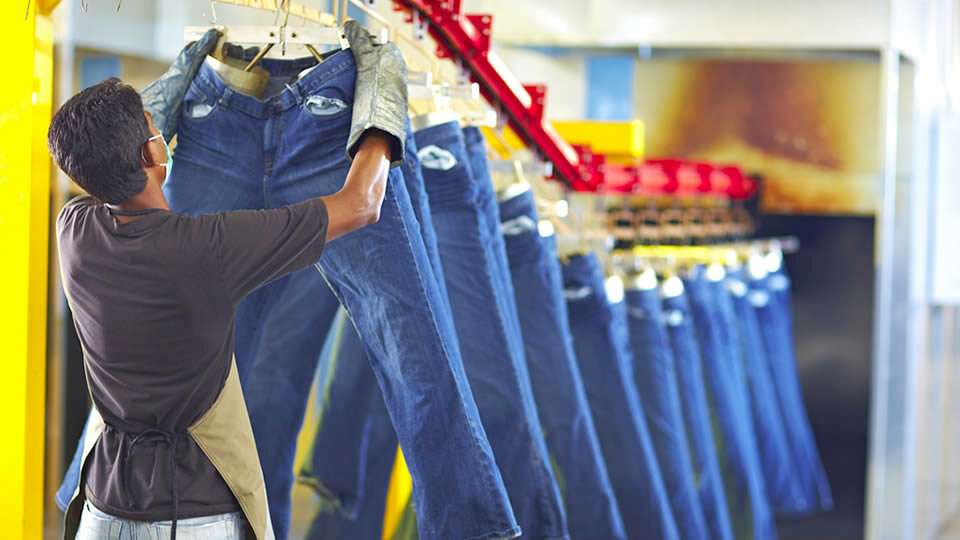
California in the US produces about 75 per cent of the premium jeans sold worldwide. But the state is in the middle of a long drought right now. And that’s a bit tricky for the state’s denim industry because getting that expensive, distressed vintage look is all about washing with water.
Some companies are now investing in waterless technologies as an alternate to washing and distressing denim with water. They are advising consumers to wash their jeans sparingly. Southern California produces 75 per cent of the high end denim in the US that’s sold around the world, making it the largest US fashion manufacturing hub.
The drought is having an impact on designs and manufacturing process of garments. Some companies are using ozone machines. These machines use ozone gas to get the stonewashed look without using water. The ozone machine can cut water use by as much as 50 per cent. Ozone machines are also used by denim brands to replace the bleach used to lighten denim.
So-called premium denim is used to make jeans costing anywhere upwards of 100 dollars sold by companies like 7 for All Mankind, True Religion and J. Brand. Repeated washing with stones, or bleaching and dyeing the denim, creates that ideal look.
Textile parks flourish in Surat
Surat is the hub for manmade fabrics. Now it has become a hub for textile parks as well. In the last six years, around eight textile parks have become operational. Their yearly production of yarn, fabrics and garments is pegged at Rs 3,364 crores. These parks have generated direct and indirect employment opportunities for more than 21,000 people.
The Gujarat Eco Textile Park at Palsana leads in production with value of fabrics, shirting, saris, denim synthetic textiles pegged at Rs 1,396 crores per annum. Around 70 textile parks spread across 16 states have been approved as on March 2015 with a total cost of Rs 7,100 crores. Out of the 70 parks, 30 parks are functional—most of which are in Gujarat, Maharashtra and Tamil Nadu.
About 20 more textile parks have been sanctioned, with a focus on north-eastern states like Manipur, Meghalaya and Assam. The textile ministry provides a grant to the extent of 40 per cent of the cost of basic infrastructure, common facilities and factory buildings subject to a ceiling of Rs 40 crores for each park. The balance project cost is to be mobilized by the special purpose vehicle through equity and debt funding.
More...
NTPC to build solar power for spinning mills
India's biggest power generator NTPC has a plan to create a 100 mw solar power capacity in spinning mills of Tamil Nadu. The plan is to take this to 500 mw. The country aims to build 15,000 mw of grid-connected solar capacity to raise dependence on solar energy to one lakh mw of output from the current 3,380 mw.
Although there is a substantial adoption of wind power by spinning mills, a larger number still dependen on grid purchases. Besides spinning, there are other nodes in the textile supply chain, such as weaving and garmenting, which would be willing to join the NTPC scheme.
The textile hub of Tamil Nadu boasts 47 per cent of the country's spinning capacity with 2.1 crore spindles. For a 25,000-spindle textile mill, the average power consumption a day works out around 40,000 units a day. A solar plant of about 2 mw capacity can meet this power requirement. Spinning mills have a requirement for about 100 mw, and a potential for 500 mw in the near term, entailing an investment potential of about Rs 2,750 crores.
NTPC is a power plant developer. Entrepreneurs in the southern textile belt feel the idea will solve the energy problem and also offer investors a long-term income.
www.ntpc.co.in/
Bangladesh exports up 7 per cent
Bangladesh’s garment exports to non-traditional markets have grown by 7 per cent year-on-year in the July to March period. Exports of other major products like jute increased 6.62 per cent. Exports of home textiles rose 3.47 per cent. Exports of leather goods declined 1.14 per cent.
As major markets like the US are showing positive signs, apparel exports from Bangladesh have risen, but needs to grow by 10 per cent every month in order to achieve the target $27 billion in the current fiscal year. Exports rose 7.43 per cent year-on-year in March. The figure takes the total export earnings so far in fiscal 2014-15 to $22.90 billion, up 2.98 per cent year-on-year.
The impact of political unrest would be seen three to four months later when exporters will get their payments, as garment makers bagged fewer than normal orders from retailers between January and March. The majority of Bangladesh’s production is destined for US and European markets, Bangladesh’s readymade garment industry now accounts for approximately 78 per cent of total exports, second only to China as the world’s largest apparel exporter.
However, Bangladesh has a long history of health and safety tragedies in garment and textile manufacturing.
Texprocil asks CCI to release 50,000 cotton bales a day
The Cotton Textiles Export Promotion Council (Texprocil) has demanded the release of 50,000 cotton bales. It has asked the government to direct Cotton Corporation of India (CCI) to immediately start releasing the said number of bales per day for 100 days through e-auction to address the issue of cotton shortage.
“We have urged the government to instruct Cotton Corporation of India (CCI) to immediately start releasing at least 50,000 bales per day for a period of 100 days through E-auction directly to the actual users,” Texprocil Chairman R K Dalmia said in a statement.
For now, the cotton textiles industry is facing issues due to non-availability of adequate quantity of cotton on account of the ‘Stop-Go’ policy of the CCI in spite of holding high level of stock, he added, further stating that CCI has procured 86 lakh bales of cotton under the Minimum Support Price (MSP) during the current season to protect the interest of the farmers. Out of this, CCI has offloaded only three lakh bales of cotton so far and is presently releasing between only 3,000 to 5,000 bales per day as against a stock of around 83 lakh bales, which leading to steep rise in prices besides creating shortage of good quality cotton, which in turn is adversely affecting the exports of yarn, fabrics & made-ups.
www.texprocil.org
Groz-Beckert to unveil latest needle solutions at ShanghaiTex
Groz-Beckert, the leading provider of industrial machine needles, will unveil latest innovations in needle solutions at the ShanghaiTex, a platform for the textile machinery for automated textile technological applications that will be held from June 15-18, in Shanghai, China.
In felting, Groz-Beckert will present needles for filtration felts. The range or products comprises numerous needle types with different barb sizes and shapes, as well as gauges and cross sections. With the model of a circular knitting machine made of acrylic glass, the knitting area will allow insights into the interaction of the individual components – Groz-Beckert needles, system parts, and cylinder. Fourteen knitting technologies as well as a unique gauge gradient on a segment of a cylinder from E10 to E50 will be showcased. Another central topic will be the improvement of productivity in the circular knitting process. Groz-Beckert will demonstrate how big the positive effects of minimal changes to the five key factors in the knitting process – machine speed, efficiency, needle lifetime and breakage rate as well as energy consumption can be.
In weaving, Groz-Beckert is full-range supplier both for high-quality weaving accessories and machines for weaving preparation. At the exhibition, Groz-Beckert will present its KnotMaster tying machine. The sewing area will highlight the Sewing5 comprehensive service concept that highlights supply, solutions, service, superiority and sustainability. In chain-stitch and lockstitch machines, the innovative needle geometry LoopControl allows formation of a perfect loop. The distinctively rounded needle protects the material and reduces the risk of needle breakage and point damage.
www.groz-beckert.com