Top Value adds latex line
Top Value Fabrics has expanded its textiles for latex printing with a new line of latex performance textiles, specifically engineered to create durable, high-quality production graphics utilizing HP latex technology.
Working closely in partnership with HP, Top Value Fabrics has developed a proprietary coating for its top-selling digitally printable textile products to enhance the durability of HP latex inks. Printing on Top Value’s coated textiles with HP latex print systems and inks provides finished graphic products with rich, brilliant colors with exceptional durability and fastness properties.
The new line of latex coated products covers a broad spectrum of end use needs including backlit, front lit, stretch, banner and sheer fabric applications. These fabrics can be utilized for SEG frame systems, high-end retail, POP, banner stands, backdrops, roll-up displays, tradeshow exhibits and interior decor.
After imaging, these fabrics are designed to provide outstanding color consistency, excellent image sharpness and a wide color range. Several of the fabrics are built on similar constructions of best-selling fabrics in Top Value’s direct print textile line. The new fabrics are called Latex Performance as they feature a proprietary coating for HP latex inks.
Top Value Fabrics is a leading international textile supplier with a wide selection of stock and custom fabrics that help customers succeed in the industrial, print media, active wear and recreational markets.
Indian state Telangana widens cotton area
Cotton cultivation this kharif in Telangana is up by over 26.5 per cent compared to last year.
The extent of cotton crop cultivation is 17.84 lakh hectares, more than half of 34.42 lakh hectares covered by all crops. Last year cotton was cultivated on 14.10 lakh hectares.
Farmers took to cotton cultivation on a large scale this season because of the poor market price for alternative crops such as pulses, maize and soyabean and the favorable seasonal conditions.
Another major reason that has driven farmers to go for cotton this year is the good price commanded by the crop last year — better than the minimum support price of Rs 4160 per quintal.
There will be an increase in the number of procurement centers in the wake of the increase in production this year.
The Cotton Corporation of India operated 84 procurement centers in the state last year.
Cotton arrivals this year are likely to happen from October.
Last year the failure of the crop in the northern and western parts of the country due to drought conditions, and the pest attack in Pakistan, had jacked up the prices of the fiber crop in the national markets and for exports.
India’s garment exports down 15 per cent
Exports of readymade garments (including those made of cotton, manmade and other fibers) from India in July fell 15 per cent compared to exports in the same month last year.
During the month, exports of manmade fibers, including yarn, fabrics, and made-ups, fell four per cent compared to exports in July 2016. However, exports of cotton textiles increased one per cent.
Imports of all textiles, including cotton and manmade yarn, fabrics and made-ups, rose eight per cent in July 2017 compared to imports in July 2016. Imports of textiles have not increased much after GST.
India has a great chance to capture the market for manmade fibers that’s been vacated by China.
Synthetic textiles made from manmade fibers account for 70 per cent of the world textile supply and the rest is cotton. Given the scale of exports from China, even a one per cent shift means a ten per cent increase in India’s exports of manmade fibers and synthetic textiles.
Cotton still commands more than 50 per cent of India’s textile production. However the synthetic textile segment is gradually growing. The world is shifting toward manmade fibers.
However, there is a need to go in for innovation in fabrics, integrate the value chain and invest in skill development to boost textile exports from the country.
Strengthening currency against India’s advantage
India has clocked top position in exports of men’s and boys’ knitwear shirts to the US.
India’s share in knitwear shirts imports by the US stood at 8.7 per cent in June. After a dip in 2014, India’s market share has been growing steadily. In 2013, India’s market share was 6.4 per cent and dropped to 6.2 per cent in 2014. From then it has been steadily increasing, and in 2016 it stood at 7.8 per cent.
Heavy investments increased India’s share in exports.
Compared to that, China’s market share, which was 11 per cent in 2012, dropped to 9.6 per cent in 2016 and is now 8.5 per cent. While China’s loss is India’s gain, Vietnam is running India close. Bangladesh is also increasing its market share.
What can really go against India is the recent appreciation of the rupee against the dollar. The country is losing its edge because of rising production costs. This makes competing with Vietnam or other countries difficult. Exporters are quoting prices three to five per cent higher after the rupee appreciated, while the hike should be of around seven per cent to compensate them for the losses on account of currency fluctuations. On the other hand, competitors' currencies have depreciated and they are bringing down their prices.
Home textile show next week
Intertextile Shanghai Home Textiles will be held in China, August 23 to 26, 2017.
This is the leading trade event in Asia for the home textile industry. The full spectrum of home textiles and accessories will be on offer under one roof. This year over 1200 suppliers from 30 countries and regions will demonstrate the finest and latest products.
Upholstery fabrics suppliers like Aico Home, Culp and D Décor can be found including machine-made and handmade carpet producers from Afghanistan, China, India and Pakistan. Other fine products at the fair include bedding and toweling and carpets and rugs. To cater to the entire supply chain throughout the home textiles industry, the fair will feature original textile design studios and digital printing solutions.
Belgium, India, Korea, Morocco, Pakistan, Taiwan and Turkey will have pavilions to maximise their specialties to visitors. Four of the leading home textiles production regions in China – Haining, Shaoxing, Tongxiang and Yuhang – will also form pavilions to present their specialised products.
The digital printing micro factory will demonstrating the entire digital printing production line and a series of seminars will feature industry leaders discussing the current market situation, technology development and applications of digital printing.
The Chinese home textile industry is regaining momentum with increasing exports to the US, European Union and Japan.
Britain aims for interim customs with EU
Britain will propose setting up an interim customs agreement with the European Union after Brexit to allow the freest possible trade of goods.
But it will also seek the right to negotiate other trade deals.
One option to minimise friction when Britain leaves the bloc in March 2019 would be to introduce a temporary customs union which should be time-limited. That would provide certainty for businesses, since they fear the introduction of customs checks will cause expensive delays.
The intention is to seek an interim period with the EU of close association with the customs union that would allow for a smooth and orderly transfer to the new regime. By sorting out the customs arrangements, Britain and the bloc could avoid a hard border with EU member state Ireland.
In the meantime Britain will look to negotiate bold new trade relationships around the world. Britain is keen to move the talks with the EU forward to tackle the future relationship rather than focusing only on the split.
Countries that are part of the EU’s customs union are not allowed to negotiate bilateral trade deals. But Turkey, while not an EU member, is part of a separate customs union for industrial goods and can still negotiate bilateral trade deals.
Bangladesh may continue cotton imports
Consumption of cotton may go up in Bangladesh. The price of the fiber has declined and production has increased.
Imports of cotton in Bangladesh have risen over many years due to higher shipments of cotton-made garment items and an increasing number of spinning mills in the country.
Bangladesh is the largest importer of cotton in the world. Demand for the natural fiber is on the rise in Bangladesh as it is the only country that is still mainly dependent on raw cotton to make yarn and fabric. Local growers can meet less than three per cent of the annual demand, leading to imports worth over three billion dollars.
China stopped sourcing the raw material three years ago.
By the end of 2020, cotton consumption in Bangladesh may hit 7.9 million bales. Currently, Bangladesh imports 55 per cent of its demand for cotton from India, thanks to favorable prices, geographical proximity, shorter lead time and the quality of the fiber.
Other countries have shifted to manmade fibers like filament, polyester and viscose. As a result, the global consumption of cotton has been on the decline.
The lower price of cotton may affect garment prices as well. The sourcing costs of garments could decrease by six per cent to seven per cent.
African tariffs may hurt US firms
East Africa wants a ban on imports of secondhand clothing from the US.It’s expected that such a ban will cause job losses in the US, causing up to 75 per cent reduction in revenues for some US textile businesses.
The East African Community (EAC) says imports of secondhand US clothing have caused a decline in the African textile industry.
The African Growth and Opportunity Act (AGOA) allows several African nations favorable trade arrangements with the US. But AGOA requires countries to have a market-based economy or to be at least making progress towards one. It is felt that any import ban or tariffs would halt this progress towards a free-market system in EAC countries.
Countries like Kenya, Tanzania, Rwanda and Uganda have import tariffs. As a result 40 per cent of small and medium textile firms in the US have reduced employment by at least 25 per cent since the tariff increases, 88 per cent of firms have experienced a revenue reduction of at least 25 per cent since the tariff increases and more than 52 per cent say they would be forced to reduce their number of employees by at least 50 per cent if the full ban were implemented.
Pakistan: Currency depreciation, energy costs hurt textile industry
"Pakistan's textile exports was worth $12.45 billion with imports worth $3.35 billion in 2016-17. The country exported raw cotton amounting to $42.85 million, cotton yarn $1.24 billion, cotton cloth $2.12 billion, cotton carded $235000, yarn other than cotton yarn $24.351 million, knitwear $2.362 billion, bed wear $2.133 billion, towels $786.606 million, canvas and tarpaulin $133.853 million, and readymade garments $2.316 billion in 2016-17, reported the recent textile division data."

Pakistan's textile exports was worth $12.45 billion with imports worth $3.35 billion in 2016-17. The country exported raw cotton amounting to $42.85 million, cotton yarn $1.24 billion, cotton cloth $2.12 billion, cotton carded $235000, yarn other than cotton yarn $24.351 million, knitwear $2.362 billion, bed wear $2.133 billion, towels $786.606 million, canvas and tarpaulin $133.853 million, and readymade garments $2.316 billion in 2016-17, reported the recent textile division data.

Pakistan has a cotton shortfall and that’s why it has to import about 2.5 million bales cotton for of $850 million per annum. The country also imports around 3-4 million synthetic fibre worth $500 million as it is not produced locally and other textile items worth $1.5 billion. Further the country imports synthetic and artificial silk worth $700 million and worn clothing of around $150 million. Besides this, to meet industry requirements, machinery worth $500 million is imported every year. Energy consumption by the textile sector is based on imported oil, coal and gas, which further adds to total production costs. Given this scenario, any depreciation of the rupee will increase costs of production manifold and may hurt the high value adding to textile exports.
Government thrust needed
As Ashfaq Hasan Khan, former economic adviser to Finance Ministry points out currency adjustment should be the last resort of the government as it would increase input costs of export-oriented sectors. Moreover dependency on imports has increased and depreciation would further hurt industrial sectors. The government should first review its taxation policy, reduce utilities tariffs including power, gas and water prices and immediately pay the stuck-up refunds of exporters to boost exports.
As per media reports, about 35 per cent production capacity of textile value chain is impaired/closed while prospective investors are reluctant to make new investments due to high cost of doing business. Energy cost is more than 30 per cent of the total conversion cost in spinning, weaving and processing industries. Industrial gas tariff in Pakistan is 100 per cent whereas electricity tariff is about 50 per cent higher than the regional competitors. Pakistan textile share in global market declined from 2.2 per cent to 1.7 per cent and unemployment increased by 30 per cent, sources added.
Exporters have raised serious concerns about declining exports and termed high cost of doing business including energy prices, non-payment of refunds claims as well as overvalued rupee as major factors making them uncompetitive. They further say 30-40 per cent factories have closed down while others are on the verge of collapse due to high input cost.
APTMA officials say electricity is available at Rs 10.5/kwh for the industry in Pakistan as compared to Rs 7/kwh in other regional countries including Bangladesh. Further, gas is available at Rs 1,000 /MMBTU in Pakistan against Rs 400 in Bangladesh. In such circumstances, the industry cannot compete in the international market and hence is losing customers, they added.
As Amir Fayaz, Chairman, APTMA explains around Rs 200 billion of the textile industry is stuck with government under sales tax, duty drawbacks etc., and is creating severe liquidity crunch for the industry. Serious liquidity crunch is negatively affecting production capacity, resulting in a steady decline in the country's exports. Lot many textile mills have been shut in the past one year, resulting in loss of jobs and which has further complicated the entire trade dynamics.
Fabric of Change awards given away to select groups
Ashoka and the C&A Foundation have given away the €180,000 Fabric of Change award. The project launched in 2015, was aimed at addressing questions surrounding gender inequality, human rights abuses, unnecessary waste and child labour in the textile industry. The Fabric of Change initiative was incepted by social innovators, Ashoka, and the C&A Foundation, who fund the project. Last month, the prize money was awarded from the project’s ‘Scaling Impact Fund’, to four participants who Ashoka says will be able to address these environmental and social questions.
One is CanopyStyle, which has developed a strategy to eliminate endangered forest fiber sources from the manufacturing process. The company is seeking to ensure that the textile industry’s supply chain is as transparent as possible in protecting ancient forests from being used to produce viscose from wood pulp.
The Gender Justice award went to Rebecca van Bergen executive director and founder of Nest. Bergen received the award for developing a process for ethical compliance for self-employed, home workers and artisans in what she calls the ‘informal economy’. The strategy is a response to artisan craft and home employment being the second largest employer of women in developing economies, as up to 60 per cent of garment production is in the home, with unregulated working conditions. The strategy plans to reach over 2,00,000 artisans by 2020 and will launch a steering committee of major retail brands to pilot the initiative.
Other prize winner was Poder which has developed a platform to improve conditions for maquiladora workers in the textile sector and give them increased access to information and eliminating deniability of large companies.
More...
Robust China growth shows signs of fading in July but retail still strong
China's strong economic growth showed visible signs of fading in July as lending costs rose and the gravity-defying property market cooled, though activity levels generally remained solid, propped up by a year-long construction spree. Industrial output, investment, retail sales and trade grew less than expected last month, after the world's second-largest economy put in a surprisingly strong showing in the first half. But economists do not expect any hard landing, with the government keen to ensure stability ahead of a once-in-five-years Communist Party leadership reshuffle in the autumn.
The upshot is both foreign and domestic demand appear to have softened at the start of the third quarter, say economist. The statistic bureau says the overheated property market has cooled "somewhat", but it still expected China's economic performance to be steady in the second half. The performance in July was stable.
Growth of private investment also ebbed to 6.9 per cent in the first seven months of the year, suggesting small and medium-sized firms still face challenges in accessing financing. Private investment accounts for about 60 per cent of overall investment in China. Retail sales pulled back, too, but growth remained in the double-digits for the fifth month in a row, suggesting consumption will continue to overtake factory output and investment as the biggest growth driver of the economy, a key policy goal for Beijing.
Retail sales expanded 10.4 per cent in July on-year, down from June's 11 per cent and forecasts for a 10.8 per cent rise. But while car sales remained solid, automakers cut back production. Beijing is targeting growth of around 9 per cent in fixed asset investment for 2017, and expects retail sales to increase about 10 per cent.
North Korean apparel units producing centre for Chinese exporters
Chinese textile firms using North Korean factories for production. Once ready, the factories then send the clothes that are labeled as Chinese all over the world. Making clothes in North Korea helps Chinese manufacturers make huge cost savings. Textiles were North Korea’s second biggest export in 2016.
Chinese suppliers send fabrics and other raw materials for manufacturing RMG to North Korean factories across the border where the garments are assembled and exported. Dozens of clothing agents operate in North Korea, acting as go-betweens for Chinese clothing suppliers and buyers from the United States, Europe, Japan, South Korea, Canada and Russia. North Korea has about 15 large garment exporting enterprises, each operating several factories spread around the country, and dozens of medium sized companies. All factories in North Korea are state-owned. And the textile factories appear to be doing great business. They take orders from not only China but all over the world.
It is believed North Korean workers can produce 30 per cent more clothes each day than a Chinese worker. Total exports from North Korea in 2016 rose 4.6 per cent. In addition Chinese companies are relocating their factories to Bangladesh, Vietnam and Cambodia to take advantage of cheaper labor.
Nandan Denim’s net profit up two per cent
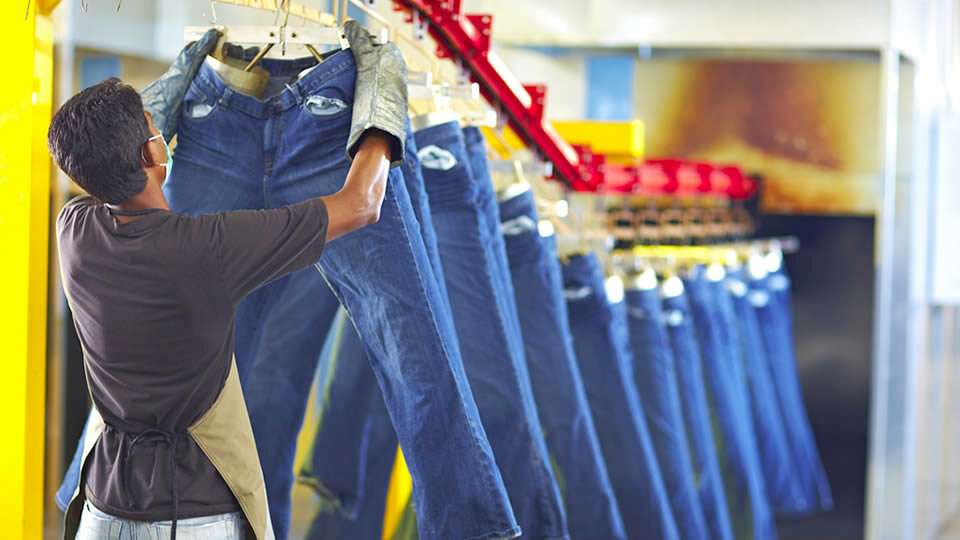
Nandan Denim’s net profit for Q2, June quarter has risen 2.06 per cent as compared to the corresponding period of the previous year. Net sales for the quarter were up by 41 per cent. Ebitda and pat margins were at 14.44 per cent and 3.84 per cent respectively.
The company successfully completed capacity expansion plans and expect to get the full realisation and synergies of the expansion in the current fiscal. Post expansion, the company has become India’s largest denim fabric manufacturer with an installed capacity of 110 million meters per annum. Spinning capacity is increased to 141 tons per day and in addition the company has created a yarn dyed shirting capacity of ten million metric tons a year.
Going forward, emphasis will be laid on fashion denim fabrics to target better realizations compared to regular denim material. A combination of higher sales volumes and value added products is likely to fuel top-line growth in the coming fiscals.
Denim fabric contributes 80 to 90 per cent to Nandan’s annual turnover. Spinning capacity has more than doubled. This will ensure adequate availability of yarn for the company’s fabric manufacturing unit besides reducing the degree of dependence on outside suppliers of raw materials and facilitating margin accretion.
Japan’s Daiichi Orimono makes waves with synthetic polyester fabric
Daiichi Orimono produces synthetic polyester fabric with an ultra high-density weave, which makes the material extremely water-repellent and durable. One of the company’s most popular fabrics is 100 per cent polyester but looks and feels like linen. Another hot seller is a polyester fabric that mimics the properties of cotton.
A loom is used to weave fabrics. The process is different for each type of thread used and requires fine adjustments by hand to get the weaving force just right. It is this craftsmanship which makes such fine textures possible.
Even when it produces a textile that does not sell well initially, the company keeps it in stock. What also sets Daiichi Orimono apart is that it sells its products directly to overseas customers, which account for about 70 per cent of its business. Business grew when upscale apparel brands began embracing synthetic fabrics that had traditionally been used in outdoor and sporting goods. Demand in the fashion world for soft, lightweight synthetic fabrics continues to swell. Since 2014, the company has taken the lead in jointly developing fabrics and opening new markets in cooperation with other fabric manufacturers from Japan.