India’s knit T-shirts exports drop in Q2, Nigeria and South Africa are exceptions
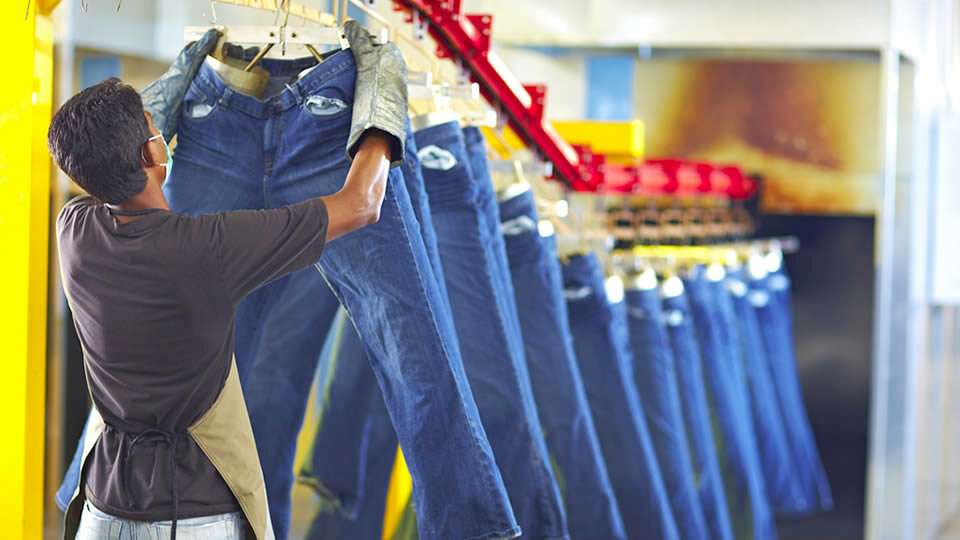
"Growth in India’s knit T-shirt exports in Q2 FY 18-19 declined by 9.62 per cent over the previous quarter. Within the knitted T-shirts segment, cotton tees accounts for 73 per cent of the total share value at $414.54 million. The second topmost commodity in Q2 FY 18-19 under the knitted T-shirt segment included those made from other fibers. The export value of this commodity was $121.61 million in Q2. Exports of T-shirts made from synthetic fibres declined 45.30 per cent at S$ 31.33 million."
 Growth in India’s knit T-shirt exports in Q2 FY 18-19 declined by 9.62 per cent over the previous quarter. Within the knitted T-shirts segment, cotton tees accounts for 73 per cent of the total share value at $414.54 million. The second topmost commodity in Q2 FY 18-19 under the knitted T-shirt segment included those made from other fibers. The export value of this commodity was $121.61 million in Q2. Exports of T-shirts made from synthetic fibres declined 45.30 per cent at S$ 31.33 million. Growth of T-shirts made of both artificial fibre and wool declined. T-shirts made of artificial fibre declined by 48.76 per cent while those made of wool declined by 69.57 per cent.
Country break up
USA: Indian exports to the US in the second quarter of the financial year totaled $126.52 million. Of this, cotton T-shirts recorded an export value of $93.78 million. The second highest commodity exported included T-shirts made from other fibers which was worth $27.2 million in Q2 FY 18-19. This commodity witnessed a decline of 19.32 per cent over the previous quarter.
Nigeria: Nigeria recorded positive growth. The country’s total knit T-shirt imports from India was $23.27 million in Q2 a growth of 43.11 per cent over previous quarter. Import of cotton T-shirts was $17.31 million whereas T-shirts made from other fibers was $5.95 million.
U.A.E: India’s exports of knit t-shirts to UAE was worth $136.88 million in Q2 FY 17-18, a drastic fall of 40.76 per cent. Export of cotton tees was $43.69 million, declining 14.25 per cent over previous quarter. Export of t-shirts made of other fibers was $24.45 million with a negative growth of 4.49 per cent over the previous quarter.
Germany: T-shirt export to Germany was $53.51 million in Q2 FY 18-19 with negative growth of 3.5 per cent over previous quarter. Here too cotton knitted t-shirt ruled the basket with an export value of $37.99 million. T-shirts made of other fibres perceived a positive growth of 12.07 per cent to $13.18 million in Q2 FY 18-19.
UK: United Kingdom’s knitted T-shirt imports from India saw a fall of 12.22 per cent in Q2 FY 18-19 to $40.44 million. Export of cotton T-shirts dropped by 14.81 per cent to $31.13 million in Q2 FY 18-19. Cotton knitted T-shirt exports was worth $0.44 in Q2. Export of t-shirts made of other fibres was worth $7.45 million.
South Africa: India’s exports of knitted T-shirts to South Africa improved with a growth of 48.90 per cent recording an export value of $24.39 million. Cotton t-shirt exports totaled $19.61 million in Q2 FY 18-19, a growth of 87.30 per cent over the previous quarter.
Italy: India’s knitted t-shirt exports to Italy dropped in Q2 FY 18-19 by 12.85 per cent. Export valued at $11.26 million. Cotton T-shirt exports dropped 10.20 per cent while T-shirts made of other fibres dropped 25.79 per cent.
Vardhman Textiles’ Q3 net profit increases to Rs 191.13 crore
Vardhman Textiles has reported financial results for the period ended December 31, 2018. The company reported net sales of Rs1,789.86 crore during the period ended December 31, 2018 as compared to Rs1,727.17 crore during the period ended September 30, 2018. The company posted net profit of Rs 191.13 crores for the period ended December 31, 2018 as against Rs 195.60 crores for the period ended September 30, 2018.
On yearly basis, the company reported net sales of Rs 1789.86 crores during the period ended December 31, 2018 as compared to Rs 1685.54 crores during the period ended December 31, 2017. Net profit was Rs 191.13 crores for the period ended December 31, 2018 as against Rs 133.29 crores for the period ended December 31, 2017.
Sutlej Textiles quarterly sales fall in Q3
For the December quarter Sutlej Textiles’ net sales were Rs 657.35 crores as compared to Rs 693.73 crores during the September quarter. Net profit was Rs 17.29 crores for the December quarter as against Rs 24.85 crores for the September quarter. EPS was Rs 1.06 for the December quarter as compared to Rs 1.52 for the September quarter.
Net sales during the year were Rs 657.35 crores as compared to Rs 604.31 crores during the previous year. Net profit for the year was Rs 17.29 crores as against Rs 16.35 crores for the earlier year. EPS for the year was Rs 1.06 as compared to Rs 1 for the preceding year.
For the six month period net sales were Rs 1972.18 crores as compared to Rs 1877.06 crores during the same six month period the previous year. Net profit was Rs 50.77 crores as against Rs 103.35 crores for the same six month period the previous year. EPS was Rs 3.10 as compared to Rs 6.31 for the same six month period the previous year.
Sutlej is one of India’s largest integrated textile manufacturing companies. It specialises in synthetic, natural and blended yarns, all types of spun yarns and home textile furnishing.
New UK report measures financial viability of closed loop fashion
A new report evaluated the financial viability of using post-consumer clothing and textiles as feedstock for chemical and mechanical fibre to fibre recycling operations in the UK. The study models the finances for both chemical and mechanical fibre to fibre recycling processes for recovering polycotton and cotton respectively. It highlights the pressure points, and potential returns, and outlines the barriers to developing post-consumer full fibre to fibre recycling.
The study, carried out by WRAP, suggests sorting done of clothing using near-infrared spectroscopy may be critical to the wider development of recycling. It also argues that chemical recycling processes are commercially farther off than mechanical but may offer higher economic potential in the long run.
The research was undertaken ahead of the anticipated global shortfall in virgin textiles. This predicts limitations in future cotton supplies, the UK’s most used fibre, with some projections suggesting a five-million-tonne global cotton deficit by 2020.
Rieter’s orders down 17 per cent in 2018
In 2018 Rieter’s orders were down 17 per cent compared to previous year while sales were up 11 per cent. Rieter achieved higher sales thanks to organic growth in the Business Group Machines and Systems. In addition, the acquisition of SSM Textile Machinery in the Business Group Components supported this positive development.
The Business Groups After Sales and Components were able to maintain the previous year’s levels of sales despite weaker market dynamics during the second semester of 2018.
In Asia, excluding China, India and Turkey, Rieter increased sales by 36 per cent. Sales in China fell by 19 per cent. With the phasing out of the subsidy program in the western province of Xinjiang, the demand for machinery declined. Sales in India fell by 16 per cent. In Turkey, Rieter achieved sales in a difficult market environment, thanks to the introduction of the new ring and compact spinning machines.
In Europe, Rieter increased sales by three per cent. Rieter is the world’s leading supplier of systems for short-staple fiber spinning. Based in Switzerland, the company develops and manufactures machinery, systems and components used to convert natural and manmade fibers and their blends into yarns. Rieter is the only supplier worldwide to cover spinning preparation processes as well as all for end spinning technologies.
Milan Fashion Week to focus on new talent
Milan women’s fashion week to be held from February 19 to 25, 2019, will focus on new design talent, featured both on catwalk show calendar and in a number of other dedicated events and initiatives. The calendar will feature a wealth of new names, both from Italy and abroad. Young designers will be strongly supported. CNMI, the leading Italian industry association, traditionally makes it possible for a selection of emerging labels to show during the fashion week. The most promising Italian design talents will be supported via a mentorship program.
One label to debut on the fashion week’s catwalks with CNMI’s support is Marios, founded in 2002 by Cyprus-born designer Mayo Loizou and his Polish counterpart Leszek Chmielewski. This women’s wear label is currently being relaunched after the arrival of a new partner.
There are also other initiatives reserved for emerging talents through the Fashion Hub, which will run from February 20 to 24. The hub will host several shows, a series of conferences and the eighth edition of the Fashion Hub Market, which allows rookie labels to showcase their collections. For February, the roster includes 12 names. There will also be a focus on creativity coming from China and Hungary.
Research shows new methods of graphene use in wearable textiles
The University of Manchester has developed a simple and cost-effective method to manufacture graphene-based wearable electronic textiles on an industrial scale. This could easily be scaled for many real-life applications, such as sportswear, military gear, and medical clothing.
Graphene is predicted to be one of the most prominent materials in wearable e-textiles. The new technique could allow graphene e-textiles to be manufactured at commercial production rates of 150 meters per minute. In the new method, the researchers have reversed the previous process of coating textiles with graphene-based materials. Conventionally, the textiles are first treated with graphene oxide, and then the graphene oxide is reduced to its functional form of reduced graphene oxide. Instead, the researchers first reduced the graphene oxide in solution and then coated the textiles with the reduced form.
By making coating the ultimate step, it becomes possible to use a coating technique termed padding, which is currently the most commonly used method of applying functional finishes to textiles in the textile industry. For instance, water-repellent and wrinkle-free clothing are often made by padding.
E-textiles made by a laboratory-scale pad-dry unit, exhibit excellent electrical and mechanical characteristics. The reduced graphene oxide forms a uniform coating around the individual cotton fibers, which results in good electric conductivity, tensile strength, breathability, flexibility, and overall comfort of the fabric.
The CanopyStyle initiatives adds new members
The CanopyStyle initiative has reached 170 brand partners with the addition of companies Abercrombie & Fitch Co., Allbirds, ELK, Reformation and Selfridges. Now eight new companies will work with Canopy to bring their innovative technologies to market at scale, with next generation enterprises Nanollose and Tyton Biosciences joining the CanopyStyle initiative.
All these partner brands will eliminate their use of Ancient and Endangered Forests, as well as advancing conservation solutions in landscapes of hope such as Sumatra’s Leuser Ecosystem, Vancouver Island’s rainforests and the Broadback Forest in the Canadian Boreal.
Over the last year, Canopy and its brand, retail and design partners have catalysed significant transformation of the viscose supply chain. Through work with producers and other industry stakeholders, companies representing 52 per cent of global viscose supply have completed the CanopyStyle Audit process, which assesses supply chain risk, recommends measures to reduce impact on forests and tracks corporate progress on innovative fibers.
The Big Plastics Debate to discuss future of plastics
To be hosted on the dedicated Ecopack stage, The Big Plastics Debate will welcome industry experts to discuss the future of plastics and reflect on the pledges made by brands over the last 12 months. Experts from some of the world’s biggest brands, including Marks & Spencer, Pepsi Lipton, together with British Plastics Federation, A Plastic Planet and WRAP, will come together at Packaging Innovations 2019 to discuss plastics in packaging.
The highly anticipated debate will be held from February 27-28, 2019 in Birminham. Day one of the debate will kick off with the Ecopack Challenge, welcoming six companies, who will present their innovative sustainable packaging solutions for the chance to work with Marks & Spencer, and the crown of Ecopack Challenge Winner for 2019. This will be followed by The Big Debate, where two teams will go head to head to debate whether plastic packaging will always play a fundamental part in our everyday lives.
Day two will see expert panels tackle two key areas of the circular economy, ‘Designing Packaging for a Circular Economy’ and the ‘Recruiting Consumers for a Circular Economy’.
Now Farfetch goes fur-free
Farfetch, an online fashion retailer based in the UK, has stopped the sale of fur. Farfetch has traditionally been a fur-heavy retailer. Other retailers who have banned fur are Net-a-Porter, Gucci, Michael Kors, Versace, Burberry, DKNY, Coach, Chanel, Jean Paul Gautier and Jimmy Choo.
Each new fur-free announcement continues the domino effect of designers and retailers seeing the importance of distancing their brands from the fur industry’s cruelty. However fashion houses like Fendi and Dolce and Gabbana are still selling fur.
The UK currently allows the import and sale of furs from a variety of species, including foxes, rabbits, minks, coyotes, raccoon dogs and chinchillas. Under existing EU regulations, import and sale of fur from dogs, cats and commercial seal hunts are banned, and campaigners want those bans extended to protect all species.
Brands like Calvin Klein, H&M, Marks & Spencer, Tommy Hilfiger, and Topshop have dropped angora wool from their clothing lines. Angora rabbit fur is being used for sweaters, hats, gloves, and more. Angora rabbits have long, soft fur. Most angora comes from rabbits on Chinese factory farms. The rabbits writhe in agony as workers tie them down and rip out their fur. So far more than 300 major retailers have banned angora.
More...
Chennai hosts Leather Fashion Show
Leather Fashion Show was held in Chennai on January 31, 2019. A showcase of what’s trending in the world of leather, it had vegan leather, leatherite along with trendy biker jackets, handbraided bags, rivets and rhinestones.
From casual wear to boho chic, stylish models sashayed down the ramp in some interesting styles--hot pants, skirts, biker jackets, athleisure and even chic formals. But the real stars were the handcrafted bags, footwear and accessories, from home-grown industries and a few international players.
The Indian leather industry accounts for 12.9 per cent of the world’s production of hide, with a massive three billion sq ft of leather produced annually. The leather fashion industry, though, is still taking baby steps. Big players are slowly moving from the export space into the domestic retail market.
The leather garment industry is still trying to make its foray into fashion, while leather bags and shoes fly quicker off the shelves. The industry offers better options than China and is now focusing on soft skills and increasing value so that it can market products under our own brand identity.
Indian consumers look at leather as a practical buy not luxury. So, natural leather jackets with a vintage, distressed look are not an easy sell.
Bangladesh wants better prices
Bangladesh’s apparel exporters are hoping US retailers and brands pay a fair price for their products. For one, exporters say, they have spent huge amounts on beefing up workplace safety and that has increased the cost of production 25 to 30 per cent. Their complaint is buyers always demand higher compliance at the factory level but do not want to increase the price of products. The US is the single largest export destination for Bangladesh.
Factories in shared or non-purpose built premises need to relocate. Firms in such premises which were not able to meet the new standards had to move and often ended up in more remote regions. Such factories have to bear the relocation costs and do not receive financial support from buyers, the government or their industry associations.
Another reason Bangladesh’s exporters do not get fair and reasonable prices for their products is lack of negotiation skills. Exporters get lower prices for readymade garment products than what Cambodian and Vietnamese exporters get from global buyers. Buyers do not want to pay higher prices, although the cost of production will go up further with wage hike, port congestion and higher transportation cost.
Ethiopia misses textile export targets
As per report by Ethiopian Ministry of Trade & Industry (MTI) and the Industrial Parks Corporation (IPC), Ethiopia continues to miss export targets for textiles due to a shortage of raw materials – including cotton – hampering output. Ethiopia’s export performance was $135 million less than the previous year for the same period. The export target for the past six months was U$1.21bn – well below the US$1.96 billion target set.
The IPC presented a performance audit report for the period 2015-18. According to the evaluation in 2015-16, exports of products originating at the Bole Lemi industrial park – a significant garment hub on which the government had pinned high hopes – was about $16.9 million. The original plan was to export products worth $130 million from the park, which offers an indication of the extent to which targets are being missed.
Similarly, for the fiscal year of 2016-17 export from the Bole Lemi Park was expected to be $40 million while actual export was $23.8 million. For 2016-17 exports from Hawassa Industrial Park – another major textile hub was $1.4 million against a planned performance of $50 million.
Ethiopia has pinned huge hopes on its textile and apparel export sectors and created a number of major industrial parks to attract inward investors. However, the rate of progress so far is far slower than had been anticipated.
Bangladesh: Liberty Fashion Wears urges Accord to withdraw unsafe tag
Management of the Liberty Fashion Wears a forcibly shut Bangladeshi apparel maker has asked the Accord on Fire and Building Safety to withdraw unsafe tag as the factory building is termed safe by BUET engineers. The factory is in operation but due to Accords’ embargo, buyers cannot buy products from the factory neither can it produce apparel goods for the European brand. In last couple of years, the factory has incurred production losses worth Tk490 crore due to the unethical shut by the Accord
After Rana Plaza incident that killed over 1,135 workers in 2013, Tesco, one of Liberty Fashion Wears buyers hired Medway Consultancy Services (MCS) to assess the structural design of the building. In May 2013, the MCS conducted a visual and observational inspection and made a report identifying the building with “Red” mark stating that the building would collapse within 60 hours. Aftermath of the report, the factory was declared unsafe for workers by the Accord.
Later, based on MCS’ report, Accord, a platform of European Union apparel buyers to improve safety standard in the apparel sector, served letter to its signatory brands not to buy products from the factory terming it unsafe to workers safety.