Japan pays highest price for Indian cotton yarn
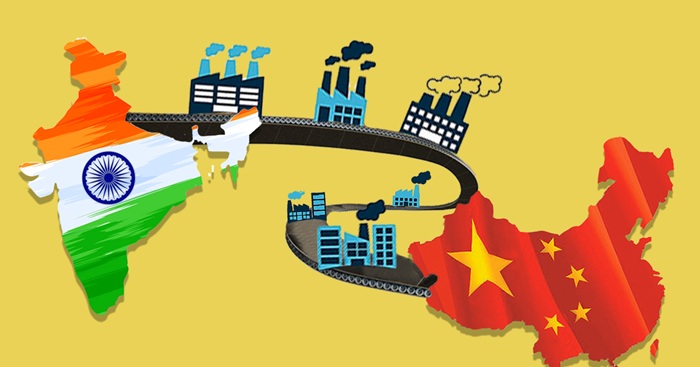
During February 2015, India exported 53.3 million kg of spun yarn to China and 14.9 million kg to Bangladesh. Of these, 53.2 million kg and 13.2 million kg respectively were cotton yarn. Among the 73 countries to which cotton yarn was exported in February 2015, Jordan paid the least and Japan paid the highest price.
However, such a wide variation may have occurred due to size of the volume, quality differentials, deliverability, and other technical aspects. But for China and Bangladesh, these qualifications are assumed to be neutral since the cargo-mix could be the same on an average.
Although China was the largest importer of Indian spun yarns, especially cotton yarn, it paid much lower than the second largest importer, Bangladesh. China was the largest importer of 32/1 cotton yarn. Export of 30/1 yarn to Bangladesh stood at 3.15 million kg and the same to China was 1.80 million kg.
Buyers in China are negotiating aggressively taking advantage of volume, which appears lacking in buyers from Bangladesh. Overall, higher volumes do have the advantage of getting equilibrium in cotton yarn pricing. In February 2015, China imported cotton yarn at 48 cents lower than Bangladesh.
Pakistan's Saud promises to boost to textile sector
The newly elected central chairman of All Pakistan Textile Mills Association (APTMA), Tariq Saud has sworn to restore the viability of textile industry to ensure growth and sustainability. Saud said that the country’s textile industry was set to invest $1 billion per year in case the government ensures a congenial environment to double exports in the next five years. He added that the government is expected to restore the confidence level of textile millers by announcing a textile package soon.
He assured the members that he and his team would do everything possible to take forward the agenda of growth and sustainability of the textile industry while ensuring regional competitiveness. He gave this assurance on the occasion of the 57th Annual General Meeting of APTMA during his maiden speech. Saud added that APTMA would be represented in the same fashion as it had been earlier on by previous management and stressed upon harmony and unity amongst APTMA members to resolve issues amicably.
Saud said it was unfortunate that the textile industry, which is mainstay of the economy, leading foreign exchange earner and employment provider through backward and forward linkages, was currently passing through unprecedented crisis. Thus, the capacity to produce $3.3 billion worth of exports was already closed. Saud is confident that the Prime Minister would announce a textile package for restoration of competitiveness in the international market and safeguard the textile industry in domestic commerce. This according to Saud, would drive industrialisation and economic growth. The much awaited textile package covers the entire textile value chain, he added.
Technical textile, the only country that can be a global player, is India'

In Europe, many technical textiles companies are facing takeovers. Why?
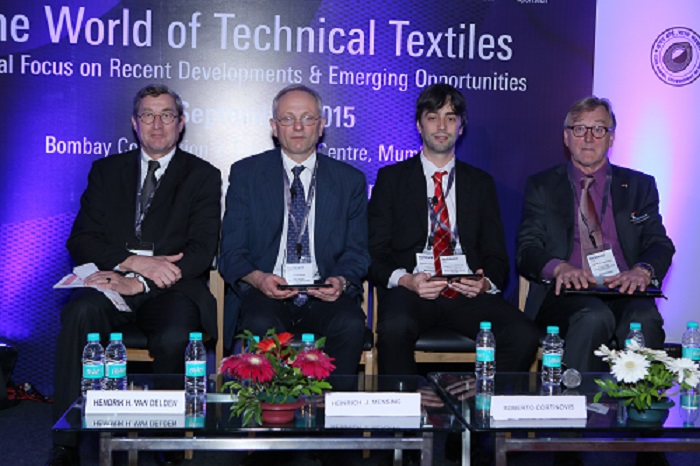
Takeovers are driven by two main reasons. One, large global players for example, US-based Polymer Group Inc (PGI), which is the largest producer of non-wovens has taken over non-woven producers like Fibertechs, and TEX and others. This is because on their customer side, they have global brands such as Procter & Gamble, Kimberley Clarke, Johnson & Johnson who ask suppliers to have a global presence. That’s a change driver. In the auto industry too customers are asking for global suppliers. And for many suppliers it is faster for them to become global if they make an acquisition.
The other driver is business. There many technical textiles companies in the world that report good results. EBIDTA, is a professional measure that financial investors talk about. In technical textiles we talk about EBIDTA levels between 12 and 25 per cent of sales, which is way above traditional textiles. And that attracts investors and family hoardings. So, the largest transaction that we’ve seen this year is Henkel in Germany, which is a large family hoarding, with a couple of billions in equity capital. They bought Bekaert, in Belgium. It is headquartered in Belgium, but is a global player in metra sticking. It is one of the the largest producer of metra sticking in the world. Then there are a lot of smaller transactions like, Innova, they buy smaller companies. The margins are so good that investors are attracted. Therefore, it’s either strategy driven, where one has to become global, and to expand they buy a company because it’s faster than building up a business yourself, or it’s financial reasoning.
Asia is in the forefront of technical textiles. Besides Vietnam and China, which other countries are emerging strong?
China is well-known. They have the advantage of being a centralised state, where the government decides and regions and private industries execute. They had an easy time to implement norms for the Olympic Games, to implement new textiles for the road, because it’s just a government decree. They also monopolised the world in certain raw materials, so, for eg, polyester yarn, which is one of the core raw materials for technical textiles is completely in their hands. However, they have reached their limit. In future, this can’t go on.
Korea is already doing well because of hi-tech fibres, a lot hi-tech companies, etc. However, Korea has only 40 million people. It’s half of Germany, which is a tiny country. They have done a good job of penetrating hi-tech or hi-end technical textiles, but with such a small domestic market, they cannot become a global player. Therefore, the only country that can become a global player is India because there are more than 1 billion people with at least 300 billion middle-class. And all these people will start buying cars and diapers for their babies, and visit private hospitals for treatment and surgery, which is by itself a huge market.
Globally, what is the share technical textile in total textile exports?
One of the difficulties in technical textiles is that it is not exported easily, other than, for e.g., if one makes cotton fabric for fabric printing in Indian dress fabric, which is a global commodity, which is easily exported. However, in technical textiles, there are a lot of trade- and non-tariff barriers, which make potential customers become wary of losing their product, but once this is overcome, they are fabulous export successes.
Turkey is going down, and India constantly goes up. There are many reasons for Turkey’s performance. The currency has appreciated and Turkish infrastructure for exports is bad, because from Turkey to go to European markets, one has to go by truck. Trucking costs are higher than shipping a container from Mumbai to Europe or from Mumbai to the US. Therefore, transport costs from and to Turkey, are much higher than India exporting to Europe or US. The other reason is appreciation of the Euro. The third reason is specifically for FIBCs. The world market leader that also owns two largest producers in Turkey has been taken over by US GREIF, and they are now shifting production to Middle East, which has created unrest in the personnel and the market has gone down. India is on the verge of becoming world number one.
Emerging and developed markets are doing well. How does progress in emerging markets affect the developed markets?
One thing is the local market aspect, as the GDP grows, middle-class grows—they want cars, medical treatment in decent hospitals, they want hygiene, proper environment, etc. As middle-class grows, it becomes an important vote share, it has higher disposable incomes, and technical textiles grow. Therefore, there is an almost automatic formula. It is not affecting the markets in Europe and US. On the contrary, lots of people buying Mercedes Benz in India is good for Europe. Exports from emerging countries to developed countries are growing, or imports to US and Europe from Asia are growing.
For example, laminated fabrics for digital prints, a lot of these fabrics come from Asia, especially China. It’s better for everybody because Asian rules demand western technology, so they buy machinery from Europe, US or Japan. Big brands such as Proctor & Gamble and Kimberley Clarke, etc., like it if there are more private hospitals such as the Apollo chain in India and if they have to buy certain staple technical textiles from India and China, it’s alright since it’s an exchange. There is no conflict in this industry as it was in the fashion industry, where textile for fashion has almost vanished in Europe or US. In technical textiles it’s a win-win situation.
What are the challenges and opportunities for technical textiles today?
The prospects are good for large domestic market. As Prime Minister Modi said that car production should go from three million to 10 million three fold growth. A car takes an enormous amount of textiles. Safety, fitting, tyres, etc., there’s textiles all over the car. Therefore, if that aim is achieved, the market will triple. If private hospitals do well, great opportunities open up in the domestic market. Exports, are slower as there is a prejudice and the prejudice has to be overcome in daily life But, some sectors have done it and we have role models, such as Welspun, this shows others we can do it.
The challenge is the need to import key raw materials from China. China has monopolised the world in certain raw materials. So, for a lot of raw materials you have to depend on China and that is not a happy situation. Therefore, it’s important to build competitive raw material bases like Korea.
Bangladesh RMG sector gets a boost from within
Sustained efforts are being made to create awareness among stakeholders to improve the image of RMG sector in B’desh, the main export earner, by the garment sector and allied business partners. Md Moshiul Azam Shajal, Director, BGMEA and Managing Director of Posmi Sweaters, points out that recently, training programs on health and safety were carried out in garment factories funded by International Training Centre-International Labour Organization (ITC-ILO) and organised by Bangladesh Employers Association, BGMEA and BKMEA.
However, increasing costs having a negative impact on the sector and to resolve this, it is necessary to decrease interest rates, reduce oil and gas prices. The US has removed Bangladesh from its GSP list of 122 nations. Experts believe the exclusion will hamper the garment sector from reaching its target $50 billion in export by 2021. According to an analysis on RMG sector, export to the US contributed only 0.5 per cent of Bangladesh's export and would not directly affect the overall quantity.
Compliance and safety issues in garment factories, is the main reason for expulsion. BGMEA, the government, and the garment companies have joined hands to find out a solution.
India-Egypt strengthen trade ties through INTEXPO
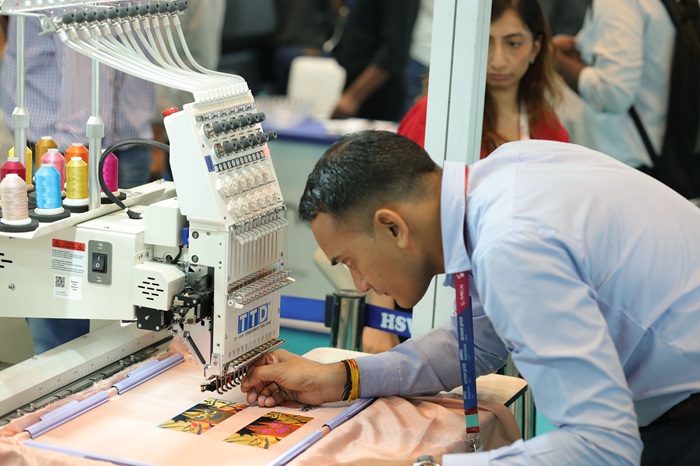
In a bid to strengthen trade between India and Egypt, particularly in the fast growing area of modern textiles, an Indian textile exhibition was organized in Egypt. The Synthetic & Rayon Textiles Export Promotion Council (SRTEPC) in association with the Embassy of India and with the active support of Cairo Chamber of Commerce (CCC) organised the event. The exhibition, Indian Textiles Exhibition in Egypt (INTEXPO Egypt), a four day event took place from October 1 to 4, 2015 at the Cairo International Conference Centre. Textile companies showcased their latest range of yarn and fabrics.
At the inauguration Sanjay Bhattacharyya, India’s Ambassador to Egypt said that there has been a partnership between India and Egypt for a very long time and there is widespread cooperation in textiles. India used to import cotton from Egypt and export garments to the country, he said.
Indian companies participating in the event showcased their latest range across suiting, shirting, dress materials, and embroidered fabrics/high fashion fabrics, furnishing, home textiles, scarves, stoles, shawls, and yarns of man-made fibres and their blends. The country’s clothing and textile industry output is $110 billion, of which around $40 billion constitutes of exports. During 2014/15, India exported around $360 million worth of textiles and clothing products to Egypt.
The aim of the exhibition was to forge a win-win partnership among the Indian and Egyptian companies for effective forward and backward business linkages in the near future.
www.srtepc.org
ILO, IFC to assess Bangladeshi factories to attract investments
The possible costs required for remediation of small and medium-scale apparel units in Bangladesh are now being calculated by the International Labour Organization (ILO) and International Finance Corporation (IFC). Launched last month, officials say, this joint exercise is part of the plan to help secure funds from different sources.
They added that a preliminary report is expected by the end of this month and the final report by the end of this year. The reports, they said can cite recommendations and a possible course of action. The two western retailers' groups expressed their concern over slow progress in remediation. The manufacturers had attributed this slow progress to crisis that delayed fixing problems in line with the corrective action plan (CAP). Apparel manufacturers said meeting the cost of remediation is a major obstacle for many factories.
Started last year, after completion of initial inspections by the western retailers, the programme is known as remediation. Around 3,000 garment factories have so far been assessed under the three initiatives-Accord, Alliance and the national initiative.
www.ilo.org
Bangladesh seeks waiver on jute imports to India
Bangladesh has appealed to India to withdraw the recent administrative notice barrier import of jute and jute products from Bangladesh, which is adversely affecting the former's economy. Tofail Ahmed, Bangladesh’s Commerce Minister raised this concern at a meeting with his Indian counterpart Nirmala Sitharaman recently. Need for registration at several levels of the trade process, placed on the country’s jute exports to India has upset Bangladesh.
The countervailing duties imposed on different goods imported from Bangladesh in spite of India's commitment to allow duty-free-quota-free access to almost all products needs to be waived, according to Ahmed. Officials accompanying Ahmed said he had instructed the officials for expeditious solution to the matter.
Besides, the process of construction of roads on Indian side to reap benefits of increased connectivity also needs to speed up as requested by the Minister. Ahmed further said that in the forthcoming 10th Ministerial Conference of WTO to be held in Nairobi, Bangladesh will seek service waiver and change in rules of origin in line with commitments made in Bali.
www.mincom.gov.bd
Pakistan's KCA announces new office bearers
For the year 2015-16, Khawaja Tahir Mahmood, Khawaja M Zubair and Syed Mohammad Sameer were elected unopposed as Chairman, Senior Vice-Chairman and Vice-Chairman of the Karachi Cotton Association respectively. They took charge from October 1, 2015.
Since 1980, Khawaja Tahir Mahmood, Managing Partner of Shafiq Enterprises and Proprietor of Cotpak International has been engaged in cotton ginning, export, related logistics and business process outsourcing. For several years, he has served as a member of the executive committee of the Karachi Cotton Association. He was even a member of the executive committee of Pakistan Cotton Ginners' Association in 1980.
Khawaja Tahir Mahmood was the information secretary and member, Managing Committee of Karachi Customs Agents Association during various tenures and member of the Cotton Inter Agency Committee (IAC) of EPB (now TDAP). Besides, he is also CEO-Country Head Pakistan of Control Union Pakistan, which is member of Control Union group.
Khawaja M Zubair of Baltic Control Pakistan meanwhile was Chairman and Vice-Chairman of the Karachi Cotton Association during 2013/14 and 2010/11, respectively. Besides, he was also member of the executive committee of the KCA for several years.
www.kcapk.org
Cambodia's union agree on wage reduction
Union representatives in Cambodia agreed to lower demands for wage hike in exchange for concessions from manufacturers, during ongoing negotiations over a new minimum wage for the garment sector. Concessions from the Garment Manufacturers’ Association in Cambodia (GMAC), though, were not forthcoming, according to those present in the meeting of Labor Advisory Committee. The GMAC stuck to an offer of a 3.5 per cent raise to the current monthly minimum wage of $128. Among themselves, unions agreed that they would seek $168, which is a significant reduction from the $207 that some were hoping for.
Mann Senghak, an adviser to the Free Trade Un¬ion said that they had decided to moderate their demand but also asked employers to raise their offer. He said that unions had agreed to reduce (their demand) from a 31.74 per cent (raise) to a 27.8 per cent (raise), so that it’s $163.58. He added that this would clear the way for workers to raise their offer.
However, he said, employers did not raise their figure at the table discussion, while they raised the issue of productivity and competition in the market, and maintained their stance of 3.5 percent. Senghak said if employers did not meet the unions’ concession with a higher figure, the unions would revert to their demand for $168.
Isko announces 'Denim Design Digital Contest' winners
The winners of second edition of 'Denim Design Digital Contest' were announced by denim fabrics manufacturer Isko. This contest is organised through its design and style research center, Creative Room. The Facebook page ‘I-Skool Denim Talent Awards’ followers were the ones to like and give their approval for their favourite outfit. They had to choose from shortlisted entries in the competition. The outfits received more than 7,000 votes in total and the winners took home sizeable metres of Isko denim fabrics.
Michal Hidas from Istituto Marangoni, received 45 per cent of votes and won 40 mt. of denim, bagging the first prize. Ilke Usluca from UAL bagged 15 per cent of votes and took home 25 metres of denim fabric, bagging the second place. Tobia Cecchin, also from IUAV, received 12 per cent of votes and bagged 15 metres of denim.
The third edition will involve more worldwide designs and marketing schools, which according to Isko, will create ferment in the fashion world. Major worldwide beacons in fashion education like UAL Chelsea, Esmod Munich, AMFI, AMD Academy for Fashion and Design, FIDM, Istituto Marangoni, were a part of the second edition. Besides, leading players of the denim industry participated in the project by providing their know-how to students.
www.isko.com.tr
More...
USDA expects cotton production to increase by 1.7 per cent
The USDA estimates global cotton production to grow by 1.7 per cent year-on-year from August to July 2016 to 23.7 million tons – a downward revision from the previous month’s estimate of 2.5 per cent growth. Meanwhile, the consumption estimate has also been significantly lowered from almost 25 million tons (2.8 per cent growth year-on-year) to 24.7 million tons (1.7 percent growth).
Accumulation of yarn stocks, lower yarn margins, and uncertainties regarding income growth in developing countries are “indicative of the challenges currently facing global cotton consumption,” says the report. Most of the blame falls on China.
China is the world’s foremost consumer of cotton and cotton yarn, and the primary export destination for a lot of developing countries including Pakistan. Recently, China made the decision to limit its cotton yarn imports and dig into its own stocks – Chinese cotton imports are expected to be an astounding 31 per cent lower in MY16, while consumption is expected to remain constant.
Chinese cotton production is also expected to be an estimated 15 per cent lower as compared to last year’s. With that said, India is expected to officially overtake China as the world’s foremost producer of cotton this marketing year, and a paradigm shift might be in the offing.
As for Pakistan, the USDA has revised down the production outlook by around 0.3 million bales to a decline of 5.7 per cent year-on-year, as opposed to last month’s estimate of 3.7 per cent decline. Previously, the government of Pakistan set a highly optimistic target of around 15.5 million bales, after the record production of over 14.8 million bales seen last year. However, due to heavy rains and floods destroying crops in the early days of August – not to mention growers missing the sowing target – the production target has been lowered to 13.3 million bales.
www.usda.gov
RSG to display specialized automation technology at ITMA 2015
For the first time, RSG Automation Technics, located within the high-tech metropolitan region of Stuttgart, is set to present its unique specialised automation technology at the ITMA 2015 in Milan.
The company offers innovative textile machinery, which can help customers significantly reduce their process costs thereby increasing product quality and production volume. Backed by over three decades of experience, the company offers tailor-made solutions and customer support, from the basic concept preparation to assembly and start-up assembled in Germany. Besides, as per customer requests and ideas, software is developed and optimised at RSG.
Both fully and semi-automated machines are offered by RSG along with patented monitoring techniques for different sewing processes. Concepts include technical textiles, such as filters, felts and fleeces and confectioning optimisation in the domain of home textiles, as well as solutions for narrow fabrics of any kind, such as belts and straps.
www.itma.com
Government to support Zambia’s textile factories
The best cotton in Africa is produced by Zambia and therefore, it has the potential to boost the local textile industry. Keeping this in mind the government has started promoting the establishment of textile factories that can create wealth and jobs for the locals since the two existing factories, Sakiza and Kariba, located in Zambia, are insufficient to promote the export of essential goods and services to other countries, points out Miles Sampa, the Deputy Minister of Commerce, Trade and Industry.
The government is also considering re-investing in Mulungushi Textiles to revive operations. The move is aimed at growing the textile industry that will reduce on the importation of goods and services. Sampa says the government is concerned with the low contribution of manufacturing industry to the country’s gross domestic product and the formal workforce. He further mentioned that the government would soon produce a list of goods and services that would be banned for import.
Gabriel Namulambe, Mpongwe Member of Parliament said exports would increase, which would in turn stabilise the Kwacha if the textile industry in Zambia is healthy. Mwalimu Simfukwe, Mbala Member of Parliament also said that the country’s economy would benefit from the ban on importation of some goods that can be produced in Zambia. www.mcti.gov.zm
Pakistan’s cotton tender fails
The Trading Corporation of Pakistan (TCP) failed to attract textile mills or traders for cotton procurement as its sixth cotton tender did not fetch a single bid. Textile mills were reluctant to procure cotton from the state-run grain trader and there was no participation in the consecutive second tender announced by TCP to offload cotton stocks procured from the domestic market to facilitate farmers.
The Federal Board of Revenue imposed a 10 per cent advance tax on cotton procurement from TCP due to which textile mills and traders are reluctant to procure cotton from TCP. As per the tender condition, successful bidders are required to pay an advance tax at the rate of 10 per cent, which will be later adjusted in their annual tax returns.
TCP issued the sixth cotton tender on September 18, 2015, for the sale of 84,600 cotton bales and accordingly the tender was opened on September 30, 2015, at the corporation's head office. In response to TCP's sixth cotton tender not a single buyer or textile mill or trader participated in the tender.
In order to stabilise cotton prices in the domestic market, the federal government, in November last year, asked TCP to procure cotton from ginning factories to facilitate farmers. Accordingly TCP procured 96,000 cotton bales from ginners.