Istanbul Fashion Connection to be a global hub for the industry
From August 20 to 22, 2025, the 8th annual IFCO – Istanbul Fashion Connection will welcome over 250 exhibitors and over 30,000 trade visitors from over 100 countries.
The event will showcase all segments of the industry, including menswear, womenswear, kidswear, denim, shoes, accessories, activewear, and homewear.
Womenswear will be the largest segment with 125 exhibitors. It will feature brands from premium to mass-scale production, including İpekyol, a top brand known for its modern, high-quality, and quickly delivered feminine fashion.
The creative center of the event is TheCore Istanbul, which will highlight 24 of Turkey’s most influential designers, such as Arzu Kaprol, Mehtap Elaidi, Hatice Gökçe, and Sudi Etuz. These designers are keys to establishing Turkish design on the international stage.
The menswear section will feature brands like DS Damat, Kiğılı, JAKAMEN, Sabri Özel, UCLA, and NCS, showcasing men's fashion that blends traditional tailoring with modern market trends.
Kidswear will be represented by 21 exhibitors offering trendy, high-quality collections focused on design, comfort, and sustainability.
With its expanded list of exhibitors, curated trend areas, high-profile runway shows, and a diverse seminar program, IFCO solidifies its position as a strategic B2B platform connecting Europe and Asia. The event's location combines cultural inspiration with direct business opportunities in a unique way.
Shein’s UK business reports 32.3 per cent rise in sales in 2024
As per a recent financial filing by Shein, the fast fashion e-commerce company’s UK business generated $2.77 billion in sales in 2024, marking a significant 32.3 per cent increase from the previous year. This growth comes as the company continues to pursue an initial public offering (IPO) in Hong Kong.
Founded in China and now headquartered in Singapore, Shein has faced considerable obstacles in its long-running bid to go public. After unsuccessful attempts to list in both New York and London, the company has also struggled to get approval from China's securities regulator for an overseas IPO. These challenges are unfolding against a backdrop of rising tensions between China and the U.S.
Shein's UK arm, Shein Distribution UK reported a 56.6 per cent rise in pre-tax profit to $48.5 million from the prior year. The company highlighted several key milestones from 2024, including a successful pop-up shop in Liverpool, a Christmas bus tour that visited 12 UK cities, and the opening of two new offices in London and Manchester.
Known for its deeply discounted prices, constant promotions, and coupon offers, Shein has been gaining market share from competitors like ASOS and H&M. This trend has been fueled by surging inflation, which has led consumers to seek out more affordable fashion options.
Shein has also diversified its offerings beyond apparel to include everything from toys and craft supplies to home storage units. The company has benefited from customs duty exemptions on low-value e-commerce packages, which allows it to ship goods directly from Chinese factories to customers with minimal tariffs.
However, this advantage is now at risk. The US has already eliminated its ‘de minimis’ exemption for parcels under $800, and the European Union plans to remove its equivalent waiver on parcels under 150 euros. Britain is also reviewing its policy, with local retailers arguing that the current system gives online players like Shein and Temu an unfair advantage.
From sorting tables to spinning mills charting the afterlife of fabrics

At first glance, the infographic from Eco TLC (now Refashion) looks like something out of an engineer’s fever dream, a maze of arrows, boxes, loops, and branching paths. “Have you understood anything? Me neither!” read a recent social media post alongside the diagram, echoing the bafflement of many first-time viewers. Yet behind this visual labyrinth lies a powerful truth: the textile recycling ecosystem especially for specialized, “technical” fabrics is complex, often inefficient, and urgently in need of a circular overhaul.
The evolution of the refashion map
The diagram in question, developed by Eco TLC before its transformation into Refashion, France’s official eco-organization for managing the end-of-life of textiles, linens, and footwear, is far more than a jumble of lines. It is, in fact, a meticulous map of textile afterlives, reflecting years of research, stakeholder collaboration, and data gathering. Its complexity mirrors reality. From humble cotton shirts to fireproof industrial uniforms, each textile follows its own journey once discarded. And that journey is rarely straightforward.
Zone 1, sorting for a second life
The infographic’s first ‘zone’ is all about preparation the moment when collected textiles are given a fighting chance at survival.
Sorting and categorization is the first stop where materials are separated by fiber type, blend, and condition. This isn’t busywork; accurate sorting dictates whether a textile can be reused, mechanically recycled, or must face more energy-intensive processes.
Reuse channels offer the greenest path garments in good condition become second-hand clothes, industrial wiping rags (‘hiffons d’essuyage professionnels’), or creatively upcycled goods (‘assemblages de coupons’). For items that can’t be worn again, there’s fibre preparation or shredding (effilochage) or defiberizing (défibrage) them to recover usable fibers for the next stage.
Zone 2, transformation into new materials
Once prepared, textiles enter the second zone that is transformation. Here, technology takesover.
Mechanical recycling: Processes like carding (cardage) and spinning (filature) turn old fibers into new yarns for clothing, geotextiles, or insulation.
Chemical recycling: Depolymerization and enzymatic dissolution can break synthetic fabrics back into their molecular building blocks, producing virgin-quality fibers, which is a lifeline for polyester-heavy waste streams.
Composite & industrial uses: Recycled fibers can be pressed, molded, or granulated into everything from building insulation to automotive interiors. In some cases, textile waste is even used as solid recovered fuel, a less sustainable last resort.
The circular loops at the diagram’s heart show the gold standard that is textile-to-textile recycling, where fabrics are reborn indefinitely without depleting virgin resources.
When the fabric fights back, the PPE problem
The system already strains under the complexity of conventional garments. Add technical textiles like PPE (Personal Protective Equipment) fire-resistant jackets, waterproof workwear, multi-layered safety gear and things get far harder. These materials, engineered to be nearly indestructible, stubbornly resist breakdown. As a result, almost 90 per cent of PPE ends up incinerated or landfilled despite its durability. The very qualities that make them life-saving in the workplace make them a nightmare for recyclers.
Beyond infrastructure a culture shift
The Refashion diagram’s accompanying text asks a deceptively simple question: “What if we thought before throwing it away?” This reframes the conversation. Recycling isn’t only about high-tech facilities; it’s also about frontline responsibility from individuals to corporations. Practical steps include:
• Inventory your waste which means know what’s being discarded.
• Think internal reuse that is could a uniform too worn for public use, be repurposed for in-house tasks?
• Repair first as it extends an item’s life before replacing it.
• Transform creatively this involves upcycling materials into different products, even for unrelated uses.
Thus the textile economy today largely follows a take-make-dispose path. The Refashion diagram however intimidating at first is a visual blueprint for change. Moving toward a viable circular model means designing for end-of-life from the start, creating infrastructure for hard-to-recycle materials, and embedding repair, reuse, and upcycling into corporate and consumer habits.
The map may look chaotic, but its message is crystal clear: every arrow represents a choice, every loop a chance to keep fibers alive. In the textile world’s complex web, the challenge isn’t just to untangle the threads — it’s to keep them spinning forever.
Gartex Texprocess India 2025 to feature over 200 exhibitors and 600 brands
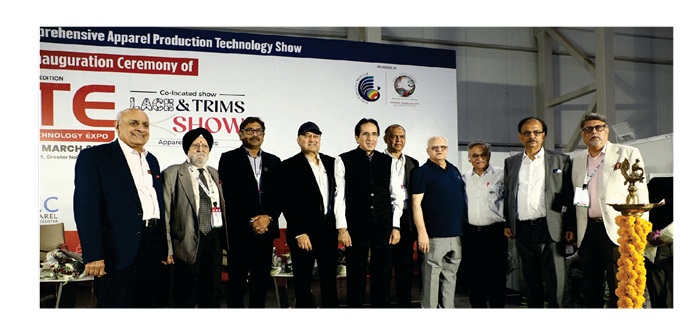
The upcoming edition of Gartex Texprocess India Expo will feature over 200 exhibitors and 600 brands including international companies from China, Japan, Italy, Germany and Singapore.
Scheduled to be held from August 21-23, 2025, at Bharat Mandapam in New Delhi, the expo will be organized by MEX Exhibitions and Messe Frankfurt Trade Fairs India. It will provide a major platform for the garment, textile, leather, and denim industries.
Spanning across 150,000 sq ft, this year’s event will have several dedicated ones like The Denim Show, the Fabrics andTrims Show and Screen Print India. Around, 35 per cent of the exhibitors will be participating for the first time.
This the scope of the show will be broadened by two new additions. The inaugural LeatherX Pavilion will create new opportunities for collaboration in sectors like leather processing, fashion accessories, and footwear. This new zone is a strategic move to integrate complementary industries and meet a wider range of industry needs.
Another key feature is the Textile Care Forum, a knowledge session organized in partnership with the Drycleaners and Launderers Association of India. Scheduled for the second day of the expo, this forum will focus on sustainable practices, including how washing and finishing processes affect a garment's lifecycle and environmental footprint. Discussions will also cover EPR guidelines, green chemistry, and smart automation in the laundry and dry-cleaning industry.
Over the past decade, Gartex Texprocess India has expanded significantly, moving from a focus on garment machinery to a more comprehensive scope that includes knitting, embroidery, digital printing, sewing technologies, trims, and e-commerce solutions. This year's expanded format, with the addition of the LeatherX Pavilion and the Textile Care Forum, offers a 360-degree view of the industry, from raw materials to finished goods.
With the Indian denim market showing strong growth - projected to reach USD 3.86 billion by 2030 - the co-located Denim Show will be a critical hub for industry stakeholders to network and drive business. The expo aims to highlight Indian capabilities on a global stage, solidifying its role as a key sourcing and networking destination.
US delegation emphasizes aligning Bangladesh labor law with international standards
In a meeting with Mahmund Hasan Khan, President, BGEMA, a delegation from the US Embassy in Dhaka reiterated the importance of aligning Bangladesh's labor laws with international standards .This expectation was shared earlier by the International Labour Organization (ILO), the European Union, and other development partners.
The US delegation included Leena Khan, Labor Attaché; Paul G Frost, Foreign Commercial Service Attaché; and Erin Covert, Foreign Agricultural Service Attaché. Both sides agreed to maintain close communication on labour-related issues to ensure clarity and avoid misunderstandings.
Discussions also focused on strengthening bilateral trade and expanding Bangladesh's exports to the US market. A key topic was a recent US executive order allowing garments from Bangladesh to receive a proportionate exemption from an additional 20 per cent duty - provided that at least 20 per cent of raw materials used are sourced from the United States.
Welcoming the initiative, Khan said the industry is keen to access this facility. He also sought clarification on the formula for calculating the US-origin raw material content and emphasised the need for transparency and traceability across the supply chain.
BGMEA leaders proposed setting up a warehouse near Chattogram Port to facilitate the import of US cotton. To be initiated by Bangladesh, the United States, or as a joint venture, the proposed facility aims to reduce lead times in the country's readymade garment (RMG) sector.
In addition to cotton, BGMEA expressed interest in importing man-made fibers such as polyester and nylon, if available from the US textile industry. Frost assured, the embassy would engage relevant US departments and share further information.
The meeting also touched on collaboration with the US Cotton Council and addressed domestic challenges, including gas and electricity shortages. BGMEA leaders voiced optimism about potential future imports of liquefied natural gas (LNG) from the United States. Khan said since assuming office, his board has engaged with 81 workers' federations to promote harmonious industrial relations and has advanced legal reforms to safeguard workers' welfare.
The US side also encouraged BGMEA to participate in SelectUSA, a major investment promotion event scheduled for May 2026, as a platform to boost exports and connect with American buyers.
Gap Inc approves $0.165 per share dividend for Q3, FY25
The Board of Directors of Gap Inc has approved a dividend of $0.165 per share for Q3, FY25. The dividend is payable on or after October 29, 2025, to shareholders of record at the close of business on October 8, 2025.
Gap Inc. is the largest specialty apparel company in the US and a purpose-driven house of iconic brands. Its brands - Old Navy, Gap, Banana Republic, and Athleta - offer clothing, accessories, and lifestyle products for men, women, and children. These products are available worldwide through company-operated and franchise stores, as well as e-commerce sites. Since 1969, Gap Inc. has been creating products and experiences that shape culture while committing to doing right by its employees, communities, and the planet.
Asics Q2, FY25 sales in EMEA region rise by 17.5%
Asics has reported strong financial performance in its EMEA (Europe, Middle East, and Africa) region, with quarterly sales increasing by 26.6 per cent in Q2, FY25. The growth was seen across all channels, with a particularly strong performance in wholesale, which saw a year-on-year increase of 36.8 per cent.
Asics' sales in North West Europe grew by 58.4 per cent in Q3, FY25 while sales in North East Europe increased by 36.6 per cent. The company's success in EMEA was driven by profitable growth across all categories, with SportStyle seeing particularly strong growth of 52.9 per cent Y-o-Y. Asics remained the top premium performance-running brand in Europe. The brand saw growth across all sales channels, including wholesale, its own retail stores, and e-commerce.
Following the strong quarterly results, Asics revised its financial targets for its Mid-Term Plan 2026 (MTP 2026), now aiming for an operating profit of at least ¥130.0 billion as against the previous target of ¥80.0 billion and an operating margin of at least 17 per cent (up from around 12%). This indicates a strong confidence in continued growth.
USGBC grants South End Sweaters LEED Platinum certification
A sweater unit of Team Group, South End Sweaters has been granted LEED Platinum certification by the United States Green Building Council (USGBC).
This achievement makes the company, the 258th USGBC-certified green garment factory in the country. Of these, 109 have Platinum status, 133 are Gold, 12 are Silver, and 4 are Certified.
To achieve Platinum status under USGBC standards, factories must score at least 80 out of 110 points. South End Sweaters earned 85 points. A score of 60–79 is needed for Gold, 50–59 for Silver, and 40–49 for Certified status.
With South End Sweaters, Team Group now operates three LEED-certified factories. The others are its outerwear unit, 4A Yarn Dyeing (LEED Platinum), and its woven unit, Brothers Fashion (LEED Gold).
Notably, 4A Yarn Dyeing is the world’s first outerwear manufacturing company to become a signatory to the Fashion Industry Charter for Climate Action, which was convened by the UNFCCC.
Abdullah Hil Nakib, Deputy Managing Director, Team Group, says, the company has always aimed to set benchmarks not only in business standards but also in sustainability. Their efforts to achieve LEED certifications are a testament to their commitment to environmental sustainability.
Brazil launches ‘Sovereign Brazil’ for exporters impacted US tariffs
The Brazil Government has launched a new plan to support local exporters impacted by the 50 per cent tariff imposed by US President Donald Trump. Named ‘Sovereign Brazil,’ the plan includes a series of measures designed to help companies endure the economic shock.
President Luiz Incio Lula da Silva introduced the initiative as a crucial first step to assist affected businesses. The highlight of the plan is a substantial credit of 30 billion reais ($5.5 billion) to provide financial stability for exporters. Additionally, the government will postpone tax charges for companies hit by the tariffs and offer 5 billion reais ($930 million) in tax credits specifically for small and medium-sized businesses until the end of 2026. The plan also expands access to insurance against canceled orders, offering another layer of protection for exporters.
Lula emphasizes, the tariffs are an opportunity for the country to innovate, stating, the crisis will help them create new things.
Beyond financial aid, the ‘Sovereign Brazil’ plan encourages public institutions to prioritize purchasing goods that can no longer be exported to the US. This measure aims to create a domestic market for products that would otherwise struggle to find a buyer, helping to maintain production and employment levels.
With these comprehensive measures, the Brazil Government hopes to mitigate the economic fallout from the US tariffs and support its export-driven industries during this period of trade uncertainty.
BEPZA, Kaixi Garments Bangladesh to build new intimate garments facility in Dhaka
The Bangladesh Export Processing Zones Authority (BEPZA) and a Kaixi Group subsidiary Kaixi Garments Bangladesh have signed a $40.05 million agreement to build a new intimate garments and accessories facility. This new factory will be located in the BEPZA Economic Zone (EZ) at the BEPZA Complex in Dhaka.
To produce 18 million pairs of lingerie and undergarments and 20 million bra foams and cups annually, the new facility is expected to create 3,003 local jobs.
Major General Abul Kalam Mohammad Ziaur Rahman, Executive Chairman, BEPZA, states, Kaixi Group’s decision to reinvest just over a year after beginning its first operations shows increasing confidence from foreign investors in the zone.
Approved in November 2022 with a $60.85 million investment, Kaixi’s initial BEPZA EZ venture started production in June 2024 and employs about 3,700 workers. With operations now in both the Dhaka EPZ and the BEPZA EZ, the group supports around 6,000 jobs in total. The authority’s largest initiative, the BEPZA EZ has so far attracted more than $1 billion in investments from 45 companies, with four already in commercial production.
More...
US’ T&A exports declines 2.7% Y-o-Y in value in H1, FY25
Continuing the declining trend seen in recent years, US textile and apparel (T&A) exports fell by 2.7 per cent Y-o-Y in value to $11.2 billion during H1 FY25 spanning January-June 2025.
The decline wasn't uniform across all product types. While apparel exports increased in volume, fabric and yarn exports declined, suggesting a shift in the composition of US exports.
A significant factor contributing to this volatility and decline is uncertainty surrounding tariff policies. Recent tariff hikes, particularly those targeting a major export partner like India, have been cited as a cause for concern among exporters, leading to a halt in some production and orders.
In contrast to the exports decline, the US’ T&A imports rose by 4.3 per cent in value to $51.4 billion during the period. This indicates a growing trade deficit for the sector.
Despite the overall decline, T&A exports by some countries like Bangladesh, Vietnam, and India to the US saw robust growth in H1, FY25. This highlights a shift in global supply chains and sourcing patterns.
In summary, the US textile and apparel sector faced headwinds in H1, FY25, with a notable decline in exports driven by factors like trade policy uncertainty and a shift in global market dynamics. At the same time, imports into the country grew, widening the trade deficit in this sector.
UK retail sales rise 2.5% Y-o-Y in July 2025: BRC-KPMG report
UK retail sales rose by 2.5 per cent Y-o-Y in July 2025 accompanied by a strong’ consumer card spending, particularly in clothing. However, industry leaders say, the growth ‘barely touches the sides’ of the £7 billion in new costs from the latest budget.
The uptick in UK retail sales was against the 0.5 per cent growth observed last July and the 12-month average growth of 1.9 per cent, according to British Retail Consortium (BRC)-KPMG data.
Helen Dickinson, CEO, BRC, says, with sales growth at these levels, it is barely touching the sides of covering the £7 billion new costs imposed on retailers at the last Budget.
If the upcoming Autumn Budget sees more taxes levied on retailers’ shoulders, many will be forced to make difficult choices about the future of shops and jobs, and ongoing pressure would push prices higher.
Ultimately, this means more families struggling, particularly those on lower incomes, reduced consumer spending and a drag on economic growth.
Separate figures from Barclays show, consumer card spending grew 1.4 per cent Y-o-Y in July 2025 up from a decline of 0.1 per cent in June 2025 - with discretionary spending up 2.4 per cent as changeable weather led shoppers to both sunny and rainy day activities and items.
Barclays found clothing performed strongly, rising by 4.2 per cent, while growth in online retail spending excluding groceries reached 4.9 per cent, up from 2.4 per cent in June, as shoppers made the most of discounted items and sales events including Prime Day.
However, confidence in the UK economy’s strength dipped once again in July, falling three points 22 per cent M-o-M to 22 per cent, the lowest level seen since January.
Karen Johnson, Head-Retail, Barclays, says, the summer sales, changeable weather and shoppers seeking the 'feel-good factor led' to a strong July for retailers, particularly among beauty, clothing and furniture stores.
While confidence in the UK economy remains subdued, prudent money management, supported by the growing popularity of AI tools to help with budgeting, is contributing to a continued resilience in personal and household finances, she adds.
Kimberley Cotton Gin opens in Kununurra, Australia
Owned by the Kimberly Cotton Company, the $60 million Kimberley Cotton Gin cotton gin facility has officially opened in Kununurra, Australia, heralding a new era for the region's cotton industry.
The new facility will eliminate the need for local farmers to transport their cotton over 2,175 miles (3,500 k,) to Queensland for processing. This move is expected to significantly cut costs and streamline operations.
According to Daniel Draheim, Construction Manager, Namoi Cotton, the project is a game-changer as a big part of cotton and growing cotton is logistics. The processing facility will provide the capacity for the already successful industry to expand, he notes.
The facility is slated to initially process between 100,000 and 120,000 bales annually and is projected to create more than 1,000 jobs over the next decade. Cotton grown in the area will not only be processed locally but also exported through the nearby Wyndham Port.
Tony Chafer, CEO, Cambridge Gulf, states, the port is working to secure First Point of Entry status to handle container imports—a crucial step that will facilitate cotton exports. During a visit to Kununurra in January, Prime Minister Anthony Albanese announced the federal government's support for granting First Point of Entry status to Wyndham Port. The Western Australian government has also pledged $14 million to upgrade port infrastructure.
Madeleine King, Federal Resources Minister and state government representatives were among the hundreds who attended the official opening of the Kimberley Cotton Gin. The federal government's $34 million loan through the Northern Australia Infrastructure Facility (NAIF) will be the most impactful, notes King. Built on a 196-acre (79.4-hectare) site, the gin operates entirely on hydro-electricity, making its power supply 100% renewable.
Oeko-Tex Summit & Exhibition 2025 scheduled from December 9-10, 2025 in Mumbai
Ohenstein India plans to host the Oeko-Tex Summit & Exhibition 2025 in Mumbai from December 9–10, 2025, at the Bombay Exhibition Centre (NESCO). This summit will bring together global Oeko-Tex standards with India's dynamic textile, leather, and footwear sectors.
The event will act as a powerful platform for stakeholders across the entire value chain - from raw material producers to final product manufacturers - to explore sustainable solutions and forge new international partnerships. It will feature eleven pavilions dedicated to various product categories, including fibers, yarns, fabrics, garments, and home textiles. The event will also feature a special International Pavilion housing global certifiers, experts, and regulators, making it a truly global affair.
The summit is particularly beneficial for professionals involved in buying, sourcing, merchandising, production, and compliance, especially those who export to major markets like Europe, the US, the UK, and Australia. It provides a unique opportunity to network with Oeko-Tex certified supply chains, source compliant and innovative materials, and showcase sustainable manufacturing capabilities. High-value knowledge sessions and panel discussions will offer the latest insights into compliance, traceability, and transparency.
Vinod Kumar, Managing Director, Hohenstein India & SL, highlights, the even aims to strengthen India's integration into the Oeko-Tex certified global supply chain from Fibre to Fashion.’ The summit will promote sustainable choices and serve as a platform for industry players to ‘source, share, and grow,’ he emphasizes.
The Oeko-Tex Summit & Exhibition 2025 promises to be a hub where innovation meets influence, offering attendees exclusive visibility and engagement with key decision-makers. It provides a prime opportunity for business growth within the certified textile market and a chance to build new global partnerships that will drive the future of sustainable textile production.