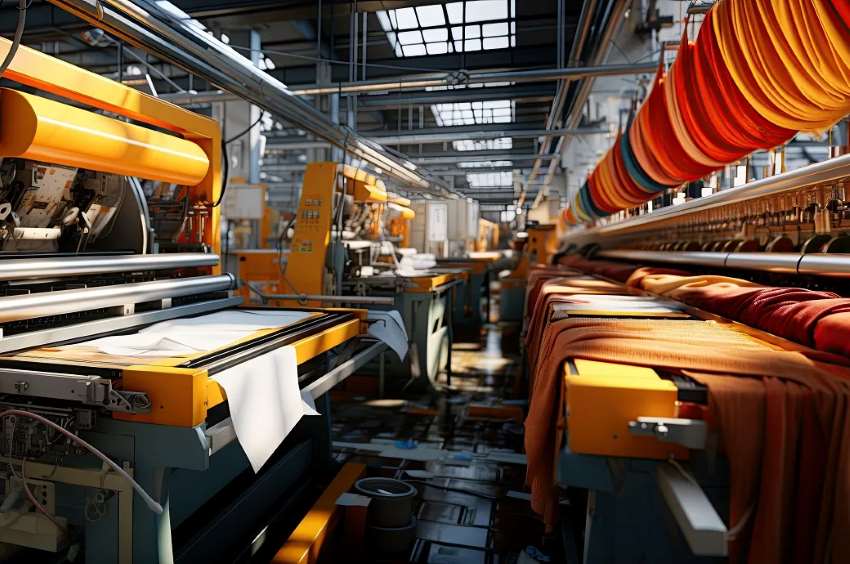
The Indian warp knitting industry is scattered in different pockets like Mumbai, Surat, Delhi, Ludhiana and Amritsar mainly producing two- and three-bar tricot fabrics. The main application areas are women’s dress material and saris, lingerie and outerwear, furnishing fabrics, shoe fabrics, automotive fabrics, agro textiles and interlinings.
Demand for warp knitting machines continued to grow due to the huge consumption for warp knitted fabrics in the domestic market. Warp knitting is by far the most versatile and a high productive fabric production system in the textile industry. Although this industry has been present in India for many decades, it is not widely known or popular like other fabric forming processes such as weaving and circular knitting.
Warp knitted fabrics can be produced in various structures such as rigid and elastic, open or closely knit structures, in flat or tubular or also in three dimensional form. The fabric widths can go up to 6.6 meters or even in multiple of this width if it is a net structure.
Warp knitting machines are mainly classified in two sections or groups – Tricot and Raschel. Basic knitting elements on the Tricot machines are guides, needle, tongues and compound sinker and those on the Raschel machines are guides, needles, tongues, stitch comb bar and knock over comb or trick plate.
- 1
- 2
- 3
- 4
- 5
- 6
- 7
- 8
- 9
- 10
The new Brussels rulebook, every EU apparel order is now a balance-sheet risk
The humble export order sheet is undergoing a transformation. What was once a straightforward commercial instrument: SKU, volume, FOB price,... Read more
Why 2026-27 could be a defining cotton year for India’s farm-to-fashion economy
The global cotton economy is entering a more constrained phase, and for India, the implications run far beyond the farm... Read more
Luxury resale’s next big battle is no longer digital, it is about who controls s…
For nearly a decade, the luxury resale story was written in the language of platforms. Market leadership was measured by... Read more
Digital Arms Race: Indian apparel giants deploy AI to neutralize tariff crisis
The Indian textile and apparel sector is in a digital survival phase in 2026, shifting from traditional labor-intensive models to... Read more
Europe’s Textile Endgame: Why Project FAE is becoming fashion’s most critical in…
Europe’s apparel majors are no longer treating circularity as a branding layer. With Project FAE or Feedstock Activation Europe, the... Read more
Engineering color at source, dye-free production is cutting cost, water, and tim…
For over a century, coloring has been anchored in wet processing, an energy-intensive, chemically saturated stage that happen post spinning.... Read more
The €11 bn deadlock, can Europe’s textile recycling catch up?
Europe is at a tipping point. Fast fashion consumption, led by rising incomes and a growing global middle class, has... Read more
From field to fiber, Bharat CottonNet is closing India’s cotton value gap
India’s cotton economy is entering a decisive phase of reform with the rollout of Bharat CottonNet 2026 along with the... Read more
US apparel imports drop 13.5% as Vietnam gains and China’s grip breaks
The US apparel sourcing market has entered 2026 with a sharp demand decline but an equally important shift in supplier... Read more
H&M finds growth below revenue line as margin discipline pays off
H&M Group’s latest quarter signals a decisive shift in global fast fashion: scale is no longer the primary reason for... Read more