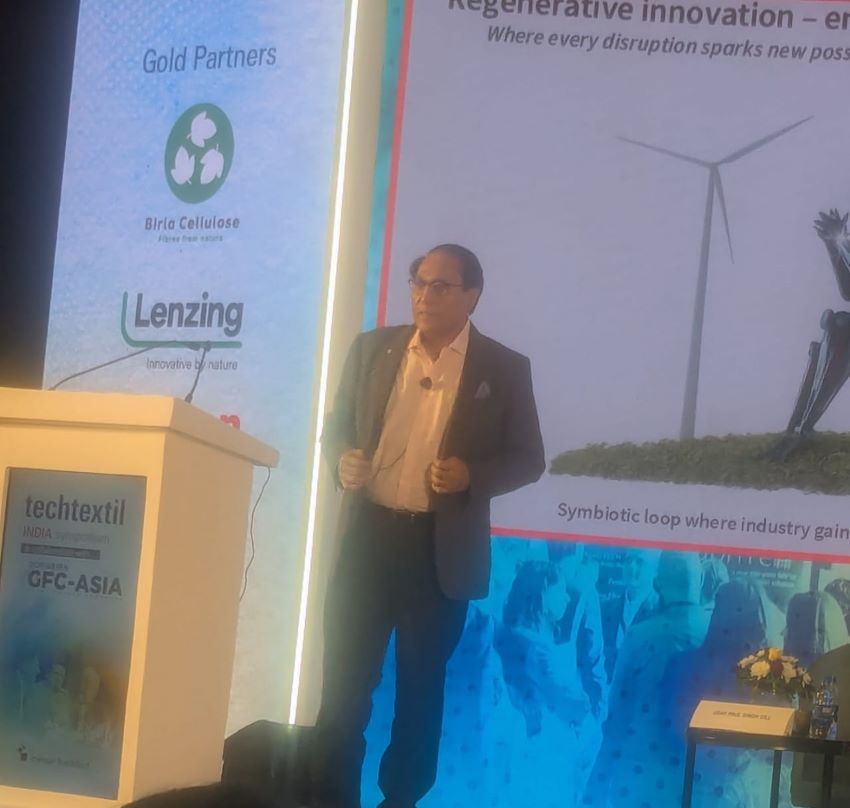
The global textile industry is at a crossroads where mere efficiency and profit no longer guarantee survival. This was the central message delivered by Uday Paul Singh Gill, Senior Partner at Gherzi Consulting, Zurich, during his keynote address at the Dornbirn Global Fibre Congress (GFC). He argued that long-term success requires a fundamental shift in mindset, prioritizing regenerative innovation that balances profit with purpose.
The Innovation Paradox: Unintended consequences
Gill challenged the traditional view of innovation, pointing out that some of the greatest scientific achievements have led to profound environmental damage. "I have worked in polyester all my life. But yet, polyester is said to be the miracle of science. And we didn’t know that the solution to the fibre industry by polyester can end up in creating microplastics."
He used the invention of the combustion engine and the widespread use of polyester, which fragments into microplastics, as classic examples of how innovation, when unchecked by purpose, leads to "highly unpredictable, unintended consequences." He concluded that the new mandate is to put "purpose and discipline on innovation" to ensure it benefits humanity and the planet.
The call for ‘Regenerative’ innovation
The key to long-term survival, according to Gill, is regenerative innovation—a system that moves beyond just being "less bad" to being actively good for the environment and the community.
This concept demands the creation of symbiotic groups where:
● Industry prospers.
● Nature benefits.
● The community is prosperous.
Gill stressed that simply scaling up ideas or achieving cost efficiencies is no longer enough. Instead, innovation must create lasting value, not just profit, by leveraging the convergence of three major domains: physical, digital, and biological.
Surviving the shortening corporate lifespan
The speaker warned that as the pace of disruption accelerates, the average lifespan of corporations is shrinking. Companies that fail to continuously renew themselves will become obsolete, much like Blackberry or the Indian TV company Onida, which failed to adapt to digital technology.
Gill linked this instability directly to inefficient resource deployment and overcapacity, stating that innovation is required when "scale out grows demand." The solution lies in creating a strategic architecture for resilience and "first time right execution."
The brain economy and human centricity
Perhaps the most thought-provoking argument centered on the "Brain Economy," which focuses on capturing and leveraging human cognitive surplus. Gill criticized modern workplaces for pushing humans to work like machines while simultaneously trying to make machines think like humans."We are pushing the humans beyond their limits and stretching them to work like machines. Whereas at the same time we are trying to make the machines think and work like humans. So this is why I think we are going wrong on both sides."
For regenerative innovation to succeed, the human element—creativity, well-being, and mental state,must be superior and agile, working on top of the machines, not beneath them.
Finding the "Sweet Spot" for sustainable profit
Gill’s strategic recommendation for manufacturers looking for long-term survival was to integrate their value chain to find the "sweet spot" between scale and value.
● Commodity Model: High scale, low profitability, high volatility.
● Speciality Model: High overheads, inconsistent profitability.
● The Sweet Spot: Integrating the chain to combine the best aspects of scale and specialty, resulting in improved earnings quality and long-term viability.
He concluded with an urgent call to action, emphasizing that the time for incremental change is over. Successful innovators are those who execute their ideas sustainably and fast, making it clear that, going forward, the industry must prioritize the planet first, the people first, and then the profit.