FW
E-com to support Indian artisans
Indian artisans may soon be able to sell their products through e-commerce platforms and cater to a larger market. A list of 200 products that will be sold on e-commerce platforms has been drawn out. Some handicrafts and handloom products, such as Madhubani paintings from Bihar, tribal paintings from Jharkhand, terracotta items from Rajasthan and tussar silk wear from Bhagalpur, made by rural artisans, mainly women entrepreneurs, are already being sold online. The initiative is now being expanded to products such as folders, pen holders and gift items. Coming on to the e-commerce platform is expected to help artisans get larger volumes and better prices for their products even after parting with at least 40 per cent of the revenue to these sites as seller charges.
A dedicated value chain development center, with about five regional offices, will be set up to provide complete value chain solutions to rural artisans. This will provide artisans technical assistance as well as help in designing and packaging of products to enhance their global appeal.
Producer companies will be set up in select clusters. At present, rural artisans sell their products through central and state exhibitions or directly through traders, besides catering to local demand restricted to their own districts.
EU trade deal may challenge Vietnam
Vietnam's newly signed free trade deal with the European Union (EVFTA) presents both a huge opportunity and a logistical headache. Garments, worth around 10 per cent of Vietnam's exports and currently subject to EU tariffs of around nine per cent, will be by far the biggest beneficiary of the FTA. The tariff-slashing free trade agreement promises to bring an influx of orders and pave the way for Vietnamese garments to dominate the European market. The FTA will reduce duties on nearly half of all garment products to zero.
However, staff shortages have already started to manifest in Vietnam's garment industry, where the vast majority of manufacturers are focused on labor-intensive sewing and cutting processes. Factories’ demand for workers has increased by seven per cent since 2018. The industry lacks human resources especially high-level employees who have specialised skills. Finding people to operate dyeing or weaving machines is one thing. These are workers and can be trained. But finding experienced chemical engineers with a thorough knowledge of chemistry and dyeing is another. Also, European garment manufacturers feel the agreement will pave the way for cheap Chinese textiles to enter the European market after being transformed into garments in Vietnam. The EU is Vietnam’s second largest garment market after the United States, accounting for 15 per cent of the country’s total garment exports.
BPD Expo in New York highlights green techniques
BPD Expo was held in New York City, July 24, 2019. Comfort and sustainability were woven into every detail, from the seed paper marketing materials to the in-house CBD installation. Exhibitors showcased their top selling denim, most of which featured eco-friendly, ultra soft fabric that felt less like a pair of jeans and more like a pair of sweatpants.
Indigo Textile was just one denim manufacturer offering new possibilities with its Beyond collection, a line crafted for all body types. The enhanced fabrics provide extreme stretch and shape retention that hugs—and never restricts—curves. Indigo Textile touted its Retro Rebooted collection, which featured ’90s styles with more give than the original versions. Indigo Textile’s Blu collection incorporated orbit dyeing, which can achieve shades typical of conventional rope dyeing with less indigo and chemicals. Azgard-9 also softened up its old-school looks and showcased a number of high stretch jeans, including a high waisted acid wash skinny made from organic and recycled cotton.
Green techniques also took center stage with most manufacturers. Rajby, from Pakistan, prominently displayed its denim reborn signage, pointing to the manufacturer’s latest upcycling initiatives. Tuong Long uses non-toxic material in all of its fabric. The company featured aniline-free denim, which offers customers a traditional indigo blue without the toxicity.
Bangladesh export earnings from India up 79 per cent
Bangladesh’s earnings from exports of readymade garments to India are up 79.09 per cent. Indian business giants such as Reliance and Tata have started their apparel businesses and opened up retail chain shops across the country. This has opened up an opportunity for Bangladesh to act as a supplier for them. The purchasing power of Indian people has increased, which has driven them to import more apparel from Bangladesh. The Indian market is closer to Bangladesh compared to Europe or the US. The shipment time is just four hours from Bangladesh to India. Also, it is a win-win situation for both countries since Bangladesh imports raw materials for garment making such as cotton and machinery from India. So Indian exports are also helped.
India and China are two of the biggest markets for Bangladesh. Both countries have shifted from manual industries to high-tech industries and wages have been increasing, which has eventually led to a hike in production costs. Remediation work of more than 95 per cent of the factory buildings in Bangladesh has been entirely completed and has fulfilled the requirements of Accord and Alliance, the two platforms of western buyers. Bangladesh is not only seeing growth in exports to India, the quality of products has improved.
Shima Seiki wants to KNITify the World
Shima Seiki , the industry leader in knitting, showcased here at ITMA Bacelona, with a great new ambition and confidence, a new way of looking at knitting and wide range of possibilities that knitting can offer under its new theme KNITify the World – Smart Solutions in Textiles, Proposing knitting as an alternative manufacturing solution for non-fashion related industries, Shima Seiki demonstrated that what was impossible to knit in the past can now be knitted, and what was never even considered knitable is now possible with its KNITification solutions.
Shima Seiki , the industry leader in knitting, showcased here at ITMA Bacelona, with a great new ambition and confidence, a new way of looking at knitting and wide range of possibilities that knitting can offer under its new theme KNITify the World – Smart Solutions in Textiles, Proposing knitting as an alternative manufacturing solution for non-fashion related industries, Shima Seiki demonstrated that what was impossible to knit in the past can now be knitted, and what was never even considered knitable is now possible with its KNITification solutions.

“Through combined application of our patented core technology that is widely accepted as the benchmark of the industry, Shima Seiki is disrupting the conventional perception of knitting, offering its benefits to prospective customers who are as yet unaware of the true and current potential that knitting possesses,” commented Masaki Karasuno, Media Relations-Planning Group, Total Design Centre, Shima Seiki, Japan.
Shima Seiki's new comprehensive knits machines boosts global textile sector
Leading computerised knitting machine manufacturer Shima Seiki, has launched a comprehensive line-up of products, including new Wholegarment knitting machines, computerised flat knitting machines, and computer graphic design systems, as well as various digital solutions. The manufacturer, which earlier was engaged with 3D design, has now introduced a 4D machine. “This machine does all programming and simulation with its keyboard manipulating the 3D space,” says Masaki Karasuno.
The machine offers both 3D and 4D facilities. Its keyboard manipulates the 3D space. The brand offers both the software and hardware for this machine. “With left hand one can control the machine while the right hand can be used for drawing. The machine works on suede tape yarn. Usually, when one feeds the yarn it twists. It also has a special device called the yarn unwinder for unwinding. This can be installed with the existing machines,” adds Karasuno. The machine creates virtual simulations by scanning existing data or creating the yarn digitally.
Intersia machine with loop presser for more productivity
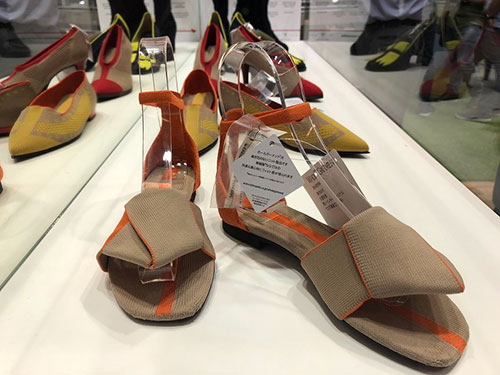
Shima Seiki has also introduced the Intarsia machine with a loop presser. This is a new machine with a smaller, wider compact carriage, which allows 15 percent higher productivity and higher energy efficiency. It’s a lot more productive and sustainable. “This machine works on suede tape yarn. It twists when you feed the machine with yarn. It has a special device called the yarn unwinder. This can be installed with the existing machines,” adds Karasuno.
Shima Seiki also offers a machine with a loop presser bed with two systems. Two colored yarns can go back and forth on this machine so that one color show and other does not. This can be done on every single needle. It is the jacquard that is also used in denim. It allows the creation of three dimensional patterns to be created and cups like this never seen before. The machine right now offers an option of ten colors though it can be further upgraded to 20 colors.

Scarf knitter for sportswear with elastic yarn
Another of its innovations is the scarf knitter. This machine knits sportswear with elastic yarn. “It combines the seamless properties of Wholegarments with underlayer for sportswear. We use elastic yarn to overcome the problems of circular yarn in flat knitting. The tension motoring device in the machine calculates stretch properties in a fabric. This ensures size consistency throughout the product and from product to product,” adds Karasumo. This machine makes the entire garment besides its conventional knitting. It has an additional yarn carrier which moves back and forth between two colors,” adds Karasuno.
Great potential for technical textiles
“Knitting offers great potential for technical textiles with its inherent characteristics: stretch and compression,” continued Karasuno. “Flat knitting provides further potential with its capability to shape fabric on the machine. New knitting techniques such as inlay made possible with special loop pressers feature add further value to knitting and have gained particular attention for its ability to produce hybrid knit-weave fabrics that allow insertion of technical yarns heretofore considered incompatible with knitting, into existing knit fabrics. These include carbon fibre, monofilament and even metallic yarns. Shima has even developed a special Yarn Unwinding Device for unwinding spools of technical yarn to ease yarn feed for such difficult-to-handle material.”, Karasuno concluded.
Brands to create ‘best out of waste’ to curtail garment pollution
"One of the most disastrous impacts of the fashion industry on the environment is the enormous amount of water needed to grow raw materials like cotton. Brands require around four years of drinking water on an average to make one cotton T-shirt. Additionally, the chemicals sprayed on cotton crops, electricity power in the garment factories, the fossil fuel emissions from transportation of clothing across the seas, railway and road networks and by air to high street stores add to the growing pollution by the fashion industry."
 One of the most disastrous impacts of the fashion industry on the environment is the enormous amount of water needed to grow raw materials like cotton. Brands require around four years of drinking water on an average to make one cotton T-shirt. Additionally, the chemicals sprayed on cotton crops, electricity power in the garment factories, the fossil fuel emissions from transportation of clothing across the seas, railway and road networks and by air to high street stores add to the growing pollution by the fashion industry.
As per a 2017 report from the Ellen MacArthurFoundation, an environmental advocacy organisation set up by MacArthur, an equivalent of one truck of textiles is land filled or burned every second, .An estimated €443 billion is wasted every year on clothing that is barely worn. The report further predicts that the fashion industry will consume more than a quarter of the world’s annual carbon budget by 2050.
Increasing garment life through recycling
To deal with this, the British parliament recently recommended a 1per cent tax on each garment to stop companies from over-producing. However, the recommendation was rejected last month. The report presented a vision of a new system based on circular economy principles that offers benefits to the economy, society and the environment.
As per this vision, designers will henceforth design clothes differently. These clothes will not only be worn longer but also rented, resold and reused much more often. Materials will be recycled, either for making new clothes or using as insulation, mattress stuffing or wipe cloths. The report has been endorsed by some big fashion brands including Nike, C&A, and H&M.
Using sustainable materials
The MacArthur Foundation report also recommends less synthetic materials that do not leak microfibres into the existing water systems. Some of the leading designers are already using such sustainable or recycled materials in their collections. These include reputed brands like ASOS, Marks & Spencer, Burberry, etc. Fast fashion brand Zara recently announced by 2025 all its collections will be made from 100 per cent sustainable fabrics by 2025. These also include the collections of its partner brands, including Zara Home, Massimo Dutti and Pull&Bear, etc.
The new flagship boutique of English fashion designer Stella McCarthy in London’s Old Bond Street stocks biodegradable mannequins to display her handmade organic cotton collection. On the other hand, Patagonia sells bags that prevent microfibres from being released into waste water streams when synthetic clothes are washed in a machine.
Though these efforts are praiseworthy, it is actually reduction in the volume of clothing produced that holds the key to making the industry more sustainable. The efforts of H&M on this front are definitely noteworthy. The brand takes back old clothes through its Garment Collecting Recycling Programme. In 2018 alone, they collected 20,649 tonne of clothing. The brand recently partnered with the second-hand online marketplace Sellpy, for selling second-hand clothing on their own website. The project will be trialed on the Swedish website of its subsidiary clothing chain and Other Stories. Hope, other brands take a leaf from this.
Violeta Andic and Carlos Costa step down from their roles at Mango
Violeta Andic, Director of the plus-size Violeta label of the Spanish clothing brand Mango, and its Operations Chief Carlos Costa are stepping down from their roles. In charge of the Violeta label since its launch in 2013, Andic spent the past 12 years at the Spanish fashion brand, founded in 1984 by her father Nahman Andic and her uncle Isak Andic, who currently holds the role of chairman. Before taking the helm of Violeta, the executive was responsible for special collections between 2008 and 2013. Andic will be replaced by Laura San Martin, currently in charge of the brand’s outlet stores and has been with the company for more than 15 years.
Meanwhile, Carlos Costa, director of operations and strategy since 2013, is leaving Mango to focus on a personal project. He is also a member of the Mango board of directors, and before joining the clothing label he led the Barcelona office of Boston Consulting Group. His responsibilities as head of operations at Mango included overseeing the areas of logistics, imports and exports, IT systems, human resources, corporate social responsibility and operational strategy. Mango has yet to announce his effective departure date and replacement.
China, Bangladeshi textile companies collaborate at Texworld USA
Many Chinese and Bangladeshi textile companies have collaborated for this year’s Texworld USA edition. One such collaboration including that of Chinese Nantong Fenglan Textile Co with the Bangladesh company Farseeing Knit Composite. While Li presented his own textiles, Taher brought a number of T-shirts and other garments to the exhibition booth.
Running his company in Nantong city in east China's Jiangsu province, Li has formed partnerships with two Bangladeshi textile plants starting from 2012 to better explore international opportunities, and Taher's company was one of them.
Farseeing Knit Composite imports around 95 percent raw materials from China to meet the demand for his garment plants. This partnership further strengthened the both the companies’ position in the market as a U.S. customer of Nantong Feglan Textile placed an order of 6,600 pieces on site.
Tariff war damages global trade
Global trade languished for a seventh straight month in May, says the CPB World Trade Monitor. The tariff battle between the US and China is heightening uncertainty and slowing growth in Europe and elsewhere in Asia. The reduction of trade between the two countries has damaged confidence and companies worldwide are wary. Other problems include: a surge in oil prices. Trade was flat in the three months through May, compared with the previous three-month stretch, after six consecutive months of declines. The overall index stood at 124.5 in May, a 0.3 per cent rise from a month earlier, when it fell 0.6 per cent. The latest reading was 0.4 per cent lower than in May 2018. Global markets remain vulnerable to shocks in confidence or sentiment this year.
China’s trade imports and exports are both below 2018 peak levels. The International Monetary Fund has further reduced its global growth outlook, already the lowest since the financial crisis, and suggested that policy missteps on issues such as trade could derail a projected rebound. The IMF also slashed expectations for growth in the global volume of trade in goods and services, reducing its estimate by 0.9 points.
Steiger launches new flat knit
Switzerland-based Steiger’s Vega 3.130 is a compact flat knitting machine for technical textiles. It can be equipped with warp and weft insertion for inlay applications involving high-performance yarns. It has a specific cam-box for semi-rigid yarns, as well as adapted sinker kinetics. The distance between the needle-beds can be specifically adjusted and set and other key features include a special take-down for 3D products, a new system of clamp and scissors that can cut yarns like Kevlar, and a selectable carriage inversion ramp for optimised production. The machine can also be supplied in a special format to process carbon fiber preforms for use in automotive, aerospace and industrial composite applications. Steiger has also launched a new app, which will allow, for example, a Steiger machine user in Brazil to live link to a Steiger technical expert in Europe for assistance.
The company launched the Stitch Lab in 2017, where experts in knitting and programming work together with clients on developing their future applications. In the Stitch Lab Steiger develops 3D articles for knitwear, for medical applications and for composite materials. The Vega 3.130 is a product of the Stitch Lab.
Steiger, based in Switzerland, is part of the Cixing Group, the world’s largest manufacturer of flat knitting machines.