FW
Ed Filipowski a strategic fashion PR, dies at 58
Ed Filipowski co-chairman of New York-based public relations agency KCD, has died at his home in New York after complications following a recent surgery.
“I will always remember the kindness Ed showed to me in the very early days of BoF, giving constructive feedback and advice, encouraging me to stay true to my voice and providing valuable access and opportunities to create meaningful stories,” said BoF’s founder Imran Amed. “All of us at BoF will remember him fondly and offer our deepest condolences to his loved ones and the KCD team. His spirit and keen eye for talent will live on in their dedication to our industry.”
An amazing orator of powerhouse fashion PRs, Filipowski supported the industry’s transformation from a loose network of independently run brands into a global business driven by multinational conglomerates. Throughout his career, he worked to help shape the careers of John Galliano, Donatella Versace, Tom Ford and others.
Born outside of Pittsburgh, Filipowski earned a journalism degree from Northwestern University and moved to New York in the early 1980s. He met the publicist Kezia Keeble just a few years later, eager to work at her hip PR agency, which repped brands like Stephen Sprouse and the of-the-era retailer Charivari. “It all goes to back to Kezia,” Filipowski told BoF in 2016.
Don Jones felicitated by 2019 Cotton Genetics Research Award
The announcement was made today during the 2020 Beltwide Cotton Improvement Conference, which convened as part of the National Cotton Council-coordinated 2020 Beltwide Cotton Conferences. Jones, who has devoted his 35+ professional years to plant breeding and genetics, received a plaque and a monetary award.
Since 2009, Jones has been instrumental in the development and collaborative release of more than 50 public germplasm lines resulting in six cultivars. Of those six, two have exceptional fiber quality traits that are valued by the market and that help to maintain cotton’s competitiveness.
Jones led the development of a Universal Material Transfer Agreement that helped protect the intellectual property of public cotton breeders/institutions and later private seed companies who were willing to abide by the Agreement.
He also spearheaded efforts to identify cotton fields with appropriate levels of Fusarium wilt race 4 (FOV4) infection and coordinated the first nationwide screen for resistance – an effort that identified 11 breeding lines with possible resistance to this upland cotton production disease threat.
The author of 74 peer-reviewed publications in the past decade, Jones received the 2017Special Service Award from Texas A& M University and the 2019 Agronomic Industry Award from the American Society of Agronomy.
Jones earned his B.Sc. and M.Sc. in Agronomy from the University of Tennessee and his Ph.D. in Plant Breeding and Genetics from the University of Nebraska. Prior to joining Cotton Incorporated in 2003, he was a research scientist at Syngenta and then Monsanto.
Narinder International launches two new machines at GMMSA
The 5th edition of GMMSA Expo India 2020, organised by Garments Machinery Manufacturers and Suppliers Association (GMMSA), was held from January 03-06, 2020 at Ludhiana.Narinder International, one of the major machinery suppliers from Ludhiana, was a major participant at the expo. Narinder Kumar, Director of the company reveals about the products launched by the company at the expo and the current industry scenario.
 One of the major participants at the GMMSA expo, Narinder International is one of the major machinery suppliers from Ludhiana. The company manufactures and supplies a wide range of machinery like the flat knit machines, circular knit machines and accessories like knee caps. “We are also involved in the upgradation of blankets and high pile fabrics,” reveals Narinder Kumar, Director of the company.
This time at the expo, the company launched two new products; the super soft fur and the rabbit fur which is used for making car seats, carpets and curtains. “This is our fifth participation at the expo. The platform keeps us abreast of new technologies, machines and products launched across the world. This not only reduces our labor and production costs but also increases our efficiency and productivity,” states Kumar further informing that last year over 20,000 people visited GMMSA.
Heavy expenditure, secondhand machines pose challenges
Elaborating on the current industry scenario, Kumar says, “The knitting industry is doing very well in India as Chinese imports are declining. Our country is likely to emerge as one of the major machinery suppliers in the future.”
Manufacturing machines is a cumbersome process as it involves heavy expenditure. “It is difficult to make spare parts, assemble and market them. A single person can’t do this. The main machinery has to be made in one place after which people can give orders for making the spare parts. We then assemble these parts and start making the machines,” adds Kumar.
Another big challenge is the flood of secondhand machines in the industry. As buying a second hand machine is cheaper than buying a new machines, it does not encourage local manufacturing in India. “However, the scenario is different in China. The country does not allow the import of second hand machines as there are many companies involved in assembling and manufacturing machines. Many others have also banned such imports,” adds Kumar.
Texworld Paris 2020 offers range of diversity
 Texworld Paris, international offer of fabrics, supplies and accessories through nearly 750 exhibitors from more than 25 countries. There is always a new player in cotton, wool, linen and silk notably from China, India and Korea. An exceptional offer is also expected from the print and jacquard sectors, which contains a lot more exhibitors than usual.
Premiere for this February 2020 edition the creation of a Turkish pavilion of about thirty companies on more than 500sqm2, to focus on the potential of the country's industry, driven by a great knowledge of the habits and customs of the industry of its neighbor Europe. A must for many brands! This Turkish pavilion, organized in collaboration with the Istanbul Chamber of Commerce, will be located in Hall 2 near the Elite and Denim sectors. It will gather an offer composed by 70% of new companies, represented in many sectors: Drapery, Knit, Silky aspects, Prints,
Shirting, Woolen, Embroidery & lace, Functional fabrics without forgetting the Turkish companies outside the pavilion, fifteen of them have joined the sustainable sourcing itinerary, thanks to a certified sustainable offer. Turkey will also be well represented in the ELITE sector, with some fifteen companies, 3 of them are exhibiting on our shows for the very first time.
Return of the Indian group Texprocil, which will present about thirty companies in the Cotton, Silk, Embroidery & Lace, Linen & Hemp, and Drapery & Tailoring sectors - also represented in the sustainable sourcing itinerary! Since its inception in 1954, as an autonomous non-profit organization dedicated to export promotion, the Cotton Textile Export Promotion Council, known as TEXPROCIL, has been the international face of India's cotton industry, facilitating exports around the world. Texprocil has a membership of about 3,000 textile manufacturing and exporting companies, and connects international buyers with appropriate suppliers according to their specific needs.
Talking about South Korea it keeps showcasing a growing number of companies through a pavilion organized by the Korean Textile Centre (KTC) and the Korean Federation of Textile Industries (KOFOTI). It will bring together around fifty companies with a strong focus on research & development, offering extensive ranges in Knit, Jacquard, Embroidery & Lace, Silky Aspects, Cotton, Sportswear & Functional Fabrics, Silk, and Woolen Material.
LVMH gets environment executive
Hélène Valade is the new environment development director at LVMH. Her mission will be to stand up for the improvement of the environmental performance of all of the company’s products, to deploy the highest standards in all its supply chains, to improve the key environmental effectiveness indicators in all of its production sites and to ensure CO2 emissions are reduced.
A graduate of the Paris Institute of Political Studies, Valade began her career at the Institut français de l'opinion publique (IFOP) before being hired by French utilities and waste management group Suez in 2005. Until 2014, she was sustainable development director of the group’s water supply company Lyonnaise des Eaux, and was then appointed Suez’s vice-president of sustainable development. Since June 2018, she has also been the president of CSR watchdog ORSE (Observatoire de la responsabilité sociétale des entreprises), and is a director of environmental advisory agency ADEME.
LVMH is a French luxury group. It boasts the largest market capitalization of any company in France. In the current climate of geopolitical and economic instability, creativity and quality, the group’s founding values have become benchmarks. The increasing digitalization of its activities reinforces the quality of the experience it brings to customers. Its largest division is of fashion and leather goods.
L Brands sales down four per cent in the holiday period
L Brands’ sales fell 4.07 per cent over the holiday period. Comparable sales for the period fell three per cent. Victoria’s Secret continued to be the main source of the parent company’s financial woes in November and December, posting a 12 per cent decrease in comparable sales over the holiday period. These plummeting revenues were offset somewhat by an increase of four per cent at Bath & Body Works. Year to date net sales fell 2.76 per cent compared to the prior-year period, while comparable sales for the 11-month period decreased two per cent.
Bath & Body Works was left to pick up the slack with a five per cent increase in comparable sales against a nine per cent decrease at Victoria’s Secret. The iconic lingerie brand, which has failed to adapt to changing consumer attitudes, has continued to prove a problem for L Brands this fiscal year. In the light of its disappointing performance during the holiday period, L Brands has revised down its outlook for fourth-quarter earnings per share.
L Brands has been focused on diversification of its supply chain over the past five years. The company has been in negotiations with its Chinese suppliers to take costs out of the production chain to offset the increases, but that also means leaving a little bit on the table so vendors don’t end up seeing their businesses fail.
YKK’s QuickFree zipper wins Good Design award
QuickFree, a zipper developed by YKK, has won the Good Design award. Founded in Chicago, the Good Design Award is among the oldest and most prestigious global award program for design excellence and design innovation. The award honors both product and industry leaders in design and manufacturing that have chartered new directions for innovation and pushed the envelope for competitive products in the world marketplace. One of the main factors for the awards selection is whether a product can enrich society and people’s lives through its design.
QuickFree, a zipper developed by YKK, promotes safety, security, and a sense of independence and accomplishment in small children. They can open and close clothing alone through the zipper’s improved function. By improving the zipper’s visibility through changing the shape of the slider and widening the area into which the pin is inserted, YKK has reduced the possibility of the pin being inserted into the wrong part of the slider. Moreover, when a certain load is applied to the left or right of the zipper, the slider snaps off with a releasing function that allows the zipper to open without lowering the slider, thereby reducing the possibility of the clothing putting pressure on a child’s body, such as when the child’s clothing get caught on playground equipment.
US jeans imports down three per cent
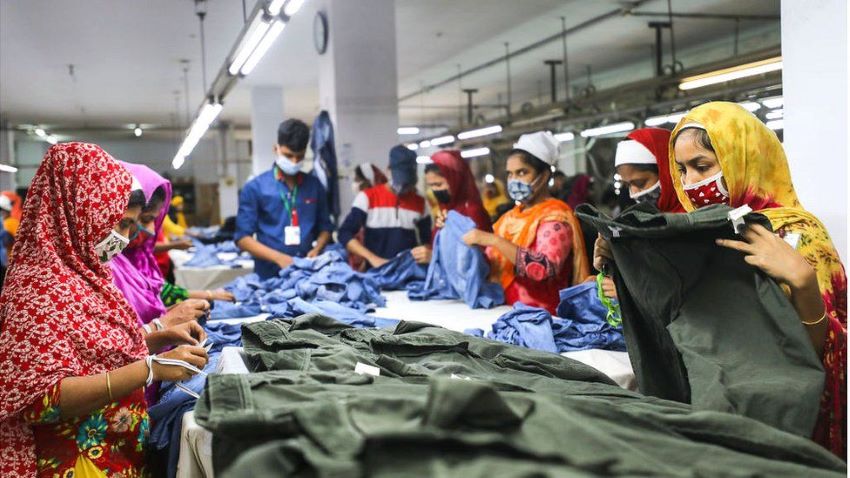
US jeans imports from the world were down 3.05 per cent for the year to date through November. US jeans imports from China fell 24.35 per cent. China lost its top supplier spot to Mexico earlier this year, as the US-China trade war cut into its US-destined production. For the third straight month since the 15 per cent tariffs on denim jeans and associated products imported into the US from China took effect, shipments dropped significantly. This is an expansion of the erosion of sourcing from China for the category, after a 21.97 per cent year-to-date decline was posted in October. At the same time, a diverse array of suppliers, from Vietnam, Pakistan and Cambodia to Egypt, Jordan and Nicaragua, have consistently posted gains in the year through November. China’s decline as a source of denim apparel manufacturing expanded in November, as US companies look elsewhere to save costs and reduce risks. They are accelerating the efficient and effective diversification of their manufacturing base.
Bangladesh’s denim exports to the US rose 1.5 per cent. Vietnam’s shipments climbed 22.61 per cent. Nicaragua’s shipments increased 19.84 per cent. Egypt’s denim exports to the US were up 15.37 per cent and Cambodia’s shipments increased 7.7 per cent.
Vietnam faces rules of origin challenges
To take advantage of free trade agreements, Vietnam’s garment and textile sector has to comply to with rules of origin. The country expects a lot from the Comprehensive and Progressive Trans-Pacific Partnership (CPTPP) and the EU-Vietnam Free Trade Agreement (EVFTA). But Vietnam needs to invest in fabric production to meet origin requirements when exporting to CPTPP and EVFTA countries. This would not be easy because Vietnam must compete in designs, quality, prices and delivery time with other major fabric producers like China and India.
Investing in fabric production needs careful consideration in terms of production scale because Vietnam’s garment industry uses less than a billion meters of woven and knitted fabrics every year, or 18 per cent of global exports. If the fabric production targeted only Vietnam, production scale would be too small while investing in large-scale production. Instead Vietnamese garment firms have to work with global giants to establish value chains and invest in production to meet their demands and have to invest in raw material production to meet rules of origin in trade deals. Shortage of fabric resources is a big obstacle for the garment and textile industry of Vietnam. It has to speed up reforms with innovations in designs, management, fabric production and building brands.
M&S sales down three per cent
For the third quarter Marks & Spencer sales fell 3.7 per cent. Revenues were 0.7 per cent less than in the third quarter of 2018. Fashion sales generated through the online channel rose by 1.5 per cent though the increase was smaller than what the group had expected. The group continues to accelerate its closure plan intended for 2022 and has reorganized its fashion team by simplifying its structure and announcing 47 layoffs in the purchasing, marketing and logistics departments in 2019.
Performance in menswear and the gifting categories held the British group of department stores back from delivering a stronger result. But the changes made at the beginning of the year in the fashion division have arrested the worst of the issues of the first six months and the company is progressively building a much stronger team for the future. Marks & Spencer will incorporate a new supply chain director for the fashion division in spring. The chain’s fashion division employs a thousand people and has suffered stock ruptures throughout 2019.
The company is still at the early stages of far-reaching changes in range, in style, customer focus and channel mix. Its objective is to reshape its buy, deliver market leading value and focus on stylish and wearable wardrobe must-haves as it grows the business with family-aged customers seeking style, quality and value.