FW
Cambodia to produce face masks, PPE equipment
The Cambodian government has approved a request of the Garment Manufacturers Association in Cambodia (GMAC) to produce all kinds of face masks, medical equipment, and protective clothing for both domestic consumption and export.
As masks, medical equipment, and protective clothing are being sought after by the world to help curb the COVID-19, the government supports and encourages factories to produce the aforementioned items, according to the Ministry of Economy and Finance’s letter sent to GMAC president.
Spokesperson of the Cambodian Ministry of Labour and Vocational Training Heng Sour earlier said the export of garments and footwear is forecast to drop by 50-60 percent in the second quarter of this year due to the impact of the pandemic.
The Q1 exports nosedived by 80 percent year-on-year when the COVID-19 broke out in the EU and US – the two largest markets of Cambodian garment products – in February, he said.
Over 180 apparel factories have now suspended operation, and another 60 are thought to be close to suspension, affecting lives of about 200,000 workers.
According to the Cambodian Ministry of Industry, Science, Technology and Innovation, the Southeast Asian country is home to 1,099 factories operating in textiles, footwear and handbag industries.
Lack of suppliers threatens US-China deal for hemp fiber
While China has agreed to purchase an unspecified amount of hemp fiber from the United States in a recently signed agriculture trade deal, there are currently no suppliers of the material in the US
The leading company that had been processing hemp for fiber, Kentucky-based Sunstrand LLC, filed for bankruptcy late last year, in part due to its inability to source raw material. The company had been turning out fabric fibers for apparel maker Patagonia, and claimed to be producing hemp-fiber based door panels for BMW as well as filters for water treatment and hemp fiber products for the construction industry.
Wyndrige Farm, a private company based in southeastern Pennsylvania, USA buys purchasing Hemp Train decortication technology from Canadian Greenfield Technologies for $1.5 million to be installed in an 80,000-sq-ft fiber processing facility.
Dallas-based Panda Biotech has signed a contract with an international equipment manufacturer for construction of the largest hemp decorticator in the country, with plans to process hemp grown in Texas exclusively into textile-grade fibert and cellulose. But Texas farmers are yet to get licenses to grow the hemp fiber.
G-Star Raw files for bankruptcy
G-Star Raw has entered into voluntary administration in Australia, despite reportedly not experiencing any major debt. The decision leaves an uncertain future for G-Star Raw’s 57 stores across Australia and 200 employees.
Ernst & Young’s Justin Walsh, Stewart McCallum and Sam Freeman have been appointed administrators of G-Star Australia and are conducting an urgent assessment of the company’s affairs and will determine the strategy for the administration as soon as possible. The administrators named major commercial landlords as the company’s most significant creditors.
The Australian operations of G-Star Raw previously went into voluntary administration in 2015. States and territories in Australia, which has 97 reported deaths from COVID-19, are easing restrictions since the country shut its boarders to all non-citizen and on March 19, 2020.
Since the start of 2020, Australian department store Harris Scarfe shut more than 20 stores and several specialty retailers have collapsed. Jeanswest, a denim chain store with 146 stores in Australia, also entered voluntary administration, citing online competition and tough market conditions.
China’s e-commerce report for Textiles and Apparel 2019 showed stable growth
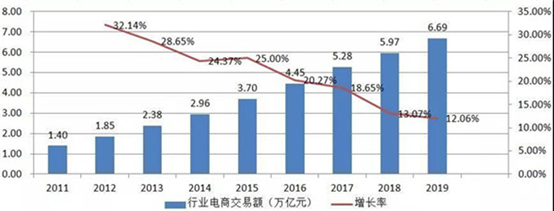
In the pre Corona period, statistics show 2019 as an year of continued growth in textiles and apparel online sales to conclude 6.69 trillion Yuan, up by 12.06 percent Year- on- Year. B2B ecommerce sales topped taking a lion-share of 73.24 percent at 4.9 trillion Yuan. Online retail sales of apparel/home-textiles maintain an impressive share of 19.6 percent of all the online shops, selling all types of goods in the country. Also, it is significant to know; online share of sales of offline players is growing and reaches touches up to 22percent.
On May 13, China Commercial Circulation Association of Textile and Apparel (CATA) issued an annual report (E-Commerce of Textile and Apparel 2019) that gives a panoramic view of the textiles and apparel sales online, a very good source of information for readers to understand shopping behaviour, in spite of the slowdown in brick-and-mortar.
Executive summary
The year of 2019 witnessed a stable growth in textile industry in the process of the reforms on the front of supplies, industrial transformation and upgradation while putting efforts to withstand the risks of the economic down. As e-commerce system has been evolving and growing to a big scale, the textile and apparel online sales, that had experienced high-speed growth in the e-commerce during pre-matured phase, is now getting into an evolved new model, new business practice and new consumption phase through increased digitalization process. 2019 was a year of continued growth in textiles and apparel online sales to conclude 6.69 trillion Yuan, up by 12.06 percent Year- on- Year.
| Online Business for the whole textile industry in trillion Yuan |
 |
| unit: trillion Yuan in blue bar, red curve for growth rate |
B2B leads the total e-commerce pack
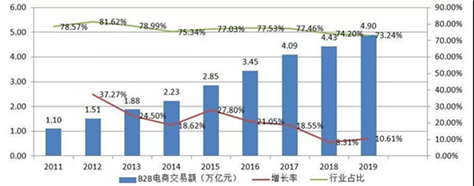
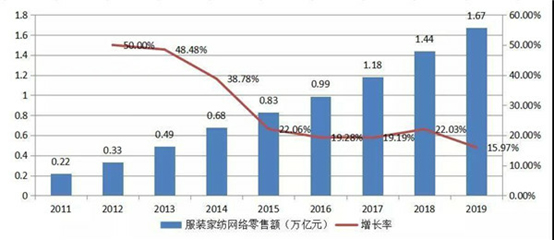
As calculated, the total turnover of online sales for textiles and apparel reached 6.69 trillion Yuan, B2B stood out at the top, amounting to 4.9 trillion Yuan, taking a lion-share by 73.24 percent, while apparel and home-textiles combined to reach sales of 1.67 trillion online retail. While the overall growth continues to drop from 32.14 percent in 2012 to 12.06 percent in 2019 (indicated above in red), as in the initial years, the total base value wasn’t as high.
| B2B online deal in trillion Yuan |
 |
| unit: trillion Yuan in blue, growth rate in red curve, and share of total sales in green curve |
Textiles/apparel sector enjoys 19.5% share in sales
Although B2B is growing by 10.61 percent and still dominating in value in the total sales of textiles/apparel sector, but it is 15.97 percent growth rate of the online retail of apparel/home-textiles that speaks louder. Just to mention, online retail of apparel/home-textiles has an impressive share of 19.6 percent across the all goods online shops in the country, observing from 14 important e-commerce retail platforms monitored by Ministry of Commerce ( MoC). The statistics from MoC databank show that there are 19.469 million online retail shops, out of which the apparel and home-textile shops takes up leading 33.1 percent in total share.
| Apparel and Hometextiles Retails in trillion Yuan |
 |
| unit: trillion Yuan in blue bar, and growth rate in red curve |
Online sales share of offline players reaches upto 22%
In the report, China Commercial Circulation Association of Textiles and Apparel (CATA) particularly pointed out that the brick-and-mortar textile and apparel-specific wholesale markets (yarn, fabric, home-textiles, knitwear, and garment buildings/complexes, sales center or specialty markets, etc) through e-commerce to touch 1.47 trillion Yuan, up by 8.89 percent, representing 21.97 percent the total online retails for textiles and apparel. Apparently, that is the way forward for all the off-line specialty shops or garment buildings/complexes to align with the tide of online boom.
Contributed by Mr. ZHAO Hong
He is working for CHINA TEXTILE magazine as Editor-in-Chief in addition to being involved in a plethora of activities for the textile industry. He has worked for the Engineering Institute of Ministry of Textile Industry, and for China National Textile Council and continues to serve the industry in the capacity of Deputy Director of China Textile International Exchange Centre, V. President of China Knitting Industry Association, V. President of China Textile Magazine and its Editor-in-Chief for the English Version, Deputy Director of News Centre of China National Textile and Apparel Council (CNTAC), Deputy Director of International Trade Office, CNTAC, Deputy Director of China Textile Economic Research Centre. He was also elected once ACT Chair of Private Sector Consulting Committee of International Textile and Clothing Bureau (ITCB)
Havaianas launches first RMG collection
The Havaianas brand, which is known all over the world for its rubber flip-flops, has opened a new chapter in its history with the launch of its first ready-to-wear collection for the 2020 spring-season.
Over the years, Havaianas has considerably expanded its range of rubber-soled summer shoes. But the brand has now embarked in a new direction for the 2020 spring-summer season with the presentation of its very first ready-to-wear collection for men and women, which is mainly composed of beachwear.
Not surprisingly, this first collection launched in Europe is inspired by the Brazilian style so dear to Havaianas, which emphasizes vibrant colors and comfort as do the brand's flip-flops.
The collection consists of a wide selection of swimsuits, pool shorts, T-shirts (in short, fitted, and oversize styles), dresses, shorts, and jumpsuits. Note that some of the designs in the ready-to-wear collection perfectly match those of Havaianas flip-flop models.
Havaianas is already selling a selection of these beachwear pieces in its online store.
Japanese apparel maker Renown files for bankruptcy
Japan's Renown Inc, part of Chinese fashion empire Shandong Ruyi, filed for bankruptcy with 13.9 billion yen ($130 million) in debt, the country's highest-profile business to collapse amid the coronavirus outbreak.
Renown, a century-old textile company which sells clothes under brands such as Arnold Palmer, Hiroko Koshino and D'Urban filed for bankruptcy protection after a month-long closure of department stores brought the already-struggling business to its knees.
It joins a list of global fashion companies, including retailers such as J. Crew and Neiman Marcus, which have collapsed due to the pandemic.
Renown, which at one point owned British clothier Aquascutum, had reported losses for years. Shandong Ruyi emerged as a leading shareholder in Renown a decade ago and has since become its majority stakeholder.
Earlier this year, Renown was seen struggling to collect more than 5 billion yen ($45.2 million) in debts from its Chinese parent. Its top executives were also recently voted out of its board by the parent firm.
The Chinese group has been facing increasing refinancing pressure after spending billions of dollars to buy a range of European luxury brands and Asian labels, including French fashion house SMCP and Aquascutum.
So far more than 140 Japanese companies have gone bankrupt since February due to the outbreak of the coronavirus, according to research company Tokyo Shoko Research.
Prime Minister Shinzo Abe's government last month declared a state of emergency in response to the coronavirus crisis. While this did not involve a strict lockdown as seen in other countries, department stores and bars have been closed.
Labor groups question safety measures by Bangladesh garment factories
Labor advocates are questioning if Bangladesh’s garment sector, which employs 4 million workers, is lifting restrictions too soon.
More than 1,750 factories in Bangladesh have come back online despite the nationwide lockdown. BGMEA inspectors have found the reopened factories by and large satisfactory, but union leaders warn that many of them fail to follow safety measures meant to protect workers from the spread of the contagion.
According to the Bangladesh Centre for Worker Solidarity, only 20 percent of the factories are maintaining social distancing and that’s because they are big factories and they have the space. The rest are focusing on the other aspects of the health guidelines such as providing soap or measuring the temperature of workers before they enter.
At least 100 factories have struggled to maintain social distancing, particularly when workers enter and leave the premises, said Sommilito Garments Sramik Federation, a union representing more than 100,000 workers.
Since the outbreak began in January, Bangladesh has officially clocked 18,863 positive cases and 283 deaths. Under dispute, however, is the number of garment workers who have tested positive for COVID-19 since factories began opening on a limited scale on April 25.
Lingerie-maker Caely to export face masks, PPE
Malaysia-listed lingerie maker Caely Holdings Bhd has branched out into manufacturing of face masks and personal protective equipment (PPE) for Germany, the US, Australia, Saudi Arabia and India markets.
The company sees this diversification as a good opportunity to broaden revenue streams under its manufacturing segment, as well as obtain income sources from new product types other than its traditional undergarment business.
Caely currently deals in manufacturing, retail, export and direct sales of undergarments, household products and property development and construction.
Its wholly-owned Marywah Industries (M) Sdn Bhd recently signed a product manufacturing agreement with Ni Hsin Marketing Sdn Bhd (NHM), a wholly-owned subsidiary of Ni Hsin Resources Bhd.
According to this agreement, Marywah will be the original equipment manufacturer of NHM's brand name products which mainly consist of fabric face masks and PPE.
The face masks that the company produces would help protect against virus transmission and are washable for up to 30 times after each use. The company is also currently manufacturing protective suits which are urgently needed for healthcare workers and certain frontliners in the fight against COVID-19.
Nike collaborates with 7-Eleven to launch co-branded sneakers
American fashion label Nike has collaborated with 7-Eleven to launch co-branded sneakers, which will have latter’s unique logo colors.
Reportedly, Nike SB Dunk Lows along with 7-Eleven sneakers will include an exquisite colour-blocking design in orange, green and red.
There will be 3 packs of extra laces to match the beautiful colours – each of these comprising stripes in 3 logo colours. That’s something to rejoice for Nike and 7-Eleven lovers.
While Nike’s logo will appear on the sides of the sneaker, 7-Eleven’s logo will be embroidered on the lateral heel. Notably, the midsole will be using Nike Air technology, which will help in optimal cushioning.
The co-branded sneakers will initially be launched only in Japan, but considering the reach that 7-Eleven currently has across the globe, including Asia, it would be soon launched in some other countries too.
Lucky Brand returns to work with a new code of ethics
Lucky Brand is preparing to return to work with a new code of ethics as a result of the COVID-19 pandemic.
As the denim brand prepares to reopen select retail locations, it’s continuing the community outreach and employee support it began at the start of the coronavirus pandemic.
In March, the brand partnered with community organizations such as Suay Sew and LA-based factory partner New Fashion to provide materials and support for mask production.
It also launched a mask purchase program, ‘Give 5 Get 5’, that donated five masks for every pack of five purchased. By the end of this week, the brand will have donated more than 20,0000 masks to people in need.
On May 13, Lucky Brand held a “Salute to Heroes” ceremony to pay tribute to the West Los Angeles Veterans Administration Hospital and its staff, providing them with camouflage masks and T-shirts. The brand also worked with partner Avery Dennison on 1,000 iron-on patches featuring the word “Hero” to commemorate the VA’s efforts.
As the brand readies a retail relaunch, it’s ensuring this same level of support to its employees, sending health and safety kits with cleaning supplies, sanitizer and reusable face masks to each location. Masks were re-purposed from materials such as promotional bandannas and fabrics from stock supplies.