FW
3D-printed footwear to grow at CAGR of 19.5 per cent by 2025
A new finding by SmarTech Analysis shows, the 3-D printed footwear at a will grow at a CAGR of 19.5 percent to account for $6.5 billion in yearly global revenue by 2029. Footwear companies will invest billions of dollars in 3-D printing technology and manufacturing over the next decade, with billions more in revenue up for grabs, according to a new report.
According to SmarTech, revenue from 3-D printed footwear, which currently represents roughly 0.3 percent of total global footwear revenue, is expected to grow to about 1.5 percent of overall global footwear revenues by 2029. This value is inclusive of AM hardware, AM software, prototyping and tooling as well as end-use products related revenues.
Revenues associated with additive manufacturing in the footwear industry are expected to rise predictably over the next ten years. The growth will not be relegated to typical 3-D printed footwear, i.e. a croc-like slip-on made from a single piece of material that strongly resembles plastic or rubber. SmarTech says the market for 3-D printed footwear components will be the first to grow, with individual 3-D printed footwear parts generating $1 billion in revenue as early as 2023.
Sri Lanka’s apparel sector targets emerging markets to boost growth
 In order to achieve its ambitious target of $8 billion worth of exports by 2025, Sri Lankan apparel sector is looking to first upscale access in emerging markets such as India, China and Brazil. The country will differentiate its products with quality standards and excellent product delivery to capture global demand. The apparel industry, which contributes 7 per cent of GDP (Gross Domestic Product) and 53 per cent of export earnings, plans to expand its operations to South Asian countries such as India and China and to South America. Apparel exports, last year, grew by 5 per cent; while this year it is expected to grow at an annual compound growth rate of over 6 per cent.
Exports subject to tariff rules
Around 12 per cent of Indian apparel exports are shipped to other continents. The countries for exports are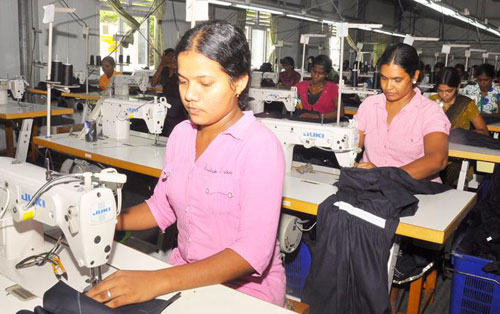 determined on the basis of the tariff and country of origin rules. Earlier bilateral agreements were the exception to the rule but now World Trade Organisation (WTO) regulations has become the exception while bilateral agreements are the rule.
A standard rule that the apparel industry follows is the double transformation principle which involves converting fiber into yarn, yarn into fabric and fabric into garments. This theory helps countries such as India, Indonesia and Thailand, where vertical integration is very high.
Issues faced by the Sri Lankan apparel sector
Sri Lanka, as a nation does not recognise the value of apparel exports as much. The sector contributes to the economy on its own efforts. Government support in terms of facilities and recognition will attract more industrialists to the nation besides ensuring skilled labour in the workforce.
The SME sector within the apparel sector faces labor issues. As this sector fails to attract youth, it faces acute scarcity of labor. Besides, the present level of the trade reforms agenda lacks forward looking policies which makes it extremely difficult for the industry to maintain its growth momentum.
Government initiatives to boost growth
Though the industry has still not stabilised, this year’s budget provides enhanced capital for expanding a company. The government is also trying to improve the availability of credit, skills and finances. However, these efforts will prove beneficial only in the longer run. The industry needs to be controlled and maintained on a systematic basis. It should be organised so as to enable buying continuously or promote concepts such as rentals.
Before 2005, there was no competition among countries for apparel as the industry did not offer its buyers the freedom to plan their purchases. However, this system liberalised post 2005 enabling all countries to enter into the business. Sri Lanka, which already faces difficulties such as unavailability of fabric and scarcity of labour, needs to differentiate itself through quality and value added services. The sector has already negotiated with the government for minimising transactions with state agencies mainly with regard to apparel exports. It has also requested the government to make all documentation processes available online, thus reducing human intervention.
The sector has also requested the government to recognise digital signatures and online transactions. It is also negotiating with the Sri Lanka Customs to automate the verification processes to clear the goods quickly. These methods will quicken the will not only quicken the delivery process but also improve its efficiency.
Stock management, decentralisation to help brands deal with Brexit
"The British fashion industry, over the past two years and nine months, has been preparing for an unforeseen future. As the UK voted to leave the European Union, a range of fashion and footwear businesses across the UK including manufacturers, brands, agencies and retailers are adopting various measures to mitigate the aftereffects of this exit."
 The British fashion industry, over the past two years and nine months, has been preparing for an unforeseen future. As the UK voted to leave the European Union, a range of fashion and footwear businesses across the UK including manufacturers, brands, agencies and retailers are adopting various measures to mitigate the aftereffects of this exit. British multinational clothing brand, Next Fashion, has actively voiced its discontent over the uncertainty looming over Brexit. Not sure of its impact on customers, the brand plans to remain flexible and respond to the changes.
Alternate supply chain, new warehouse mitigate effects
Another clothing brand Joules shipped around 90 per cent its products to the EU markets a few weeks prior to the Brexit date. The brand also made a detailed plan to mitigate disruptions by finding alternative routes to avoid delays to its shipments. It also plans to open a warehouse in Holland with a third party supplier so that it can move its products for the European market into the EU by passing the UK. The brand is worried if Brexit is delayed by a couple of months, it will have to repeat the entire stock management process. Also the volatile currency rates are likely to increase the costs of goods in the market.
Increasing stocks
English Fine Cottons is facing price pressures as the brand increased its stock position by around 10-15 per cent. The uncertainty of the situation is also forcing it to defer plans of altering the supply chain Charles Clinkard has been running a Brexit no-deal contingency plan for nearly 12 months and most things that they could take action on have been done. For example, the brand has forward-bought currency through until the end of Spring 20. As a precaution it also stocked around 87 per cent of spring ’19 requirement before March 29 to avoid any shortages on the stock side.
Decentralising operations
Maternitywear retailer Seraphine plans to de-centralise its UK distribution centre and open another one in either France or Belgium. The brand, which has reviewed the situation deeply, is not ready to take any action unless necessary as it would incur a significant start-up cost of about €250,000 (£214,282)
Swedish brand Gant has increased its stock postion in UK warehouse. In case of a no-deal Brexit, the brand plans to move its distribution to Germany. Besides, it has also informed its employees to register for UK citizen status.
Becoming a custom-accredited warehouse will enable men’s and children’s wear brand house Douglas & Grahame to manage imports and exports, VAT and duty in a more efficient way. The brand will also open another warehouse in either Dundalk or Dublin which will allow it to operate within the Republic more efficiently.
Vietnam: Trade agreements, import-export mix to ease effect of Chinese slowdown
"Vietnam has been exporting unprocessed agriculture and other primary products to China for decades. Of late, there has been strong growth in its export of higher value agriculture products, including fruits, vegetables and other horticulture products and seafood. Vietnam also exports electronic and other manufactured products to China. However, its integration in regional production chains has reversed the situation leading to an increase in Vietnam’s imports and investment from China."
 Vietnam has been exporting unprocessed agriculture and other primary products to China for decades. Of late, there has been strong growth in its export of higher value agriculture products, including fruits, vegetables and other horticulture products and seafood. Vietnam also exports electronic and other manufactured products to China. However, its integration in regional production chains has reversed the situation leading to an increase in Vietnam’s imports and investment from China. Now, besides consumer products, the country also imports large volumes of components and parts for its manufacturing sector from China.
Impact of Chinese slowdown on Vietnam’s markets
China’s slowing economic growth is affecting growth of Vietnam’s key markets like the US, EU and Asean. This is likely to impact global demand for Vietnamese exports. Although the net impact of this slowdown on FDI from China is not clear, it will emerge as an increasingly attractive option to diversify investment risks. Though it is unlikely for China to return to previous high levels of growth, it is important to ensure that the growth rate remains high. The country accounts for nearly 20 per cent of global trade with its potential as economic partner continuing to grow.
Trade agreements to provide new opportunities
The implementation of the Comprehensive and Progressive Agreement for Trans-Pacific Partnership (CPTPP), and the long-anticipated EU-Vietnam trade and investment agreements (EVFTA), will provide new opportunities for Vietnam to expand and diversify its economic relations. The country will also benefit from the expected agreement on the Regional Comprehensive Economic Partnership (RCEP) in 2019. Its other bilateral initiatives, including streamlining of cross-border inspections and payments services will stimulate its economic cooperation with China.
Import-export mix to reduce global economic shocks
The negative impacts of Chinese slowdown on Vietnam’s economy will be relatively limited. Increase in exports of higher value-added agriculture, manufactured goods and services to China will remain strong. The country would face serious concerns if its growth falls to OECD country growth rates. Its exposure to global economic shocks can be reduced by providing a more diversified mix of import and export markets. The country can diversify its trade and investments through reforms under regional and economic cooperation agreements.
American denim market gets innovative
The American denim market has entered an exciting phase where brands are becoming more and more innovative. Earlier this week, American Apparel relaunched its denim line in a variety of cuts, colors and extended sizes. In December, ’80s cult favorite brand Jordache reintroduced itself to the world after falling out of favor with shoppers for several years.
The Jordache brand printed the company’s logo on certain of its products that glowed in the dark when consumers flashed a light on it, It also experimented with new washes and trends. A big hit for Jordache is a special rainbow-wash denim, available both in jeans and jean jacket styles.
A key to success for denim brands today will be in their ability to not only create products that consumers will fall in love with, but also to create them in a way that consumers will appreciate. Today, the consumer isn’t looking to be one of a million; they are looking to be one in a million. They don’t want to look like everybody else. They want to have their own unique style and product.
TT completes two hi-tech garment manufacturing projects
During the financial year 2018-19, TT Ltd has completed two hi-tech world class garment manufacturing projects at Avinashi in Tamil Nadu and Gajroula in Uttar Pradesh. These plants have been installed after modifying the existing spinning mills buildings. Both plants have been approved for social compliance (SEDEX and WRAP) and will attract world class garment importers. Both of these plants are eligible for tuf subsidies and state government incentives presently in force for apparel industry.
The company has also been exploring various other fields for diversification of its business to more profitable lines such as packaged food, agri products, bulk transportation, retail business, e-commerce and dairy products. Depending upon the results of test marketing, consultations and market feedback,
The company recently reconstituted its Board of Directors as per SEBI requirements. VR Mehta has been re-appointed as Independent Director of the company for a period of further five years. Ankit Gulgulia has been inducted as an Independent Director. He is expected to contribute substantial inputs for chalking out the company’s strategy, economic policies and funding growth.
The Lycra Company showcases sustainable denim at Kingpins Amsterdam
At the Kingpins Amsterdam tradeshow, The Lycra Company is showcasing fabrics with its latest sustainable offerings, including Lycra® fiber 166L which was recently awarded a Gold Level Material Health Certificate by the Cradle to Cradle Products Innovation Institute. The company will also display customers’ fabrics made with its EcoMade technology, including Lycra® T400® and Coolmax® fibers. The EcoMade versions of these products offer the same performance benefits as their standard counterparts, while being made partly from recycled materials. The latest innovation to be launched within this group is Coolmax® Natural Touch technology, which uses a patented composite yarn structure to deliver enhanced moisture management and a natural appearance and hand.
The Kingpins Show is being held from April 10-11, 2019 in Amsterdam.
Frankfurt to host Texprocess from May 14
Texprocess, a trade fair for processing textile and flexible materials will be held in Germany, May 14 to 17, 2019. The theme in this edition is: smart textiles micro factory. Visitors will be able to get an idea of how integrated textile processing works and where micro factories are already being used. Partners from industry and research will produce a smart pillow which, with the application of integrated LEDs, provides a platform for all new ways of interaction. With this demonstration, partners in the project will present an exemplary, fully connected manufacturing process for a smart textile from design to finished product. Behind it, however, lies a host of complex processes, involving production, processing and logistics.
Individualization, automation and digitalization: micro factories are the way forward for the future of clothing production. Texprocess will display the main theme broadly and prominently. Micro factories, based on networked and integrated procedures, represent the progressive way of making textile processing quicker, more flexible and, because it is more local, also more sustainable, while, at the same time, producing personalized products. So it’s possible for one to send their favorite design to the manufacturer via an app and get an individually designed, perfectly fitting trainer or shirt tomorrow.
Pakistan: PRGMEA calls for five-year plan to boost textile exports
Ijaz A. Khokhar , Chief Coordinator, Pakistan Readymade Garments Manufacturers and Exporters Association (PRGMEA) has urged upon the government to chalk out next five years plan to bring boom in exports and stablilise the national economy. He feels, the government should formulate short term and long term policies for getting economic benefits. It should take effective steps to explore non-conventional international markets to boost export volumes. The PRGMEA Coordinator further disclosed that Trade Development Authority of Pakistan (TDAP) is organising the Textile Exhibition (TEXPO) from April 11 to 14, at Expo Centre Lahore. Delegations from Middle East, Far East, China, Africa and Europe will attend the exhibition alongiwth over 250 domestic delegations.
The exhibitors will showcase products like knitwear, readymade garments, sportswear and accessories, etc. The exhibition will provide an opportunity to domestic businessmen to develop not only B2B links bout also help in establishing joint ventures with their foreign counterparts.
Levi Strauss’s revenue growth in double-digits in 2019
Driven mostly by soaring sales of products other than men's bottoms, Levi Strauss registered double-digit revenue and operating income growth in 2018. This momentum carried over into the first quarter of 2019. The company’s revenue increased in double-digit percentage on a constant-currency basis, and its adjusted operating income grew at an even quicker pace. The company's guidance for the full year was a little less impressive, but Levi still sees revenue and earnings marching higher in 2019.
Levi's revenue growth was driven by both the wholesale business and the direct-to-consumer business. Its wholesale revenue totaled $869.3 million, increasing by 5 per cent year over year, while direct-to-consumer revenue jumped 9.6 per cent to $565.1 million. Its direct-to-consumer revenue included sales at its company-operated stores, company-operated shop-in-shops located in third-party retail stores, and company-operated e-commerce sites.
Levi's revenue also grew across its three geographic regions. America’s revenue increased by 9 per cent year over year; European revenue increased by 3 per cent year over year; and Asian revenue was up by 8 per cent year over year. All three regions also saw increases in operating income.
Levi's adjusted operating income growth was driven by higher revenue and a reduction in operating expenses as a percentage of revenue. However, adjusted net income soared primarily due to a $37 million charge related to undistributed foreign earnings in the prior-year period.