FW
CPTPP helps Vietnam’s exports to Canada
The Comprehensive and Progressive agreement for Trans-Pacific Partnership (CPTPP) will open up Canadian market for Vietnamese goods. The CPTPP will open doors for many processed and manufactured products which are Vietnam’s advantages like textiles and garments, footwear, wood and aquatic products.
Canada is one of the CPTPP members with the highest market-opening commitments. Under this pact, it will cut tariffs on 95 per cent of imports down to zero per cent, and that covers 78 per cent of Vietnam’s total export revenues from Canada. Though this market is also one of the three CPTPP members with which Vietnam has not yet signed a bilateral trade agreement, the two sides’ export structures do not compete with but are complementary to each other. All of Vietnam’s aquatic exports to Canada benefit from a zero per cent tariff. The North American market has also reduced import tariffs on wooden furniture, tea, pepper and cashew nut to zero per cent.
For Canada, this agreement will help reinforce relations with new free trade agreement partners like Vietnam and improve Vietnamese consumers’ awareness of Canadian goods. The CPTPP will also facilitate Canadian companies’ investment in and provision of technical support for Vietnam within the official development assistance framework so as to help local firms, especially those run by women.
China’s March exports up 21 per cent
China’s March exports increased 21.3 per cent year-on-year. Foreign trade remained stable in the first quarter. This is directly related to the stabilization of the domestic economy. In 2018, private enterprises contributed more than 50 per cent to China’s import and export growth. In the first quarter of this year, private enterprises played an increasingly prominent role in promoting China’s foreign trade. The total import and export volume of China’s private enterprises in the first quarter increased 9.9 per cent over the same period last year. Private enterprises account for 40.6 per cent of China’s total foreign trade.
Another manifestation of China’s foreign trade and even the whole Chinese economy in improving quality and efficiency is the increasing competitiveness of products with high technological level and added value, such as automobiles and mobile phones. The export volume of mechanical and electrical products accounts for 60 per cent of China's total exports, more than three times as much as that of clothing, textiles and other labor-intensive products.
Though the growth rate of China’s foreign trade in the first quarter was lower than that in the same period last year, it has been achieved at a time when global trade is in a downturn and trade frictions continue.
GST inflicts losses on Bhilwara
Bhilwara in Rajasthan produces almost 45 per cent of the total yarn manufactured in India. With GST the entire system had to be computerized and price of goods went up 20 per cent leading to massive losses. More than 20,000 people are employed in the Rs 700 crore industry in Bhilwara, considered to be one of the textile hubs of India. Traders want minimal GST for all raw clothing categories including textiles, polyester yarn, wool and other materials. Further, textile traders have also sought tax sops for entities engaged in the business for more than 20 years.
Power supply is a major issue and no subsidies are available. Several stores in the textile market of Bhilwara have downed shutters. Many businessmen could not sustain in the textile industry and have now shifted to industries like marbles and granite. Most shops in the erstwhile textile market belong to finance companies and broking houses. Looking at the opportunity presented during the post-GST slowdown, dozens of alternate financing firms have opened up in Bhilwara.
The decline started with demonetisation in November 2016, which reduced purchasing power for a few months. It left thousands jobless for a while. The industry had barely recovered from the shock of demonetisation when GST was introduced, slowing growth further.
US swimwear imports up eight per cent
US swimwear imports in January to February ’19 were 8.45 per cent higher than imports in the same period of the prior year. The rise is seen amid changes in fashion trends and an increase in the disposable income of US consumers, which has resulted in a higher spending on the swimwear category.
China remains the dominant supplier. China’s shipments of swimwear were up 2.92 per cent. China’s contribution is almost 50 per cent to the total swimwear import value of the US. Vietnam’s swimwear shipments to the US were up 25.87 per cent. Indonesia’s rose 2.83 per cent. Indonesia is a known manufacturer of swimsuits, bikinis and cover ups. Cambodia’s swimwear exports to the US were up 29.76 per cent while Jordan’s exports rose 61.89 per cent. Jordan is an emerging supplier of swimwear to the US. The most surprising name that has emerged this year in swimwear exports to the US is Egypt. In the first two months of 2019, Egypt’s exports grew a staggering 779 per cent. The rise of Egypt can be attributed to the country’s efforts of taking its overall textile and clothing exports to $10 by 2025.
India gears up for technical textiles
India is gearing up for a big push into technical textiles due to the stressful situation faced by the spinning sector due to cotton price volatility and supply issues. Margins in the spinning sector have been eroding with margins being almost non-existent in most mills. Mills that have invested in wind power and modernization are surviving but still need to focus on diversification. There is an immediate need to create a flow channel for downstream technical textiles fabrics that can be translated into value-added products, used by consumers. Investing in infrastructure to produce roll goods will be fruitful. Additionally, creating collaborations with advanced nations in this field such as Germany and the United States will pave the way for growth of this sector.
India has been promoting the technical textile sector for nearly two decades. The technical textile sector is getting attention by entrepreneurs as well as conventional players. Players in family-based weaving and agriculture activities are exploring the advanced textile sector. More information on the type of products needed and how to go about developing those products should be made available for the new entrants.
The Indian nonwoven fabrics industry organized its first nonwoven technical workshop in Mumbai in January 2007.
SAC hosts LA event
Bringing together experts and apparel-industry veterans, the Sustainable Apparel Coalition (SAC) hosted its first Los Angeles event at the California Market Center on April 24. Sustainable Apparel Coalition works within the apparel industry to lead sustainable, ethical initiatives by limiting environmental impact and promoting social welfare for garment workers.
At the LA ‘The Future of Design’ workshop, SAC introduced tools for a better apparel industry and invited speakers from companies implementing sustainability efforts. After learning about the Los Angeles apparel-manufacturing industry by working at his family’s business, Scott Miller is now the director of business development for SAC. SAC brings together brands, retailers, service providers and academics and drives them to design sustainable fashion on-site. By 2050, the goal is to have zero waste to landfills.
Apparel industry professionals do want to implement sustainable practices but may feel overwhelmed by the seemingly insurmountable task of becoming an eco-friendly and ethical brand while still remaining profitable. Sustainable Apparel Coalition’s sustainability measurement tool, the Higg index, can be used to ensure brands are progressing toward more ethical and ecologically sound practices. The Higg index has become a benchmark for companies at every stage along the supply chain to monitor and remain accountable for their contributions to a sustainable industry. While it is necessary for the apparel industry to adopt more beneficial practices, small steps can mean greater progress over time. SAC feels it is absolutely a business and planetary imperative for the industry to embrace circular and regenerative production concepts immediately and that it’s possible to adopt incremental change and have the ability to make sustainability decisions within the design phase without conceivably increasing cost.
A stable outlook for Chinese home textile industry
"Chinas’ home textile industry, during the first 11 months of 2018, maintained a steady growth rate. National Bureau of Statistics claims, around 1,861 home textile companies achieved total revenue of 193.302 billion yuan during January-November 2018, a year-on-year increase of 3.78 per cent and a decrease of 0.82 percentage point over the same period previous year."
 Chinas’ home textile industry, during the first 11 months of 2018, maintained a steady growth rate. National Bureau of Statistics claims, around 1,861 home textile companies achieved total revenue of 193.302 billion yuan during January-November 2018, a year-on-year increase of 3.78 per cent and a decrease of 0.82 percentage point over the same period previous year.
Out of these total companies, 202 enterprises surveyed by China Home Textile Association registered a 1.14 per cent year-on-year increase on their business main income amounting to 76.871 billion yuan. However, the association registered a 4.78 per cent point’s decrease in income growth rate compared to the same period previous year. The 13 industrial clusters tracked by the Association realised revenue of 273.282 billion yuan, a year-on-year increase of 5.68 per cent from the same period of the previous year.
Outstanding performance by fabric companies
Statistics from the National Bureau of Statistics indicated, the fabric industry performed outstandingly in the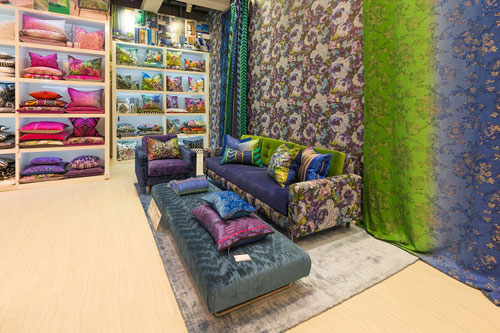 first 11 months of 2018. The year on year revenue of 223 fabric enterprises increased by 7.77 per cent to 22.044 billion yuan. Around 287 towel enterprises above designated size achieved the main business income of 36.246 billion yuan, a year-on-year increase of 5.65 per cent, 1.87 percentage points higher than the overall growth rate of the home textile industry; 988 above-designated bedding enterprises realised a revenue of 101.782 billion yuan from January to November, an increase of 2.87 per cent year on year.
Steady export growth in both traditional and emerging markets
Home textile exports in both traditional and emerging markets grew steadily from January to November 2018. The top four home textile export markets included the United States, the European Union, Japan and ASEAN. China’s exports to its traditional markets of the US, Europe and Japan increased by 10.80 per cent, 8.13 per cent and 5.35 percent respectively. Among these, exports to the United States had the largest volume and the highest growth rate.
China’s carpets exports increased 11.8 per cent to $2.728 billion from January to November 2018. Among them, exports to the US increased 21.4 per cent to $649 million, to the EU by 9.44 per cent to $ 471 million; Japan BY 7.78 per cent to $335 million and to the ASEAN countries by approximately 4.2 per cent year on year.
Increase in industry efficiency
The efficiency of home textile industry also increased significantly from January to November 2018. Around 1,861 home textile enterprises above designated size achieved a total profit of 10.576 billion yuan, a year-on-year increase of 11.80 per cent. The profit margin was 5.48 per cent. The 202 surveyed home textile enterprises achieved profit of 6.303 billion yuan from January to November, an increase of 16.03 per cent year on year. The surveyed 13 industrial clusters realised a profit of 15.318 billion yuan, a year-on-year increase of 9.96 per cent.
From January to November 2018, 1,861 home textile enterprises above designated size achieved a total cost of 167.464 billion yuan, a year-on-year increase of 3.63%. The accumulated management cost was 7.097 billion yuan, a year-on-year increase of 8.91 per cent; the accumulated financial expenses was 1.196 billion yuan, a year-on-year decrease of 28.03 per cent.
Overall, the home textile industry from January to November 2018 achieved a stable growth. The export market also maintained steady growth and the industry’s efficiency increased significantly.
Watchdog urges Bangladesh to fastrack setting up tribunal for worker’s cases
Graft watchdog Transparency International Bangladesh has recommended the formation of a speedy trial tribunal for resolving cases, reinstatement of dismissed workers and ushering in a fear-free environment in the readymade garment sector.
More than 4,000 cases, filed between 2013-19, are still pending for disposal moreover the disposal of such a big number of cases is a big challenge for the sector. Currently trade unions are available in only three per cent and most of them are found to be controlled by factory owners and political goons. Besides, fatality vacation as per the law is six months but it is only four weeks in practice. Moreover, almost 1,250 factories, including 1,171 under the national initiative, have closed and 4,50,000 workers lost their jobs while only 6,676 workers from two factories got compensation although there is a provision in the law to compensate the workers losing jobs.
Even six years after the Rana Plaza accident some challenges still remain as factory owners give more attention to their businesses than to the rights of workers. There hasn’t taken place notable progress regarding compensation for the loss of a job, commensurate compensation for an accident, maternity benefits, freedom of association or social safety.
Vietnam feels China is a good partner
Vietnam and China are collaborating in the textile and garment sector. China and Vietnam hold a pivotal position in the global textile market. Industries in the two countries are highly complementary. China is the world’s biggest exporter and Vietnam is the second biggest. Vietnam is taking a path similar to China’s, both having communist leaders who turned toward export-led market capitalism in recent decades, and in terms of selling ever more footwear, clothes and bags to the world. Their industries compete for customers but they are also complementary in that Chinese factories supply much of the fabrics and other inputs needed in the business, while Vietnamese factory hands are increasingly supplying the labor as costs rise in China. Textile firms on both sides of the border are working together to turn a profit.
Amid the trade war with the United States, China has lost some of its business to Vietnam. On the other hand, it is not just foreign third parties moving factories from China to Vietnam. Chinese investors themselves deem it beneficial to relocate some of their supply chain to Vietnam. However Vietnam does not have as large and complex a network of textile suppliers and processors as China does. That is one reason the smaller country relies on the larger one as its biggest source of imported goods overall.
Italy to host three-day Pitti Bimbo in June
Pitti Bimbo will be held in Italy, June 20 to 22, 2019. This children’s wear show will host 560 exhibitors, of which 337 will be from outside Italy. A new section will present the latest experimental approaches in children’s wear, with exhibitors divided in among five sub-sections: Kidzfizz, for experimental brands; #Activelab, for athleisure/urban brands; an incubator area, The Nest, for up-and-coming brands; EcoEthic, for sustainable brands; and a series of mini capsule collections. The show’s section for experimental children’s fashion will also include communal areas dedicated to exhibitions, editorial projects and events.
Pitti Bimbo’s other main sections are Apartment, featuring labels with a couture inspiration; Sport Generation, for sportswear labels; Superstreet, dedicated to streetwear labels; and the Fancy Room and Editorials sections, showcasing the increasingly large contingent of lifestyle brands, exploring a variety of different children’s wear trends. The show’s last summer session was attended by 5,350 buyers (2,450 of them from outside Italy) and 10,000 visitors in total. The organisers hope to boost attendance in June thanks to an intense program featuring many novelties.
In terms of digital tools, the e-Pitti.com site will yet again put at the buyers’ disposal, once the physical show is over, its B2B platform featuring more than 370 brands and 2,000 products.