FW
UCB’s new Spring/Summer collection adorns the July edition cover of Rolling Stone India
"United Colors of Benetton (UCB) recently unveiled the July edition of Rolling Stone India at Select Citywalk in Delhi. The cover features Indian comedian, singer, songwriter and YouTube sensation Bhuvan Bam on the cover in a complete Benetton look from the brand’s eclectic Spring Summer 2019 collection. The magazine was unveiled by Ram along with Sundeep Chugh, CEO and MD, Benetton India."
 United Colors of Benetton (UCB) recently unveiled the July edition of Rolling Stone India at Select Citywalk in Delhi. The cover features Indian comedian, singer, songwriter and YouTube sensation Bhuvan Bam on the cover in a complete Benetton look from the brand’s eclectic Spring Summer 2019 collection. The magazine was unveiled by Ram along with Sundeep Chugh, CEO and MD, Benetton India.
The Spring Summer’19 collection of the brand encapsulates the essence of Italian fashion with contemporary prints, dynamic denim themes and fun soft floral prints. The collection offers a variety of classic designs in floral, stripes, quirky tees and bold prints in an array of colors and high quality fabric. This season’s collection is all about mixing up colors and prints, with pastels making a rich recurrent story and warm shades that are reminiscent of the autumn gone by. The Spring Summer’19 collection encapsulates the essence of Italian fashion with contemporary prints, dynamic denim themes and fun soft floral prints.
The Color Palate: This summer, pantone being the seasonal inspiration of 2019, the brand offers a wide range in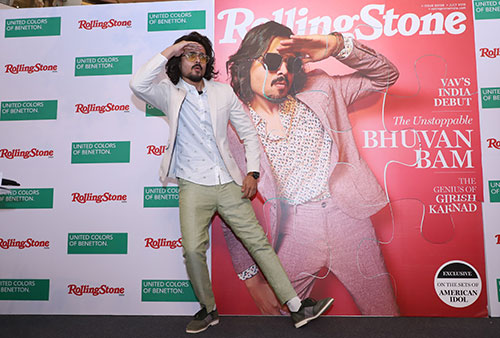 pantone hues. The collections key color palate focuses on pastel shades and a mix of colorful prints in warm color harmonies, material and product application across men’s, women wear.
Benetton Group is one of the best-known fashion companies in the world, present in the most important markets with a network of about 5,000 stores. A responsible group that plans for the future and lives in the present – with a watchful eye to the environment, to human dignity, and to a society in transformation – the Group has a consolidated identity comprised of colour, authentic fashion, quality at democratic prices and passion for its work. These values are reflected in the strong, dynamic personalities of the United Colors of Benetton and Sisley brands.
Sundeep Chugh, CEO & MD, Benetton India said “Benetton has a long history with art. We love to infuse art of any form into fashion and create a collection that is young and positive. Benetton and Rolling Stone have been partners since a long time and we are happy to have a popular youth icon like Bhuvan Bam sport our SS19 collection for India’s leading music magazine.” Styled in Benetton’s vibrant Spring Summer collection, Bam said. “The magazine is known for shaping music and pop culture vibes across the globe and in India and I’m delighted to be featured in the magazine that I have read during my teen years. Benetton feels like a perfect brand to be spotted in for all the work it has done to empower art, culture and music. I have always admired Benetton for their color plays and unique fashion statements. Our cover shoot styled in the new Spring-Summer collection was absolutely fun and I loved tropical summer looks that I was styled in.”
United Colors of Benetton’s commitment to social issues has always been a central feature of the brand that, through its communications campaigns and collaborations with leading non-profit organisations, makes the public reflect on social issues of universal relevance.
UK brand Arcadia fights for market share
Arcadia’s share of the UK women’s wear market is forecast to fall to 4.9 per cent in 2019, a decline of 1.4 percentage points since 2016. The brand mainly targets shoppers over 35. It is known for its brands Topshop and Miss Selfridge. Neither Miss Selfridge nor Topshop stocks clothes over a UK size 18. Both use only slim mannequins and models in store and in their campaigns. Extending their sizing to widen their appeal and projecting a more positive attitude towards body image will help. Arcadia has also fallen behind in celebrity endorsements. The Kate Moss range for Topshop was the height of cool more than a decade ago, and Dorothy Perkins’ exclusive Kardashian Kollection enabled it to tap into a new customer base back in 2012; however these partnerships have taken a backseat in recent years. Investing in bolder marketing, which highlights each brand’s personality, as well as fully using social media to better connect with shoppers, will be essential for Arcadia to remain relevant. Though Arcadia’s brands have released small sustainable ranges, such as Topshop’s vegan footwear collection and Miss Selfridge’s eco denim range, the minimal options within these propositions have limited their impact.
The highly saturated fashion market means it is crucial that retailers invest heavily in marketing to capture shoppers’ attention and drive top of the mind appeal.
India: Textile industry hails new budget proposals
The Indian textile industry has hailed the Budget proposals for 2019-20. As the Cotton Textiles Export Promotion Council (Texprocil) notes, the budget will bring down the cost of transport, especially for bulk products such as raw cotton. While the Confederation of Indian Textile Industry believes that the increase in allocation for development of handloom, handicraft, wool, silk, jute and power loom sectors and additional funds for skilling will benefit the industry.
P Nataraj, Chairman of Southern India Mills’ Association appreciated the announcement of “One Nation One Grid” power sector tariff and structural reforms, which according to him, will be a boon to the textile industry. The increase in the annual turnover threshold limit from Rs 250 crore to Rs 400 crore for Corporate Tax of 25 per cent will benefit several textile mills.
A Sakthivel, Vice-Chairman, The Apparel Export Promotion Council points out that the budget focuses on developing the Indian economy to a $ 3 trillion economy this year. It gives importance to infrastructure development and encourages Foreign Direct Investment. However, some of the demands of the textile industry have not been met.
Tirupur Exporters’ Association President Raja Shanmugham calls it generic budget with no specific announcement for the textile sector. He informs that the pending amount for ROSL scheme for Tirupur alone is likely to be Rs 300 crore. Further the extension of 25 per cent Corporate Tax for companies that have up to Rs 400 crore annual turnover is not available for proprietor firms.
Mayer launches new machines
Mayer’s new MJ 3.2 E is an electronic single jersey machine that specialises in the production of mesh and body mapping structures. The OVJA 1.1 EETT’s sports focus is on the manufacture of shoe upper fabrics and sports outerwear. It combines double electronics and bidirectional transfer selection and can knit an almost infinite variety of patterns, including hole structures. It can also knit multi-colored spacer fabrics. The OVJA 2.4 EM makes a special contribution toward optimal post-sport regeneration. This new member of the OVJA family is the most productive machine for the manufacture of mattress cover fabrics.
An established machine with new features is the Spinit 3.0 E. The fact that the Spinit 3.0 E now also processes polyester, is capable of a higher working speed and is linked to the knitlink digital platform makes the spinning and knitting machine an even more attractive proposition.
In contrast to a conventional circular knitting machine that uses latch needles, the Weftnit, inspired by weft knitting, uses bearded needles. That has advantages in stitch formation, which for one is much more gentle than when latch needles are used. For another, the stitch structure is finer than that of a conventional circular knitting machine with the same gauge. In addition, the bearded needle technology increases the machine’s production speed.
GSP loss may hurt Sri Lanka
The EU and the US may withdraw GSP Plus concessions for Sri Lanka. If this happens, it will automatically reduce the country’s export earnings and the competitiveness of its products in EU markets vis-à-vis several Asian countries enjoying such concessions. If the US too withdraws its GSP concessions, it will be a double whammy for Sri Lanka. About 57 per cent of Sri Lanka’s total exports go to these two markets. Apparels are Sri Lanka’s biggest exports to the EU. Almost 90 per cent of Sri Lankan exports to the EU are exported under GSP Plus or with zero duty. The GSP Plus scheme encourages increased value addition within Sri Lanka and thereby promotes backward integration, resulting in the setting up of new industries, and creating new employment opportunities in the country. Sri Lankan exporters can also exploit the potential for agro-based processed food exports in collaboration with European companies through joint ventures and transfer of technology. Small and medium enterprises can be encouraged to work more effectively and be part of the value chains of larger companies. However, the GSP Plus utilization rate is still relatively low in Sri Lanka. It was only 55 per cent in 2017. In clothing, it was 43 per cent.
EU signs deals with Mercosur and Vietnam
The EU has signed trade agreements with Mercosur and Vietnam. Mercosur is a bloc comprising Argentina, Brazil, Paraguay and Uruguay. The agreement is expected to give European companies an important head start in a market with an enormous economic potential. It will remove the majority of tariffs on EU exports to the countries—which will spell an opportunity for textiles, too. For clothing and footwear, the agreement will see 35 per cent tariffs eliminated, and the 26 per cent tariff on knitted fabrics will also be removed. This will help boost exports of EU products that have so far been facing high and sometimes prohibitive tariffs. Through this trade pact, Mercosur countries have decided to open up their markets to the EU. This is the largest trade agreement the EU has ever concluded.
The free trade agreement with Vietnam is the most ambitious free trade deal between the EU and an emerging economy to date. The deal is set to strengthen trade relations between the EU, and not just Vietnam, but the entire Asean region, which also comprises Indonesia, Malaysia, Philippines, Singapore, Thailand, Brunei Darussalam, Vietnam, Laos, Myanmar, and Cambodia. The EU is aiming at closer trade and investment relations between the two regions.
Countries repress garment workers
Garment workers in many countries are being exploited, says the International Trade Union Confederation. In many countries, including Bangladesh, Cambodia and Indonesia, union-busting measures are frequent and workers attempting to form a union are systematically dismissed. Conditions in the Asia-Pacific have deteriorated more than any other region with an increase in violence, violent attacks on workers, and criminalisation of the right to strike. In Colombia 34 workers were murdered in 2018.
The condition workers in Bangladesh are among the worst in the world. They are exposed to mass dismissals, arrests, violence and state repression against peaceful protests. In the garments sector, strikes are often met with extreme brutality by police forces.
Even in Europe 50 per cent countries now exclude groups of workers from the law, up from 20 per cent in 2018. A shocking 85 per cent of countries violate the right to strike while 80 per cent of them deny some or all workers the right to collective bargaining. Workers have no or restricted access to justice in 72 per cent countries ut of 145 countries; 54 deny or constrain free speech and freedom of assembly. Authorities have impeded the registration of unions in 59 per cent of countries and workers experience violence in 52 countries.
Companies monetize e-textiles
Over the past 20 years, e-textiles have progressed from an academic curiosity to an important technology platform generating revenue for companies globally. Companies in e-textiles get the majority of their revenue on a project-by-project basis. Many companies continue to investigate this sector, fuelled by a clear long-term vision for the potential around e-textiles. Electronic products and their surrounding digital ecosystem which they fuel are key products for the four largest companies in the world. The idea is to combine the features of each, providing a comfortable, fashionable, customisable interface between humans and digital products, creating huge value in the process. These early steps are critical to establishing real short-term revenue, before developing towards the bigger picture ideas.
Challenges for e-textiles companies range from optimising supply chain and manufacturing, validating product value in the minds of consumers to end of life management of the products once they are sold. Steps are being taken across these challenges, in investing to consolidate advanced manufacturing in house, pursuing medical approval routes for biometric monitoring after consumer routes have proven unfavorable, and by optimising materials with recycling or disposal in mind.
Most prominent e-textile brands remain relatively young, driven either by recent start-ups, spin-outs from larger companies lower in the value chain, or generally companies outside of the mass-market consumer sector in either textiles or electronics.
Budget lowers textile grants
In the budget, the grant for textile and apparel is about 30.41 per cent lower than the previous year’s revised grant. This is mainly because of the discontinuation of ROSL scheme from March 7, 2019. The new scheme called Rebate of State and Central Taxes and Levies which was announced simultaneously will be issued through free transferable scrips. In terms of percentage change, the maximum change in grant is for the Integrated Wool Development Program, which has increased by about 447 per cent.
In terms of value, the maximum grant is for procurement of cotton by the Cotton Corporation of India, which is 118 per cent higher than the last year. There has been a slight increase of about 12.4 per cent in the Amended Technology Upgradation Fund Scheme. For the handicraft development program, the grant has been increased by about 18.9 per cent. For silk and jute, the grant has been increased by 23.2 per cent. The power loom sector has got an increase of 49.8 per cent in the total grant. The grant for the Integrated Scheme for Skill Development has been increased by about 139.3 per cent.
The textile sector in India is the biggest employer after agriculture.
Apparel Sourcing Paris to be held from September 16
Apparel Sourcing Paris will be held September from 16 to 19, 2019. The event will foster exchange of ideas and allow both visitors and exhibitors to compare information about current trends. This is the biggest trade fair in Europe for sourcing clothes and will host over 700 exhibitors from all over the world. The offer encompasses all the markets for women’s, men’s and children’s ready-to-wear. This covers knitwear, dresses and blouses, tailoring, sportswear, evening wear, outerwear, made-to-measure, lingerie and swimwear, work wear and textile accessories.
The September edition will mark Turkey’s return. The exhibition is also expecting participation by countries which traditionally attend Apparel Sourcing, such as China, which accounts for the main contingent coming to the show from overseas, and Hong Kong, a hub for business with China. However, it will also welcome India, Bangladesh and Pakistan, in addition to Ethiopia. Cambodia will have artisan and classic products on display, such as dresses, tunics and traditional scarves.
There will be a series of lectures on changing markets and topical issues such as clothes sourcing in Vietnam, a supply region which is expanding, and financing for fashion labels. In addition, the agenda includes live catwalk shows and presentations of collections by Bangladeshi, Pakistani, Chinese, Cambodian and Ethiopian delegations.