FW
US shows Apparel Sourcing and Texworld focused on sustainable practices
Apparel Sourcing and Texworld were held in the US, January 19 to 21, 2020. The shows made news because of a greater focus on sustainable practices. They are seen as the premiere platform for sourcing and product discovery in the marketplace. Attendance increased eight per cent. Exhibitors were from Canada, the United States, Colombia, India, China, Hong Kong, Japan, Thailand and Ukraine. Country pavilions were organized to represent the offerings of Mauritius, Korea, Nepal and Taiwan. Lenzing showcased products using Tencel and Lenzing Modal. The show floor equipped retailers, designers and apparel buyers with knowledge about new materials, technology and trends to grow their businesses. Industry leaders discussed trends and advancements, including blockchain technology, circular tracing and biosynthetic materials.
As sustainability continues to reflect an expanding umbrella of progressive initiatives such as ecologically sound manufacturing, closed-loop apparel manufacturing, ethical sourcing and empowerment of developing communities, this edition provided the needed clarity to help attendees make decisions regarding their next steps. The push toward sustainability in the garment industry is growing with rising concerns about environmental impacts and social awareness.
Trident Q3 net profit down 27 per cent
For the third quarter Trident’s net profit fell 27.7 per cent. Consolidated profit before tax slumped 74.1 per cent. Tax expense dropped 70.1 per cent. Net debt jumped 10.42 per cent. This year Trident saw growth in the first two quarters. However, the third quarter brought some headwinds due to which overall revenue declined as compared to the previous quarter as well as compared to the corresponding period of last year. Lower traction in the home textile segment along with reduced realizations in the yarn and paper segments impacted revenue as well as profitability for the quarter. The company is expecting an improvement in capacity utilization in the bath linen segment in the next quarter and is looking at the order book for the sheeting segment for the next quarter.
Trident is a vertically integrated textile and paper manufacturer. Trident believes in offering innovative solutions and delivering high-quality value-added products to customers. Trident is expanding spinning capacity at its Madhya Pradesh plant. The project, expected to begin commercial production by January 2021, will help strengthen Trident’s existing home textile business and further expand its market presence. Trident’s existing capacity is 5,43,744 spindles and 6,464 rotors, and the current capacity utilisation is 99 per cent. Trident has planned for maintenance capex at Rs 100 crores for fiscal ’20 and the same will be utilized toward small maintenance capex in the form of de-bottlenecking and upgradation of capacities.
Myanmar’s apparel sector adopts environment friendly initiatives
Myanmar has begun investing in environmental sustainability. Till now, only one garment manufacturer in the nation has been certified Leadership in Energy and Environmental Design platinum. Two other facilities, both operated by garment manufacturer Guston Amava, comprise 34 per cent recycled building materials, such as reclaimed steel, in their construction, along with rooftop solar panels, an evaporative cooling system and water-reduction features.
However, Myanmar has a long way to go. Factories are missing cost-saving benefits of making their operations greener and securing higher investments as buyers pay closer attention to sustainable production. Myanmar is one of the world’s fastest growing garment, footwear and travel goods suppliers. But this growth also results in increased environmental impact, which requires best-practice solutions for improved production efficiency, energy, water and waste management.
At a time when retailers and consumers are paying close attention to the conditions under which their garments are produced, ethical and sustainable production is a big deal. Making their operations more environmentally friendly will help factory owners compete with other sourcing markets and give them a better chance of retaining existing orders and securing new business. Else they face the danger of ceding business to competitor countries.
Japan’s footwear brand Asics invests in AI, buys stake in New New Folk Studio
Asics has bought a stake in No New Folk Studio. Asics jointly with No New Folk Studio is developing smart running shoes that give runners real time feedbacks on the changes in their foot movement. Foot movement data, including number of steps /distance, cadence, and angle of ground contact, are collected and together with biomechanics expertise are analyzed to provide runners feedbacks on gait analysis, including step length and foot strike pattern.
Asics is a footwear and sports equipment group from Japan. No New Folk specializes in the design of artificial intelligence applied to sports shoes. No New Folk Studio develops IoT interface that seamlessly integrates movement, light, and sound to facilitate new forms of art and performance. No New Folk was founded in 2014 and has previously worked with Asics on different projects. The companies have developed smart shoes to measure the shape of the footprint and the movement of the foot while exercising or walking. One of the core strategies of Asics is enriching sports lives through the use of digital technology, and the company is focusing on improving the sense of fulfillment customers get from sports by using digital power. The investment in No New Folk Studio is part of that strategy.
Helen Helmersson is the new H&M CEO
Helena Helmersson is CEO of H&M, a veteran of the same company she started in 1997 as an economist at the buying department and held various roles within buying and production. She was sustainability manager for five years, and after that production manager based in Hong Kong.
H&M with nine labels is one of the biggest fashion retailers globally. It has gradually improved profits and has a strong position with many well-established brands, millions of customers worldwide and good financial strength. For the fourth quarter net sales rose nine percent. The online and physical stores are being increasingly integrated with continued optimisation of the store portfolio. Developments this year will include both physical spaces and web stores. Around 200 new stores are planned to open in 2020, mainly in growth markets, but there are also around 175 planned store closures, mainly in established markets. Australia is scheduled to become a new H&M online market in the second half of 2020 and H&M will be launched on an e-commerce platform in South Korea this year. In a challenging context, and while the industry is facing a radical transformation, the Swedish group has been experimenting with new store concepts and chains for the past years in a trial and error strategy.
Gap closes 40 stores globally while restructuring business
As part of its restructuring process Gap closed 40 stores across the world. The US retailer plans to close a total of 230 stores over the next two years.
The closings come as part of Gap’s restructuring plan, which includes withdrawing Old Navy from China this year and focusing on its North America market to boost sales. The apparel retailer is focused on aggressively addressing the operational issues that are hindering the performance of its brands. The company’s management structure will be slimmed down in order to speed up decision making as well as a refreshed senior compensation plan, based around performance and accountability. Meanwhile Gap and Arvind have embarked on a water-saving project. This is at Arvind’s denim manufacturing facility in Ahmedabad. The project will save eight million liters of fresh water a day or 2.5 billion liters of freshwater on an annual basis. The first mill in India to manufacture denim, this will now operate entirely with reclaimed water using Membrane Bio Reactor technology, which will treat domestic wastewater drawn from the surrounding community and avoid the use of chemicals in the process. A newly constructed pipeline will draw wastewater from the local municipal line. In the face of local water scarcity challenges, the facility will also reduce business risk for Arvind, Gap and other brands that source from the facility.
Pakistan’ fashion sector gaining ground
Pakistan’s fashion industry has come a long way, and it is only expected to flourish in the coming years. The fashion industry, though quite small, has kept growing over the years. There are award programs such as the Lux Style Awards and Hum Awards, fashion shows like the PFDC Fashion Walk held by the Pakistan Fashion and Design Council, and model-hunt shows like Veet Miss Super Model, among other things.
An important addition to Pakistan’s fashion industry besides clothes, jewelry ad makeup is fragrances. Ayesha Ziya is known for her luxury perfume brand. Television host and anchor Waseem Badami also has a perfume collection, as does retired cricket player Wasim Akram as well as the late musician turned religious scholar Junaid Jamshed.
The country’s fashion industry got international attention and is viewed as a promising market. Being able to design outfits in a range of categories is a skill among the country’s fashion designers. The Annus Abrar studio is known for its luxury pret, festive and bridal collections. Modeling is an important aspect of the fashion industry. Model Aneesa Sharif has a clothing brand named Niya. Models use their star status to raise awareness regarding different social causes.
Global apparel industry facing numerous challenges
Challenges confront the global apparel industry in 2020. Polarisation of manufacturers is continuing, with top class of large, well equipped manufacturers growing their market share at the expense of smaller suppliers. Domestic production in the US and in Europe is growing, but its market share is still very small. All of these trends are expected to continue in 2020.
The supply chain needs to accelerate the transformation to a more demand driven model. That’s a prerequisite for improving the bottom line. The challenge is for buyers and manufacturers and their suppliers to build responsive, flexible and sustainable value chains that are able to deliver the right product in the right amount at the right time. This requires collaboration which in turn requires from buyers to look beyond cost, to be prepared to share part of the investment burden by forfeiting short term lower buyer prices for long term gains and to engage suppliers as strategic partners. It also requires an acceleration of implementation of the ample technology available to move the industry into the digital age.
Another challenge is to reduce the environmental impact of clothing. Once improvements are made they must be communicated in the right way to consumers.
USMCA offers stability in key markets
The National Cotton Council (NCC) applauded President Trump’s signing of the Congressionally-approved U.S.-Mexico-Canada Agreement (USMCA).
NCC Chairman Mike Tate said this trade agreement will provide a boost in trade certainty for U.S. cotton and cotton textile products in the North American market. He noted that Mexico is the second largest export market for U.S. cotton textile/apparel products and Canada is the fourth largest for these goods. Mexico also is a top market for U.S. raw cotton.
The Alabama cotton producer said the USMCA, which updates and modifies the North American Free Trade Agreement, includes a textile chapter that offers significant improvements for domestic textile manufacturers and workers. Among those provisions are: a stronger rule of origin for certain regional textile products; strong customs enforcement language; and ensuring that a significant amount that the Department of Homeland Security spends annually on clothing and textiles is on domestically-produced products.
Collection Premiere Moscow – source of information and inspiration
At the 34th edition of CPM – COLLECTION PREMIÈRE MOSCOW from 24-27 February 2020, around 1,300 brands from 30 countries will be showcasing their autumn/winter 2020/21 collections on the exhibition grounds of Moscow’s Expocentre. An average of 20,000 buyers from Russia and the Eurasian Economic Union use CPM as a valuable source of information and inspiration for doing business and placing orders. “Due to the currently stagnating disposable income of its consumers, the Russian market is regarded as challenging – yet still lucrative. Its core appeal is still the prevailing mindset that fashion is a strong statement of people’s desire to convey a positive image in their working, leisure and social lives. At the 34th edition of CPM, professional buyers will be presented with a wide offer tailored specifically to them, without any decreases in space or exhibitor numbers: CPM stands for Collection, Premiere, Moscow – and a whole lot more!” - Thomas Stenzel, Managing Director of OOO Messe Düsseldorf Moscow.
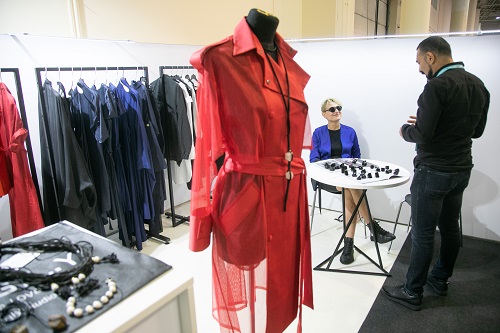
At the beginning of the new decade, the biggest Eastern European ordering platform for the fashion industry, organised by Messe Düsseldorf Moscow in partnership with IGEDO Company and Messe Düsseldorf, is all about renewal and change. With its various segments and areas, CPM covers the entire fashion spectrum and presents collections from ladies’, men’s and kidswear brands alongside lingerie, beach, sports and yogawear, shoes, accessories and fabrics. “My team and I are proud to once again be attracting many international participants to CPM. The response from the companies shows that the Russian market is still vital to their turnovers. Our regular exhibitors and the many new additions are well prepared for taking part in the fair and looking forward to a successful ordering season and the opportunity to make new contacts.” - Christian Kasch, Project Director of CPM International.”

Highlights of the Show
• Change and renewal at the focus
• Large number of international exhibitors with growth rates of up to 10 percent
• New: ‘Labels to Watch’ in cooperation with TextilWirtschaft magazine
• RFRF: Additional presentations, panels and seminars on relevant industry topicsq
• ‘CPM Body & Beach’ with approx. 135 international brands and separate line-up
• ‘CPM Shop & Retail Solutions’ with leading suppliers
• Interactive trend zone, media partnerships, new catwalk shows