


FW
Bangladesh RMG sector needs a proper cost analysis to push up earnings
 The second-largest apparel supplier to the global apparel market, Bangladesh might soon lose its coveted title to Vietnam as its apparel exports declined to just 0.44 per cent against 7.30 per cent export growth achieved by Vietnam in 2019. Since the last few years, the Bangladesh readymade garments sector has been facing multiple challenges such as rise in production costs, labor wages and utility rates. This is making survival difficult for small and medium factories as price of their products does not match production costs. This prevents exporters from covering their operational cost leading to a drastic decline in profit margins.
For the last few years, Bangladesh RMG exporters have been focusing more on product costs to achieve desired profit margins. However, buyers recently introduced the open costing approach for price fixation. As per this approach, manufacturers in the ‘A’ category bargain for fair price whereas those in the ‘B’ category bargain for lower price targeting their unused capacity utilization. This makes the product a loss making proposition and shortens its lifecycle in the Bangladesh market.
Identify cost drivers
Every Bangladeshi RMG company has its own cost structure involving cost elements like material cost, salary and wages, utility cost,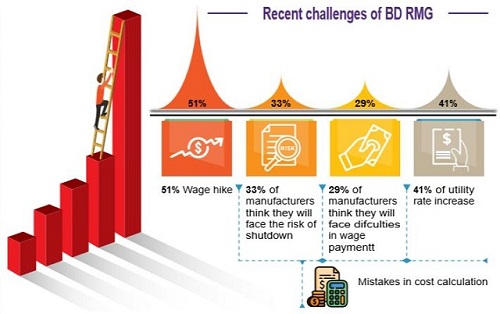 depreciation of assets, spare part and repair maintenance, other manufacturing overhead, administrative and selling expenses, finance cost, etc. incurred in different cost centers responsible for making the company cost-effective.
Hence, it is important for the owners of these cost centers to identify their cost drivers. They need to price their products through a standard costing procedure like the CPU (cost per unit) which has a basic formula that says that total cost of production plus total output is equal to cost per unit.
Combine techno-finance knowledge
Bangladesh RMG factories also need combine techno-finance knowledge for perfect costing of their products. For this, manufacturers need to train non-finance professionals in finance and financial professionals in technical issues. A combination of techno finance knowledge will make the price bargain with buyers.
Some buying houses have introduced open costing approach. This entails standard, buyers to have a costing team having technical and finance people. However, not just the technical people deal with open costing from the buyers’ side. The query and format of these technical people is not up to the standard of company cost structure and accounting standard procedure. Hence, buying houses should have a costing team having technical and finance professionals to make the open costing procedure smooth and acceptable for garments manufacturer.
In Bangladesh, all marketing professionals should know the actual cost of their factory. Actual cost shows the actual output, wastage, actual cost structure. Every company should compare the standard cost and actual cost frequently and identify for continuous improvement through process innovation. From the principal of CPU (cost per unit) to optimize the cost, Bangladesh has to work on efficiency. Higher efficiency will help the country absorb the fixed cost resulting in lower CPU.
Involve government and professionals institutes
One drawback of the Bangladesh RMG sector is the lack of proper future analysis. As buyers deal with a number of manufacturers simultaneously for capacity building and future order placement, they usually opt for cheaper products. Hence, most of the RMG factories do not get the expected orders which leads to underutilization of factories. In such a situation, factories opt for low cost products to make maximum utilization of the plant.
Industry professionals in Bangladesh are aware of this costing issue. They need to engage government and professional training institutes to change this training or education system. Their target-oriented initiatives will help the industry to overcome these challenges.
Chinese designers make a mark with exclusive boutiques, fashion shows
 Known for their artsy, edgy and socially risky designs, Chinese designers like Qiu Hao and his partner Wang Chuqiao (Qiaoqiao) have cemented their position by opening designer boutiques in the country. These collective designer shops such as those on Brand New China (BNC) and Dong Liang have provided Chinese fashion designers diversified retail options. The 540 sq m BNC store houses the largest collection of over 150 Chinese fashion designers under a single roof. Designed by Yung Ho Chang, an architecture professor at MIT, the store’s glass facade allows a view into the store’s interior and customized displays.
Designer shops like these have been rapidly growing into Tier II cities across China. Many of these shops integrate online retail with offline try-on services, fans’ activities or entertaining promotional experiences.
Lack of service and media exposure
Though the growth of fashion e-commerce has been rapid in China, these boutiques remain critical for Chinese luxury designers as they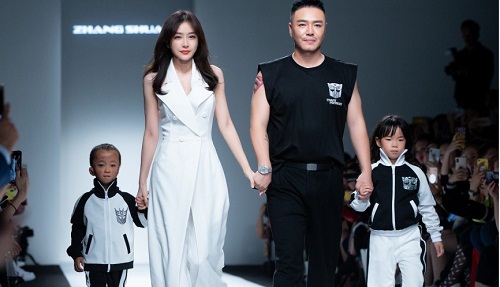 enable them to personally interact with customers. However, though these designers train their sales staff as communicators and persuaders on the selling floor, most fail to focus on customer service due to budget constraints, says Designer Liu Canming, also a professor at Donghua Uni¬versity.
Many designers also lack media exposure. While designers such as Wang to participate in fashion shows they do so only for showcasing their collections and not selling.
Seeking visibility through fashion shows
A fashion show that is popular with designers is the Shanghai Fashion Week, which provides them a highly visible platform to display their collections. Initiated by the Shanghai Municipal Government and the SFW Organizing Committee since 2003, Shanghai Fashion Week is often criticized for failing to attract international buyers. In 2013, the show, along with the Shanghai Fashion Designer Association, launched a ‘Design by Shanghai’ program during London Fashion Week to promote young Chinese fashion design talent to international buyers and con-sumers.
Another government-supported multi-entity, the Shanghai International Fashion Federation, organized the first Shanghai New Couture Week, April 10-16, 2015, which is an important part of the city development plan. New Couture Week is supported by the Shanghai Promotion Centre of Design, whose goal is to aid the establishment of Shanghai as a world centre for design and creativity, which is in line with the central government’s call for an economic trans¬formation from a labor-centered, industrialized and environmentally unsustainable economy to one driven by service, creativity and personnel.
Offering authentic fashion in familiar style
Fashion foundations and collective showrooms in China also showcase the country’s future fashion shapers. Independent designers organize fashion shows featuring ordinary consumers walking the runway in natural poses and with natural facial expressions. These shows are intentionally held in obscure, using bars, deserted factories, old houses or concert halls.
As Chinese consumers seek authentic fashion in familiar style they are not bothered about the original inspiration for these designs. This allows Chinese designers to be inspired by other art forms or cultures or hire foreign professionals. Though the creativity of these designers can be legitimized by the Chinese market, they can’t be given a collective identity as they have diverse backgrounds and multiple approaches to design and retail.
Online activewear retailers record exponential growth in sale
Asos, which sells workout clothes from the in-house line saw its activewear sales double in the four months through June 30 versus the same time last year. It also saw strong growth in sales of casual clothing and sneakers, helping its total sales to rise 10 per cent over the period despite the pandemic. Sales of evening dresses, formalwear, and day dresses all sank.
In May, US retail chain Kohl’s similarly called out activewear as one of its highlights for the quarter, with sales doubling. Smaller labels such as SETactive and Ten Thousand have reported healthy sales too.
In the US, where the great majority of consumer purchases still happen in stores, widespread store closures have dragged down activewear sales overall. Even powerhouse companies such as Nike and Lululemon have seen their total sales fall as a result of having to shutter many of their physical shops.
But online sales of activewear are proving resilient. In the UK, for example, the amount of activewear appearing online has grown 17 per cent since the start of May compared to the same period last year, according to Edited, a retail technology firm that tracks fashion e-commerce. It found sellouts of new products had risen too. In the US, online new arrivals of activewear did drop 15 per cent as per Edited’s data, but sellouts of new styles jumped more than 100 per cent.
Texworld Paris to provide a digital platform to exhibitors
Texworld Paris and its related events will provide a digital platform from September 2020 to support exhibitors. The digital platform will cover each of the The Fairyland for Fashion fairs including Apparel Sourcing, Avantex, Leatherworld, Shawls&Scarves, Texworld and Texworld Denim Paris.
The platform will enable exhibitors from Messe Frankfurt France tradeshows - textile and clothing manufacturers, brands, accessory manufacturers, etc to present their collections and know-how to international buyers through a complete digital networking solution: virtual showroom, matchmaking, definition of needs, etc. Buyers will also profit from a specific section to define their requests and build their collection based on selection criteria designed for the textile world: country, minimum quantities, type of service, certificates, etc.
Available from September 01 on the respective trade fair websites, the platform will be offered for a renewable period of 6 months to exhibitors at the February edition of the Paris trade fairs. It will also help to maintain a working relationship between buyers and manufacturers and support them in their projects between two editions of the Messe Frankfurt France trade fairs.
Pace of decline in Pakistan’s textile exports slows down
Data released by the Pakistan Bureau of Statistics showed the pace of decline in Pakistan’s textile exports slowed down in the last two months owing to a recovery in international orders. Compared to 36.5 per cent decline in May, exports in June declined 5.43 per cent over the last year.
Easing of lockdown in the North American and European countries — top export destinations for Pakistani textile goods are helping revive sinking exports. Piled up containers at ports since March 22 were mostly cleared in the month of June. Moreover, the government also reopened exports through the land route to Iran and Afghanistan in June. A report produced by the customs authorities showed that cargo handling at Karachi ports posted a growth of 7.23 per cent in June as 49,953 export containers were shipped this year as against 46,583 of last year.
It was only in February when the textile and clothing exports jumped by nearly 17 per cent on a year-on-year basis — growth witnessed after a long time as the past few years had been marred by single-digit increases.
Details showed exports of ready-made garments by dipped 3.81 per cent in value and drifted much lower in quantity by 10.07 per cent during July-June FY20, while those of knitwear dropped 3.64 per cent in value and 10.11 per cent in quantity, bed wear posted negative growth of 4.91 per cent in value and 2.31 per cent in quantity.
Towel exports fell by 6.52 per cent in value and 6.39 per cent in quantity, whereas those of cotton cloth dipped by 12.94 per cent in value and 17.66 per cent in quantity. However, exports are expected to revive in July as exporters have resumed production to honor their international orders.
Florida Swimwear Association cancels October edition of SwimShow
The Swimwear Association of Florida has cancelled its plans to host an October edition of SwimShow in Miami. The association has launched a digital edition of the event, which made its debut on July 11. The virtual offering will run through the end of the year, with hopes that a return to a physical model will be possible in July 2021. The platform will be constantly updated with new imagery, look books and sheets as vendors continue to have collections.
In May, the association had cancelled its July event at the Miami Beach Convention Center during Miami Swim Week due to the uncertainty surrounding the COVID-19 pandemic. The event would have celebrated its 38th annual edition had it not been canceled.
One of the largest of its kind in the world, the SwimShow attracts more than 7,500 buyers, manufacturers, designers, corporate personnel, press, bloggers, influencers, fashion consultants, stylists, VIP’s and other fashion industry leaders from over 60 countries across the globe to showcase brands and create business opportunities.
Virtual Home Textiles Sourcing Expo planned in July
Traditionally held at the Javits Center in New York, Home Textiles Sourcing Expo will be held on a virtual platform from July 21-23. Connecting Asian resources with American buyers, the show will focus on offering a free access to sourcing and education, AI-powered matchmaking, dynamic online showrooms with vivid customization, live chats, virtual networking, interactive educational programming and flexibility to engage at the user’s convenience during the live event and beyond
The show will provide manufacturers, retailers, jobbers, converters, contract specifiers and designers a dedicated avenue to locate new fabrics and products for their latest home collections. It will solely focus on fabrics and finished soft goods for home applications. The show will be held in collaboration with Texworld USA and Apparel Sourcing USA.
Istanbul’s textile trade volume to decline 40%: Report
A report by Turkish daily Dunya says the overall textile trade volumes in Istanbul’s Laleli, Osmanbey and Merter districts are likely to decline by up to 40 per cent in 2020. According to a report, when the country began reopening its economy by gradually lifting most of the previously imposed restrictions, the number of closed companies in Laleli increased.
Gıyaseddin Eyyüpkoca, Chairman of the Laleli Industrialists and Businessmen’s Association (LAS-AD), which represents some 2,500 traders in Laleli, said in 2019 the district reported about $3 billion in commerce. A large portion of this trade was conducted through applications such as WhatsApp during the coronavirus restrictions.
ICRA predicts a drop in revenues of Indian cotton spinners
Revenue of Indian cotton spinners are likely to decline 25-30 per cent year-on-year in 2020-21 due to COVID-19 led disruptions in manufacturing activities and weakness in demand in global as well as domestic markets, Icra Ratings said in a report. This will further add to the woes of the sector which saw an estimated 5-7 per cent decline in revenue and 200-250 basis points (bps) correction in operating margins in FY20.
The report says, business outlook appears adverse owing to an inventory pile-up being witnessed across the value chain, which is likely to keep demand from downstream segments subdued over the next few quarters, while keeping working capital requirements high.
Even though the nationwide lockdown, implemented from March 25 onwards to contain the spread of the virus, was officially lifted from the second week of June 2020, spinners were not able to fully ramp their operations. Their capacity utilization averaged at 30-40 per cent in the first quarter of FY21.
Apart from COVID-19 related concerns, another cause for worry for the Indian spinning sector has been the flare-up witnessed in geo-political tensions between India and China in recent months. While the tensions have since de-escalated to an extent, it remains a key monitorable for the sector, as China has been one of the major export destinations for Indian cotton yarn over the past one decade, accounting for as much as 45 per cent of India’s exports at its peak level (in FY16).
Fashion retailers hope for US-Kenya FTA
Fashion retailers are keeping a close watch on the ongoing trade talks between US and Kenya which could lead to a free trade agreement between the two countries. According to a data, 99.7 per cent of US apparel imports from Kenya got all AGOA benefits between 2015 and 2019. Brands hope these benefits will continue with FTA.
Almost 100 per cent of these imports gained from ‘third country’ fabric facility wherein Kenya enjoyed duty-free access to US market for clothes made of yarn and fabric originating from anywhere else in the world. These will surely be the core areas of discussion before the FTA comes into effect. The agreement should not make any changes with respect to market access and duty-free treatment for apparels made in Kenya effective from the date of entry into force of the agreement, views fashion brand PVH.
However, many feel the FTA may help move to yarn-forward rule of origin in phases to help the development of the local textile industry in Kenya. Betty Maina, Cabinet Secretary for Industrialization, Trade, and Enterprise Development, also believes that the trade agreement will help Kenya foreign direct investment from the US.











