


FW
New CTC sewing thread range offer sustainable alternatives to polyester
Made from 100 per cent recycled materials, the new range of industrial sewing threads from US textile manufacturer Champion Thread Company (CTC) offer ‘sustainable’ alternatives to polyester, and can be used across fashion, personal protective equipment and home textile industries. The collection includes three products: Renu Poly ChampCore; a recycled polyester-wrapped thread with a multifilament core; Renu ChampSpun; a recycled staple spun polyester thread; and Renu AeroTex Plus, a recycled textured polyester thread.
As per Matt Poovey, President, CTC, these products reduce energy consumption, waste and oil dependence. They are engineered to CTC’s extreme quality standards and are finished with proprietary lubricants to ensure high productivity.
Looking ahead, the Renu range can support brand and retail partners meet their sustainability goals and commitments. They can also maintain the productivity, seam performance, colour fastness, and chemical resistance characteristics they enjoy in traditional polyester treads, adds Poovey.
Political turbulence, violence threaten Myanmar’s apparel orders
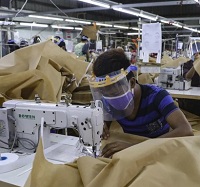 The ongoing political turbulence in Myanmar is having a profound impact on its apparel industry. As per a CCF Group report on March 15, protestors attacked a number of Chinese-owned apparel mills in the Laydaya Industrial Zone in Yangon. These mills were destroyed, looted, and burned, threatening future investments in the country.
Myanmar currently has 600 apparel mills, of which, Chinese enterprises account for about 60 per cent. Around 300 Chinese enterprises are concentrated in Yangon alone. The current turbulence may affect China's investment in these apparel mills and may cause orders to flow to other markets.
Cheap labor, low cost drive apparel exports
Myanmar’s apparel exports have been growing in recent years. The country mainly exports to Japan, Germany,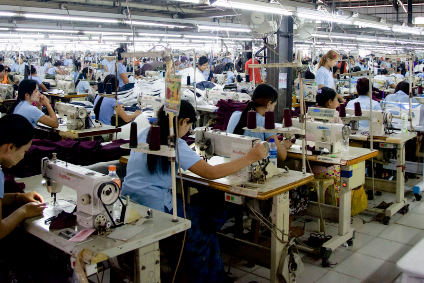 the United Kingdom among other markets. From 2015-19, the value of apparel exports grew 43.7 per cent annually. Lifting of economic sanctions by the EU and US helped Myanmar exploit its advantages of abundant labor and low production costs. GSP benefits also helped its textile and apparel industry boom. In 2018, Myanmar's textile exports grew to $2.225 billion. They accounted for 25.2 per cent of the country’s total exports.
COVID-19 affected global economy in 2020. Myanmar, however, emerged unscathed from the crisis as imports and exports grew in fiscal year 2019-20. In 2019, the proportion of apparel exports in total exports grew to 27.9 per cent. Knitted garments accounted for nearly a quarter of Myanmar's apparel exports, and woven garments accounted for the largest proportion.
Japan, largest export destination for Myanmar
Japan remains the largest destination for Myanmar’s apparel exports. The country accounted 22 per cent of Myanmar’s total apparel shipments in 2019 followed by EU, Germany, Spain, the United Kingdom, the Netherlands, etc. As the world economy recovers from the pandemic, incidents such as the military coup in February and the recent violence in Yangaon might drive apparel orders, especially from Japan and EU, away from Myanmar.
Fashion retailer Gant rolls out Cegid software across Europe
Gant, the branded apparel retailer with over 750 stores in 80 countries, has rolled out the Cegid Retail’s Unified Commerce Platformacross Europe in a bid to improve stock management and customer service across multiple channels and territories. The cloud-based point-of-sale and merchandising solution has recently been added in France and goes live in the UK in March. This is part of the brand’s strategy to introduce more omnichannel and digital technologies and standardising systems throughout the group. Theinitiative follows a move to bring more of its overseas franchise partners under the same roof - such as Portugal and Spain during 2020 - as wholly-owned subsidiaries, sharing the same processes and accelerating a shift towards more digital services like “click-and-collect”.
The retail software is also pre-configured to take care of complicated tax regimes which tend to change year to year and vary from country to country. For instance, VAT and receipt rules in Portugal differ widely to those in France and Sweden.
The retailer also plans to roll out other digital services and mobile solutions across the group. It has used live video-streams in some stores to stay in touch with the customer, particularly when stores were forced to close during lockdown. GANT has also been trialing a few of Cegid’s mobility tools, including a Mobile Inventory module (for instance, to help staff carryout stock checks directly on the shop floor) as well as a mobile point-of-sale solution.
Kontoor Brands announces expansion of Indigood program
Kontoor Brands, Inc, a global lifestyle apparel company, with a portfolio led by two of the world’s most iconic consumer brands, Wrangler® and Lee has announced the expansion of its Indigood™ program, an initiative that targets water savings during the fabric construction phase of the apparel supply chain. Debuted in 2019 with the introduction of foam-dyed denim, the Indigood™ program has expanded to include any water savings technology in apparel fabric production that uses at least 90 percent less water than conventional fabric production.
Kontoor Brands produces millions of products globally each year, and has committed to using its global scale to advance the denim industry. Through the expansion of the Indigood™ program, Kontoor is encouraging denim mills across the globe to adopt radically different water saving technologies in the vein of indigo foam dye. Additional approved technologies include increased water recycling, advancements in the dyeing process and fabric finishing innovations. Kontoor works with independent third parties to validateIndigood ™ claims, ensuring they meet the 90 percent threshold.
In 2020, Wrangler announced it had saved more than 7 billion liters of water in the finishing phase of denim manufacturing, exceeding its 2020 goal of saving 5.5 billion liters, and launched a new goal, to reduce its water usage by 50 percent by 2030. The Wrangler brand’s updated water goal targets the fiber production, fabric construction, and product finishing phases of the denim supply chain, which together encompass more than 95 percent of the total water used throughout the production of a pair of jeans.
The Lee brand also focuses on conserving water throughout the denim manufacturing supply chain including fiber production with goals for sustainable cotton and sustainable synthetics by 2025, in fabric construction, and in finishing, where Lee has saved more than 1 billion liters of water. In 2020, Lee announced its first global sustainability goals, which include increasing Indigood™-dyed products every year through 2025.
AAFA welcomes global approach to end campaign against Uyghurs
The American Apparel & Footwear Association (AAFA), Footwear Distributors and Retailers of America, National Retail Federation, Retail Industry Leaders Association, and The United States Fashion Industry Association have appreciated the announcement of a global approach to end the campaign of oppression against Uyghurs and other ethnic Muslim minorities in the Xinjiang Uyghur Autonomous Region (Xinjiang).
The announcement recognizes that no single country and no single approach can stop the persecution of Uyghurs. All stakeholders must play an active role to bring the current genocide to an end. AAFA h has spent the last two years working to end any nexus with Xinjiang or with Uyghurs trafficked to other parts of China in order to undercut one component of the campaign of oppression against Uyghurs – forced labor. The association continues to work with the US government and Congress to implement an effective and enforceable strategy to address forced labor in and related to Xinjiang.
The American Apparel & Footwear Association is the national trade association representing apparel, footwear and other sewn products companies, and their suppliers, which compete in the global market. Representing more than 1,000 world famous name brands, we are the trusted public policy and political voice of the apparel and footwear industry, its management and shareholders, its nearly four million U.S. workers, and its contribution of more than $400 billion in annual U.S. retail sales. AAFA provides exclusive expertise in trade, brand protection, and supply chain & manufacturing to help our members navigate the complex regulatory environment and lower costs. Members gain unparalleled access to information and exclusive insights on regulation and policy, and premier opportunities for networking and collaboration.
India’s organic cotton industry to grow by 10% in 2021
Organic Trade Association expects the Indian organic cotton industry to grow by 10 per cent in ‘21. According to the association, the industry grew by 31 per cent in the past one year, reports The Times of India.
Shikha Kumar, Director & Co-Founder, Nino Bambino opines, though growing organic cotton requires huge amount of water, there has a been an exponential growth in its cultivation over the years. Ahmedabad is particularly popular for its cotton textile production.
Another largely concentrated cotton-growing area is Mumbai, Maharashtra. There are many factors behind these cities becoming popular for their cotton production and some of them include cheap labour, humid climate, and to port facility.
According to Economic Times, the rates of organic cotton have increased by 8 to 12 percent or say 356/kg each. Major contributors of organic cotton across the globe are India, China, Turkey, Kyrgyzstan, Uganda, Greece, Benin, Peru, Pakistan, Thailand, and few other countries. The crop is grown using such materials and methodologies that have very little impact on the environment.
UK products held in high regard across the world: Barclays study
A new study from Barclays Corporate Banking, which interviewed 10,000 people across 10 key markets shows, products made in the UK are still held in high regard around the world. As per the study, Indian consumers are reportedly willing to pay an average of 11.8 per cent gross premium on British-made products. They are followed by consumers in UAE, US and China, who are willing to pay 10.9 per cent, 10.4 per cent and 8.8 per cent more respectively.
Two thirds shoppers in India and China are inclined to pay more for products emblazoned with the Union Jack as they believed them to be of higher quality. Promisingly, 69 per cent of Indian shoppers and 64 per cent of Chinese shoppers are now buying more British goods than they did five years ago.
As per the research, this creates a significant opportunity for growth in markets such as China, India and the UAE, when new trade routes open up to markets further afield. While the EU and the US remain the biggest trading partners for the UK, there are considerable opportunities for British businesses to grow exports to less traditional markets.
APTMA refutes allegations of non-performance
All Pakistan Textile Mills Association (APTMA) has rejected accusations hurdled at a recent meeting of the National Assembly Standing Committee on Commerce.
The association was recently criticized as a non-performing sector despite conferred with ample ‘subsidies’ from the government. Moreover, it has also been alleged that yarn manufacturers and spinners sell maximum products locally but enjoy the status of an export-oriented industry. The textile sector is also wrongly indicted of presenting ‘fake invoices’ to reap the benefits of subsidies.
The implementation of FBR’s faster and WeBOC systems ensure invoices are scrutinized digitally without any human involvement. The taxes and processing of refunds are also done automatically after complete verification of transactions. Thus, faking invoices for ‘subsidies’ is highly improbable, given the efficiency of FBR’s portal. The companies in this sector pay their dues in full in a timely manner, and with honesty. APTMA is of the view that yarn manufacturers lie at the bottom of the textile value chain feeding raw materials to value-added entities to make exportable products. Spinners are indirect exporters. A quick analysis would reveal that yarn export decreased since larger firms were locally procuring raw materials for the export of value-added products – earning precious foreign reserves, reducing import bill, and promoting the domestic industry.
Levi’s revamps Wellthread Collection
Levi’s has revamped its Wellthread collection by adding new sustainability features to it.
As per Sourcing Journal, the collection, which debuted in 2019 with denim featuring 30 percent hemp has increased its hemp count and added natural dyes and a new men’s fittings range.
The new collection offers garments including men’s and women’s Trucker Jackets, and men’s 502 Taper jeans, made with 55 percent hemp blends. Though too-high cottonized hemp formulations have traditionally sacrificed comfort and hand feel, Levi’s Wellthread team was able to achieve an end product that is both soft and lightweight. By increasing the hemp percentage to anything above 50 percent,
The collection also uses environmentally friendlier dyes. Though chemicals are often used to allow the dye to penetrate yarn, select garments in the Wellthread line are made with a process that uses ultrasonic waves to apply plant-based dye. Select denim pieces and all T-shirts in the collection are made using the new process, with vibrantly colored tees displaying a range of plant-based themes and images.
Also using a more natural dyeing technique is the 551 Z for men, a new authentic straight leg with a zip fly. The Botanic Blue wash is achieved through indigo grown in the U.S. as a replacement crop for tobacco farmers. The denim is made from 100 percent organic cotton from India.
Wellthread also features its “most sustainable jean ever” in the new collection. Launched in July 2020, the 502 men’s jean is made with organic cotton and Circulose, Re:newcell’s material that includes 20 percent recycled denim and 20 percent sustainably sourced viscose. The collection features additional circular design elements, including back patches, Red Tabs, thread and pocketing made with all-natural fibers that ensure easier recycling at end-of-life.
Uniqlo launches new eco-friendly denim production process
Uniqlo has launched its BlueCycle jeans program, an eco-friendly denim production process developed at the company’s Jeans Innovation Center in Los Angeles. As per the Sourcing Journal, the program aims to innovate traditional denim production.
BlueCycle reduces the amount of water used in denim finishing by up to 99 percent and replaces labor-intensive sandpapering with laser technology. The water savings are measured against the company’s study of regular fit jeans made between 2017 and 2018.
To achieve this water reduction, Uniqlo has replaced natural pumice stones that require large amounts of water to wash away residue, with reusable, powderless eco stones. The process is combined with an ozone mist washing machine that uses nanobubbles, which breaks up the denim surface, resulting in jeans that have a softer hand feel.
Uniqlo reported that the jeans are finished to the same standard of quality as traditionally finished jeans with “just about a teacup’s worth of water.











