


FW
Bremen Cotton Conference warns against misrepresentation of natural fibers
The recent Bremen Cotton Conference warned participants against sustainability rating systems that misrepresent natural fibers. Attended by over 450 participants from 32 countries, the online conference cautioned attendees that, under current ratings systems, products made from wool and cotton are at risk of being rated poorly compared to synthetics.
At present, fiber rating schemes do not reward the attributes of natural raw materials; likewise, they do not penalize key environmental impacts of fossil fuel-based raw materials.If this misleading picture remains the same, the net result will be falling demand for wool and cotton as brand purchasing managers are forced to look for alternative fibers with ‘better’ ratings.
If the industry wants to establish responsible textile and fiber production standards for the future, it will have to get over its addiction to fast fashion. This highly lucrative business model, enabled by the massive growth in fossil fuel-based fibers turned into low quality garments by the lowest labor rate available for the season, has been dominating its industry for the past 30 years, resulting in opaque supply chains.
Natural fibers such as wool and cotton offer many solutions to the current environmental crisis. Unlike fossil fuel-based fibers, wool and cotton are indefinitely renewable, and they can be grown again year after year.
H&M reiterates commitment to China
H&M reiterated its commitment to regain the confidence of Chinese shoppers' and partners' trust following a recent backlash in the country against comments it made in 2020 on China's Xinjiang region.
On March 24, Chinese officials criticized H&M, the Swedish fashion brand, for a statement issued last October that raised concerns about forced labor and religious discrimination against ethnic minorities in China’s Xinjiang region.
H&M had stated that it was deeply concerned by reports from civil society organizations and media that include accusations of forced labor” and that it did not source products from Xinjiang, where more than one million Uyghur Muslims, members of other ethnic groups, and dissidents are believed to be incarcerated.
Two of China’s largest e-Commerce sites, Taobao and JD.com, have since removed the brand. The company’s celebrity endorsements in China have been cancelled as well.
On March 25, Chinese official media went on to accuse other international brands like Burberry, Adidas, Nike, which had all issued similar statements recently. Facebook joined in, blocking about 100 fraudulent accounts associated with the Chinese Communist Party (CCP).
Primark to create multiple jobs with new stores
Dublin-based fashion retailer Primark plans to create job opportunities for 2,000 people by opening 8 new stores in Italy.
As per Apparel Resources, all the 8 stores will start trading only by the end of 2022. However, the first of the aforementioned stores will open this summer in the Roma Est Shopping Centre.
The fashion retailer also plans to launch two stores at Megato Shopping CENTRE IN Chieti and Centro Sicilia Shopping Centre in Misterbianco by the end of this year. The stores to open in 2022 will be located in Shopville Gran Reno (Casalecchio di Reno, Bologna), Campania Shopping Centre (Marcianise, Caserta), Shopville Le Gru (Grugliasco, Turin) and Nave De Vero Shopping Centre (Marghera, Venice).
Additionally, Primark also plans to open another store next year at Via Torino (Milan), which will also house Primark’s new regional office in the country. The 8 stores will showcase the best of fashion for men, women and kids, which also include footwear, fashion accessories and lingerie, amongst others. Besides, the stores will also display all Primark products that are made of eco-friendly, recycled and organic materials.
Emma Scalion bags Sustainable Fashion award
Emma Scalion, a student of Textile and Design at Istituto of Arte Applicata e Design, emerged as the winner of the Imagining Sustainable Fashion competition, held through a webinar on March 30 and led by GiusyBettoni, CEO, CLASS Eco Hub; Anna Detheridge, President, Connecting Cultures; Lucy Orta, Chair, Art & the Environment, University of the Arts London; and DioKurazawa, Founding Partner of The Bear Scouts.
Scalion was awarded for the project Take A Walk On The Green Side,which designed communications crafted with strong and impactful images and simple but detailed wording intended for younger consumers to inform them about sustainable fashion issues.
Emma Scalcon was awarded the €3,000 prize sponsored by ROICA™ by Asahi Kasei and other sponsors of the project: Ecosensor™ by Asahi Kasei - a latest generation fabric collection that promotes responsible innovation with advanced high-tech performance, CLASS, and the Greek smart cotton SUPREME GREEN COTTON® by Varvaressos.
The award was established in October 2020 by Connecting Cultures and CLASS. with the aim of creating new visual imagery and innovative communication models in sustainable fashion. Stylists, photographers, designers, illustrators, artists and other creatives, invited to rethink how to communicate the new generation of values of an ethical and sustainable fashion system, joined the open and international call.
Sustainable business model can help Bangladesh maintain its position in global RMG market
 For years, Bangladesh reigned as the world’s most preferred apparel sourcing destination. However, a 2019 survey published by the Chief Procurement Officers of McKinsey & Company had highlighted Vietnam’s rising power in world apparel market. Titled ‘What’s next for Bangladesh’s garment Industry after a decade of growth?’ the survey advises the sector to innovate, upgrade and diversify. The report suggests, for retaining its market position, Bangladesh needs to invest more in flexibility, sustainability, worker welfare and infrastructure.
Need to focus on nearshoring and upskilling Though Bangladesh remains one of the top RMG exporters to Europe, a new preferential trade agreement signed between the European Union and Vietnam in August 2020, threatens its position. In 2020, Vietnam exported 2.5 times more garments than Bangladesh to the US.
To outpace competition, Bangladesh needs to shift towards a more demand-driven and sustainable sourcing model. The country also needs to intensify its focus on nearshoring for greater flexibility and speed, says a Daily Star report. Apparel suppliers need to invest in upskilling, vertical integration, digitalization and automation to ensure speed and transparency.
The inspection and remediation initiatives launched by the Accord and Alliance have made Bangladesh a frontrunner in transparency on factory safety and value-chain responsibility. The Accord on Fire and Building Safety in Bangladesh, the Alliance for Bangladesh Worker Safety, and the RMG Sustainability Council helped Bangladesh close hundreds of unsafe, bottom-tier factories and scaling-up of remediation activities in many others.
Greater capacity to produce high value-added items
As per the McKinsey report, Bangladesh now has a greater capacity to produce garments made from synthetic fibers, manufacture more complex products such as outerwear, tailored items, and lingerie, and provide new washes, prints and laser finishing. Suppliers can offer reduced time than the standard 90 days and its share in the global garment exports increased from 4.7 to 6.7 per cent.
The McKinsey report shows the country has not been able to achieve the growth levels forecasted by a similar report in 2011. Ten years ago, McKinsey had forecasted Bangladesh’s RMG exports will grow 7-9 per cent. However, in 2020, the value of exports fell 17 per cent, registering a a revenue losses of up to $5.6 billion
The report acknowledges the recent progress made by Bangladesh’s RMG industry and its new initiatives on climate change and circularity, says Rubana Huq, President, BGMEA. It says the RMG sustainability Council has added to Bangladesh RMG sector's credibility.
The report terms the resilience of Bangladesh RMG industry as being time-tested having faced several crossroads in the past. Initiated by Daniel Seidl, Former Executive Director, BGCCI and SK Tanzer Ahmed Siddique, Former Senior official, BGCCI in 2011, the report urges the industry to maintain its focus on sustainability and innovation.
Huge visitor turnout boosts industry prospects at CHIC Shanghai
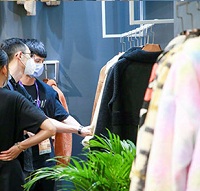 A big relief for the industry suffering from COVID-19 induced slowdown, this year’s CHIC Shanghai recorded over 88,000 visitors during the three days starting from March 17-19, 2021. Held at the National Exhibition and Convention Center NECC, CHIC Shanghai was attended by 905 exhibitors, 932 brands covering 10 categories including CHIC Men´s, CHIC Women´s, CHIC Impulses (designer), CHIC Young Blood (streetwear), CHIC KIDZ (kidswear), CHIC Accessories, Shoes and Bags, CHIC Tailoring, CHIC Winter´s (fur and leather goods), CHIC Sourcing - Superior Factory/Denim, CHIC Sourcing - Future Link (innovations for fashion and retail).
Menswear area showcased modern dandy styles with a waistcoat in contrasting colors and an English jacket,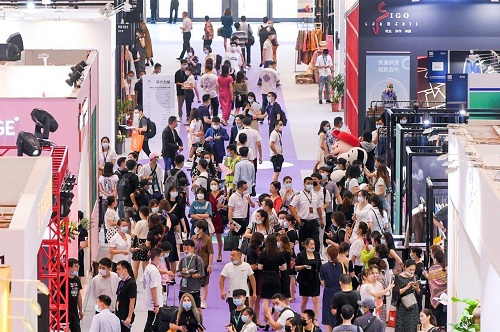 combined with casual trousers. The kidswear area showcased swinging silhouettes for girls, and fancy sweatshirts and jeans for boys.
CHIC Garden: The CHIC & GFS (Green Fashion Society) area showcased the amazing talent of artists Ma Defan and Li Haitao through CHIC Garden, an installation made of old clothes and fiber. The area featured sustainable products and collections such as DuPont / Sorona (USA), centdégrees (France), the Consinee Group (China), LangerChen (Germany / China), Sateri (Japan / China), Kingdom (China), Testex (Switzerland) or PIPING HOT from Australia, who work to preserve the ecosystems of the oceans. Following this was matchmaking meeting on sustainable hemp fiber products from Kingdom Holdings and the Sustainable Fashion Forum on the future of sustainable fashion.
CHIC Impulses: The Impulses design area showcased creations of over 100 designers including the Wa Yin or Yvonne Choi, Dumpty, QZ Shen Ding Jie with the label D. The presentation was accompanied by DouYin (TikTok), who presented their live streaming platform for fashion sales.
CHIC Winter: With 128 brands, CHIC Winter was the largest exhibitor area at the fair. The area was represented by Market leader Bosiden which presented its collection in collaboration with Jean Paul Gaultier. Another exhibitor Kopenhagen Fur launched its new collection in the Chinese market while young label Christopher Raxxy integrated modern designs with traditional Chinese elements in its collection
CHIC Shoes: The Chic Shoes area included the ‘Footwear Industry Forum in association with ‘Footwear News.’ This forum focused on topics such as the development of shoe fashion design and sales in the context of digital challenges, the sneaker hype and consumption, the behavior of the new generation of women on new trends, and innovative technologies in shoe production.
CHIC Wonderland: Organized in cooperation with IMG, the CHIC Wonderland area presented innovations like the new Nike King Bear Max I sneakers by King Saladeen and Nike.
CHIC Events: The Chic Events area included over 10 shows like the ‘New Page Hong Kong Brand Release Show,’ the ‘Another One Brand Release Show,’ and the ‘HLA Brand Release Show.’. A highlight of this area was the ‘Reach & Touch,’ designer show which presented Tang style suits by designers Xu Xiaoyan and Zhao Shuang.
CHIC Match Making: The CHIC match-making zone held 54 meetings. One of the participants in this zone included the Little Red Book while international companies such as the French brand Capsule by Juliette and MGF Import & Export SRL from Italy also participated in this zone.
The CHIC App: The CHIC App supported networking at the fair by enabling visitors to interact with other participants
CHIC Talk: The CHIC Talk discussion forum held nine seminars on topics such as ‘How to make entertainment marketing under the domestic fashion trend’, ‘Apparel Manufacturing - from lean production to digitalization’, and ‘Digital solutions for the garment production chain.’
Bangladesh RMG industry adopting new business models to address COVID-19 challenges
The Bangladesh ready-made garment (RMG) industry has gradually been adopting new business models or innovative plans to address the challenges surfaced due to the COVID-19 pandemic, says a report by BGMEA.
Titled ,'A Pathway to Manage Private Sector Impact on Bangladesh National Priority Indicators (NPIs) and Sustainable Development Goals (SDGs)m ' the report also showed that the RMG industry not only contributed to economic development, but was also directly engaged in achieving nine SDGs.
The report was published in collaboration with the United Nations Development Programme (UNDP) and the Global Reporting Initiative (GRI).
The report showed how the RMG sector was not only contributing to the country's macro-economic performance, but also to achieving NPIs and SDGs by creating employment, supporting healthcare of its workforce, making investments in up-skilling the workforce, adopting resource recycling, and increasingly using renewable energy.
About 13 per cent of the surveyed RMG factories furloughed workers because of the financial losses that they incurred due to the Covid-19 pandemic, according to the report.
Some 24 per cent of the factories reported that they had COVID-affected workers, and the workers returned to work within an average of 25 days upon submission of coronavirus negative test reports.
According to findings, all the participating factories had an environment management system, and 42 per cent of these had set measurable goals to reduce energy, waste and resource consumption by 2.0 to 15 per cent in the next three years.
Global cotton market sees drastic fluctuation in March
As per a report by the CCF Group, the global Cotton linter market saw drastic fluctuation in March. Cottonseed oil plants resumed operation slowly back from the Chinese Lunar New Year holiday, so the supply was hard to increase.In early March, cotton linter supply was tighter and major producers in Shandong, Hebei and Xinjiang generally became reluctant sellers with firm prices, so the market continued to be stronger. In addition, dissolving pulp price also kept rising amid short availability during the same period, so some VSF plants replaced dissolving pulp by cotton linter pulp and some cotton linter pulp mills resumed operation, which sharply boosted the demand for cotton linter. Since the beginning of this year, the cumulative increase of cotton linter price had been around 1,500-1,800yuan/mt as of early-to-mid-Mar.
Since then, the price stopped rising and started to decline at a faster speed in particular around mid-to-late Mar, which was affected by great volatility of bulk commodities, worries over tightening global liquidities and troubled China-EU and China-US relations. Moreover, the sanctions on Xinjiang cotton also caused sharp decline of ZCE cotton futures and cottonseed oil places generally stopped procurement to avoid risks, leading to slipping cottonseed prices. Affected by this, cotton linter trades were almost thin with constant price decline. Till now, the price has been tumbling by more than 800yuan/mt from the higher level.
In addition, imported cotton linter also weighed on Chinese cotton linter price. According to customs data, cotton linter import of China totaled 18,788.3 tonne in the first two months of 2021, up 37.4 per cent y-o-y. The import price averages at $275.66/mt (equivalent to around 2,100yuan/mt), down 18.45 per cent on the year.
Pakistan to reduce customs duty to boost synthetic fiber exports
Pakistan Prime Minister’s advisor on trade Razak Dawood said the government plans to reduce the customs duty to boost synthetic fibers’ exports in the coming budget. The advisor indicated that, the customs tariff and fiscal regime are rationalized and the textile and clothing exports will increase at Rs. 925 trillion by $19 billion in 2024-25 growth incentives. At the outset, the advisor said that Pakistan had dependent heavily on 70 per cent cotton exports and 30 per cent human-made (synthetic) fibre.
Dawood claims that since he has entered the International Monetary Fund (IMF) scheme he has failed to report customs duty to lift income collection. He continued that the remaining 2 percent custom duties have been scrapped and the Budget also abolishes three percent duties. He said that the IMF contended that Pakistan’s tax generation was extremely poor and needs to be increased as the government entered through the IMF program. The Government then agreed to introduce additional custom duties of two percent, four percent and seven percent, he said, adding that they were battling to eliminate this now. The advisor also requested help from the commission for the withdrawal of customs duty from imports because it was reported that the Federal Revenue Board (FBR) could avoid the withholding of revenue.
Economic integration helps Vietnam boost apparel exports
International economic integration process is helping Vietnam increase its exports by 22 percent year-on-year and imports by 26 percent in the first quarter of 2021, said Tran Thanh Hai, Deputy Director, Agency of Foreign Trade, Ministry of Industry and Trade.
Hai said the EU-Vietnam Free Trade Agreement (EVFTA), the UK-Vietnam Free Trade Agreement (UKVFTA) and the Comprehensive and Progressive Agreement for Trans-Pacific Partnership (CPTPP) have become effective, and the Regional Comprehensive Economic Partnership (RCEP) is about to come into effect.
For the EU market, several Vietnamese commodities have enjoyed incentives of the EU’s Generalised System of Preferences (GSP) for years.
However, for the long term, taking advantage of opportunities brought about by the EVFTA is a sustainable and equal preference. Specially, for the commodities that Vietnam has advantage, they can enjoy preferences on origins combined in the EVFTA, Hai said.
He advised enterprises to bring into full play advantages of the agreement by understanding the advantages for their commodities and then change their production process and material supply to meet requirements of origin.











