


FW
BGMEA demands 10 per cent incentive on non-cotton garment exports
Faruque Hassan, President, BGMEA, has demanded 10 per cent incentive on the export of garment items made from non-cotton fibers to encourage investment in the MMF sector. Hassan said, Bangladesh imported 20.52 lakh tonne of fiber in the last fiscal year, of which 93.57 per cent was cotton. Currently, 403 out of the 430 spinning mills operating in the country produce cotton fiber. Hence, investment and production in the MMF-based fiber industry is still low even though it has very high potential, he added.
Currently, Vietnam holds 10 per cent share of the global MMF-based garment market while Bangladesh is still struggling to attain a 5 per cent share in this segment, Hassan added. This market is growing 3 to 4 per cent annually with 75 per cent of garments being produced globally from MMF-based fibers. On the other hand, the global market share of the cotton-based garment industry is growing at just 1 or 2 per cent annually.
Hassan also demanded loan rescheduling facilities for up to December as garment manufacturers and exporters have been struggling amid the ongoing COVID-19 pandemic. He also urged the government not to classify the loans of the garment sector for up to December this year so that they can be more competitive in the business.
Guess’ Q2 revenues increase 57.7 per cent
Los Angeles-based apparel retailer Guess’s net revenues increased 57.7 per cent to $628.6 million during the second quarter of the current financial year as improved margins boosted year-over-year revenue gains. Disruptions caused by the COVID-19 pandemic, had led to retailer’s sales declining to $398.5 million last year. Compared to the same period two years ago, when the company generated $683.2 million in revenue, sales decreased 8.0 per cent.
In last year’s second quarter, the retailer recorded a net loss of $20.4 million, or a diluted loss per share of $0.31. Operating margin for the quarter was negative 3.6 per cent compared to $1.22 billion in the same period two years ago. The company’s net earnings for the first half of the fiscal year came to $73.1 million, or $1.10 per diluted share. This compares to a loss of $178.0 million, or $2.72 per diluted share, in the previous year’s first half, and earnings of $3.9 million, or $0.05 per diluted share, the year before. At the end of second quarter, Guess directly operated 1,046 retail stores in the Americas, Europe and Asia, with a further 551 locations being run through the company’s global partners and distributers.
Zhongyuan Group exports drop as logistic costs rise
Zhongyuan Group’s exports to Vietnam, India and Honduras dropped dramatically in recent months due to rising logistics costs and container shortage. Zhongyuan started its export business in 2019. Earlier the company exported 1,000 to 2,000 ton of polyester every month before. However, in recent times, the company’s waiting period for a container increased from a week to a month. Its shipment costs also increased by three, four or even five times for some regions, informs Chen Yiren, Assistant President. The price of its container from China to UK has increased by five times to $14,000. This is affecting the company’s foreign trade
The value of China's textile exports declined by 26.78 percent in July, shows data from China Customs shows. Beside the rising logistic costs, the dropping demand of masks and protecting suits was the other factor behind the decline. Customs data shows that exports of masks and protective clothing accounted for only 6.3 percent of total textile exports in the first half of the year, compared with 22.4 percent recorded last year.
Jason Kent appointed new CEO of BTMA
The British Textile Machinery Association (BTMA) has appointed Jason Kent the new Chief Executive Officer of the group. This also includes subsidiaries nw texnet and The Textile Recorder (Machinery & Accessories) Exhibitions (TREX), effective from Monday 23rd August 2021. A non-executive member of the BTMA board for over eight years, Kent has over 35 years of experience in carpet tufting machinery industry. He is a mechanical technician engineer who ascended through a series of positions of greater responsibility with Cobble Blackburn until its acquisition in 2013 by the Vandewiele Group, where he undertook the role of Managing Director for the tufting machinery business.
He also studied part-time for his MBA back in 2011 and is also a Chartered Fellow of the Chartered Management Institute. Alan Little, Director, says, Jason’s textile machinery background, business development skills and extensive knowledge of the BTMA and its members will help in delivering the strategic vision of the board.
Founded in 1940, the British Textile Machinery Association actively promotes British textile machinery manufacturers and their products to the world. The non-profit organisation acts as a bridge between its members and the increasingly diverse industries within the textile manufacturing sector.
Bangladesh brands sign agreement to extend Accord
Brands and unions have signed an agreement to extend the Accord agreement in Bangladesh and expand its scope to other garment- and textile-producing countries. The agreement has been hailed by labor groups across the country as it paves the way for more robust worker protections globally.
Titled the ‘International Accord for Health And Safety in the Textile and Garment Industry,’ the new agreement extends out to October 2023. It remains a legally binding commitment to ensure worker safety in Bangladesh. Companies including H&M Group and Zara-owner Inditex have signed the new agreement. A full list of signatory brands will be announced September 1, when the new Accord comes into effect.
The Bangladesh Accord was established in the wake of the collapse of the Rana Plaza factory complex in 2013. The disaster killed more than 1,000 people and remains one of the deadliest garment industry disasters to date. Amid widespread public outrage, more than 200 brands signed onto the initiative, which made them subject to legal action if their supplier factories in Bangladesh did not meet health-and-safety standards or failed to fix issues within an agreed-upon time frame. It was an unprecedented level of accountability and remains an unusually robust framework in an industry that is still largely governed by voluntary codes of conduct.
Demand for technical textiles drops in China while nonwovens exports surge
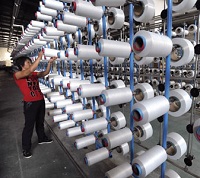 After rapid surge in 2020, demand for technical textiles in China is slowly stabilizing. Demand for surgical masks, protective clothing and related raw materials is gradually declining, slowing the industry’s annual growth rate. A survey by the China Nonwovens & Industrial Textile Association (CNITA) of member enterprises shows domestic and international demand for technical textiles in China dropped 40 per cent during January-May 2021. Demand indexes for both domestic and international market dropped to 49.0 and 43.4 during the first half of the year.
They have since dropped further to their lowest levels of 31.4 and 34.8. As per a China Textile Leader report, the operating rates of 36 per cent of manufacturers dropped to 80 per cent during the period while those of 18.8 per cent dropped to 60 per cent. The operating rate of 17.6 per cent companies dropped to less than 40 per cent.
Average growth stable but profits drop
The industrial added value of enterprises above designated size in China dropped 11.9 per cent year-on-year from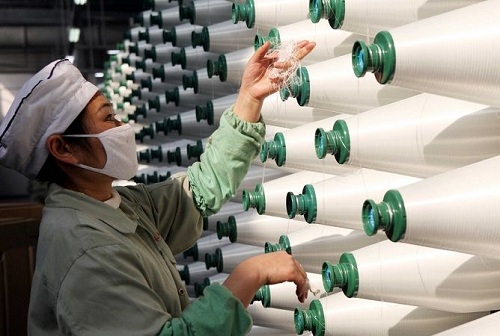 January-May 2021, shows data from the National Bureau of Statistics. However, the two-year average growth of these enterprises still reached 15.2 per cent. Their operating income also increased 0.3 per cent year-on-year to CNY 117.51 billion. On the other hand, total profit dropped 54.5 per cent to reach CNY 7.02 billion while profit rate also declined 7.2 percentage points to 6.0 per cent. The industry is still in a relatively ideal state though it is growing at a slower rate than the chemical fiber and textile machinery industry.
Around 16 per cent companies surveyed by CNITA reported 50 per cent drop in their annual profits while 64 enterprises reported 20 per cent drop. Around 40 per cent of these 64 enterprises view this as a normal adjustment against the rapid growth witnessed in 2020. They believe, it would require one to two years to get out of this round of adjustment period.
Profit margins drop by 6.2 per cent
The surveyed nonwovens enterprises also reported a 7.7 per cent drop in operating incomes and 67.8 per cent year-on-year decline in total profits. Their profit margins also declined 6.2 per cent and 11.5 percentage points year-on-year. The operating income and total profit of twine and rope (cable) enterprises above designated size increased 24.6 per cent and 43.6 per cent year-on-year respectively. Their profit rate increased 0.6 percentage points to 4.2 per cent, up by 0.6 percentage points year-on-year. Similarly, operating income and total profits of textile belts and cord fabrics enterprises above designated size surged by 28.2 per cent and 198.0 per cent year-on-year, respective while their profit rate increased by 3.3 per cent to 5.7 per cent. On the other hand, the operating income and total profits of other technical textile enterprises above designated size declined by 10.3 per cent and 53.5 per cent year-on-year, respectively while their profit rate declined by 6.0 per cent year-on-year.
Travel ban impacts technical textiles demand
Around 50.4 per cent enterprises in China recorded a drop in demand for technical textiles during the period. They attributed this decline to stagnation in global travel, which prevented them from participating in international fairs and exhibitions. Around 37.8 per cent enterprises also reported difficulties in hiring qualified workers and increase in international shipping costs.
The surveyed enterprises also reported facing external challenges like the excessively rapid increase in raw material prices. Around 52.4 per cent enterprises believe, excessive expansion in production capacity has increased competition amongst the enterprises. However, these enterprises are confident that their ability to innovate and maintain the required quality standards will help them surge ahead of competitors.
Bangladesh spinners await authentication certificate for import of organic cotton from India
Around 18 Bangladeshi spinners who imported organic cotton from India are yet to receive the authentication certificate – called a transaction certificate (TC) – from their suppliers even after a year of import. These spinners now fear huge losses following possible order cancellations as their buyers seek TCs as proof while buying raw materials from these mills.
The millers have repeatedly tried to reach out to the suppliers to get the certificates but have not succeeded, says Bangladesh Textile Mills Association (BTMA). Though some Indian suppliers have provided TCs for the supplied cotton, but these certificates were later proven to be fake and subsequently withdrawn by the Control Union.
According to the BTMA, Bangladesh imported 7.5 million bales of raw cotton in FY20, and more than a quarter of it came from India. But, the BTMA does not have information on the amount of organic cotton imported during this time. Indian suppliers are not giving transaction certificates for 16,100 tonnes of organic cotton imported by 18 Bangladeshi companies against 23 LCs. Certificates were issued to only three importers, which were later revoked as they were fake.
According to BTMA sources, they have identified at least nine Indian cotton exporters who are not certifying organic cotton or giving fake certificates. The list includes Agrotech Industries, Gujarat Cotton Corporation, Axiata Cotton, Glossy Impex, Ghanshyam Agro Resources, Basil Commodities, Kratos Impex, Sri Salasar Balaji Agrotech and Narendra Overseas.
Turkey’s garment shipments grow 27 per cent from January-July 2021
Turkey’s ready to wear and confection shipments to foreign markets grew by a robust 27 percent to over $11.1 billion on an annual basis from January to July this year. Exports to Germany grew to $1.9 billion, followed by Spain to 1.5 billion and the UK to $1.2 billion. Exports to the Czech Republic grew by over 200 per cent in the first seven months of the year to $148 million and by 250 percent to Tunisia to $63.5 million.
The industry’s exports are expected to hit $20 billion at the end of this year, opines Burak Sertbaş, Chairperson, Aegean Ready Wear and Confection Exporters’ Union. At the start of the pandemic, local companies shifted to export more of medical textile products but now exports are producing mainly traditional outfits, such as suits, shirts, trousers, he adds
According to Sertbaş, local companies are presently working at full capacity and cannot take orders to be delivered in a short period of time.
Vishal Fabrics sells 1,016,000 equity shares to promoter group
A part of the India-based Chiripal Group, and a denim manufacturing and fabric processing unit incorporated in 1985, Vishal Fabrics has sold 1,016,000 equity shares to promoter group Savitridevi V Chirpal. This increased the group’s share in the company by 1.54 per cent. The group purchased 511,000 equity shares on August 12, 2021, and subsequently another 505,000 shares on August 23. The total trades executed by the promoter group included 1,016,000 equity shares.
VFL constantly strives to improve and innovate with wider fabric manufacturing capacity and carbon-reducing technology across its processing units. The company’s state-of-the-art manufacturing facilities are equipped with the latest technology and deliver innovative products that adhere to international quality standards. Over the years, the company has managed to emerge as a pioneer in the textile industry, setting new standards of excellence.
Witness signatories welcome signing of new Accord by Bangladesh
Known as witness signatories, the non-governmental organization signatories to the Bangladesh Accord – Clean Clothes Campaign, Worker Rights Consortium, Maquila Solidarity Network, and Global Labor Justice-International Labor Rights Forum – have welcomed the signing of the new international safety agreement. The new agreement maintains the vital elements of ground-breaking model established by the Bangladesh Accord: legal enforceability of brands’ commitments, independent oversight of brand compliance, the obligation to pay prices to suppliers sufficient to support safe workplaces, and the obligation to cease doing business with any factory that refuses to operate safely. The successful outcome of negotiations this summer will ensure that the sweeping safety gains the Accord has delivered in Bangladesh will be maintained and extended.
The new agreement will continue the progress on fire and building safety achieved in Bangladesh over the past eight years besides expanding the program to other countries. Every responsible apparel and textile brand is expected sign this new agreement.
Ineke Zeldenrust, International Coordinator, Clean Clothes Campaign, believes, the agreement will begin the long-awaited expansion of this model that holds brands legally accountable to other countries where workers’ lives continue to be at risk.
Scott Nova, Executive Director, Worker Rights Consortium adds, the Accord will end the atrocities committed by world’s leading apparel brands on hundreds of garment workers in Bangladesh.











