FW
Veocel adds fiber traceability system
Beauty brand Veocel has launched a fiber identification system. Recent years have witnessed an evolution within the beauty industry, from merely focusing on the quality of nonwovens fabric, to ensuring authenticity and transparency of fiber materials used in facial sheet masks. This will address the increasing need for transparency and traceability in materials used in beauty products. The fiber identification system is applicable to the skin fiber types under Veocel, which are ideal for use in facial sheet masks. Made in Austria, the fibers are of botanic origin, biodegradable and compostable.
The fiber identification system can identify fibers in the final products, providing quality control and authenticity assurance for brands against inferior counterfeit products. Products verified by the system also provide consumers with an added level of assurance and peace of mind that materials used in their beauty products are certified clean and made of genuine premium eco-friendly fibers.
Globally, strong growth is expected in the beauty segment, with the facial sheet mask market forecasted to reach 14 billion dollars by 2030. As consumers continue to look out for ways to lead a more sustainable lifestyle, the need for brands to provide product quality assurance and supply chain transparency is ever growing.
RSWM records Rs 44 crores Q2 profit
For the second quarter RSWM’s net profit was Rs 44.75 crores. The company continued to see the rallying effect of the positive sentiments and market recovery on the business in fiscal ’22, reflecting in the strong sales and profit results recorded in the first half of the year, despite the continued lockdown in the initial months of the first half of fiscal ’22.
RSWM is one of the largest manufacturers and exporters of synthetic and blended spun yarns from India. Within the group, yarn business witnessed a sudden demand surge in the second half. With the ease in restrictions, the denim business performed better with increasing demand from existing customers which continues to see an upward growth trend and reflects in the strong business performance of the group. RSWM plans a few critical structural changes, capacity building and allocation of funds for expansion of the denim fabric manufacturing capacity, cotton melange yarn manufacturing capacity and modernisation and balancing equipments across all units.
RSWM is looking forward to continued robust business performance in the third quarter. Despite the initial impact of local lockdowns and night curfews which impacted dispatches in the first quarter, consumer sentiments and market confidence improved due to increasing vaccination and operations at the manufacturing plants remained normal.
Puma’s second half output may be hit
Supply chain issues would mean a shortage of Puma products for the near future. Compounded by higher costs of raw materials, could feed through to higher prices in the second half of 2022.
The German sportswear company expects that factory closures, compounded by shipping constraints, will hit its product supplies. This is exacerbated by port congestion and a lack of shipping capacity. Puma also expects sales in China to continue to be impacted by lockdowns and consumer boycott of Western brands triggered earlier this year by a political row.
Factories in Vietnam, a major supplier to the footwear industry, were closed for nearly two and a half months due to Covid, though they are expected to resume full production by the end of November. Puma makes a third of its products in Vietnam. Puma’s third-quarter earnings confirm a brand in rude health in western markets. Sales fell 16 per cent in Greater China due to ongoing lockdowns there and the impact of a consumer boycott.
Puma increased its forecast for full-year currency-adjusted sales growth to at least 25 per cent from a previous outlook of at least 20 per cent and the company eventually hopes to double its annual sales to more than ten billion euros.
China may lose EU’s GSP privileges, will affect textiles and apparel sector
The EU will soon remove GSP privileges for Chinese exporters. That means they will no longer enjoy preferential tariff treatment in most European countries. Removal is expected to accelerate the trend of labor-intensive manufacturers including apparel makers moving out of China and to cheaper destination countries like Vietnam and Bangladesh.
Only Norway, New Zealand and Australia will continue to provide preferential tariff treatment to China. Since 2014, Switzerland, Japan, Russia, Kazakhstan and Belarus have removed China from their GSP lists.
Chinese apparel makers and low-end electronic producers would be hit most by the changes. Once the epidemic situation improves in South and Southeast Asia, more production lines are expected to move out of China to neighboring Vietnam and Bangladesh.
China’s exports increased 22.7 per cent year on year in the first three quarters of this year. Since China announced its plan to transform itself from a planned to a market economy in 1978, the country has been given duty-free treatment on certain exports by 40 countries under the GSP. In 2000, it was also given PNTR status by the US. In 2001, China entered the World Trade Organization and has since then seen enormous growth in its external trade.
Top global brands looking for new sourcing hubs
Major clothing and shoe companies are moving production to countries closer to their US and European stores and away from manufacturing hubs in Asia like China or Vietnam. This is because of the massive shipping logjam that is driving up costs and forcing companies to rethink their globe-spanning supply chains. Spanish fashion retailer Mango has accelerated the process of increasing local production in countries such as Turkey, Morocco and Portugal. In 2019, the company largely sourced its products from China and Vietnam. Similarly, US shoe retailer Steve Madden has pulled back production in Vietnam and shifted 50 per cent of its footwear production to Brazil and Mexico from China. Clogs maker Crocs is moving production to countries including Indonesia and Bosnia.
Bulgaria, Ukraine, Romania, the Czech Republic, Morocco and Turkey are some of the countries drawing new interest from clothing and shoe producers. In Turkey, apparel exports are at an all-time high, driven by a spike in orders from the European Union. Guatemala’s clothing exports are up 34.2 per cent from 2020 and 8.8 per cent higher than in 2019.
However, China continues to produce a large share of apparels for US and European clothing chains. Many companies are still heavily reliant on Vietnam.
Adidas Q3 inventories down 22 per cent
German sportswear brand Adidas third quarter inventories decreased 22 per cent. Operating working capital decreased 17 per cent. Average operating working capital as a percentage of sales declined five percentage points to 20.1 per cent.
Revenues grew three per cent in the third quarter. At the same time, sales in Asia-Pacific declined eight per cent, reflecting the impact from the extensive lockdowns in the region. In Greater China, the geo-political situation, resurgence of Covid-related restrictions as well as natural disasters weighed on the company’s top-line performance and led to a revenue decline of 15 per cent. As a percentage of sales, operating overhead expenses decreased 27.2 per cent. In the first nine months of 2021, revenues grew 21 per cent.
Adidas performed well in an environment characterized by severe challenges on both the supply and demand sides. As a consequence of successful product launches it is experiencing strong topline momentum in all markets that operate without major disruption. In total, the challenging market environment in Greater China, extensive Covid-related lockdowns in Asia-Pacific as well as industry-wide supply chain disruptions reduced revenue growth. From a channel perspective, the company’s top-line development was driven by growth in its own direct-to-consumer channel.
Apparel hubs turn to sweatshops
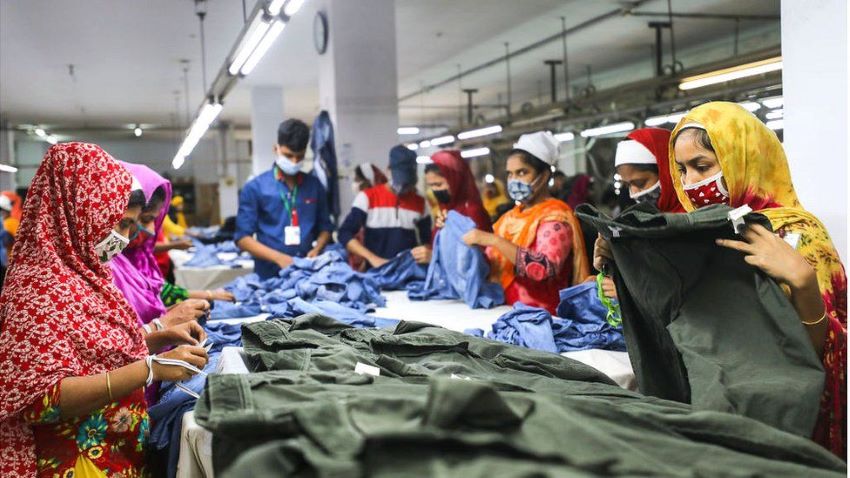
Much of the clothes made today come from countries where workers’ rights are limited or nonexistent. The problems include: dangerous working conditions, 18 hour workdays, no breaks, less than living wages and more are rife. The apparel industry employs 60 million workers around the world, nearly 75 per cent of whom are women.
Human rights violations have increased in the past four years. Since the beginning of the pandemic, health crises, disasters, conflict and widespread human rights violations have increased, straining global supply chains. Over the past five years, issues such as child labor, forced labor, health and safety, and the exploitation of migrants in the workplace have worsened globally for the industry. Apparel manufacturing hubs such as Bangladesh, Vietnam, and Cambodia have all gone from high to extreme risk for modern slavery.
Agricultural workers are actually the lowest paid in the garment supply chain. While garment factory workers are paid around half the living wage, agricultural workers get paid even less in all the four countries. On an average, in Asia, garment workers get about one-third of the minimum living wage. But consumers, in general, are becoming more conscious about how and where their clothes are made. A growing trend for workers’ rights and sustainability seems to be having a knock-on effect for businesses.
Nearshoring gains in the US
For the nine month period US imports of blue jeans from the western hemisphere rose 43.46 per cent.
Imports from Mexico rose 46.53 per cent. The countries of the Central American Free Trade Agreement (CAFTA) combined for an increase in imports of 32.69 per cent. Among CAFTA countries, shipments from Nicaragua rose 34.57 per cent while imports from Guatemala were up 24.73 per cent. Imports from Colombia were up 25.52 per cent.
The western hemisphere supply chain for textiles and apparel is a core pillar of the partnership between the United States and the countries of the Dominican Republic-Central America-United States Free Trade Agreement. The CAFTA-DR rules of origin provide the certainty needed by industry to invest and expand operations in a way that promotes economic opportunity for both US workers and those in the region. The US textile industry has invested over $20 billion in the United States and billions more in the hemisphere over the past decade to grow economic opportunities in the US and in the region.
Meanwhile US imports of jeans from Bangladesh increased 31.4 per cent in the nine month period. Shipments from China rose 15.02 per cent. Imports from Pakistan were up 63.4 per cent.
Techtextil India 2021 makes a grand return post pandemic with hybrid exhibition
 Making a grand return post-pandemic, the upcoming edition of Techtextil India will be held in a hybrid format from November 25 to 27, 2021 at the Bombay Exhibition Centre in Goregaon, Mumbai. The event will attract all leading technical textile players from across application areas. Some top technical textile brands participants are: JB Ecotex, PARK Nonwoven, Loyal Textiles Lenzing, Mehala, Meera Industries, etc. The event will also host a few leading German brands in the German pavilion.
The juxtaposition of a physical exhibition and online business matchmaking platform will offer greater networking opportunities to visitors. The ‘MFI virtual app’ will host live knowledge sessions and product demonstrations for visitors unable to attend the event physically. The event will also offer visitors access to specific products like fibers, yarns, nonwovens, machinery, coated textiles. Visitors to the physical event will have to follow government-authorised safety protocols of ‘MFI SafeConnect’. These protocols will enable visitors to engage in secure face-to-face interactions with exhibitors and witness the latest technical textile technologies and innovations in-person.
Tie up with Tamil Nadu government
The nodal agency for investment promotion and facilitation for the Government of Tamil Nadu – Guidance has signed up for Techtextil India 2021 to reduce import dependency and bring investments in R&D, manufacturing, innovation by partnering with global technical textiles companies, says Pooja Kulkarni, IAS MD & CEO, Guidance Tamil Nadu.
International exhibitors
Techtexil India 2021 edition will feature an exclusive German Pavilion showcasing products and technologies from top German manufacturers, including Autefa Solution Germany GmbH, DILO Systems GmbH, Emtec Electronic GmbH, Georg Sahm GmbH & Co, Karl Mayer Verwaltungsgesellschaft mbH, Merz Maschinenfabrik GmbH and Oerlikon Barmag Zweigniederlassung der Oerlikon Textile GmbH & Co. the Indian representatives of brands from Austria, China, Italy, Spain, Taiwan, Turkey, the UK and the USA are also participating at the exhibition.
Product launches and live demos
New product launches and latest technological offerings from brands will be one of the major attractions at Techtexil India 2021. The physical exhibition format will showcase a series of key product launches from brands, including like Autefa Solutions, DiloGroup, Meera Industries, Sicam, Suntech Geotextile and Weavetech, etc, while the virtual exhibition format will feature live product demonstrations exclusive for the visitors tuned in live.
Raj Manek, Executive Director and Board Member, Messe Frankfurt Asia Holdings says, Techtexil India 2021 aims to provide a collaborative atmosphere that the industry needs to get back on its feet and look ahead towards the future. The return of face-to-face exhibition combined with the virtual model will open doors to excellent sourcing, collaborative and learning opportunities for professionals.
WGSN releases color forecast
Trend forecasting firm WGSN’s Fall/Winter 2023-2024 palette developed with color authority Coloro, colors reflect the different journeys consumers will encounter as they adjust their lifestyles and set new directions for the future. The colors have been chosen for their renewing and energizing qualities. The colors are described as motivational forces that will help consumers reconnect with qualities they might have lost sight of during the pandemic, like healing, discovery, transformation, simplicity and pleasure.
The gender-inclusive hue of Astro Dust is expected to update outerwear, knitwear and makeup. Glossy finishes, stained wood effects, anodized and leather applications will dial up the color’s richness and tactility. It also serves as a promising commercial and directional color for the interior category, suitable for large-scale furniture, carpets and bedding.
Galactic Cobalt, a new hyper-bright shade of blue, makes a natural choice for functional outerwear, consumer tech and virtual experiences. Galactic Cobalt’s richness, however, lends itself as a key jewel tone for occasion wear, accessories and cosmetics.
Sage Leaf is a quiet and settling green that instills a sense of contemplation, rest and reflection. The color will be important for reductive, considered design in the home as a color for walls and furniture. Apricot Crush, a mid-tone orange, is a natural companion to neutral colorways in bath and bedroom products while its gender-inclusiveness is fit for loungewear, active wear and outerwear.