FW
Marks & Spencer sells independent eco-fashion brand on website
Marks & Spencer has started selling an independent eco-fashion brand on its website as part of a plan to reinvigorate its struggling clothing arm.
The Nobody’s Child label bills itself as an antidote to a damaging fast-fashion industry and makes its £35 floaty minidresses and teadresses out of recycled polyester and sustainably sourced viscose. The brand was founded five years ago by Andrew Xeni, an entrepreneur whose family have a background in clothing manufacturing. The company’s backers include the New Look founder, Tom Singh.
The decision to stock outside brands is a departure for M&S, which is still the country’s biggest clothing retailer. In May, Steve Rowe, the company’s chief executive, said it would stock guest brands both online and in its largest stores as part of plan to broaden its appeal and boost online growth. In the summer M&S lost out to rival Next in the battle to operate the lingerie brand Victoria’s Secret in the UK.
MarediModa shifts to new venue
The organizers of the leading swimwear, beachwear and athleisure fabrics show MarediModa, have taken action to switch the location of the upcoming show, due to travel restrictions caused by the COVID-19 pandemic. The forthcoming edition of MarediModa, scheduled from November 03-05, 2020, will now be held at Villa Erba, Cernobbio, on the shores of the beautiful Lake Como in Northern Italy.
MarediModa has proved to be extreme reactive and flexible to design a trade show for exhibitors and visitors in respect of every safety major. For this edition it has abandoned the extraordinary Palais des Festivals, which has been accompanying it all these years and has chosen an equally fascinating venue.
For the first time in its history, MarediModa, the tradeshow of fabrics and accessories for beachwear, underwear and athleisure, is held in Italy, at Villa Erba on the Como Lake, in one of the most evocative location of our country and setting of important international events, the organisers said in a statement
FBCCI, CII to develop synergies between India-Bangladesh T&A sectors
The Federation of Bangladesh Chambers of Commerce and Industries (FBCCI) and the Confederation of Indian Industry (CII) have pledged to develop synergies in the textile and apparel sectors of Bangladesh and India.
The pledge was made during a virtual conference, entitled "India-Bangladesh Virtual Conference on Textiles and Apparel Sector."
Textile and Jute Minister Golam Dastagir Gazi said,Bangladesh has been the biggest ally of India and with improvement in policies and infrastructure under the current government the country can leverage trade facilities. It can collaborate in the spinning, weaving and dyeing are sub-sectors to develop and grow according to the evolving needs of the consumer
Indian Textile Minister Smriti Zubin Irani said, to facilitate reduced lead time between the trade of the two nations, India will engage with its counterparts in Bangladesh, involving the Ministry of Infrastructure and other relevant stakeholders. Additionally, any existing issues that have been highlighted by its counterparts through this platform will be identified and discussed in our future engagements.”
She also highlighted the Indian government’s provision for technical textiles and the diversification of jute products, requesting her Bangladesh counterpart’s expert aid to this end.
AAFA welcomes extension of CBTPA
American Apparel & Footwear Association President and CEO Steve Lamar welcomed the passage of legislation by the US Senate that would extend the Caribbean Basin Trade Partnership Act (CBTPA) . The program provides textile and apparel trade preferences to Caribbean countries; however, it is currently scheduled to expire today. The bill would extend the program to 30 September 2030.
AAFA is a strong supporter CBTPA and has been calling for the renewal of the program for some time. In April, AAFA sent a letter to Congress emphasizing the importance of the program. On 28 August, AAFA led a group of associations in a letter to U.S. Trade Representative Robert Lighthizer, calling for him to convey support for the program in conversations with Congress. Today’s action followed a similar letter by that group of associations to every Senator urging CBTPA’s speedy renewal.
The American Apparel & Footwear Association (AAFA) is the national trade association representing apparel, footwear and other sewn products companies, and their suppliers, which compete in the global market. Representing more than 1000 world famous name brands, AAFA is a trusted public policy and political voice of the apparel and footwear industry, its management and shareholders, its nearly four million U.S. workers, and its contribution of more than $400 billion in annual U.S. retail sales.
Manufacturers shift focus from low costs to stability in supply chains: Survey
Two survey findings suggest, there is a change in the way manufacturing executives have shifted their focus from low costs and lean inventory, to stability and resilience in global supply chain. One survey was conducted by law firm Foley & Lardner LLP. Titled ‘Global Supply Chain Disruption and Future Strategies Survey Report’, the survey interviewed 150 manufacturing companies about general trends in supply chain management.
The second survey, ‘Accelerating Trends: Assessing the Supply Chain in a Post-Pandemic World’ looked specifically at a shift in supply chains away from China as well as how companies are using new technologies to improve efficiency. Seventy per cent respondents agree with COVID-19, companies will reduce their focus on sourcing from the lowest-cost supplier and 62 per cent expect the focus on just-in-time (JIT) manufacturing models will also decrease.
As per the survey, manufacturing executives are taking prudent steps to manage risk in their supply chains, with strengthening relationships and increasing transparency with suppliers and buyers as the top strategy identified by survey respondents. In addition, the 92 per cent of them are taking at least some action to create more visibility within their supply chains, including requiring more information on suppliers’ own risk management and continuity strategies.
The Foley report also analyzes the extent to which COVID-19 has accelerated the movement of production and sourcing away from China. Of the survey respondents who have operated in the country, 59 per cent have either already withdrawn operations, are in the process of doing so, or are considering it.
The Accelerating Trends report analyzes the key costs, benefits, and risks to consider in several regions that present alternatives to China. According to the survey findings, the result of this analysis has increasingly led companies to move supply chains closer to home to either US, Mexico or Canada
The Accelerating Trends report also identifies eight specific areas that may see greater investments and provides guidance on how they stack up against each other in terms of resilience, cost, and maturity.
Euratex welcomes EU initiative to address foreign subsidies impact
As per reports, Euratex has welcomed EU’s initiative to address the impact of foreign subsidies on the internal market. The organization has called for a comprehensive instrument which guarantees level playing field, but it is not protectionist and does not discourage foreign investment. The European textiles and clothing industry (T&C) has complex value chains and is inter-dependent on many other sectors. The absence of a level playing field and fair reciprocity between EU and third country competitors on EU internal market, is a concern.
The distortive effects of subsidies provided by non-EU governments have jeopardized the competitiveness of many EU T&C companies. These foreign subsidies could distort the internal market, specifically the general market activity of economic operators in the EU, the acquisitions of EU undertakings, public procurement procedures and access to EU funding. The commission proposes to create a new legal instrument to address these challenges.
Euratex opines that the EU proposal needs to be as comprehensive as possible, both in its scope and in the redressive measures it proposes. The new legal instrument should take into account provisions already available in e.g. EU competition law, Trade Defence Instruments (TDIs) and the International Procurement Instrument.
H&M to close 250 stores worldwide
H&M plans to close 250 stores next year as the coronavirus crisis drives more shoppers online. The brand has shut more stores and opened fewer over the past couple of years as it adapts to the online shift that is driving more competition. The company’s sales continued to recover in September from the impact of the virus.
Its pretax profit declined to 2.37 billion crowns ($265.6 million) in its fiscal third quarter, from a year-earlier 5.01 billion. Analysts polled by Refinitiv had on average seen a 2.03 billion crown profit.
In the March-May quarter, H&M’s sales halves while they declined by 5 per cent in September after falling by 19 per cent in the three months through August.
Of more than 5,000 of the brand’s stores worldwide, 3 per cent remain temporarily shut against around 80 per cent at the height of lockdowns. The brand’s inventories remained unchanged from a year earlier. Markdowns increased half a percentage point, and H&M predicts they would grow by 1-1.5 per cent in the current quarter.
Government to announce National Textile Policy
At the annual general meeting of CITI, Ravi Capoor, Textile Secretary, revealed that the government plans to soon announce the National Textile Policy that would unleash India’s textile potential, and make it globally competitive, says an Economic Times report.
Capoor informed the government is also working on a Focus Product Scheme, wherein it has analyzed the export data of top-40 manmade fibre (MMF) products and found that India has a miniscule share of just 0.7 per cent in the total global market of $150 billion.
Similarly, in the top-10 technical textile lines, India just has a share of 0.6 per cent out of the total global market size of $100 billion. He further said, a study done by the government has revealed that by 2030, the share of MMF-based textile and apparel products will reach 80 per cent. The share of cotton will decline to 20 per cent as the global demand for MMF based products is more.
Fashion for Good initiates textile project focusing on cellulosic fibers
As per a Textile Focus report, Fashion for Good has initiated ‘Full Circle Textiles Project: Scaling Innovations in Cellulosic Recycling’ a first-of-its-kind consortium project. It focuses on cellulosic fibers and aims to validate and eventually scale promising technologies in chemical recycling from a select group of innovators to tackle these issues. Leading global organizations Laudes Foundation, Birla Cellulose, Kering, PVH Corp and Target have joined the project to explore the disruptive solutions and create new fibers and garments from used clothing and ultimately drive industry-wide adoption.
The project’s aims is to investigate economically viable and scalable solutions for cellulosic chemical recycling to enable a closed loop system converting textile waste – of cotton and cotton-blend materials, to produce new man-made cellulosic fibers.
Over 18-month period, project partners will collaborate with innovators, Evrnu, Infinited Fiber Company, Phoenxt, Renewcell and Tyton BioSciences, to validate the potential of their technologies in this still nascent market. The recycled content produced by four of these innovators will be converted at Birla Cellulose’s state of the art pilot plants to produce high quality cellulosic fibers.
Bangladesh apparel makers expand PPE capacity
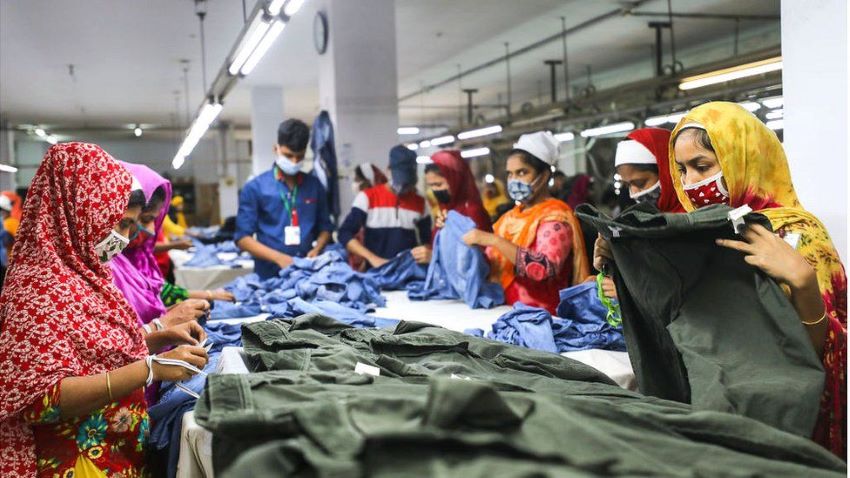
Many apparel makers in Bangladesh have expanded their PPE production capacity while others are investing afresh to gain the market share, sources said. Pran-RFL Group has invested $18 million for producing PPEs at the Adamjee EPZ (Export Processing Zone). Similarly Banga Plastic Internationa, a sister concern of the group plans to make 850 metric tons of PPEs, including surgical face masks, KN 95 masks, N 95 masks, surgical hand gloves, shoe cover, mop cap, medical gown, sanitary napkin, diaper and hand sanitizers, a year. The company signed a MoU with the Bangladesh Export Processing Zones Authority (BEPZA) on September 16. It will also produce toys and create employment for 1,900 people.
Likewise, Beximco supplied 6.5 million pieces of PPEs to US clothing giant Hanes within less than two months' time. 'Mapped in Bangladesh', a digital mapping technology that conducted a rapid survey on 3,342 export-oriented readymade garments (RMG) factories in Dhaka, Gazipur, Narayanganj and Chattogram, found that around 143 factories have been producing face masks and/or PPEs along with their regular products while 69 factories were producing PPEs for the global market and 66 factories for the domestic market.
Last month, Snowtex completed a work order by supplying 2.6 million face masks to a French buyer. Currently, the company is producing face masks only for the local market under the brand name of Sara. Rubana Haq, President, BGMEA says, Bangladesh has a great opportunity to diversify into PPEs as these exports have grown to $501 million in just about five years.
However, this would require capacity building in the industry together with the policy supports, Huq said, adding that Bangladesh needs special preparation to cater to this market, particularly it needs to develop special skill sets, technical knowhow, and make the right investments in backward linkages.