


FW
2020 BWCC to highlight latest research and technologies in Cotton
The 2020 Beltwide Cotton Conferences (BWCC), to be held from January 08-10, 2020 at the JW Marriott in Austin, Texas, will highlight latest research and technologies in the cotton industry. The BWCC, coordinated by the National Cotton Council (NCC), annually brings together university and USDA researchers, extension personnel/agents, consultants, and industry sales/support personnel. The forum helps U.S. cotton industry members tailor new products and production/processing systems to their operations for maximum efficiency.
The topics selected by the consultant community for consideration on the 2020 program are: an expert panel of entomologists to discuss timely topics ranging from Bt resistance to results of testing Bollgard 4. Among other key issues receiving a focus will be water restrictions, including the status of aquifers across the Cotton Belt; an update on precision agriculture technology; a discussion of EPA’s role in the plant protection chemicals’ review and registration processes; and a briefing on a multi-state potash study.
The 10 BWCC cotton technical conferences, which will provide updates on research and current/emerging technology, will meet concurrently beginning on January 9, 2020 and conclude on January 10, 2020. The Engineering-Systems Conference, for example, will feature presentations on sustainability and contamination prevention while the Economics Conference will cover such topics as crop insurance, disaster assistance and trade. The Ginning Conference will continue to focus on efficient processing/maintaining quality fiber along with updates regarding ongoing ginning research, ginning efficiencies, new equipment, and lint contamination prevention/research.
Vardhman Textiles Q1 income falls
Vardhman Textiles’ total income was Rs 1683.08 crores during the period ended June 30, 2019, as compared to Rs 1856.37 crores during the period ended March 31, 2019. Net profit was Rs 120.99 crores for the period ended June 30, 2019, as against Rs 182.01 crores for the period ended March 31, 2019. EPS was Rs 20.36 for the period ended June 30, 2019, as compared to Rs 33.17 for the period ended March 31, 2019.
Total income was Rs 1683.08 crores during the period ended June 30, 2019, as compared to Rs 1727.24 crores during the period ended June 30, 2018. Net profit was Rs 120.99 crores for the period ended June 30, 2019, as against Rs 162.74 crores for the period ended June 30, 2018. EPS was Rs 20.36 for the period ended June 30, 2019, as compared to Rs 27.92 for the period ended June 30, 2018.
Vardhman Textiles, which began operations in 1965, is engaged in manufacturing yarn, fabric, acrylic fiber, garments, sewing threads and alloy steel. The group has over the years developed as a business conglomerate with a presence in India and in 75 countries across the globe. The company is a one-stop shop for all kinds of spun yarn offering a variety of contemporary blends and shades.
Luxury players acquire companies in adjacent sectors
As per Deloitte’s latest Deal Monitor report, of the 265 mergers and acquisitions that took place in the luxury sector last year, many involved conglomerates who were seeking to diversify their holdings by buying companies in adjacent sectors. One of several luxury-focused companies expanding sideways is Fartech which recently announced a $675 million acquisition of New Guards Group, the Italian incubator of streetwear labels including Off-White and Palm Angels. The move will enable Farfetch to extend its proposition upstream by adding design, production and brand development to its capabilities.
LVMH recently forayed into the tourism sector with its $3.2 billion purchase of the Belmond hotel brand while Dubai-based property developer Damac acquired a controlling stake in Roberto Cavalli last month.
While fashion companies are investing in adjacent sectors, private equity investors are continuing to prioritise luxury fashion, despite the mixed success of such investments. For the third consecutive year, a Deloitte survey of 60 leading private equity firms noted that these were interested in investing in fashion even though they expect beauty, restaurants and digital luxury goods to grow twice as fast.
Tech companies try to avoid scrutiny
New rules being proposed especially by the US and the EU can enable the likes of Google, Facebook, Amazon and Microsoft to monetize data on a grand scale.
That means the role of governments in overseeing global electronic commerce can weaken. The US, for example, does not want any discriminatory restrictions on the treatment of digital products, cross-border transfer of information by electronic means, and location of computing facilities, including cloud computing, among others. The US’s position is also being shared by Japan and several other former members of the Trans-Pacific Partnership agreement.
However, the US, EU and Japan among others want to prohibit the mandatory transfer of source code by suppliers of software in other countries. Studies have shown that software with complex source code could contain certain hidden algorithms that facilitate dark data flows without the consent of the countries and help tech-companies in monetizing that dark data. Russia has challenged the need for a prohibition on source code, saying that without credible security and other guarantees, it is incumbent on the suppliers of software to provide source code.
Tech companies, while insisting their technology is too complex to be legislated, spend billions of dollars lobbying against any oversight.
Philippines to generate P2.53 million revenues from US fashion trade event
As pe Center for International Trade Expositions and Missions, (CITEM), Philippines aims to generate over P2.53 million revenues from its maiden participation at the US trade show Pretty Women that will feature contemporary lifestyle fashion brands for women. The Philippines delegation also aims to generate $790,000 in export sales and around 240 buyer inquiries from the trade show.
Project Women is a part of the Men’s Apparel Guild in California (MAGIC) event being held from Aug 12 to 14 at the Las Vegas Convention Center. The trade fair is considered as the most comprehensive fashion marketplace in the US. CITEM, the export promotions arm of the Department of Trade and Industry, is organising the country’s participation at the event, along with the Philippine Trade and Investment Center in Los Angeles and in San Francisco. The participating brands include Calli, Lara, Vesti and Virtucio, which make handbags; Agsam Fashion Fern, Beatriz Accessories, Ken Samudio and Maco Custodio.
Rise in Nandan Denim’s Q1 income
Nandan Denim’s total income was Rs 464.30 crores during the period ended June 30, 2019, as compared to Rs 389.40 crores during the period ended March 31, 2019. Net profit was Rs 3.21 crores for the period ended June 30, 2019, as against Rs 4.07 crores for the period ended March 31, 2019. EPS was Rs 0.67 for the period ended June 30, 2019, as compared to Rs 0.85 for the period ended March 31, 2019.
Total income was Rs 464.30 crores during the period ended June 30, 2019, as compared to Rs 359.62 crores during the period ended June 30, 2018. Net profit was Rs 3.21 crores for the period ended June 30, 2019, as against Rs 5.23 crores for the period ended June 30, 2018. EPS was Rs 0.67 for the period ended June 30, 2019, as compared to Rs 1.09 for the period ended June 30, 2018.
Nandan Denim is India’s largest denim fabric manufacturer. From a year-on-year perspective, Nandan has completed capacity expansions at the denim fabric, shirting fabric, and yarn manufacturing units. The company’s fabric manufacturing capacity is 110 million meters per annum. Going forward, emphasis will be laid on fashion denim fabrics to target better realizations compared to regular denim material.
Century Textiles Q1 profit up 11 per cent
For the first quarter, Century Textiles and Industries’ net profit rose 11.06 per cent. Total income fell 10.37 per cent. Total expenses fell 3.62 per cent. Mumbai-based Century Textiles and Industries is active in textiles, viscose filament yarns, cement, and pulp and paper. In textile business, Century Textiles has two revenue streams: cotton fabric and denim units, The company has a vertically integrated plant at Bharuch for manufacturing cotton fabrics. The cotton division is one of the oldest in India and manufactures a wide range of premium textiles and supplies to many international players, including Royale Linen, Ralph Lauren, DKNY, Belk and US Polo. Century Textiles’ financial metrics have declined, mainly due to its high debt. Interest costs have corroded its profit after tax. Besides, due to falling demand and pressure on selling prices of cement, the financial performance of cement units has also suffered.
Net sales were Rs 2209.38 crores during the three month period ended June 30, 2018, as compared to Rs 2301.18 crores during the three month period ended June 30, 2017. Net profit for the three month period ended June 30, 2018, was Rs 162.66 crores as against Rs 120.24 crores for the three month period ended June 30, 2017.
Rupa and Company’s profit down 10 per cent in Q1
Rupa and Company’s net profit for the first quarter dropped 10 per cent. Revenue rose three per cent. Ebitda was up two per cent.
Rupa, one of the largest knitwear brands in India, produces inner wear, casual wear, thermal wear, and sleepwear for men, women, and children. The company will be expanding its product portfolio especially in the women’s category and will be entering the women’s lingerie segment later this year. It is also looking at leveraging its brand equity by entering the children’s innerwear segment and has launched the Kidline brand. The company has its presence in the infant wear segment through its brand Bumchum Tots. It expects a ten per cent growth in turnover in 2019-20.
Rupa has over 18 brands and 8000 stock keeping units. In the innerwear industry, the company is a leader, having a distribution network across India. It has a pan-India presence with a large distribution network consisting of four central warehouses, six EBOs, 20 branches, 1000 dealers and more than 1,18,000 retailers. It is also looking at enhancing availability through presence in e-commerce, multi-brand outlets and large format retail stores. The company is also looking forward to open Rupa EBOs through the franchise route across India and expand its retail footprint.
GSP helps Indian exports to the US
Indian exports to the US registered a growth of 32 per cent in June. These goods enjoy benefits under the preferential tariff system Generalised System of Preferences. The major products which have shown an increase in exports include plastics, rubber, base metals (aluminum), machines and equipments, transport equipment, hides and leather, pearls and precious stones. This is a clear indication that Indian products have the full potential to compete globally and are not solely dependent on support.
The US rolled back export benefits to over 1,900 Indian goods from June 5, 2019. These incentives were provided by the US under the GSP program. India needs to incentivise new sunrise sectors like furniture and electrical by creating a cluster-based mega ecosystem, which can boost export growth enormously. The era of continuously sustaining labor incentive sectors should end, as their growths have already flattened, despite sustained support. Both India and the US have agreed to engage regularly at various levels to resolve outstanding trade issues by exploring mutually beneficial and suitable solutions. The countries have agreed to deepen economic cooperation and bilateral trade by ensuring greater cooperation among stakeholders, including governments, businesses and entrepreneurs. They will explore suitable solutions, which are mutually beneficial and promote economic development and prosperity in both countries.
New innovations, strategies spurring growth of wool yarn
"Wool manufacturers are innovating with new crossbred yarns leading the way for the creation of trans-seasonal apparels and other innovative garments. Latest study by the Persistence Market Research reveals 2019 was a milestone year for wool yarn manufacturers as the market recovered from its sluggish period from 2014-2018 to such an extent that manufacturers now plan to focus on boosting sales. Wool manufacturers also plan to collaborate with sheep farmers to ensure direct access to raw materials and introduce new innovations to boost the quality of wool yarn."
 Wool manufacturers are innovating with new crossbred yarns leading the way for the creation of trans-seasonal apparels and other innovative garments. Latest study by the Persistence Market Research reveals 2019 was a milestone year for wool yarn manufacturers as the market recovered from its sluggish period from 2014-2018 to such an extent that manufacturers now plan to focus on boosting sales. Wool manufacturers also plan to collaborate with sheep farmers to ensure direct access to raw materials and introduce new innovations to boost the quality of wool yarn. They also plan to introduce specific properties in wool yarn to meet application-specific requirements of customers.
The application of woolen fabrics has expanded with these fabrics now being adopted in new kinds of apparels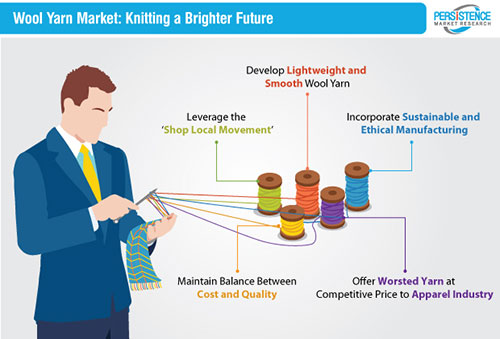 such as blazers, jackets, and also sports apparel. Wool’s application in athleisure has also increased with the segment accounting for nearly half of sales of wool yarn. The application of wool for making athletic shoes is creating new opportunities for wool yarn manufacturers in the sports fashion landscape.
New innovations and strategies push-up growth
Growing concerns over animal-cruelty are forcing wool yarn manufacturers and retailers to adopt a cruelty-free approach. Manufacturers are adopting new strategies to market the breathability and biodegradability properties of their wool yarn, besides promoting various sustainability policies and ethics to establish new brand image.
Stakeholders are increasingly investing in worsted wool yarn, especially those in Europe and East Asia. These investments are being done through various collaborations and associations. For instance, in October 2018, Indorama Ventures (IVL) entered into an agreement to acquire the worsted wool yarn business of the Schoeller Group through its indirect subsidiary – Glanzstoff Management GmbH.
Small companies and start-ups in regional markets are adopting the ‘shop local’ movement in various countries, including the United States and China. New entrants in the wool yarn landscape are developing a network of local yarn producers and distributors to gain an edge in the market.
A bright outlook for growth
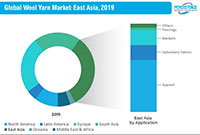
The global wool yarn market is projected to grow at a CAGR of over 4 per cent over from 2019–2029 owing to its increasing applications in the apparel industry. This growth will be concentrated in the East Asia and Europe markets which will record high market value and volume growth over the forecast period. The North American market, on the other hand, will experience moderate growth.
The growing consumption of jackets and blazers will create a substantial demand for wool yarn in future alongwith a growing fascination for sportswear. Increasing demand from upholstery interior is also likely to boost demand for wool yarn. The demand for wool yarn is also expected to increase on account of rising urbanisation, growing middle-class population, and increasing awareness towards sustainability. Growing GDP and increasing per capita spending is encouraging people to use natural fiber-based fabrics resulting in increase in demand for various wool yarn types such as cashmere, merino, etc.










