FW
Behavioral changes, sustainable materials can help brands manage biodiversity
 The planet’s biodiversity is declining at a fast rate with the apparel industry being one of the most significant contributors to this loss. Indeed, global apparel companies have been launching myriad initiatives to become carbon neutral. However, measuring the impact of their operations on the environment requires multiple metrics and indicators. McKinsey & Company has made a deep study of the effect of each apparel value chain on Earth’s biodiversity and identified some of the largest contributors to its loss. These include:
High use of insecticides and pesticide in cotton farming: Although grown on only 2.4 per cent of global cropland, cotton accounts for 22.5 per cent of the world’s insecticide and pesticide use. It is also a water-intensive crop with around 713 gallons (2,700 liters) of water needed to produce one T-shirt.
Unethical sourcing of wood-based fibers: Around 30 per cent of man-made cellulose fibers (MMCFs) are obtained from endangered plantations. The water and soil pollution from chemicals used in the plantation of these forests results in habitat loss and endangering of species.
Exploiting fresh water resources: Textile dyeing and treatment, which overexploit freshwater resources and contaminate waterways, accounts for approximately 25 percent of industrial water pollution. The European Union classifies around 165 of the 1,900 chemicals used in clothing production as being hazardous to the health or the environment.
Contamination with microfibers: The report states on an average of 700,000 fibers are released in a standard laundry load, what’s more7 and half a million tons of microfibers (which are a type of microplastic) flow on the oceans every year. An estimated 35 percent of primary microplastics in the world’s oceans originate from the washing of synthetic textiles. Toxic chemicals in synthetic microfibers poison marine wildlife
Unmanaged waste: Around 12 per cent of textile waste is broken down into its component materials, and less than one per cent is closed loop recycled. Nearly three-fourths—73 per cent—of textile waste is incinerated or ends up in landfills, which release pollutants into their surroundings and contribute to habitat loss. Anywhere from 30 to 300 species per hectare may be lost during the development of just one landfill site
To mitigate these risks, apparel companies can adopt the following strategies:
Make materials more sustainable: Each of the materials used in the industry can be made more sustainable with new innovations and investments.
Support multiple production systems: The industry can optimize the environmental footprint of global cotton production by supporting multiple production systems. It can also develop low-impact alternatives to conventional fibers.
Tougher stance against waterway pollution: Waterway pollution from textile dyeing and processing requires a tougher stance from apparel brands. For this, brands can engage with suppliers to establish basic certification standards at scale. Suppliers should also comply with Zero Discharge of Hazardous Chemicals, Manufacturing Restricted Substances List (ZDHC MRSL), and Wastewater Guidelines, which regulate the use of hazardous chemicals and wastewater discharge.
Brands and suppliers can pursue high-tech options like moving from wet processing to waterless dyeing, which uses supercritical carbon dioxide, or to digital printing, which reduces water and chemical dependency. They can retrofit microfiber filters into their washing machines can help consumers prevent microfibers from entering waterways.
Make behavioral changes: Brands can minimize biodiversity loss by making simple behavioral adjustments and consumption choices like changing their washing-machine settings from delicate to cold express cycles.
They can also incentivize behavioral change by offering small vouchers in exchange for used clothing. The industry can provide viable business models for repair and reuse like Patagonia did in 2019, when its Worn Wear Program repaired more than 40,000 pieces of clothing.
Manage biodiversity like value creation. Brands can also manage biodiversity like financial performance by committing to new biodiversity science-based targets. They can team up with other apparel companies to invest in scaling and industrializing emerging, low-impact technologies and substitutes for nonsynthetic fibers.
Post COVID-19, biodiversity is likely to become an even greater concern for consumers and investors. Apparel industry should make bold moves to tackle it.
HKTDC launches advanced online virtual exhibition
 In view of the current COVID-19 pandemic situation, the Hong Kong Trade Development Council (HKTDC) has migrated the nine physical exhibitions originally scheduled to be held by the end of July onto an online platform. In addition, an artificial intelligence (AI)-enabled business matching service is being introduced to help suppliers and buyers close more deals. Organised by the HKTDC, Summer Sourcing Weeks | Go ONLINEopens today and runs until August 7. This 9-in-1 virtual trade exhibitionhas attracted more than1,300 exhibitors, featuringlighting, electronics, information and communications technology (ICT), medical and healthcare, houseware, fashion, home textiles and furnishings, gifts, printing and packaging products. Thisbrand-new online exhibition platform will helpglobal buyers to replenish supplies and assist small and medium-sized enterprises (SMEs) in exploring newbusiness opportunities duringa difficult time.
Benjamin Chau, HKTDC Deputy Executive Director, said: “Although theCOVID-19 pandemic is presenting huge challengesfor businesses globally, it also offers theprospect of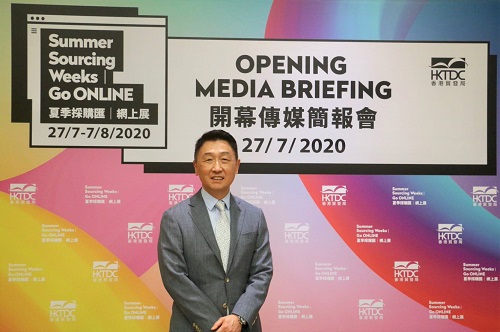 online business opportunities for enterprises. The HKTDChas initiated various online promotions,including the Spring Virtual Expo in April and the Summer Virtual Expo in late June and July, to assistSMEs and international buyers overcome the challenges during this difficult period. Now, to further boost business connections between global exhibitors and buyers, we are launchingSummer Sourcing Weeks | Go ONLINE, an advanced online virtual exhibitionthat runs for 12 days starting from today and featuresthe AI-enabled Click2Match business matching platformto help SMEsforge more connections and opportunities.”
Chau added that Summer Sourcing Weeks | Go ONLINE is one of the HKTDC initiatives helping to expandthe e-commerce capabilities of Hong Kong businesses. “The HKTDC is actively equipping SMEs to embrace the digital economy. In addition to strengthening cooperation with a number of technology partners to provide Hong Kong companies with more cost-effective digital solutions, the interface and functions of our hktdc.com Sourcing online marketplace will be further enhanced andrelaunched later this year, utilising a variety of new technologies to improve business matching efficiency.”
New AI business matching platform
The one-monthSummer Virtual Expodrew to a successful close on 24 July, helping more than 22,000 suppliersconnect with buyers from around the world. From April to July, the number of buyers browsing thehktdc.com Sourcing online marketplaceincreased bynearly 20% to 4.2million compared to the same period in 2019.
Building on these achievements,Summer Sourcing Weeks | Go ONLINEhelps exhibitors from the nine physical fairs build a virtual presence to connect with global buyers.The virtual exhibitionoffers multiple new functions that make it easy for buyers tosourceonline.These include the Click2Match business matching platformthat operates automatically using big data and AI technology, and other functions covering meeting planning, video meetings, live chat and online seminars run by industry experts, all of which will provide a better online sourcing and communication experiencefor buyers and exhibitors alike.The HKTDC’s 50 global offices have been keeping in touch with buyerswho attended its physical fairs previously along with newly registered buyers. Over 5,000 business matching meetings have been pre-arranged to increase business opportunities.
Online seminars
The Summer Sourcing Weeks | Go ONLINEportal highlightsfeatured products and details of the nine fairs for participants’ easy reference. The Intelligence Hubintroducesvarious webinars, including “Tech Trends Symposium 2020 – The Future of Intelligent Connectivity” (28 July), which will address the impact of the artificial Intelligence of Things (AIoT), the smart home, 5G technology applications and other related issues. Elsewhere, representatives from WGSN,the global authority on consumer and design trends,willshare their viewsin “WGSN Presents: Lifestyle & Interiors Trends Presentation S/S2021” (29 July), while the “Asian Lighting Forum 2020 – Shaping the Future of Lights” (30 July)will analyse the prospects of smart lighting from a human-centricperspective. The“Trendwatcher – The Reshaping of Retail Landscape” seminar (31 July) will feature representatives from internationally renowned market research agency Euromonitor International and local branding consultancy REALLY DESIGN.
Focus on anti-epidemic products
Ever since the COVID-19 outbreak began, local scientific research companies have worked to develop a range ofanti-epidemic productsfor better hygiene and health protection. The online exhibitionpresents a variety of disease prevention and control products, with theSmart Health Hong Kong zoneshowcasinga wide range of locally developed healthcare products. They include anantibacterial and antiviral coating,a disinfection robot,nanofibre-technology air filters, air sanitisers, an AI-assisted body temperature screening system, quarantine trackingtechnology and more.
The stay-at-home economy has also been drivingdemand for consumer electronics and home entertainment equipment. The virtual fairfeatures a broad selection ofsmart home and lifestyle products.
Subsidies to exhibitors
To assist enterprises in overcoming the challenges brought about by the pandemic, the HKTDC is providing a special subsidy of HK$5,000 for each exhibitor taking part inSummer Sourcing Weeks | Go ONLINE. The original participation fee for the fairwasHK$10,000.After deducting this special subsidy, local companies that meet theapplication criteria for theSME Export Marketing Fundare eligible to apply for an additional 50% subsidybased on the original participation fee. This means that theirparticipationin the virtual expo will be freeofcharge.
ILP bags hosiery orders
Following lifting of lockdowns in the European Union and the US, Pakistan’s leading textile exporter Interloop Ltd (ILP) has received several new orders for hosiery products such as socks.
A listed company at the Pakistan Stock Exchange (PSX), ILP manufactures products for renowned brands such as Adidas and Nike. The company’s denim division lost over half of its orders due to the COVID-19 pandemic while its hosiery division lost 15 per cent of the orders.
Around 60 per cent of the company’s export revenue comes from the EU while the rest comes mainly from the US.
The company has been able to get orders for its hosiery division from three new clients whereas work has also been done to bring new clients on board for its denim segment and one good brand is placing orders at very attractive prices.
Currently, the ILP’s denim segment is operating at a loss, however, it is expected to start contributing to profits from next year. Currently, the company is one of the world’s largest hosiery manufacturers and Pakistan’s sixth largest exporting firm.
It has two manufacturing units in Pakistan and Bangladesh, and one associated company in Sri Lanka, along with services available in the US, the Netherlands, China and Japan.
LondonEdge cancels trade shows for 2020
LondonEdge, a UK-based trade fair with focus on youth, lifestyle and subculture fashion, has cancelled the upcoming edition of its show scheduled on September 6 and 7, 2020 at Islington’s Business Design Centre. It will also not go ahead with the VegasEdge, the Las Vegas edition stipulated for 18-19 August. The shows scheduled for February, August and September 2021 are currently still planned to go ahead.
As the rest of the world moves towards a more digital approach, the organizers of the show have a pre-existing platform – LondonEdge, which is a virtual marketplace for buyers to view, source and order collections in the absence of a live event. Anybody can register on the multi-brand, wholesale sourcing platform and source the collections they would have otherwise viewed at the show.
Supima Cotton Design Competition to go digital
Supima, the cashmere of cotton, is taking its next design competition for emerging talent online. The non-profit organization that promotes the use of US-grown American Pima cotton around the world, will hold 13th edition of its annual Supima Cotton Design Competition.
The virtual presentation, which will be simulcast on Instagram Live leveraging a mix of pre- recorded and live video content, will take place in September to align with New York Fashion Week.
The competition supports emerging talent by enlisting student designers from the nation’s top fashion schools to create capsule collections using Supima cotton fabrics. These will be presented in a collective digital runway show and evaluated by a panel of judges. The winner of the competition will receive $10,000 cash prize and industry recognition. Moreover, inalists of the Festival de Hyères will be given the chance to present one look in Supima.
Pakistan: FPCCI webinar calls for more access to the UK market post Brexit
At a webinar organized by the Federation of Pakistan Chamber of Commerce and Industry (FPCCI), Sheikh Sultan Rehman, Vice President, said, Pakistan must have same level of access to the UK market after BREXIT which it currently enjoys with EU. He said, UK plays a key role in economic and social development of Pakistan. At present, the balance of trade between Pakistan and UK is in favor of Pakistan. Trade is being conducted under EU GSP Plus scheme which will end for UK from January 1, 2021. He urged the Pakistani government to sign Bilateral Investment Treaty with UK.
Kamal Shahryar, GSP Plus Advisor, TDAP stated Pakistan and UK are negotiating for a similar facility that Pakistan enjoys under EU GSP Plus. He added that after BREXIT, border trade with EU will not take place for moving goods in EU member countries. Zakaria Usman, Former President, FPCCI emphasized on the need to finalize the agreement with UK as Pakistani exporters have made huge investment in textile sector in accordance to EU GSP plus requirements which should not be affected with BREXIT.
Asim Yousuf, Vice President, Pakistan UK Chamber of Commerce and Industry added there are huge opportunities for Pakistan’s export in agriculture, textile and food items to UK. In this context, there is a need of early formulation of Pakistan’s trade delegation to UK for getting new orders from UK.
Sheikh Muhammad Tariq, Chairman-Pakistan UK Business Council, FPCCI urged Pakistan to comply with standards and SPS measures as UK is importing 1.2 million ton of meat. He also underlined the need of developing Pakistani business center in UK as UK is establishing business hub wherein all the countries are establishing their offices.
Shariq Vohra underscored the need of research for enhancing exports to potentials market as our Pakistan export is stagnant for 10 years.
Brazilian associations collaborate to launch Brasil Fashion Now project
Apex Brasil (Brazilian Agency of Promotion of Exports and Investments), ABEST (Brazilian Fashion Designers Association), ABIT (Brazilian Association of Textiles and Apparel) and Abicalcados (Brazilian Association of Footwear Industries) have collaborated to launch the Brasil Fashion Now project, which will be featured on the Blanc Fashion digital platform.
With an initial duration of six months, Brasil Fashion Now will be held via Fashion Label Brasil (Program of internationalization of value-added Brazilian fashion), Texbrasil (Brazilian Fashion Textile Industry Internationalization Program) and Brazilian Footwear, fashion export programs in partnership with Apex-Brasil.
It will introduce, facilitate and generate exports of Brazilian innovative and unique brands for international retailers, a model known as B2B (business to business). The project will appoint an exclusive space for Brazilian brands on the digital platform, which currently has more than 10k buyers from 60 registered countries.
Only 35 per cent Bangladesh apparel capacity booked for July-December 2020: BGMEA
A BGMEA survey revealed only 35 per cent of production capacity of Bangladeshi apparel manufacturers has been booked for the consolidated period of July-December this year. Moreover, prices of apparel goods booked by global retailers over the same period have fallen on an average 14 per cent due to shortages of work orders.
The survey examined responses of over 100 manufactures to determine the impact of the COVID-19 pandemic on work orders for the second half of 2020. Manufacturers confirmed work orders for 127.50 million pieces in the July-December period of 2020, while 365.78 million pieces can be produced at full capacity. December is the worst month in the second half of the year, with only 17 per cent of total production capacity having been booked, while in July, 56 per cent of the total production capacity has been booked.
The biggest decline in prices has been for men’s undergarments followed by babies’ garments with a 35 per cent fall. Only the price of knit bottoms rose this year, by 6 per cent.
LVMH to weather COVID-19 storm better than rivals
Thanks to its financial strength and a diversified portfolio that includes champagne and spirits as well as perfume and beauty chain Sephora, LVMH is expected to weather the COVID-19 crisis better than most rivals. This is mirrored in its share price, which is just 9 per cent lower than its pre-COVID 19 peak, compared to -18 per cent for Gucci owner Kering, which will also release results next week, and – 40 per cent for Burberry
Yet, the group’s sales for the three months to June are forecast to plunge around 40 per cent on a like-for-like basis, a touch better than the sector average but not a significant outperformance. That is partly due to an unfavorable regional mix for the quarter. LVMH is more US-driven than China-heavy relative to peers even before the planned purchase of Tiffany. A big rebound in the key Chinese market, where shops reopened earlier, may have had less of a mitigating effect.
There are some signals already that point to LVMH being more upbeat than others about how quickly it can turn the corner. Its top fashion brands Louis Vuitton and Dior have raised prices recently, and Dior has also been very active in the past few weeks — it presented two new collections, opened a flagship store in Paris and held a series of events in China.
Bernard Arnault, Chairman has flagged some quite vigorous signs of recovery in June, even though he acknowledged that the fallout from the crisis would weigh on the group’s performance for some time yet.
Kingpins cancels upcoming Amsterdam show
Kingpins Show organizers have canceled their upcoming trade show scheduled on October 28 and 29 in Amsterdam. The event was aligned with the city’s Denim Days Festival and a Transformers conference. Kingpins was also forced to cancel its April event in Amsterdam, as well as its shows in New York and China. The organizer has stayed connected with the industry it serves through Kingpins24, a two-day online event with panels and interviews. It also pivoted its Transformers events to a virtual version this month.
Munich Fabric Start and Bluezone have also downsized their September event to hold a regional show called Fabric Days from September 1-3 at the Munich Order Center. Its organizers plan to return to the original format on Jan. 26-28, 2021.
Though Première Vision will take place in Paris on September 15-17, it will adopt a hybrid physical and digital format Denim Première Vision will be held as per schedule from November 24-25 in Berlin.