FW
US apparel exports from Bangladesh increase by 2.3 per cent last fiscal
US remained the biggest market for Bangladesh apparel exports in the last fiscal. During the period, products worth $5.98 billion were exported – which is over 16 per cent of the total export of Bangladesh. Export earning was 2.3 per cent higher compared to the $5.84 billion exported during 2016-17.
The main exported item was woven garments worth $3.97 billion, followed by knitwear products at $1.37 billion, home textiles $180 million, and caps $126 million. US procured over 25 per cent of Bangladesh’s woven products, 9 per cent of knitwear and 18 per cent of home textiles products.
Until January 2019, apparel exports to US rolled in $3.59 billion, marking a 18.8 per cent gain over last year’s $3 billion. During July-January 2018, trade of knitwear fetched over $896 million. Trade in woven was over $2.7 billion.
Pressure on Bangladesh to extend Accord tenure
European brands, global rights groups and a group of 190 global investors want Bangladesh to give Accord an extension. They feel terminating Accord’s work will benefit no one -- brands, garment makers or workers –and that a premature closure of Accord’s operations in Bangladesh would be detrimental to the health and safety of garment workers and to brands that depend on a secure and safe workforce.
Bangladesh’s inspection bodies are not yet seen to have the capacity to oversee around 1600 Accord-covered factories. Also, a viable alternative to worker safety training and a worker complaint mechanism offered by Accord is nowhere in sight. In such a situation, it is feared, brands would lose suppliers, factories would lose buyers, workers would lose jobs and factories would become more unsafe.
As a legally-binding agreement between brands and trade unions, Accord's mandate remains valid until 2021 and signatory brands cannot withdraw from the program before having fulfilled all their obligations. Accord was allowed a six-month extension until November 30, after its tenure expired in May last. The issue of Accord's extension remains under judicial consideration. There is no transparency and no verifiable assurance that the level of factory safety achieved by Accord will be maintained.
India: Weavers in the Northeast get passbooks
Yarn passbooks have been distributed among weavers in Arunachal Pradesh, Assam, Mizoram and Manipur. This makes yarn available at subsidised rates. In several districts, the coverage has been almost 100 per cent. Marketing events organised in these districts generated substantial sales for artisans and weavers.
Weavers and artisans have also been enrolled under the social security insurance scheme. Centers of excellence, comprising 55 display outlets, have been set up in Varanasi for the sale of products which are G.I. tagged. Tufting frames and carpet looms have been provided to carpet weavers of Bhadohi in Uttar Pradesh.
Prominent garmenting companies of India have agreed to placing orders with clusters of weavers through the handloom verticals of these companies. Weavers are being provided facilities like tool kits and yarn at subsidised rates to cut down the cost of production and enhance their income. The Promotion Council for Handlooms and Handicrafts has signed MoUs with weavers’ societies and artisans for promoting exports through design and skill enhancement and such other interventions.
Weavers’ service centers have been designated as supervising agencies for effective coordination with banks, district administrations and weavers. Three-fourths of the cost of education for girls and children belonging to the SC, ST and BPL categories will be funded.
Pakistan may continue importing cotton from India despite losing MFN status
India’s withdrawal of Most Favored Nation to Pakistan and the 200 per cent hike on imported goods has put an end to import of cement from Pakistan. But ginned cotton and cotton yarn exports to Pakistan may remain impervious to the current turmoil. A shortage in domestic output and the favorable cotton market provided by India will keep Pakistan a key buyer of Indian cotton.
Pakistan’s cotton industry requires raw material from India. India is the most accessible and price-lucrative market for Pakistan. Pakistan is expected to import around a million bales of cotton from India in the current financial year. The possibility of a reciprocal hike in duty by Pakistan on the purchase of cotton from India is ruled out. Pakistan faces a shortage in domestic output of the natural fiber and the growth of its textile industry will be hampered.
Cotton exports to Pakistan are expected to continue even in the event of an increase in duty as the consignments would be routed via ports in Dubai and Singapore. Cotton purchases by Pakistan have grown in recent years due to the growth of the local textile industry and the price advantage due to proximity with India.
Visitors at Munich Fabric Start decline by 3 per cent
The latest edition of Munich Fabric Start, held from January 29 to 31, 2019, experienced a decline in footfall for the first time in the show’s history. The number of visitors declined 3 per cent as compared to January 2018. Despite the challenging market conditions, a total of 19,800 international visitors from German-speaking and European countries attended the Munich-based event. Non-German European visitors accounted for 38 per cent of footfall.
Over 1,000 exhibitors showcased their collections at the three day event that provided them with networking and trading opportunities. There was an optimistic atmosphere at the trade fair, boosted by the message “What is Love” in anticipation for the Summer 2020 season.
The next edition of Munich Fabric Start will be held from September 3 to 5, 2019, while Bluezone will be held on September 3-4, 2019.
India among top textile giants, growing at 5 per cent CAGR
The global textile industry is growing at a CAGR of five per cent. The textile industry encompasses the production and sale of materials such as cotton, yarn, fiber and finished products or apparels. China, Japan, India and United States dominate the global textile industry.
China is the leading textile manufacturing country and is worth about a fourth of the global textile industry with an export value of more than a 100 billion dollars. China’s textile exports went up by three per cent in 2018. The textile industry of the European Union has Germany, Spain, France, Italy and Portugal in the forefront with a value of more than one-fifths of the global textile industry. India is the third largest textile manufacturing industry and holds an export value of more than $30 billion. India is responsible for more than six per cent of the total textile production globally and is valued at approximately $150 billion. India is followed by the United States in the exports of textiles. The United States has now become one of the largest consumers of textiles, being responsible for almost 75 per cent of total textile imports.
The Brexit deal might bring about a lot of uncertainty in the global textile industry.
Karl Mayer incorporates conductive yarns technology into its machines
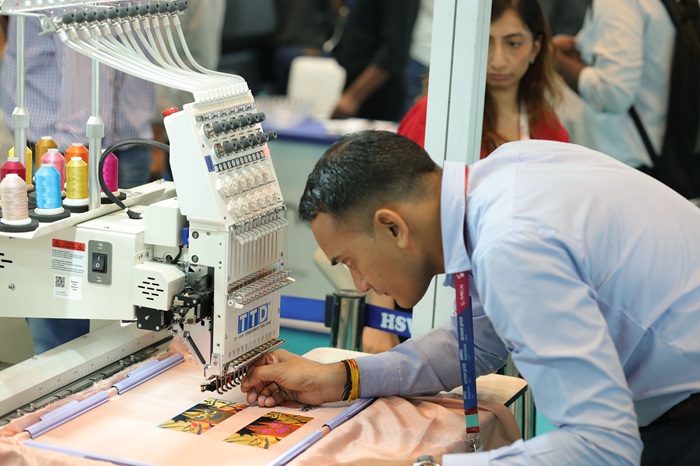
Karl Mayer multibar raschel machines are used with and without a jacquard facility to incorporate conductive yarns directly into the textile during manufacture. Electrically conductive structures with a virtually unlimited range of designs can be produced on multibar raschel machines. This is possible thanks to multibar patterning using Karl Mayer’s innovative string bar system, with which the yarns can be positioned individually and as required onto a ground – following the principles of tailored fiber placement. The ground can be produced with a wide variety of different designs, and jacquard patterns can also be worked, depending on the type of machine.
Besides offering extensive design freedom, warp knitting also delivers maximum efficiency when producing electrically conductive textiles. Moreover, typical performance features of textiles, such as softness, flexibility, elasticity and breathability, are fully retained. Textiles can be used for heating, cooling and lighting. They can measure the heart rate, as well as monitor soil erosion on slopes, and can even be launched into space for use as space reflectors – as long as they are electrically conductive.
At the functional heart of these innovative e-warp-knitted textiles are filaments containing metal. Silver-plated polyamide can be processed very easily on multibar raschel machines.
India’s cotton yarn exports down 25 per cent
India’s cotton yarn exports fell 25 per cent from 2013 to 2018. Spinning mills performed well in exports during 2013-14 when cotton yarn was covered under schemes such as the two per cent incremental export incentive, the two per cent interest subvention and the three per cent focus market incentive. The sector could penetrate into markets other than China. However suddenly all incentives were withdrawn leaving spinning mills high and dry.
China which is the largest importer of cotton yarn has shifted from India to Vietnam and Indonesia as they have duty free access while Indian yarn carries a 3.5 per cent import duty. From 2013 to 2017, there has been a decline in India’s cotton yarn exports to China by 48 per cent while exports from Vietnam and Indonesia have increased at a remarkable rate of 129 per cent and 55 per cent respectively in the same period.
Fabric exports from India are at serious disadvantage vis-à-vis exports from competing countries due to duty differentials in leading export markets. Markets like EU, China, Turkey and Vietnam impose an import duty in the range of eight per cent to 12 per cent on Indian fabric while duty free access is given to countries such as Pakistan, Cambodia and Bangladesh.
EU activates withdrawal of trade benefits to Cambodia
The European Commission has activated the process of withdrawal of tariff benefits for Cambodia, the country that made the most progress in the implementation of collective bargaining in textiles. The garment industry would be one of the most affected by this measure, since exterior sales in the sector account for 75 per cent of the total. Cambodia is one of the main countries that benefit from the Everything but Arms (EBA) program, which allows least developed countries in the world to export to the European Union with zero tariff.
However, commercial preferences may be temporarily removed if violations of human and labour rights are determined. The European Executive considered the general elections last summer in the country were not fair. Even before the elections, the European Commission had already warned the Asian country about the worsening situation.
The European government activated the process after current political party in Cambodia illegalised the one in the opposition just before the voting. Finally, in October, the European Commission implemented the process. Since then, Cambodia’s Prime Minister, Hun Sen, has kept standing firm in his politics.
Asics launches recycling program
Japanese sportswear company Asics, is collaborating with the Charity I:Collect on a sports apparel recycling and reuse initiative in Europe. The initiative will be launched at the Barcelona Marathon on March 10 where the two companies will work together in order to collect used sports apparels and footwear for reuse or recycling.
The program will enable the recycling and reuse of Asics products at eight marathons happening across Europe, the Middle East and Asia. A product-driven company, Asics is shifting to more sustainable materials and engaging its customers and consumers on the journey to a circular business model is at the heart of its sustainability strategy. While working on its global program to reduce greenhouse gas emissions, Asics has identified that more than 80 per cent of CO2 emissions originate from the processes and materials that are being used to create footwear and apparel and end of life treatment of sold products.
Asics aims at collecting more than 30,000 pieces of sports apparels from consumers in Japan. The collected pieces will be further recycled by the year 2020. The aim is to cut greenhouse gas emissions by 55 per cent across the globe by the year 2030.