FW
63rd India International Garment Fair - The perfect platform for apparel exports
The 63rd India International Garment Fair [IIGF] was inaugurated by Shantmanu, IAS, Development Commissioner [Handicrafts] that is being held concurrently with 12th edition of Indian Fashion Jewellery & Accessories show (IFJAS) at India Exposition Mart in Greater Noida.
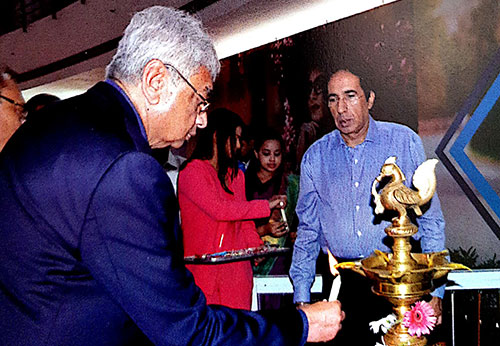
The three day international fair,being held from July 04-06, 2019, covers the Spring/Summer collections of Japan, European Union, USA, and other western markets. This grand fair aims to provide a perfect business platform for the Indian apparel exporters and international buyers and bring together the best sourcing solutions from India.
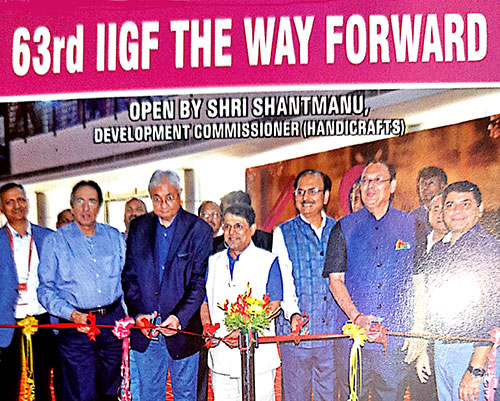
Shantmanu, Development Commissioner [Handicrafts] says, "IIGF is a window for Indian exporters to the emerging markets in Asia, Latin America, Africa and East European countries. Government pays high emphasis on export promotion of apparels and a number of new schemes are also proposed for the current year. The northern and tribal region should be focused in future shows.
Benetton India unveils the July 2019 edition of Rolling Stone India magazine
Sundeep Chugh, CEO & MD, Benetton India alongwith Indian comedian, singer, songwriter and YouTube sensation Bhuvan Bam unveiled the July 2019 of the popular music magazine-Rolling Stone India. The cover of the magazine features Bam on the cover in a complete Benetton look from the brand’s eclectic Spring Summer 2019 collection.
Comsat equips Tecmat sectional wrapping machine with EltexEyETM
Comsat is equipping its latest Tecmat sectional warping machine for weaving preparation with the new EltexEyETM yarn tension monitoring system.

Unlike yarn tension monitors that are fitted solely on the weft insertion systems of weaving machines, the new Eltex technology is for the warping process prior to weaving – and instead of monitoring only the tension of the six-to-eight yarns fed by the weft insertion system the EltexEyETM keeps a close eye on literally hundreds.

With warping that can operate at high speeds, the yarn tension values from all yarns are continuously updated and displayed on the screen. Tension values outside the warning level are indicated both on the sensor’s LEDs and on the screen. This greatly increases yarn evenness and subsequently the woven fabric quality. In addition to being fitted on our latest Tecmat machine, the EltexEyETM can also be retrofitted to existing comsat machines already in operation.
HKRITA signs MOU with International Iberian Nanotechnology Laboratory
The Hong Kong Research Institute of Textiles and Apparel (HKRITA) and the International Iberian Nanotechnology Laboratory (INL) signed an MoU to foster research development and knowledge exchange.
The MoU aims to strengthen collaboration between HKRITA and INL in the development of sensor and wearable technology. These research areas have inspired projects that are developing more precise ways to measure physiological and biomechanical phenomena, leading to the design of new devices and testing methods for the continuous enhancement of wearable solutions. The solutions will play increasingly important roles in improving life in a range of social and occupational settings.
Established in 2006, HKRITA is funded by the Innovation and Technology Commission of the HKSAR Government and hosted by The Hong Kong Polytechnic University. HKRITA engages in applied research to support the textile and apparel industry in order to boost its overall competitiveness, and to drive sustainable improvements and bring benefits to society. By providing one-stop services for applied research, technology transfer and commercialisation, HKRITA makes sustained efforts to promote successful projects for industry application.
The INL was founded by the governments of Portugal and Spain under an international legal framework to perform interdisciplinary research and to deploy and articulate nanotechnology for the benefit of society. The INL provides a cutting-edge research environment in which today’s major societal challenges can be addressed: ageing populations and well-being, mobility and urban living, and social safety and security.
Vietnam, Taiwan organise forum to promote textile cooperation
The Vietnam Chamber of Commerce and Industry recently collaborated with the Chinese National Federation of Industries to organise the Vietnam-Taiwan Industrial Collaboration Forum. The event will connect leading enterprises in the fields of textile, light industry, automation, smart city and other applications. At present, the most intimate textile exchange and trade is happening between Taiwan and Vietnam. In future, the two parties will exchange newest international fashion trend, of which, Taiwan will introduce the highest quality nano-fabric researched and developed by Taiwanese firms to Vietnam, promoting the cooperation between two sides to come into reality.
Vietnam is the largest importer of Taiwanese-made fabric while Taiwan is the second largest territory in importing garment products of Vietnam with import turnover at nearly $400 million last year. As the price of Taiwan’s functional fabrics is higher than that imported from China, so export value of products made of Taiwanese functional fabrics will increase, helping Vietnam to hold a key position in global supply chain.
Pakistan: Introduction of sales tax shuts down textile units
The business of wholesalers and retailers associated with textile processing mills has come to a standstill after the government introduced a sales tax of 17 and 20 per cent on the textile sector. APTPMA Chairman Mohammad Arif Lakhani held an emergency meeting which unanimously passed a resolution demanding an extension for sales tax implementation on CNIC basis besides continuing SRO1125 and zero rating till July 31, 2019. The association also asked the government to find a solution for sales tax issue by July 31 after holding negotiations with dyeing and weaving sectors along with textile retailers and wholesalers.
APTPMA former president Zubair Motiwala said imposition of 17 per cent and 20 per cent sales tax along will decline exports by 30 per cent. The Lahore Chamber of Commerce and Industry (LCCI) also warned the government that trading activities will come to a halt if the condition of disclosing CNIC details of sales to unregistered persons is not delayed for at least one year.
Under an amendment introduced by the government in the Sales Tax Act, sellers are required to include the buyer’s CNIC number on the sales tax invoices. However, the business community believes that this condition would result in a potential misuse of CNICs and can be used in fraudulent transactions of billions of rupees as reported from time to time.
DuPont’s Sorona can replace spandex
DuPont Biomaterials’ Sorona fiber has unique stretch applications. Garments today no longer need spandex for athletic movement. Sorona fibers are a replacement for spandex (or elastane), achieving long-lasting, mechanical stretch and recovery with a better-for-the-planet profile. Sorona fibers are bio-based, use lower dying temperatures and are recyclable unlike bamboo or rayon. Sorona can be used as a standalone elastane alternative – one that does not breakdown over time with heat, washing, UV rays, or chlorine exposure and is recyclable in any normal polyester recycling stream. With mechanical stretch and recyclability at its core, the Sorona brand is offering innovative solutions to this industry-wide challenge. Whether incorporated into yoga tights or a luxury gown, Sorona fiber’s versatility and mechanical, long-lasting stretch make it an excellent replacement for spandex.
Companies which are into knit fabrics, denim fabrics or woven fabrics utilise textured yarns to provide the fabrics optimal stretch performance. These fibers are 37 per cent bio-based and can be used in a variety of applications, including seamless knitted T-shirts and other apparel as well as knitted footwear. Australian brand Think Love Live’s Serotonin shorts and Endorphin tights are made from 70 per cent lyocell and 30 per cent Sorona fibers for optimal comfort and stretch.
Pakistan welcomes Chinese investors
Pakistan is attracting Chinese investment in the textile sector. This includes the whole value chain of textiles, from cotton to garments. The Chinese are already cooperating in manufacturing of polyester yarn in Pakistan.
For instance Chinese private textile company Challenge Apparels will establish a state-of-the-art garment manufacturing facility in Pakistan. The aim is to enhance Pakistan’s exports and help generate thousands of new jobs in the country over the next couple of years. Challenge Apparels is among the leading exporters to top brands around the world, especially in developed countries.
Pakistan is facilitating investors through various reforms and hopes to benefit from the US-China trade war. If businessmen from China bring fabrics to Pakistan for making the finished products, and export those to the US, then they will not only able to maintain their client base but Pakistan will also benefit. Enabling Chinese textile exports this way will give a boost to Pakistan’s exports and deal with the balance of payments situation. When Chinese businessmen carry out their exports jointly with Pakistan, making use of the raw materials as well as Pakistan’s human resources, it will add to the earnings of Pakistan. Also China is helping Pakistan's spinning mills become more cost efficient and competitive.
Orta works toward transparency
Orta Anadolu is on a mission toward greater sustainable denim manufacturing. With the help of Better Cotton Initiative, Orta is contributing towards a sustainable shift. The Turkish textile manufacturer is contributing to a more ecologically sound denim supply chain. One of the ways is by using a washing-machine filter that captures micro-plastics, eventually allowing enzymes to consume the collected waste. Stepping outside the larger format of trade shows and forums, the company is connecting with brands on a more personal level. Believing in the power of collaboration, it wants everyone in the entire value chain to work together. The mill is educating its brand partners regarding greener denim throughout the product lifecycle.
As a part of its push to promote an eco-friendly industry, Orta is using technology to facilitate connections along the supply chain and implementing changes to remain transparent. Using a Lifecycle Assessment QR code printed on its labels, Orta leads its brand partners through its denim sourcing, affording greater insight into how its textiles are produced.
Utilizing more sustainable raw materials at the beginning of the supply chain and less harmful processes during production is a major concern for many denim textile manufacturers and jeans brands.
Germany to host cellulose fiber event next February
A conference on cellulose fibers will be held in Germany, February 11 to 12, 2020. The conference will cover the entire value chain of cellulose fibers from lignocellulosic feedstock, dissolving pulp, cellulose fibers – such as rayon, viscose, modal or lyocell and new developments – to a wide range of applications, woven textiles (clothing) and nonwovens (wipes and technical applications), as well as micro- and nanocellulose for food, cosmetics and pharmaceuticals. The aim of the event is to gather together technology providers and developers, academia and industry, pulp, fiber and equipment suppliers, retailers and textile brands, policy makers and investors to debate recent market dynamics, in other words, all developers, producers and players in the value chain of modern cellulose fibers.
Cellulose fibers are a success story within the textile market with a cumulated annual growth rate of at least ten per cent over the last ten years. This makes them the fastest growing fiber group in the textile industry and also the largest investment sector in the bio-based economy worldwide. The high growth rates are driven by the demand for natural fibers (and bottlenecks in cotton), the microplastic problem and possible bans for plastic fibers. All three drivers will continue to play a significant role in the future development of the sector