


FW
Transparency helps brands win consumer trust: Lenzing survey
Lenzing’s new consumer survey, highlights the importance of transparency in helping brands win consumer trust and confidence titled ‘Global Consumer Perception Survey on Sustainable Raw Materials in Fashion and Home Textiles,’ the study was conducted in partnership with Wakefield Research, a market research firm, and surveyed 9,000 respondents between 18 to 64 years of age from nine countries including China, Japan, Korea, India, Indonesia, Turkey, Germany, the UK and the US in early 2020.
The study states, 83 to 82 per cent respondents consider brands transparent about their ingredients and the origin of raw materials as being trustworthy. Around 82 per cent respondents consider brands transparent about production processes, sustainable practices and the origin of their raw materials as trustworthy. They believe proper knowledge of raw materials used in their clothing and home textile products helps build consumer confidence. They also believe a brand’s environmental impact is important for consumers while deciding to make a purchase.
Eighty six per cent respondents believe purchasing clothes made from sustainable raw materials is a key component of living a more sustainable lifestyle, and they frequently purchase products from brands that are committed to using sustainable raw materials or recycled materials in their products. Majority of respondents learn about sustainability by researching about the production process of products before purchasing. Around 88 per cent of respondents agreed to reading handtags before buying their products with respondents being willing to pay 40 per cent more for sustainable clothing or home textile products.
Polish textile industry more resilient than in 2009: Euler Hermes
Analysts at Euler Hermes opine the Polish textile industry is more resilient and competitive than in 2009, which makes it a better candidate to return to normalcy. Comprising 25,000 companies, the Polish textile sector employs 1,45,000 people. Despite significant signs of recovery, sales in the Polish textile sector from January to May, fell by 15 per cent year on year.
According to Euler Hermes, the unprecedented disruption of trade, manufacturing and retail activities, with ensuing severe economic crisis, will lead to a 19 per cent decline in European textiles and clothing falling in 2020, with a 9 percent decline in GDP in euro area countries. Turnover in 2021 is expected to rebound by 15 per cent, but it will return to pre-crisis levels in 2023. By the end of 2021, EU employment industry will see a 8 percent job cut with 6 percent of companies disappearing. The share of SMEs in the total turnover of the textile industry is twice the average of the European manufacturing sector, which makes the industry more sensitive to the current situation.
Xinjiang labor issues need stricter laws, greater collaboration with suppliers
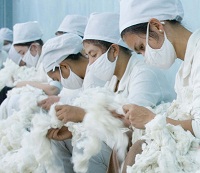 Wang Wenbin, China’s foreign minister has accused the US of restricting China’s development by withholding five import orders under the pretext of human rights. US Customs and Border Protection recently released five orders withholding the import of cotton and other goods produced in Xinjiang on allegations of human rights abuses and forced labor in the region, informs a Vogue Business report. Based on Section 307 of the Tariff Act of 1930, these orders prohibit the import of goods produced under forced labor conditions.
A broader ban on Xinjiang products
Xingjiang produces almost 85 per cent of China cotton, which is converted into clothes in either Chinese or other Asian garment manufacturing factories. However, lack of transparency makes it tough to track the origin of these garments. Most often products labeled made in countries like Bangladesh, Vietnam, the Philippines and Cambodia may contain cotton produced in Xinjiang, says Sheng Lu, Associate Professor-Department of Fashion and Apparel Studies, University of Delaware.
Hence, the US’ ban on a Chinese cotton producer, two apparel factories and one vocational skills education and training centre would have little effect as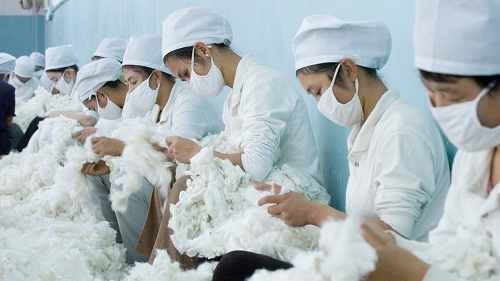 US needs to ban all cotton, yarn and textiles produced in Xinjiang, besides banning apparels made with cotton produced in this region. For this, US companies would have to investigate suppliers across the value chain to ensure products have no connection with Xinjiang cotton. Such a ban would encourage companies to change their modus operandi, points out Di Fan, Assistant Professor, Hong Kong Polytechnic University. Experts say, there is greater need for reassessing fashion, and engaging with other suppliers.
New law to prohibit forced labor
Most often, companies are unaware of the activities of lower-rung suppliers involving smaller subcontractors. As per 2020 Fashion Industry Benchmarking Study, only 85 per cent of US companies track their first and second-tier suppliers, while 25 per cent do not know their third and fourth-tier suppliers. To make these European companies legally responsible for implementing due diligence across their supply chain, the European Union plans to introduce a new law that would make it mandatory for these companies to act against forced labor.
Working as a non-tariff trade barrier, this ban would lead to significant glitches across the supply chain as non-complying products would be detained by customs. Companies relying on global supply chains would consequently have to diversify their supply chain to countries like Vietnam, Pakistan or India and possibly repatriate raw cotton supply to the US.
To implement mandatory due diligence, companies would have to routinely engage with their suppliers, assess their operations and invest in training, auditing and reform, says Tara Van Ho, Co-Director, Essex Business and Human Rights Project at the University of Essex. To stop the violation of human rights, these companies may have to also abandon their business in the region. As per Gearoid O Cuin, this would help them, and China resolve labor issues.
Government in crosshairs as Reliance-PTA battle over MEG dumping
 The government is caught in a battle between India’s largest mono ethylene glycol (MEG) producer Reliance Industries and purified terephthalic acid (PTA) Users Association-a body of end-users of PTA and MEG. As per a request by Reliance Industries, the government initiated a process to impose ‘anti-dumping’ duties on MEG imports. However, this move is being vehemently opposed by the Association, say reports.
This current situation is similar to 2014 when the government had imposed anti-dumping duties on PTA imports. This too faced bitter opposition from user industry’s representatives in various chambers of commerce and lobby groups. However, the government had stuck with its decision benefiting Reliance Industries. Now, the government has withdrawn these benefits. It has also initiated a similar process to impose an anti-dumping duty on import of mono ethylene glycol (MEG).
Huge impact on jobs
The PTA Users’ Association, a body of end-users of PTA and MEG, has opposed the government’s move. The association has warned the Ministry of Textiles it to could lead to a loss of over 40,000 jobs for small and medium manufacturers of polyester fiber, yarn and fabric.
The Association says, India’s MEG imports have fallen drastically since 2016, as has its import-share as domestic producers have expanded their production capacities. Yet, domestic MEG producers are unable to meet total demand and have to import MEG to a large extent. In 2018-19, India imported 80,000 tons of MEG and 85,000 tons in 2019-20. Now the Association expects imports to touch 87,000 tons in current fiscal and 75,000 tonne in 2021-22.
PTA Users’ Association argues, COVID-19 has devastated 40,000-45,000 small and medium polyester fiber, polyester yarn and polyester fabric manufacturers in the country. Anti-dumping duties may further impact their viability by increasing raw material prices. An anti-dumping duty of over and above the basic 5 per cent customs duty, may cause an acute of shortage of MEG in India, says the association. It may compel domestic MEG producers to increase prices forcing end-users to buy this key raw material at higher prices and incur further losses. The association has urged the Ministry of Textiles to persuade the DGTR, Ministry of Commerce & Industry as well as the Ministry of Finance to terminate the ongoing anti-dumping investigation against imports of MEG.
The battle continues
In a petition filed before the Gujarat High Court on August 13, RIL challenged the government’s decision. The petition was jointly filed by RIL, which produces 70 per cent of the country’s domestic PTA, along with MCPI, the Kolkata-based manufacturer of 21 per cent of PTA output, and the Chemicals and Petrochemicals Manufacturers’ Association. The petition describes the government’s decision as illegal, arbitrary and in gross violation of the principles of natural justice.
The petition argues PTA is important for the survival of domestic industry and the government should initiate an investigation in accordance with the Customs Act and anti-dumping rules. Meanwhile Nirmala Sitharaman, Union Finance Minister had announced a decision to abolish anti-dumping duties on imports of PTA from China, Taiwan, Malaysia, Indonesia, Iran, South Korea, and Thailand. The PTA Users’ Association plans to soon file an intervention application in the case.
Superdry’s trading performance improves
Superdry’s trading performance has improved since April despite uncertainty around the COVID-19 pandemic, as the British fashion retailer swung to an annual loss due to lockdown-led store closures.
The company’s demand has been gradually returning, with a major shift of customers to its online stores, but it had to discount heavily in the last few months to clear items that had accumulated in stores during lockdowns.
Superdry, which sells sweatshirts, hoodies and jackets adorned with Japanese text, has embarked on a plan to turn the business around under co-founder and Chief Executive Officer Julian Dunkerton, who retook control of the group in April last year. Its online sales for the 20 weeks to September 12 jumped to 55.3 per cent.
Underlying pretax loss stood at 41.8 million pounds ($54.1 million) for the year ended April 25, compared with a profit of 38 million pounds a year ago. Group revenue fell 19.2%.
Bangladesh Denim Expo to adopt Kingpins’ standards
Bangladesh Denim Expo (BDE) plans to adopt Kingpins’ standards starting with its upcoming show from November 05-06, 2020.
This year Kingpins Amsterdam, the bi-annual denim supply chain trade show, began the process of requiring all exhibiting denim mills to meet or exceed standards in areas of corporate social responsibility (CSR), environment and chemical usage.
Kingpins believes that the adoption of a clear and unified approach on sustainable chemical management in the denim supply chain will reduce complexity, increase transparency, improve communication and ultimately lower costs – both in certification and in evaluation tests of chemical substances. To this end, Kingpins Show is collaborating with The ZDHC Foundation to develop the show’s sustainability protocol.
Now, Bangladesh Denim Expo has announced that it too will be requiring denim mills exhibiting at its shows to meet or exceed standards in the areas of corporate social responsibility (CSR), environment and chemical usage. BDE will use Kingpins Show’s CSR and chemical responsibility standards as a template for its exhibitor requirements.
QIMA survey names Bangladesh as top sourcing destination for foreign retailers
The survey ‘Evolution of Sourcing in 2020 conducted by Hong Kong-based QIMA names Bangladesh as one of the top destinations for foreign clothing retailers and labels after China due to favorable prices even during the pandemic. The survey draws from feedback from more than 200 companies worldwide across a range of consumer product segments and based on previous QIMA studies.
The study analyzes the evolution of global procurement in response to the ongoing COVID-19 pandemic, trade disputes between the United States and China, and other threats to global supply chains. The report notes that China continues to dominate as the global sourcing destination although its dominance is noticeably less dramatic than in previous years, particularly in industries such as textiles and apparel, where diversification of supplier portfolios has been a priority for some time now.
Consistently ranked among China’s regional rivals, Vietnam continues to reap the most benefits from the continued mass migration of Western buyers from China, with 40 percent of EU respondents and nearly as many U.S. brands listed Vietnam among their top sourcing regions. The US and EU brands are seeking closer to home sourcing options, but are more likely to target near-shore rather than re-shore.
Roberto Cavalli CEO to quit by 2020-end
Gian Giacomo Ferraris, CEO, Roberto Cavalli will step down from his role by the end of this year. Ferraris joined Roberto Cavalli in 2016, when he succeeded Renato Semerari. He was formerly the CEO of luxury brand Versace, where he is credited with getting the brand's finances back on track and repositioning it in the luxury segment after years of lacklustre sales.
Roberto Cavalli Spa is an Italian luxury fashion company founded by designer Roberto Cavalli in Osmannoro, Florence, during the 1970's. Known worldwide for its glamour and animalier prints on leather and textiles, the label is in charge of manufacturing and marketing haute couture, ready-to-wear, and accessories, including handbags, eyewear, watches, shoes, perfumes and jewellery. The company also develops interior design projects for high-end buildings and hotels.
In 2019, the Roberto Cavalli was acquired by the DICO group, owned by Emirati businessman Hussain Sajwani, who purchased the brand from Clessidra through private investment fund Vision Investments. The label's UAE-based parent company intends to take the historic Italian house in a new direction in order to successfully relaunch it.
Pakistan government committed to make textile industry competitive: APTMA
Pakistan government is committed to making the textile industry competitive and realize its true export potential, says Nadeem Babar. He says the government is committed to introduce a stable textile policy at the earliest to help the industry attract foreign exchange, create jobs and bring investment in the country. The government will ensure maximum relief to the industry within the ambit of the GIDC verdict announced by the apex court. It will ensure supply of gas to the industry during the winter season.
Moreover the idle capacity has become operational and textile exports have started rising over the past two months. Exports are projected to grow 14 per cent in September.
Adil Bashir, Chairman, APTMA adds the association is working with the government for a viable textile policy. He further suggested industries using gas for in-house consumption should be exempted from GIDC charges at captive tariff. He further recommended that a billing mechanism should be devised for disbursement of subsidy to SNGPL for providing gas to the five export-oriented sectors at $6.5 per mmbtu.
Pakistan government committed to make textile industry competitive: APTMA
Pakistan government is committed to making the textile industry competitive and realize its true export potential, says Nadeem Babar. He says the government is committed to introduce a stable textile policy at the earliest to help the industry attract foreign exchange, create jobs and bring investment in the country. The government will ensure maximum relief to the industry within the ambit of the GIDC verdict announced by the apex court. It will ensure supply of gas to the industry during the winter season.
Moreover the idle capacity has become operational and textile exports have started rising over the past two months. Exports are projected to grow 14 per cent in September.
Adil Bashir, Chairman, APTMA adds the association is working with the government for a viable textile policy. He further suggested industries using gas for in-house consumption should be exempted from GIDC charges at captive tariff. He further recommended that a billing mechanism should be devised for disbursement of subsidy to SNGPL for providing gas to the five export-oriented sectors at $6.5 per mmbtu.











