FW
Pro-democracy rallies lead to decline in textile and apparel orders for Swaziland
Textile and clothing orders for Swaziland have declined due to effect of pro-democracy rallies that culminated in violent acts. As per a Textile Value Chain report, the national demonstrations have made suppliers hesitant to deploy trucks to deliver to the Kingdom of Eswatin. This will cost the factories a lot of money since the buyers would charge them a lot of money for missing deadlines.
Insiders in the textile and garment industries in the Kingdom of Eswatini claim they are having ’sleepless nights’ as a result of the continuing pro-democracy rallies. If they fail to get orders and run out of material, the thousands of emaSwati who work in the sector would be out of employment. The textile and clothing market is a delicate one because when a company fails to deliver, the customers shift their business elsewhere.
Industrial added value of China’s garment enterprises grows by 14.1%
According to the National Bureau of Statistics, from January to April, the industrial added value of garment enterprises above designated size increased by 14.1 per cent year-on-year. Affected by the higher base in the same period last year, the growth rate dropped by 3.4 percentage points from the first quarter; the garment production of enterprises above designated size totaled more than 7.05 billion pieces, up by 23.87per cent year-on-year, and the two-year average growth reached 4.8 per cent.
Total retail sales of consumer goods amounted to over CNY 13.83 trillion during the four month period, increasing by 29.6 per cent year-on-year. Retail sales of clothing, foot and head wear and knitted goods by major retailers above designated size surged by 52.6 per cent year-on-year to CNY 323.8 billion, reports China Textile Leader.
China's online retail sales grew by 23.1 per cent year-on-year to CNY 3.07 trillion and the two-year average growth reached 15.6 per cent. In the online retail sales of physical commodities, wearing goods increased by 33.8 per cent year-on-year. According to the Customs Newsletters, from January to April, China's garment and accessories exports rose by 51.7 per cent year-on-year to $44.41 billion.
Almost 98% UK fashion, textile companies faced red-tapism in H1’21: Study
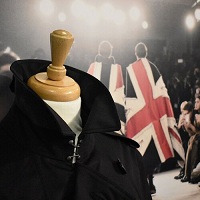 Shedding light on increasing bureaucracy in the UK fashion industry, a new survey by UK Fashion and Textile Association (UKFT) reveals, around 98 per cent companies faced red tapism in fashion trade during the first half of this year. And 92 per cent faced increased VAT costs and extra paperwork, affirms a UK menswear brand. They had to also deal with a 30 to 50 per cent increase in freight costs; 83 per cent faced delays in custom clearances as UK officially exited the European Union on December 31, 2021.
Tariffs and cancelled orders lead to cost increase
Seventy five per cent respondents faced increased tariffs while 44 per cent got affected by re-export duties. Around 55 per cent had to deal with cancelled orders from wholesale customers/retailers due to Brexit. Orders of 44 per cent brands were rejected as EU consumers had to now pay 12 per cent tariffs on products bought online. Around 38 per cent EU consumers also returned unsold goods. This further added to their costs of sending samples to customers and organizing trade shows. Around 32 per cent respondents were unsure about UK-manufactured goods meeting the Rules of Origin requirements for the UK-EU Trade Continuity Agreement (TCA). Another 41 per cent faced double duties due to the implications of free circulation in the agreement.
Simple solutions to boost exports
Respondents also questioned the stifling of freedom of EU citizens. A British fashion brand rued the lack of access to new talent in the industry due to the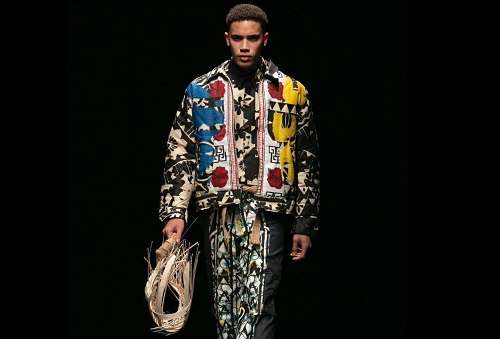 new rules while others hailed the opportunities offered by UK’s exit from the EU, particularly in reshoring and enhanced appeal of UK goods in domestic market.
Discussions on problems faced by the industry post Brexit have been underway for a long time. UKFT has held numerous meetings with civil servants and ministers to ease movement of product samples across countries. These meeting mainly focused on simplifying the rules of origin. UKFT also held several webinars to explain changing trade dynamics with the EU. In conjunction with BTC, it also held media briefings to provide in-depth reports on the organizations interactions with government.
UKFT plans to continue seeking support for businesses to trade in its biggest and closest market. The association plans to develop simple and effective solutions to help the UK fashion and textile industry increase export sales.
Future trading to become more complicated and expensive
Conducted in May 2021, the survey received responses from 138 businesses, including leading UK fashion brands, UK textile manufacturers, wholesalers, fashion agencies, garment manufacturers and retailers. A Scottish textile manufacturer predicted further difficulties in trading and a negative impact on British goods. Another held a pessimistic outlook on future production costs.
A UK-based technical textile manufacturer said, it plans to increase production capacities in the EU and make UK production redundant. And a UK women’s wear brand said it plans to suspend business due to Brexit challenges. An occasion wear brand from the UK predicted an increase in product prices by companies that do not export their goods. The brand said it plans to focus on non-EU markets as the current scenario in EU looks bleak.
A UK knitwear manufacturer said, it expects custom costs in EU to decline as cost for customers would increase. A designer fashion brand urged manufacturers to re-think their existing business models as they might have to close their UK business and move operations to Portugal.
YKK to explore GTT’s Empel™ water protection technology on zippers
Global leader in zippers and fastening products, YKK plans to explore Green Theme Technologies’ (GTT) water-free and non-toxic Empel™ water protection technology on its zippers and has signed a licensing agreement with the company. As per a Textile World report, GTT operates at the leading edge of sustainable performance textile finishes, and its PFC-free Empel platform is one of the best performing dry fabric finishes in the world, now being utilized on zippers for the first time.
The adoption of GTT’s Empel water protection technology is in keeping with YKK’s Sustainability Vision 2050 action plan to reduce water and chemical usage through innovative new technologies. The company has a long history of zipper innovation with its slide fasteners being used on everything from commercial fishing nets to space suits.
As a leader in product sustainability, YKK launched the Natulon® zipper — the first zipper to be made with recycled material — in 1994. Since that time YKK has developed an expansive portfolio of eco-friendly products such as GreenRise® the first zipper to use plant-based polyester, and Natulon® Ocean Sourced® zipper, made from ocean bound plastic waste.
GTT launched the Empel platform in 2018 and began with the goal of eliminating toxic PFCs. In addition to being highly sustainable, Empel treatment ranks among the highest water repellency and longest lasting protection available. GTT and YKK plan to collaborate with leading premium brands on the best quality and performance zippers on the market.
US’ jeans import surges by 29.18%: OTEXA
US’ import of denim jeans surged 29.18 per cent year over year in the five months through May to a value of $1.15 billion, shows the latest report by OTEXA. As per Sourcing Journal, US import of jeans surged by 30 per cent, or $26.39 million, cumulative year-to-date from April to May. Imports of blue denim apparels from Bangladesh rose by 35.61 percent in the year through May from the same period in 2020 to $218.35 million. Imports from Mexico surged by 51.35 percent to $232.76 million after a 25.07 per cent hike the previous month.
Among the Top 10 suppliers from Asia, imports from Vietnam rose by 8.69 per cent in the five months to $121.58 million, following a 2.86 percent drop the prior month, as sourcing experts have said capacity issues have started to challenge the country’s rapid rise. Imports from China increased by 38.67 per cent in the period to $117.27 million, while shipments from Pakistan increased 38.73 per cent to $116.62 million, imports from Cambodia rose 10.33 per cent to $59.92 million and shipments from Sri Lanka gained 32.79 per cent to $23.48 million.
Pakistan cotton planting areas to decline 11 per cent Y-O-Y
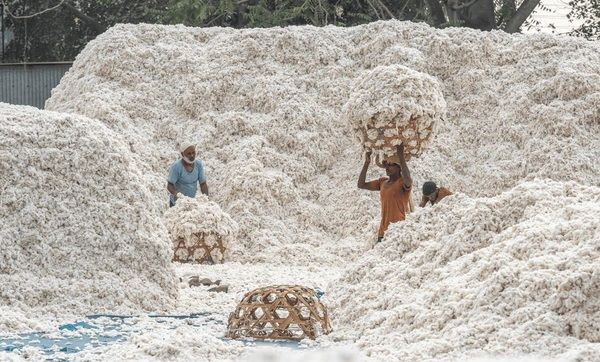
A CCF Group' report estimates, 2021-22 Pakistan cotton planting area may decrease by 11 per cent year on year to 1.974 million hectares, and cotton production may reduce to less than 1 million tons affected by hot weather, drought and pest infestations. As of June 15, cotton planting area in Pakistan declined 16 per cent year on year. The areas in Sindh declined 13 per cent to 533,000 hectares. On June 3, the cotton planting areas in Punjab fell by 11 per cent to 1.305 million hectares. Since the area devoted to cotton has fallen short both of the government’s target and of last year’s recorded level, trade sources are not very optimistic.
The decline in area of plantation has led to a rise in prices of Pakistani spot cotton By July 5 the price has hit a historical new high to be Rs. 12,900 per maund, equivalent to 98.76cent/lb. to be the one of the most expensive cotton in the world. Currently, the market price of cotton is Rs. 4,000-4,500 per maund, and the growers hope the minimum support price of Rs. 6,500 per maund.
Li & Fung to provide digital services for JD.com’s private brand initiatives
As a part of strategic investment made by JD.com in the company in 2020, Hong Kong-based multinational group Li & Fung is now partnering the firm. As per Apparel Resources, the partnership will focus on providing end-to-end digital supply chain management services for JD.com’s private brand initiatives.
Together both companies will create a multi-category collection that includes homeware under the brands ‘Made by JD’ and ‘Best Home’, and also develop a pet product brand ‘Jingmeng’ to capture China’s burgeoning pet care market. The latest partnership will help leverage emerging consumer-to-manufacturer (C2M) business model that enables manufacturers to significantly lessen the time from design to consumer from the industry average of 40 weeks to as little as 2 weeks – thereby helping deliver high-quality, trend-responsive, products to the consumer.
Karnataka invites Kitex Garments to set up projects in state
The government of Karnataka has invited Kitex Garments to set up its new projects in the state. The government is offering the company 25 per cent capital investment subsidy (without cap) on fixed assets like land, building, dormitory, ETP (effluent treatment plant), machinery. Investment subsidy for anchor industries up to Rs 7-10 crore, 5 per cent interest subsidy on term loan for 5 years, concessional registration charges, 100 per cent exemption of stamp duty, 40 per cent grant support for fixed capital investment in factory buildings ft common infrastructure, 50 per cent subsidy on fixed capital investment in CETP ft CSTP up to Rs 5 crore are the major incentives on the capital expenditure side.
Power tariff subsidy up to Rs 2 for 5 years, wage subsidy of up to Rs 1,500 per employee per month for 5 years, 75 per cent reimbursement of ESI & EPF for 5 years, 2.25 per cent of turnover as investment promotion subsidy for 6-10 years for 40-60 per cent Value of Fixed Assets are the incentives on the operational expenses side.
According to Gunjan Krishna, Commissioner for Industrial Development and Director of Industries and Commerce, Government of Karnataka, the positive aspects of setting up business in Karnataka include: Strong existing ecosystem for textiles and garment manufacturing in the state; Multiple financial incentives to create favorable economics for manufacturing activities announced as part of the Textile and Garment Policy 2019-24.
ISKO collaborates with HKRITA for new recycling technology
Premium denim ingredient brand ISKO has signed a licensing agreement with textile research and development company HKRITA to develop the revolutionary Green Machine – a one-of-a-kind technology that fully separates and recycles cotton and polyester blends at scale.
This will help ISKO improve and commercialize recycling technologies which will eventually enable the company to offer a 100 per cent post-consumer recycling solution to all of its customers. In addition, ISKO and HKRITA will work together to develop related technology, strengthening the company’s position as a leader in sustainability.
Fatih Konukoğlu, CEO, ISKO says, the Green Machine uses an innovative and ultra-efficient hydrothermal treatment method that decomposes cotton into cellulose powders and enables the separation of polyester fibres from blended fabrics. The process is a closed loop and uses only water, heat and less than 5 per cent biodegradable green chemicals. Crucially, this method maintains the quality of polyester fibers; the cellulose powders, which are clean and toxic-free, can be used in a variety of ways.
Investment in this new technology is the latest in ISKO’s ongoing drive for advancements in sustainability. As a part of the company’s R-TWO™ program, it is also working to develop fabrics with a guaranteed minimum 50 per cent+ GRS (Global Recycle Standard) recycled content blend. This will significantly reduce the carbon and water footprint of a fabric, as well as make it easy for consumers to trace a garment’s sustainable journey step-by-step from the beginning of the supply chain through to the end product they purchase.
Asian garment factories in crisis as brands resort to wage theft to cut costs

Hong Kong-based leading textile and apparel manufacturer Esquel Group has filed a lawsuit against the US Department of Commerce over the erroneous inclusion of its subsidiary on US Entity List. The lawsuit has been filed in the US District Court for the District of Columbia seeking relief from the economic and reputational harms caused by the placement of its subsidiary - Changji Esquel Textile Co - on the US Entity List, reports Global Times
The listing falsely implicated Changji Esquel in using forced labor in the Xinjiang region, a conclusion that contradicts the facts, including audits by multiple world-class, third-party independent auditors using internationally recognized industry standards such as the SMETA standard, read the statement.
These audits involved site visits to facilities in the region and independent interviews with randomly selected Uygur workers. In every instance, the audits found no evidence of forced labor or coercion. Further, the Changji Esquel facility is highly automated and technologically advanced, and it requires highly skilled workers - the opposite of a business model reliant on underpaid labor, it continued.