FW
Stabilize cotton prices, urges SIMA
Ravi Sam, Chairman, The Southern India Mills’ Association (SIMA) has urged Prime Minister Modi to stabilize cotton prices that have surged to peak levels in the last 11 cotton seasons, especially in the international market. Sam said, the New York Futures Index that used to hover around 70 to 80 cents per pound is now ruling around 110 cents thus creating a panic situation and uncertainties in the business of cotton textiles & clothing products. NYF increased 25 per cent in the last 15 days. Indian cotton prices, though currently attractive due to comfortable closing stock position, have ncreased from Rs 41,900 per candy during December 2020 to Rs 57,000 per candy during the first week of October 2021 (Sankar-6 variety), he added.
India’s 2021-22 cotton season, which started with an opening stock of over 100 lakh bales, is likely to produce around 355 lakh bales, consume around 330 lakh bales, import around 10 lakh bales and thereby leave around 135 lakh bales for export and the carry over stock, Sam explains. India’s exports may exceed 100 lakh bales in the current season due to US sanction on Xinjiang Chinese cotton that accounts 10 per cent of the world cotton production resulting in not only shortage of cotton but also abnormal speculation in the cotton market.
Sam appealed to the Prime Minister to introduce an innovative Cotton Procurement and Trading Scheme for CCI by providing government funding to procure around 15 per cent of the cotton that arrives in the market during the season. This will enable the corporation to create a strategic stock for price stability, sell the cotton only to the actual users in a staggered manner till the end of the season and maintain some buffer stock for the next season, he added.
LVMH fashion and goods division sees 24 per cent rise in sales in Q3
Third quarter sales of French luxury group LVMH's fashion and leather goods division rose strongly even as the group’s overall revenue growth in Asia and the United States eased due to its stellar first-half performance. Sales of LVMH’s fashion and leather goods division rose to 24 per cent during as star labels Louis Vuitton and Dior gave a boost to business. Revenues from the division rose 38 per cent above pre-pandemic levels at the end of the quarter.
The company showed a marked improvement in performance in Europe in the third quarter, even without deep-pocketed visitors from Asia, as local travel resumed over the summer. Revenues from the US grew 28 per cent while those in Asia grew by 12 per cent. The group did not face any supply chain issues given its manufacturing is largely based in Europe and also brushed off concerns about rising shipping costs, noting that the group has sufficient margins to cope.
Overall like-to-like sales rose 20 per cent to £15.51 billion ($17.90 billion) in the three months to September. Jean-Jacques Guiony, Chief Financial Officer, said the company would continue to focus on broadening the appeal of its blockbuster acquisition, US jeweler Tiffany, by refocusing its product assortment and ongoing marketing efforts.
Elleti Group presents ‘Green Replicants’ project at Denim Première Vision
Elleti Group presented its ‘Green Replicants’ project at the Denim Premiere Vision. The leading Italian manufacturer presented ways the industry processes can be re-imagined in a greener way, in the pursuit of its mission to drastically change the environmental impact of the fashion industry.
Inaugurated a few years ago, the ‘Green Replicants’ project recreates some iconic pieces from the Elleti Group Museum of Denim with today’s most advanced environmentally sustainable technologies. This special edition replicas are fully developed in two surprising versions: one using a selection of ultimate green solutions part of Elleti’s specialty technologies – the most important ones being laser, ozone, ice-blasting, nanobubble technology and new, non-harmful chemical products, which are the highest expression of the company’s Earthkeepers project – and one realized with the latest addition to the sustainable tools of the company: the “Wiser Wash” technology, a patented washing method that eliminates the use of all potentially harmful chemicals and pumice stone, while drastically reducing the water consumption throughout the process.
Fimast 2021 to feature entire hosiery supply chain
Italian Exhibition Group’s B2B trade show, Fimast 2021 will feature the entire hosiery supply chain including yarns, production technologies, machinery, services and accessories. Scheduled from October 19-22, 2021, the trade show will feature new products, innovative services and advanced technological solutions.
As per a Knitting Industry report, confirmed exhibitors will include numerous leading companies such as Lonati Group. A world leader in textile machinery sector, the Brescia group will be at the fair with two companies: Lonati, the technological and market leader in the manufacture of hosiery machines that boasts the largest range of systems for the sector on the market, and; Santoni, a global leader in electronic circular machines for seamless garments, which satisfies 95 per cent of the world demand for underwear, sportswear, beachwear, outerwear, medical wear and knitted outerwear.
Cesare Colosio, a Brescia-based company which has been manufacturing socks machinery for 60 years, will showcase innovative and unique machines for the production of 3D inlay footwear. The company has obtained seven different patents on mechanical systems and textile processes to produce the upper, in order to protect its know-how in Italy and abroad
Autotex Italia, a leading producer of ironing machines and industrial packaging machines for the hosiery sector will also be present at the exhibtion. The Borgosatollo based company designs and manufactures a wide range of packaging machines for textile items, as well as components related to the biomedical, cosmetic and automotive sectors. The company offers flexible and customized automation solutions based on customer needs.
The Mantuan Company will present all of its production, from spool yarns of all materials and colors. These will include eco-friendly nylon or polyester yarns from pre-consumer and post-consumer recycling process.
Premiere Vision Paris showcases Autumn/Winter 2022-’23 trends
Held from September 20-24, 2021, the face to face x digital hybrid show Premiere Vision Paris, showcased the Autumn/Winter 2022-’23 fashion trends comprising bright colors, patterns, flamboyant prints and large-scale motifs in the trend areas. The exhibition’s digital market platform showed rows of different knitted swatches in various colorways, several with high proportions of fine wool like 80 per cent wool /20 per cent polyester. Knitted jacquard fabrics and jerseys were seen in grouped collections from Portugal, France and individual mills from Turkey and China.
Classic suit collections were displayed by a good number of luxury British and Italian exhibitors revisiting classics, adding touches of colour and changing the size of checks and designs. Smart Creation, the eco-based section of Premiere Vision, included developments in tracking by testing DNA, one of the advances in this area. In another initiative, HarrisTweed Hebrides and British Wool are partnering to launch authenticated and traceable wool to the market with tech company FibreTrace.
Despite shutting shop, Gap, Benetton continue to inspire future businesses
 Once renowned as ‘category killers’, fashion retailers Gap and Benetton now face an uncertain future with Gap closing all its stores across the UK and Ireland, and Benetton no longer being in demand. However, the brands continue to inspire fashion lovers across the world with their rich history wrote Thomas R Bukley in the article ‘How clothing giant Gap and Benetton once ruled the fashion street’ first published in The Conversation.
Founded in 1969 by Donald Fisher, Gap, from its inception, focused on its target consumer group. The brand aimed to attract college students and the counterculture generation, and opened its first store near the San Francisco State University. Gap initially sold records to attract customers. These were priced moderately and had enough potential to lure customers. The brand is credited with changing the way Americans shopped and dressed. It was instrumental in leading their change from denims to khakis and T-shirts. By redesigning stores, Gap focused on offering a few products at affordable prices at convenient locations. It also adopted new technologies to control inventory which enabled to satisfy customer demand.
Meanwhile Benetton opened multiple stores in local markets during the 1970. This helped the brand generate high sales volume, and manage distribution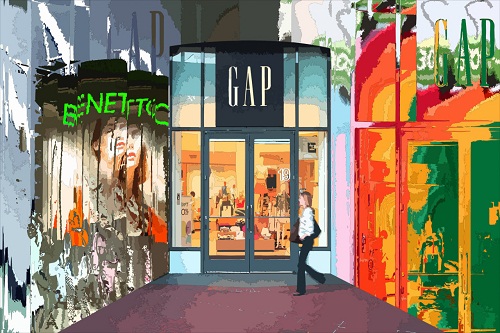 network more efficiently.
Bright colors, tight inventory keys to Benetton’s success
Bukley explains, a key quality that sets Benetton apart from competitors is its bright color palatte. The brand dyes garment at the last minute which helps it to be flexible and make alterations as per demand. Also, Benetton uses a sophisticated mechanism to control inventory and organize suppliers’ network. Most of the brand’s suppliers are located in Northeast Italy which enables it to efficiently plan supplies besides designing and manufacturing clothes as per demand.
Other retailers also tried to emulate Gap’s and Benetton’s strategies. For instance, run by Amancio Ortega, a Spanish clothing manufacturer opened its first Zara store in 1975. It focused on satisfying changing customer demand at speed.
Laying future foundation
Opportunities for retailers to increase Asia sourcing surged with accelerated adoption of new technologies. This also led to the formation of buyer-driven global value chains in the clothing industry. The pioneers of this change were Gap and Benetton who through their focus on convenience and change laid the foundation of future industry. Since then, the power of these two brands has diminished. However, their business approach continues to remain influential.
With rising environmental awareness and e-commerce acceleration, the business acumen of these two companies continues to inspire future generation brands.
Healthcare and military sectors to drive conductive textiles market till 2022
 Largely used in smart textile applications such as sensors, heating textiles and electrostatic discharge clothing, conductive textiles are seeing higher demand with the spread of COVID-19. These textiles basically comprise fabrics woven with metal or carbon that are mostly used in the fitness apparel and healthcare industry.
As per a Textile Focus report, the main purpose of conductive textiles is to shield objects, including humans, against electromagnetic interference. These textiles are made using conductive yarn or coatings. The market for these textiles is expected to witness robust growth from its 2017 valuation of 1.7 billion over the 2017-2022 forecast periods.
Healthcare, military to drive demand
The key factor driving demand for conductive textiles is the rising demand for clothes with sensory biomarkers. Demand for clothes fitted with sensors is rising amongst consumers seeking a physically active life. These clothes are made with conductive textiles to monitor the user’s heart rate, body temperature, etc.
Another sector contributing to the rising demand for global conductive textiles market is the defense sector. Electronic sensors made with conductive textiles are being used in modern military outfits to gain tactical advantage over enemies. Many countries are incorporating these technologies to increase their military capabilities.
North America to lead growth till 2022
Future market for conductive textiles is likely to be dominated by North America which has a steady presence of several innovators in the electronics and semiconductor industry. The North American market for conductive textiles is likely to grow at a 5.5 per cent CAGR between 2017 and 2022. The Europe and Asia Pacific Japan markets are also likely to witness a steady demand for conductive textiles for modernization of their military services.
The others segment is likely to remain the leading contributor to the conductive textiles market through the 2017-2022 forecast period. The segment will account for 25.7 per cent of total conductive textiles market by 2022. Its absolute growth in valuation is expected remain highest over the 2017-2022 forecast period. Future conductive textiles market is likely to be dominated by leading innovators like Bekaert Inc, Seiren Co, Toray Industries, Laird Plc, and Parker Chomerics. The market is likely to see many new innovations leading to increased demand from various application sectors.
SmartX Europe completes three calls to textile startups and SMEs
SmartX Europe has completed three funding calls aimed at textile start-ups and small businesses (SMEs) in the European Union and affiliated countries.
The program aims to build a strong sustainable community to foster interaction and collaboration within the European smart textile industry. It is operated by a consortium of 13 partners across Europe from various industries, including textile manufacturing technology, microelectronics, data processing, and IoT.
25 innovative projects from a total of 50 European SMEs, selected by a committee of external experts from the textile and electronic industries, will receive funding in the amount of 60,000 euro per project and one year of free expert coaching. The remarkable support capacity of 2.4 million euro comes from the European Union’s Horizon 2020 research and innovation programme, under grant agreement No. 824825. The main goal of the ambitious 3-year programme that began in 2019 is to accelerate the development of promising prototypes and their successful introduction to end markets.
The SmartX platform features a virtual showcase room where you can read about the funded projects and their goals, see where they are in the development process, and connect with the start-ups and SMEs who are developing them. The projects are grouped into four categories of health, industrial, protection and sport.
Neonyt Show Director quits Messe Frankfurt
ThimoSchwenzfeier, Show Director, Neonyt, has quit Messe Frankfurt to pursue new professional challenges.
He will be succeeded by Bettina Bär, who has worked in various positions for Messe Frankfurt in the field of consumer goods trade fairs since 2012 and was most recently Show Director of Tendence. Among other things, Bär was jointly responsible for the Ethical Style Guide, whereby sustainable exhibitors at Tendence were separately identified and communicated according to jury decision
As far as Frankfurt Fashion Week is concerned, whose first edition in July 2021 was held in digital form at the FFW Studio due to the pandemic, Dr. Hendrik Müller-Giegler has been responsible as Director Frankfurt Fashion Week since June 2021. He took over this position from RicardaQuehl, who is currently on maternity leave. Müller-Giegler, who has management positions and international marketing expertise in the media and entertainment industry, joined Messe Frankfurt in 2018 as Director Marketing Communications in the Entertainment, Media & Creative Industries business segment.
Also playing a key role in the development of Frankfurt Fashion Week is Claudia Franz, who has extensive experience in the international fashion and textile industry and joined Messe Frankfurt in 2019 as Director Brand Management Interior & Contract Textiles and Apparel Fabrics & Fashion. She is currently supporting the product launch of the new Quality Mainstream fashion fair Val:ue as well as the pre-stage area Apparel Sourcing in Fashion for Frankfurt Fashion Week.
Madeira launches new label and sustainable threads
Madeira is showcasing its commitment to the environment with the launch of Madeira Green and the introduction of two new sustainable threads.
The new label Madeira Green gathers the efforts made by the company with the aim of making the entire embroidery value chain more sustainable.
Madeira Green is the response to a growing demand for eco-friendly products. By introducing two new premium embroidery threads into the portfolio, Madeira underlines its commitment to support resource-saving textile manufacturing.
Available since summer 2021, Polyneon Green and Sensa Green are ideal for use in projects requiring any standard 40 weight thread. Created using processes designed to reduce energy input and water usage, minimise waste and recycle or biodegrade wherever possible, they are the first in a line of truly eco-friendly products with more currently in development.
Made of 100 per cent Tencel Lyocell fibres, Sensa Green is the first Lyocell embroidery thread available in 144 beautiful shades.