FW
Vietnamese delegation explores opportunities in Bangladesh's garment sector
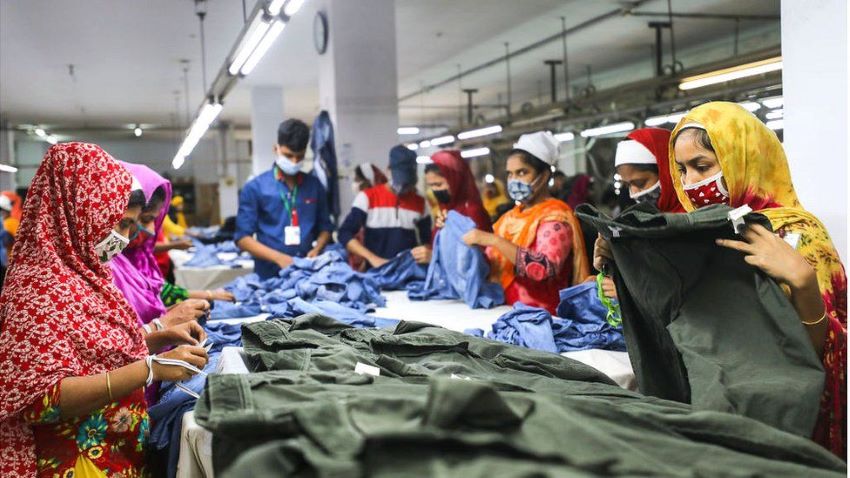
A delegation from Vietnam recently visited Bangladesh to explore business opportunities and potential partnerships in the garment sector.
The aim of the meeting was to promote business-to-business connections and cooperation in the garment sector between the two countries. The discussions covered a range of topics including global apparel business trends, current challenges and potential opportunities for trade and investment. Both sides expressed a willingness to work together to tap into the trade potential between the two countries.
It is observed that Bangladesh and Vietnam are major players in the global apparel market and there is a huge scope for them to complement each other in order to derive two-way trade benefits.
Overall, the meeting was a positive step towards promoting cooperation in the garment sector between the two South Asian countries.
Zara’s sale grows despite store closures, plans to add stores in US
Zara's parent company, Inditex, reported a significant increase in store sales in 2022, despite closing 10% of its stores and shrinking its commercial space by 6%.
Increase in foot traffic contributed to the jump in sales, with sales per square meter now 16 per cent higher than in 2019. Zara, in particular, had a "remarkably strong year," with net sales increasing by 21 per cent compared to the year before.
To continue this growth, Inditex plans to invest 1.6 billion euros in expanding its stores and warehouses, including opening 10 new Zara stores in the US over the next two years and refurbishing or expanding 13 existing locations.
US is a key market for Inditex and has potential to provide a "significant" boost to the retailer's business long-term. Despite the long lines and overcrowded stores that Zara has become known for in the US, customers have continued to flock to the brand.
Inditex is planning to do away with hard security tags and introduce RFID chips sewn into garments to reduce checkout times by 50 per cent.
TikTok popularizes sample sales for fashion brands
TikTok is helping fashion brands tap into Generation Z audiences by using sample sales to clear excess stock and build communities.
Content creators on the platform, such as stylist and content creator Seun Ogunsola, have helped to popularise sample sales by sharing DIY hacks, thrifting tips and sample sale experiences.
The trend has reached beyond its original fashion insider audience, with over 80 million views linked to sample sales on TikTok. The Box, a sample sale platform in London, has seen uplift in younger consumers, including people aged 20 to 25. Brands such as Max Mara and Shrimps have invited influencers to attend their sample sales and share content on social media. Sample sales are also providing useful insights for brands, such as understanding more about customers and identifying which pieces attract younger audiences.
Driven by sustainability, global clothing recycling market led by EU, to reach $16 Bn
The global clothing recycling market is expected to be valued at US$ 5.8 million in 2022, according to Future Market Insights. However, the market is projected to grow at a compound annual growth rate (CAGR) of 10.7 per cent through 2032, reaching an anticipated valuation of US$ 16 billion.
Sustainability is a key trend driving the demand for clothing recycling, as consumers and companies alike become more aware of the environmental impact of fast fashion and the importance of circularity. As a result, companies in the clothing recycling industry are launching awareness campaigns to educate the public about the pollution and landfill waste caused by textile waste.
The retail sector is expected to remain a major revenue-generating channel for the clothing recycling market due to the heavy reliance on textiles within the sector. Additionally, the automotive industry is seen as a promising opportunity for recycled textiles, as aesthetics become a key driver for using recycled materials to reduce overhead costs.
The report also highlights that recycled polyester, known for its durability and strength, is likely to remain the preferred recycled clothing type during the forecast period. Asia Pacific is expected to be the fastest-growing region, while Europe clothing recycling market is likely to hold a share of 26 per cent, the largest at the global level.
India's rupee trade policy gains momentum as Sri Lanka and 7 other countries open special Vostro Accounts
India's policy to facilitate trade in rupees is gaining attention from more countries, as eight countries including Sri Lanka have opened 50 Special Rupee Vostro Accounts (SRVAs) in the last six months.
With this arrangement, Indian importers can make payments in rupees for their imports from the partner country, which will be deposited in the concerned country's bank's vostro account. Based on the payment, the partner country's supplier will receive payment in their local currency. The deposited amount in the vostro account will be utilized for imports by the partner from India, which will reduce the demand for US dollars, ensuring that the currencies of India and its partner countries do not face downward pressure.
Sri Lanka, one of the eight nations with vostro accounts in India, will have better access to the Indian market once trade in Indian rupees commences. This is particularly beneficial for Sri Lanka, which recently faced an economic crisis and did not have enough foreign currency to import essential goods. This shortage had a major impact on the country's garment industry, which heavily depends on fabric supplies from India and other neighboring countries.
In the second half of last year, Sri Lanka's fabric imports from India decreased to $256.266 million compared to imports of $336.994 million in the first half of 2022 and $307.430 million in the second half of 2021. However, imports increased to $593.261 million in 2022 compared to $565.848 million in 2021. In 2020, Sri Lanka imported fabric worth $410.881 million, $485.160 million in 2019, $426.046 million in 2018, and $374.214 million in 2017.
The trade facilitation in rupees will enable Sri Lanka to overcome its foreign currency shortages, especially for its garment industry, which is a major contributor to the country's economy. It will also improve the trade relationship between India and Sri Lanka, providing more opportunities for bilateral trade and economic cooperation.
H&M US launches resale scheme in partnership with ThredUp
H&M US has partnered with ThredUp to launch its first-ever resale scheme for the US market, known as "H&M Pre-Loved".
The collaboration will enable the retailer to promote circularity and encourage customers to access pre-owned pieces in good condition through ThredUp's Resale-as-a-Service (RaaS) programme.
H&M aims to promote circularity by dismantling linear business models, which are the norm in the fashion industry. The company intends to extend the lifespan of products by introducing a circular business model.
H&M has taken several initiatives towards this goal, including its garment collecting program, launched in 2013, and its digital hub, called "H&M Take Care," which educates consumers on how to care for their garments to prolong their wear time.
In 2019, the company became the majority owner of Sellpy, a second-hand retail platform that has grown rapidly in recent years.
Coats opens state-of-the-art Sustainability Hub in India
Coats, the global leader in thread and structural components for apparel and footwear, has opened a new Sustainability Hub in Madurai, India.
The state-of-the-art spinning and twisting pilot plant will further the company’s sustainability commitment and help achieve its new targets for 2026. Over the past four years, Coats has made significant progress in the areas of energy, materials, water, waste, and people. Emissions reduction across the company’s entire value chain is at the heart of the new targets.
The Madurai hub will work with the Coats Sustainability Hub in Shenzhen, China to accelerate the transition to recycled and renewable materials. The two hubs will innovate new generation materials for sustainable sewing threads for apparel, footwear, and performance materials. The Sustainability Hub in Madurai will also support customers and other stakeholders in creating sustainability in the industry.
The new facility is part of Coats’ $10 million investment over the next five years in scaling up the development of green technologies and materials to achieve its ambitious sustainability targets.
The new spinning and twisting pilot facility is located in the heritage site of Coats in Madurai and covers 10,000 square feet, with the infrastructure to process multiple fibers, blends, and high-performance fibers like aramids.
YKK recognized as "Supplier Engagement Leader" for reducing greenhouse gas emissions
YKK Corporation, a global leader in fastening solutions, has been recognized as a “Supplier Engagement Leader” by the international environmental non-profit, CDP, for its efforts to reduce greenhouse gas emissions throughout its supply chain.
YKK’s recognition places the company in the top 8% of companies evaluated for supplier outreach on climate change. The annual Supplier Engagement Rating (SER) by CDP assesses how effectively companies engage with their suppliers on climate change issues. YKK’s governance, targets, and initiatives to collaborate with suppliers to reduce greenhouse gas emissions, aimed at reducing greenhouse gas emissions throughout the YKK supply chain, all contributed to the company’s recognition as a “Supplier Engagement Leader.”
Asako Yoshioka, Vice President, Sustainability Department, YKK Corporation, said, “We aim to replicate this in the next fiscal year and beyond by continuing to promote sustainability through our business activities, products, and technologies with the goal of solving climate change and other societal issues and helping realize a healthy global environment.”
YKK’s sustainability goal is to achieve climate neutrality by 2050.
'Indian Handicrafts and Gifts Fair' witnesses overwhelming response from 110 countries
The 55th edition of the Export Promotion Council for Handicrafts’ ‘Indian Handicrafts and Gifts Fair’ kicked off on March 15th at the India Expo Centre & Mart in New Delhi.
The fair is witnessing an overwhelming response from buyers from 110 countries, making it one of the largest and most prestigious trade fairs in the country.
The event was inaugurated by Union Minister of State for Textiles and Railways, Darshana V Jardosh, and is spread across 16 halls showcasing a range of accessories, homeware, handicrafts, and other products from different parts of India. The fair is an opportunity for Indian exporters to showcase their unique products and craftsmanship to the world.
EPCH chairman, Raj Kumar Malhotra, called the event a testament to the entrepreneurial spirit and creativity of their member exporters who have been promoting Indian handicrafts to the world for nearly three decades.
The IHGF is designed to act as a global platform for the Indian handicrafts sector to promote exports and boost international business. Exhibitors can network with international buyers to expand their distribution networks across the world while forecasting trends in the industry.
The fair promises to be a significant step towards a more vibrant and robust handicrafts sector in India.
Lucky Brand collaborates with Laura Ashley for limited edition women's fashion collection
Lucky Brand, the denim and lifestyle brand, has teamed up with Laura Ashley, a quintessential British-inspired style and iconic floral print brand, to create a limited-edition women's fashion collection.
The collection celebrates self-expression for a new era while staying true to the hallmark styles of both brands. The 15-piece collection features a range of pieces, including jeans, dresses, shirting, shorts, and jackets, embellished with patchwork, embroidery, and floral patterns.
The collaboration highlights the best of both brands, bringing together Laura Ashley's iconic British designs and Lucky Brand's classic American style. The festival-ready denim corset lined with a pink floral print, mid-rise distressed denim boy shorts, and loose jeans set the tone for the denim offerings. The collection also includes spring-ready white denim shortalls with embroidered blue florals and two workwear-inspired sleeveless coverall shorts in charming floral prints pulled from the Laura Ashley archives.
The standout piece in the collection is the coordinating trucker jacket and jeans adorned with faded floral accents, perfect for seasonal transitional dressing. The collection also features a romantic floral midi dress and jumpsuit, two boyfriend-style relaxed button-down shirts with floral patches, and a pair of floral corset blouses. The tiered baby-doll dress featuring complimentary prints rounds out the collection.