


FW
GartexTexprocess India to take the hybrid route
GartexTexprocess India will be the first textile sector exhibition to take the hybrid route. Scheduled alongside Messe Frankfurt’s Screen Print India fair, both Mumbai and Delhi editions aim to bring the entire textile value chain together through their new co-located and hybrid formats.
A year after textile and printing sectors were hit by unprecedented business challenges, the much-awaited Mumbai edition is set to bring industry players face-to-face with new opportunities from 18 – 20 March at the Bombay Exhibition Centre. However, with the on-going travel restrictions that are still in place globally, the new-age multimodal exhibition will allow screen printing and textile sector exhibitors and visitors to take full advantage of both physical interactions and virtual networking opportunities.
The hybrid format for both the fairs are being specially curated by the organisers with live product demonstration features to allow exhibitors to showcase their innovations and new product range to buyers who may be unable to attend the physical fair, thus ensuring dual access to trade opportunities.
In order to keep the trade momentum going in the second half of the buying calendar, the organizers have also confirmed that the New Delhi edition of the co-located fairs will now be rescheduled to August 06 –08, 2021 with its new hybrid format.
Both Mumbai and Delhi editions will allow fair goers to explore a wide range of features like targeted business matchmaking, real-time video calling, scheduling meetings in advance, live knowledge sessions through the digital platform alongside the traditional physical event.
GOTS obtains evidence against organic cotton fraud in India
Through its own investigation, GOTS has finally obtained substantial documentary evidence confirming rumours about systematic fraud abusing Indian government certification system of organic cotton production. During surveillance audits by GOTS accreditation body IOAS attended by GOTS experts, they detected fake raw cotton transaction certificates (TCs).
These TCs had been created by fraudsters using APEDA (Agricultural and Processed Food Products Export Development Authority of the Indian Government) templates with fake QR codes which led to a cloned APEDA website to pretend the TCs were authentic. GOTS has assured knowledge of 20.000 metric tons fake material.
GOTS reported that it accepts raw organic cotton if it is certified to any of the IFOAM Family of Standards. In India, the nodal agency to certify organic raw cotton for export is APEDA. Their system is similar to GOTS’, where TCs are issued by their Certification Bodies (CBs) and carry information about certified produce (volume, transport details, buyer, seller, etc.).
GOTS has instructed its’ approved CBs to cancel all upstream TCs issued based on wrongly issued TCs in order to prevent affected goods being sold with GOTS labels. A certification ban (CB) on 11 companies was imposed and the contract with one approved CB was terminated. GOTS has submitted all facts to APEDA urging investigation, criminal prosecution and improvement. All GOTS certified organisations have been informed on the matter and are being provided guidance accordingly.
India to be the next global e-commerce market
 Proving to be the black swan event, COVID-19 has given a massive fillip to the e-commerce sector in India. Reports suggest, the Indian e-commerce market contributes roughly about 4 per cent to the GDP. It is a fast evolving trend that has encouraged many foreign businesses to expand operations in India. The sector has also created job opportunities in the process, SMEs, agricultural enterprises, finance, banking, fashion, beauty, marketing and advertising, FMCGs, general merchandise, trade, health and education segments. It has revealed decades worth digitization trends in a short span of time.
E-commerce giants eye rural India, small towns
India’s e-com ambitions are depicted through prominent collaborative initiatives like the Atal Innovation Mission (AIM), the NITI Aayog joining CGI India and Tata Group talks with Big Basket for a 20 per cent stake. To enhance earnings for the festive season, both online and offline retail businesses have started collaborating with each other. They plan to make offline purchases more cost-effective, time-bound and disciplined.
To explore these opportunities, e-commerce giants have started eyeing rural India and small towns. The Indian banking sector has started using emerging technologies like Artificial Intelligence (AI) and Machine Learning (ML) for corporate loans, for productive lending. Lending to MSMEs remained stagnant for the last so many years but now, banks are likely to develop models to actively support MSMEs, thereby also improving their own balance-sheets.
A multi-crore business opportunity
India’s craze for online gaming has transformed into a multi-crore business with Indians of all ages turning into gamers. The Indian gaming industry is flourishing with celebrity endorsements, regional language interfaces and sponsorship money. However the industry faces a few formidable challenges like the constant fear of cyberwarfare and issues related to data privacy. Another challenge is the massive power outage in India's financial capital which impacts many businesses across sectors like information technology, banking and financial services and fin-tech sectors.
The industry also needs to meet divergent views brewing over a spectrum band between Telcos and tech companies. The government recently reprimanded Amazon and Flipkart for not displaying the country of origin of some of the products sold on their platforms, threatening action if they did not explain themselves within 15 days.
Regulatory hurdles
Other challenges include complying to regulatory hurdles with different digital platforms requiring distinct regulations; a group of Indian startups planning to move the Competition Commission of India against the company; global digital tax war metamorphosing into a trade war that could potentially slash global GDP every year.
OECD’s postponment of a common tax framework may lead to Google, Facebook, Amazon, LinkedIn and Netflix facing a larger domestic tax liability, a move that will allow countries like India to have their own plans of taxing the digital giants.
Indian e-commerce advantage
Thus, India can be global data and investment hub for the e-commerce sector. The country offers many benefits for e-commerce businesses like a growing demand, attractive opportunities, policy support, increasing investments and the competitive advantage of developing special skill sets for this sector.
Therefore, the government, industry and research bodies need to create a strong network and sustainable bandwidth. The success of e-commerce is dependent on many variables, like adequate customer support, multi-channel marketing and user-friendly platforms. Users should have appropriate devices, uninterrupted power supply and strong network connectivity.
Millennial to drive American retail recovery post lockdown
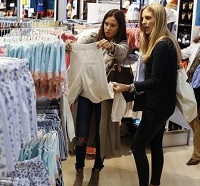 The pandemic proved to be the final blow for the already-ailing apparel sector. Hit by declining sales, the sector saw shoppers buying apparels more through e-commerce and less through bricks-and-mortar stores. As a Coresight Research report suggests, 55 per cent shoppers avoided visiting malls in early September. However, US shoppers are gradually returning to stores. Till October 6 there was a 3.7 percentage point rise in the number of apparel store shoppers, says a Apparel Resources report.
However, this gain was offset by a 1.7 percentage-point decline in the number of people purchasing apparels through digital platforms during the same period. Coresight Research further estimates consumer spending on apparels, through bricks-and-mortar stores, e-commerce or any other platform, will slump 13.2 per cent this year. However, this year, shoppers plan to start their holiday shopping early. Though their total expenditure on apparels is expected to fall, there might be some improvement in the last quarter.
Enticing shoppers with holiday season sales
A survey conducted by First Insight in May indicated 54 per cent of American shoppers were keen to buy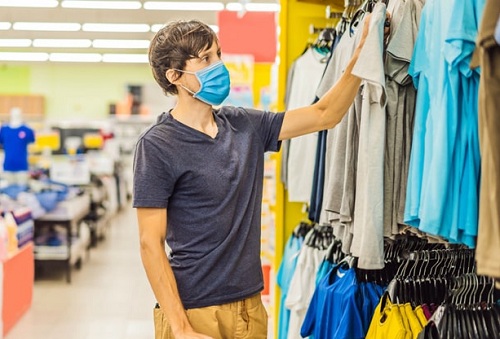 apparels from a store. The most enthusiastic shoppers were the millennials, 80 per cent of whom voted for restricting the number of people within stores while 79 per cent said wearing face masks would make them feel better and safe. Coresight Research survey confirms people’s willingness to shop for apparels, casualwear or apparels to be gifted.
To entice these shoppers, retailers are launching holiday shopping sales. Amazon launched its Prime Day sales this month while Walmart increased the inventory of athleisure, loungewear and sleepwear in October The retailer also recently launched a private clothing label ‘Free Assembly’ to catch the attention of shoppers. Similarly, Banana Republic announced a 50 per cent discount on most of its apparel products, while Old Navy launched the ‘Giftober’ scheme which offered 50 per cent discount on all its offerings.
Shopping expenditure to slump
As retailers continue to entice shoppers with new schemes, consumers’ response so far has been sluggish. As per a Deloitte survey, shoppers’ expenditure is expected to slump by 7 per cent Y-o-Y to $ 1,387 per household. Shoppers intend to visit just 5.2 retail stores on average during this holiday season. But as restrictions ease and offices reopen, there could be a surge in formalwear and partywear. A recent NPD survey shows, 27 per cent of men plan to dress more casually after the pandemic, compared to 16 per cent of women.
Shawn Grain Carter, Professor - Fashion Business Management, Fashion Institute of Technology and Tom Ott, Founder, Retail and Fashion Solutions believe though pent-up demand could increase clothing sales during the holidays, retailers and brands should focus on secondhand shoppers or those interested in renting their clothes. Ultimately, it is the consumer psyche that will determine the future course for the apparel market.
The Netherlands signs new denim agreement to strengthen circular economy
The Netherlands has taken a step forward in strengthening circular economy concept in denim industry.
Stientje Van Veldhoven, the country’s Minister for Environment and Housing, and State Secretary for Infrastructure and Water Management, recently signed an agreement with 30 companies in denim industry, committing more sustainable and eco-friendly environment.
In a letter submitted to the parliament, Van Veldhoven stated that the agreement emphasises on the use of more recycled materials in denim products.
She said that total emissions in the global textile industry are more than the collective emissions from maritime and aviation industry. It takes around 8 thousand litres of water to develop one pair of jeans and that needs to be reduced, drastically.
The new denim agreement will push brands such as MUD Jeans, Scotch & Soda and Kuyichi to jointly produce 3 million denim garments by using at least 20 per cent textiles that is recycled.
According to Van Veldhoven, the main strength of this denim deal is that it involves all major companies in supply chain who are hugely involved in manufacturing and processing of denim garments.
Penn Italia, Tessitura, ElasticiBesana launch new collection
Penn Textile Solutions/Penn Italia, internatiPonal company producing and developing innovative fabrics through warp and weft knitting technologies, Tessitura Colombo Antonio, famous for the processing of lace and ribbons dedicated to the world of corsetry, ElasticiBesana specialized in the production of narrow elastic for corsetry and underwear, have launched an innovative collection made with sustainable manufacturing process and a new set of incredible eco high tech innovations delivering a responsibility concept including also the end of life
Known as Eco connection, the collection, which underlines the importance of connect and come together for a sustainable project, features seven advanced knitted stretch fabrics by Penn Textile Solutions/Penn Italia, three precious laces by Tessitura Colombo Antonio and three functional bands by ElasticiBesana The collection is presented in its BIO -BOX that will be sent to selected brands at worldwide level.
More US fashion companies to use USMCA for apparel sourcing in 2020: Survey
According to a 2020 USFIA Fashion Industry Benchmarking study, more US fashion companies have agreed use the US-Mexico-Canada Trade Agreement (USMCA) for apparel sourcing purposes in 2020 than a year ago. For companies that were already using NAFTA for sourcing, 77.8 percent say they are ready to achieve any USMCA benefits immediately, up more than 31 percent from 2019.
Even for respondents who were not using NAFTA or sourcing from the region, about half of them this year say they may consider North American sourcing in the future and explore the USMCA benefits.
Nevertheless, when asked about the potential impact of USMCA on companies’ apparel sourcing practices, some respondents expressed concerns about the rules of origin changes. These worries seem to concentrate on denim products in particular.
It also remains to be seen whether USMCA will boost ‘Made in the USA’ fibers, yarns, and fabrics by limiting the use of non-USMCA textile inputs. For example, while the new agreement expands the Tariff Preference Level (TPL) for U.S. cotton/man-made fiber apparel exports to Canada (typically with a 100 percent utilization rate), these apparel products are NOT required to use U.S.-made yarns and fabrics.
Myanmar urges raw material producers to invest in garment factories
Myanmar is urging raw material producing factories such as buttons and thread manufacturers to invest in Myanmar, said U Aye Thaung, Chairperson, Shwe Lin Pan Industrial Zone.
Currently, garment manufacturing in Myanmar is carried out in a cut-make-pack style, where fabrics and accessories are imported and then cut, sewn and styled. The finished products are packed for exports to big fashion brands overseas.
Myanmar's garment exports have declined by more than $60 million in fiscal 2019-20 compared to the previous year and will continue to be under pressure in the current fiscal year, said U KhinMaungLwin, Assistant Secretary,Ministry of Commerce.
The sector first started facing difficulties when the supply of Chinese raw materials needed for garment manufacturing began to face disruptions. Meanwhile, order cancellations from major importers like Europe also affected production. That culminated in factory closures, job losses and declines in export revenue.
Around 70 percent of Myanmar-made garments are exported to Europe, while the remaining is sent to Japan, Korea, the US and China.
Since the pandemic started, operations at around 500 garment factories in Myanmar have been seriously affected. Meanwhile, those that reopened are only able to employ a third to half of their workforce due to COVID-19 risks and restrictions, said Thaung.
He added that most factories have not received any new orders in recent months and since the second wave of the virus started in Myanmar in September, the factories which have been permitted to reopen are working on older orders.
The factories that produce shoes and bags are facing the most difficulties, U Aye Thaung said. Things have deteriorated further since the recent lockdown in Yangon, under which all factories were instructed to close for two weeks. Many orders were forfeit during this period.
Mimaki showcases new textile printers at Innovate Textile & Apparel
Visitors browsing Mimaki Europe’s interactive virtual booth at Innovate Textile & Apparel Virtual Trade Show can see the best-selling dye-sublimation printer TS55-1800 and the new hybrid printer TX300P-1800 MkII in action. Both printers offer cost-effective innovative textile technology. Visitors will also be able to take advantage of some special promotions; including a special deal for the TS300P-1800 and a chance to win the Mimaki TS30-1300 entry-level sublimation printer. They will also be able to hold one-on-one discussions on the latest market trends and solutions to meet current demands.
Dye sublimation is a breakout technology in textile printing, allowing high quality, vivid prints on a multitude of fabrics, such as polyester or elastane, all on-demand. Mimaki’s TS55-1800 combines this ground-breaking technology with Mimaki’s renowned expertise and innovation. The printer offers industrial scale production and incorporates Mimaki’s core technologies; such as NCU (Nozzle Check System) and NRS (Nozzle Recovery System), nozzle control and restoration systems; that ensure automatic detection and replacement of clogged nozzles without interrupting production.
Additionally, MAPS (Mimaki Advanced Pass system), a system created to prevent banding; uses a special algorithm at each print pass and calculates the most effective way to jet the ink droplets according to colour, coverage and speed. Available with the Mini Jumbo Roll option that can help save up to 25% on paper costs and a 10L bulk ink system; the Mimaki TS55-1800 offers the lowest running cost in the market; and is the ideal production model for small- to medium-sized companies. At Innovate Textile & Apparel Trade Show, Mimaki will launch a special promotion for this printer, making it even more appealing to those companies looking to diversify their business during these challenging times.
Indonesia’s textile exports to Turkey decline
Indonesia is seeing a steep decline in textile exports to Turkey due to the additional duties and the coronavirus pandemic’s effect on global trade.
In the January–August period, Indonesian textile exports to Turkey declined by nearly 50 percent year-on-year (yoy) at $168.9 million, said MarthinKalit, secretary of the foreign trade director general at the Indonesian Trade Ministry
Indonesia’s overall textile exports reached only $7.03 billion over the same period, marking an annual decline of 19.92 percent.
The decline in Indonesia’s textile exports to Turkey come at a time when both countries are dealing with the COVID-19 pandemic. The World Trade Organization expects global trade to decline by between 13 and 32 percent this year as a result of the pandemic.
To keep its domestic industries afloat amid the economic downturn, Turkey introduced in April additional duties of 4 to 50 percent on textile products imported from countries with which it has no trade agreements. The duties are to remain in place until the end of the year.










