FW
The Fashion Meet-Expo’22 commences in Gurugram
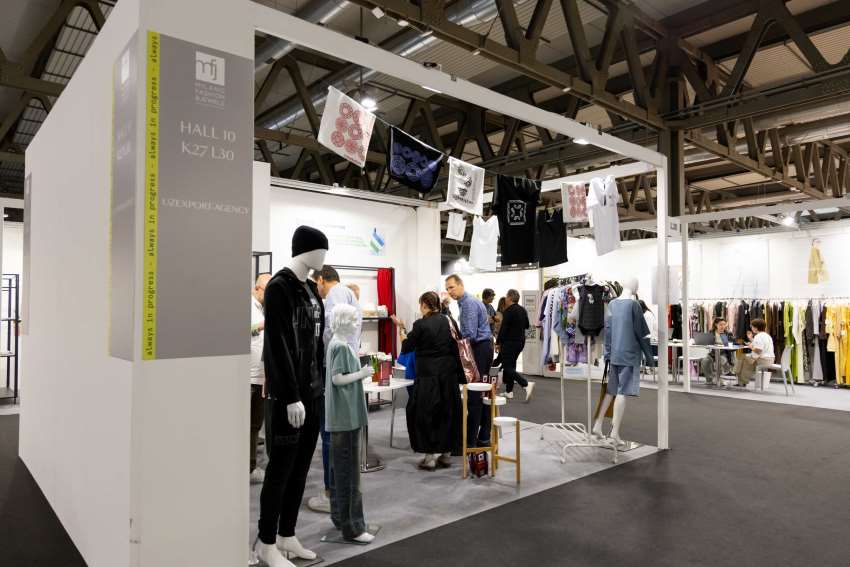
Hosted by the Top Fashion Export Council under AEPC - BAA - NAEC in collaboration with Sowtex, The Fashion Meet- Expo ’22 commenced at the Apparel House in Gurugram. The first day of the event witnessed a grand inauguration by the Chief Guest, DarshanaJardosh, Minister of State for Textiles & Railways, Trade commissioners from Australia & Canada along Top Apparel Exporters, Buying fraternity. Over 200 top fashion buyers, exporters & manufacturers of Delhi, NCR attended the event. The second day showcased a Startup Fashion Show and also had industry experts highlight the importance of digitizing the textile eco-system & fast tracking design development process to optimize India Textile recent FTA's with partner countries and achieve GOI’s target of $100 Bn fashion & Textile Exports by 2030.
The show displayed the widest collection of sustainable andinnovative fabrics n from different mills of India under one roof. The Fashion Meet had live discussions between AEPC, participating Mills on ‘Conceptualisation of Design Studio’ at Apparel House, along with the display of ‘Physical & Virtual Fabric Collection.’ Some other noteworthy topic of discussion by industry experts were on ‘Fast tracking the Design Development Process,’ ‘Stitching the Value Chain with Sustainability & Traceability,’ ‘Quick & Easy Ways to Build Fashion Exports.’
The event featured 50 fabric mills, processors, trims manufactures BS fashion technology companies from India showcasing latest collections along with trends, materials, technology. This collaboration aimed to strengthen engagement through Meet-up space between buyers and sellers of the textile ecosystem.
Sri Lanka’s crisis causes diversion of apparel orders to India
The financial crisis in Sri Lanka is leading to a diversion of many apparel orders from UK, EU, and Latin America to India,
Fuel deficiencies in the midst of its most horrendously awful monetary emergency and following power cuts are upsetting the development of key products in Sri Lanka. For example, much of the garment orders have proactively begun moving to India and presently a comparative pattern is being seen in the materials areaparticularly as India and Sri Lanka produce comparative sorts of clothing and articles of clothing.
However, Sri Lanka’s apparelgetduty-free access to different nations, in contrast to Indian products. Sri Lankan exporters are also attempting to keep their material area safeguarded in spite of the emergency,, says A. Sakthivel, Head, Indian Export Organizations (FIEO).
Sakthivel added that exporters have started getting inquiries from a few European nations. NarendraGoenka, Director, AEPC agreed that India can arise as alternative to Sri Lankan clothing as it can create most of similar items at lower cost.
First Stoll Days planned from June 07-10, 2022
The first Stoll Days for customers and other interested parties will be held from June 07 -10, 2022 in the new TexLab at Karl Mayer North America, in Greensboro, NC
During the event, customers and other business partners will get acquainted with the Stoll team, and the fully equipped TexLab, with the latest Stoll machines, other equipment to develop knitted products and multiple collaboration and training areas. For the event, Stoll prepared an exciting program to inspire the innovativeness of customers and others that are interested in the use of flat knitting technology in their products.
Highlights of the event include various Stoll machines in action, including a few models that were not shown before, seminars and workshops to introduce new design and programming software, and many inspiring knitted products for fashion and for technical textile markets. The event will also witness a presence of some yarn suppliers and other industry partners.
Saritoria adds more luxury brands to platform
Customer-to-customer platform Saritoria is adding more luxury brands to its preloved selection, with a focus on bridal wear as it aims to promote sustainable fashion in India.
Saritoria is expanding its preloved product selection and has launched a bridal wear segment to promote second hand fashion to brides-to-be. The business has also launched a series on its Facebook and Instagram platforms which recreates recent celebrity red carpet looks using preloved pieces available on its platform. The business also shares info graphics on different ways to shop fashion sustainably to promote its ethics in a wider context. By focusing on creating a community of shoppers, Saritoria aims to increase engagement with its platform and build brand loyalty.
ShehlinaSoomro founded Saritoria in July, 2021 along with fashion entrepreneur and designer Pernia Qureshi. The platform specializes in luxury labels and features clothing and accessories by brands including Anushree Reddy, RohitBal and SuneetVerma, etc
Klopman promotes innovative circular economy project in Europe
A European producer of workwear fabrics, Klopman is promoting an innovative circular economy project that aims to achieve significant energy savings and localize the supply chain in Europe.
Renaissance Textile, together with its partners, including Klopman and TDV Industries, aims to conclude an agreement with its clients to receive and recycle their clothes at the end of their first life cycle. This will allow the production of new fabrics, made with an increasing amount of recycled fiber, which can be put back on the market. A key part of the process is the advanced technology of the company’s 12,000 sq m ndustrial building in Laval, France, where garments are grouped, sorted, and then transformed into raw material ready to be trimmed and woven.
The project has set several targets for 2024, the most significant of which are an expansion to three fabric fraying lines and a target to recycle 3,000 to 9,000 tons of fabric by 2024. All this will translate into an estimated saving of 430,000 tons of CO2 by 2026, equivalent to the planting of about 57 million trees.
Haelixa participates in UN-supported project in Peru
To give sustainable rural cotton producers in Peru more visibility in the textile value chain, Zurich-based Haelixa is participating in a pilot project launched by the United Nations in collaboration with the Costach cooperative and textile company Creditex.
As per a Knitting Industry report, the initiative is jointly implemented with the International Trade Centre (ITC) and financially supported by the European Union.
With the additional support of the +Cotton Project, implemented by the Food and Agriculture Organization of the United Nations (FAO) and the Brazilian Cooperation Agency (ABC), a pilot is being realized to mark and trace the finest Pima cotton for Creditex directly at its gin in Piura, Peru.
The Haelixa technology ensures that the information about the product origin and the journey of the product along the value chain is always safely embedded into the product itself. The marked cotton will be used to make exclusive fabrics for luxury California sleepwear brand Cat’s Pajamas.
Eight new companies join CanopyStyle initiative
Eight new companies from across the globe have joined the CanopyStyle initiative to keep Ancient and Endangered Forests out of the viscose supply chain and help conserve the world’s most vital forests, biodiversity, and climate.
From Shein, to Hanky Panky and ocean+main in the US, River Island and AllSaints in the UK, and Kmart Australia and Boody in Australia, these far-reaching fashion companies are uniting with the 478 brands already signed on to CanopyStyle to save forests. CanopyStyle is a collaborative initiative dedicated to transforming viscose supply chains away from sourcing from forests and accelerating the production of low-carbon, Next Generation Solutions like recycled-textile or agricultural residue derived viscose.
The majority of these brands have also joined Pack4Good, Canopy’s initiative to make sure they are implementing smart packaging design and using the most eco-friendly paper packaging.
Canopy is a solutions-driven not-for-profit environmental organization dedicated to protecting forests, species, and climate. The organization is committed to working together to guide businesses to better, more sustainable practices.
Denim Premiere Vision to showcase F/W 2023/24 collections by 80 exhibitors
Denim focused show Denim Premiere Vision will present more than 80 exhibitors showcasing their F/W 2023/2024 collections and technical innovations at its first physical show post pandemic on May 17-18, 2022 iin the Arena Berlin.
Countries participating in the show will include, Pakistan, India, China and Japan Exhibitors will include Advance Denim, AkkusTekstil, Azgard9, BertoIndustriaTessile, Bossa, Calik, Iskur Denim, Island Denim, Kassim, Kilim, Komet Metal, Kurabo, Kuroki, Maritas, Naveena, NDL, Orta, Pacific Jeans, Panama Trimmings, Polsan Button, Prosperity Textile, Rajby, Sharabati Denim and Soorty.”
The show will also have certain new participants like Square Denim from Bangladesh, and others returning to the show, like, for instance, Isko, that hasn’t participated in any trade show since 2016, and Isko Luxury Isko by PG, a new collaboration project between Isko and denim designer Paolo Gnutti, debuting at Denim PV as a worldwide premiere.
The show will launch a new initiative - “PV Denim Fashion District” - showcasing a select group of 11 brands and designers presenting pieces they developed together with show exhibitors, including items which will be part of their collections for next season.
The show’s other initiatives will include a conference on May 17, organized as a partnership with TextilWirtschaft magazine. Among participants there will be the weaver Naveena Denim (NDL) and the brand Tom Tailor from Hamburg, Germany, discussing their latest joint development, a jeans line made from hemp. Moderating the conference will be Maria Cristina Pavarini, senior features editor international, The SPIN OFF/TextilWirtschaft.
Along with digital and physical trend seminars, the show will also host two Digital Denim Smart Talks to review the sector’s ecological progress and innovations in terms of sustainable materials.
Coloreel grants new order for printing services to Snuggle
Coloreel has granted a new order for printing services to Snuggle, one of UK's leading and largest DTG print fulfillment companies based in Peterborough. Coloreel is a Swedish textile innovation brand with a groundbreaking technology for embroidery that enables high-quality coloring of textile thread on demand, unlocking a world of potential.
The brand uses its technology to both preserve the craftsmanship of embroidery and take embroidery to the next level. The unique solution makes previously complicated designs accessible, including gradients, textures and other stunning effects. Using only a single thread and needle means that it also significantly improves quality and efficiency, enabling immediate start up and faster delivery. In short, Coloreel empowers creativity and enhances quality and efficiency, making the ordinary extraordinary. In the future, the technology can also be used for sewing, knitting, weaving and more.
Coloreel is also part of the movement to reduce waste and move the textile industry towards more sustainable production. By coloring the thread directly, there is no wastewater, hence no water pollution. And, using a single reel of thread and needle also means minimized thread waste and minimized microfiber pollution.
Snuggle is one of the UK's leading & largest DTG print fulfilment companies. Since launching in 2011 Snuggle has offered its services to businesses large and small across a wide spectrum of industries. By focusing on service, quality and turnaround times for the trade they have enabled DTG to be embraced by a multitude of companies. Launching with UV printing they now offer Direct To Garment, Sublimation & Embroidery services for print on demand sellers as well as to the industry, a core part of their mission is offering a sustainable, eco friendly print on demand fulfillment service
Archorma to produce Stony Creek’s plant-based pre-reduced indigo
Global leader in specialty chemicals towards sustainable solutions, Archromaand Stony Creek Colors, a trusted manufacturer of traceable natural indigo dyes, have entered into a strategic partnership to produce Stony Creek’s IndiGold™ high-performance plant-based pre-reduced indigo at scale.
Stony Creek Colors developed the new IndiGold™ concept as the world’s first pre-reduced natural indigo dye, which was then developed with Archroma to offer the first ever plant-based alternative to synthetic pre-reduced indigo. The dyestuff will be sold as a 20 per cent concentration in a soluble liquid form that displays similar performance to comparable synthetic indigo products available on the market.
Stony Creek Colors evolved into an innovative leader in plant-based indigo due to its complete development of an improved agricultural value chain, from seed breeding and production to biomass harvest and extraction. The company has been selling its US grown indigo to denim mills since 2015.
The pre-reduced plant-based indigo partnership took root in 2020 when Stony Creek was looking to work with like-minded partners to produce the new dyestuff at scale. Archroma emerged as the ideal partner as the company is well known for its expertise in indigo manufacturing and application, as well as for its commitment to transform the denim industry towards creating better blue jeans.