FW
Karl Mayer happy with visitor turnout at ITMA-2019
"Karl Mayer’s diverse exhibition area at ITMA 2019 soon became the industry’s favourite meeting point as nearly 1,000 visitors visited the company’s stand during the first four days of the exhibition. International visitors were impressed by the modern design of the stand and by the concept behind its presentation. The company invited visitors to embark on a voyage of discovery through the textile world of tomorrow."
 Karl Mayer’s diverse exhibition area at ITMA 2019 soon became the industry’s favourite meeting point as nearly 1,000 visitors visited the company’s stand during the first four days of the exhibition. International visitors were impressed by the modern design of the stand and by the concept behind its presentation. The company invited visitors to embark on a voyage of discovery through the textile world of tomorrow.
Karl Mayer’s stand at ITMA 2019 focused on the Future of Textiles. Discussions with clients and guests revealed that its concept focusing on innovative textile application in addition to its machine innovations, has been successful. The textile world of experience offers inspiration for innovative application developments and thus approaches for new business opportunities.
The machine show impresses by highly efficient complete solutions for a production which will give the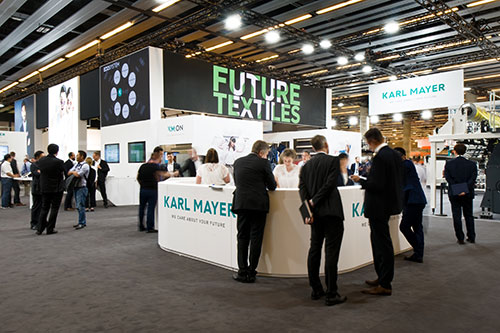 customers an important competitive edge also in the long term: flexible, trendsetting machines with excellent cost:benefit ratios for use in warp knitting, innovations in warp sampling and direct warping for the warp preparation sector, a completely new machine for composite materials. The machines are the subject of many specific project discussions and requests.
Customer’s interest is also high in Karl Mayer’s solutions regarding the responsibility for the protection of the environment. The company displays sustainability and environment at different exhibition islands: from energy-efficient machines, via the processing of resource-saving yarns up to sustainable warp-knitted fabrics and application concepts. One of the highlights of the company’s stand is machine for producing Sustainable Denim.
Lycra moves toward specialty fibers
Lycra has been successfully growing its branded differentiated fiber business for 60 years but has had particular success in the last five years in shifting from a mix of commodity and differentiated fiber business to nearly all differentiated or specialty fibers.
Lycra is now owned by China-based Shandong Ruyi. This has given the brand a chance to be totally independent and committed to the industry–to be faster, more nimble. Much time has been spent connecting with customers with renewed vigor on Lycra products and the company’s role in the market as a supply chain innovator and facilitator.
Lycra is at the forefront of stretch denim and the athleisure trend that followed getting its name known through the intimate apparel and swimwear sectors. Product innovation, long at the core of the company and what set the Lycra brand apart from other spandex and elastane companies, is even more of a focus now. The company is even more committed to bringing out category-changing products that create premiums for its customers. One of the newest innovations is Lycra Fitsense, which allows Lycra fiber technology to be screen-printed onto a fabric or garment for targeted support. Lycra Fitsense allows designers to create lighter weight, breathable, cooler fabrics that offer targeted compression and support.
Lenzing to invest €100 million to reduce carbon emissions
The Lenzing Group will invest €100 million over the coming years to reduce carbon emissions both inside its operational boundaries (scope 1+2) and in its supply chain (scope 3). Due to its ambitious CO2 emission reduction strategy, the Lenzing Group will further contribute towards helping customers to transition their business to a lower CO2 base.
The company Lenzing plans to reduce CO2 emissions per ton of product by almost 50 percent (scope 1+2 and 3) by 2020. The total CO2 reduction of all the planned initiatives will yield 1.3 Mt.
Lenzing will adopt a series of measures in production as well as new innovations and adaptations to new technologies to achieve these ambitious targets. A major contribution will also come from investments in the production of highly eco-responsible products such as Tencel branded lyocell fibres. On top of that, the drastic improvement of energy efficiency and an increase in the share of renewable energy in the energy mix will deliver the targets set.
Jeanologia unveils new sourcing model for apparel production
Jeanologia has unveiled a new sourcing model designed to streamline apparel production from fabric to garment finishing. The technology has the potential to dehydrate and detoxify the world’s most consumed product—jeans—within the next five years.
The model is the first complete production center that includes all of Jeanologia’s technologies and disruptive solutions. This operational model delivers five fundamental benefits to the textile industry: eco-efficient, cost neutral, scalable, agile and digital—connecting design, production and consumer. It is possible to design and produce with zero environmental impact in any location in the world. And by simplifying processes, the model changes how things are produced, making it easier to adjust supply and demand. The technology makes it possible to produce what sells instead of selling what is produced.
The operations model combines Jeanologia’s hardware and software to achieve quick and sustainable results. It includes Laundry 5.Zero, the first garment finishing plant that guarantees zero pollution and achieves a saving of 85 per cent in water. This operational center produces sustainably on an industrial scale by efficiently combining the technologies Laser, G2 ozone, e-Flow, Smart Boxes and the first water recycling system, H2Zero, and by eliminating all the processes that are harmful for workers and the environment.
PDEXCIL to hold India textile expo in Sri Lanka
India International Textiles expo will be held in Sri Lanka, July 29 to 31, 2019. Trade visitors from the garment industry, major importers, wholesalers, bulk buyers and institutional buyers will participate. This is an exhibition cum buyers meet, organized by the Powerloom Development and Export Promotions Council (PDEXCIL). It is a platform for Indian textile manufacturers and exporters to directly interact with Sri Lanka’s textile importers and buyers and apparel manufacturers. Exhibitors from all over India are participating in the event, displaying a variety of textiles. More than 40 Indian exhibitors from major power loom clusters of India such as Surat, Ahmedabad, Erode, Coimbatore, Ichalkaranji and Solapur will display fabrics, yarn and made-ups in various blends, textures, colors and designs suitable for apparel, industrial and technical applications. This includes cotton fabrics, check shirtings, polyester cotton blends, poly viscose, suiting fabrics, terry towels, bath towels, dress materials etc.
India is the second biggest fabric exporter to Sri Lanka. The event will provide a first-hand opportunity for Sri Lanka buyers to interact directly with a diversified group of Indian textile manufacturers and exporters.
PDEXCIL works on the objective of the overall development of the power loom industry in India and promotion of marketing of power loom products.
India May garment exports up 14 per cent
India’s readymade garment exports rose 14.05 per cent in May 2019 compared to the same month last year. In 2018-19, exports dropped 3.43 per cent compared to 2017-18. After the introduction of GST and demonetisation, Indian products became costlier and exports started declining. Exports decreased year-on-year in the last two financial years. In the last six months, the average export growth was about 31.15 per cent over the corresponding period in 2017-18. From October 2018, exports increased by 12 per cent. The sector is finally turning the corner after stagnancy or slight de-growth. Bangladesh is becoming expensive and Vietnam is showing signs of reaching the peak of its capacity. China is exiting the textile sector. All this is helping Indian exports. Reduction in costs delivered by a refund of central and state taxes, new benefits under the Merchandise Exports from India Scheme and the renewed two per cent duty drawbacks have made the industry more competitive. The other advantages for India are design, value addition and skill.
Though Indian products are costlier by 10 to 15 per cent, buyers are still interested in sourcing from the country. Since it is not about the cost alone, but quality and speedy delivery, if India can improve on this, the country can once again emerge as a strong competitor.
Finland project widens cellulose fiber base
The VTT Technical Research Centre of Finland has received another funding boost to improve wood-to-textile value chains, enabling increased production of man-made cellulose fibers.
The VTT-coordinated project is known as the green chemicals and technologies for the wood-to-textile value chain (Grete). The Grete project aims at developing innovative technologies for wood pulp modification, cellulose dissolution and fiber-quality generation. Currently, the raw material base for the production of man-made cellulose fibers is limited, as only dissolving-grade wood pulps are commonly used. The project hopes to tackle this by widening the sustainable raw material basis for man-made cellulose fibers.
The solvent systems used for the production of commercial man-made cellulose viscose and lyocell fibers are based on toxic and explosive chemicals, but Grete hopes to increase safety, sustainability and the feasibility of man-made cellulose fiber manufacturing. There are currently several steps in the textile production value chain which cause extensive freshwater pollution, such as finishing treatments and dyeing of textiles. Fibers with novel functional properties open up the possibility for targeted and water-scarce finishing treatments.
By participating in the Grete project, companies hope to gain understanding on the pulp-regenerated cellulose-textile value chain and technologies and also understand the key requirements and specs for pulp on future markets.
Italian jeanswear brand Giada’s revenues up 10 per cent
Giada, the Italian jeanswear manufacturer is known for its luxury men’s denim brand Hand Picked has reported 10 per cent rise in revenues over that of 2017. For spring/summer 2020 Hand Picked has a total look collection.
The company founded in 1987 has been active in the denim and apparel markets since 1977. In addition to managing a licensing agreement with Jacob Cohën that started in 2004 and is expected to expire by 2021, Giada also produces and distributes Karl Lagerfeld Denim and Vilebrequin’s jeanswear line under licensing agreements. The company produces all its collections in Italy and is keenly focused on preserving the environment. One of Giada’s production hubs uses solar panels for producing electricity and recycles 60 per cent of the water used for manufacturing jeans. Denim remains are reused for products employed in the car industry, while pumice stones remains are recycled in the building and gardening sectors. Jeans are aged with laser treatments and through a special stonewashing technique that uses small plastic balls instead of pumice stones. This helps conserve water. The company uses mostly fabrics by Candiani Denim, Kurabo and Albini denims. Among Albini’s denims Giada also uses a special fabric obtained by recycling denim remains.
Filpucci to launch two new collections at Pitti Filati
Filpucci, will launch its latest ‘Collection’ and ‘Woollen’ collections during next edition of Pitti Filati. Filpucci ® yarn collections represent the perfect combination of the best raw materials (high-tech and natural), the know-how in spinning and finishing process, and the integration of responsible innovative values: collections of pure contemporary luxury capable to represent a new level of smart innovation linked to transparent, sustainable and certified production.
Collection: The ‘Collection’ collection will present 28 types of yarns, including 22 continuous articles and 6 new developments, the result of precious blends involving variable raw materials such as South Africa Sustainable Mohair, GOTS certified organic wool (Global Organic Textile Standard) and ENKA viscose. Responsible Innovation echoes the desire to create a unique and innovative collection capable of reflecting at the same time the values inherent in the DNA of Filpucci and meeting the needs of style and quality required by the market.
Woolen: The second collection that will be presented, ‘Woolen’, is composed of 16 yarns, from the most subtle to the most voluminous titles, among which 3 new entries and 13 continuative. Woolen is enriched with new entries in the Ninetyfive family that combines Re.VerSo ™ cashmere - GRS certified - to the finest merino wool, RWS certified (Responsible Wool Standard), in the crispy, teddy and plume versions that add to the great classics. The Seventyfive is the absolute new entry, which combines 75per cent Re.VerSo ™ cashmere with 25per cent extra fine merino wool, RWS certified embracing new applications in the market.
Egypt upgrades upstream textile
Egypt is upgrading its upstream textile industry aiming to support the country’s upstream manufacturers’ competitiveness in global markets. The restructuring program aims at restoring Egypt’s prominent position in the world market and capitalising on the globally renowned fine Egyptian cotton fiber. The program includes: modernisation of spinning, weaving, knitting, dyeing, finishing, printing and confection, based on a product line definition which brings forth added value to Egyptian cotton, from cotton farming to readymade goods with world class levels in terms of quality and efficiency. The total value of the program includes around 7,80,000 new spindles and 1,250 new looms, dyeing, printing and finishing machinery and state-of-the-art cutting and sewing equipment.
The investments will stimulate the dynamism for upgrading technology in the entire industry and ensure a continual increase in productivity as well as technical and management skills, to maximise value creation within the Egyptian textile value chain. It will affect Egypt’s vertical integration and competitiveness.
Egypt’s upstream textile industry is trying to become a major regional sourcing hub in the Mediterranean region. Egypt’s textile and clothing sector is the most integrated on the African continent. The apparel sector is the country’s most important industrial sector.